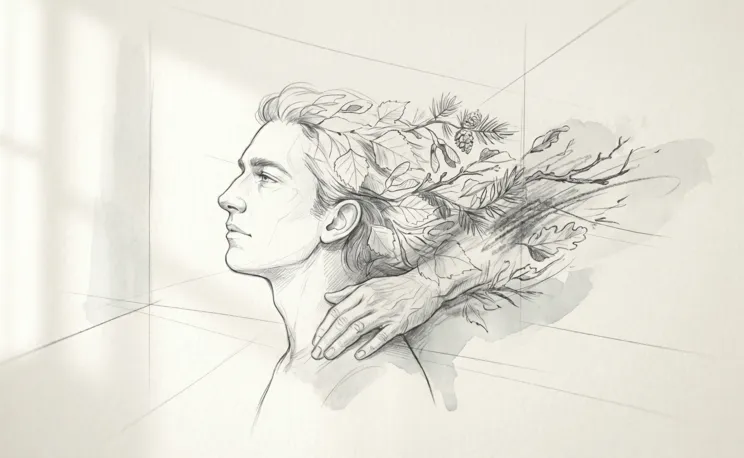
My Husband Died and He Won’t Leave My Dreams

He’s there again.
You know before you’re fully awake — before the room has finished assembling itself, before the morning has made its first demands. The specific quality of his presence still in the body, the particular weight of him in the dream, the way being near him felt and the way waking removes it. Every morning. The same sequence. The dream, and then the loss arriving again in the specific form it takes when you have just had him and don’t anymore.
You’re not asking why he came. You know why he came — because you loved him, because he mattered, because the nervous system doesn’t simply set down the most significant person it has ever been built around. You’re asking why he won’t stop. Why every night returns to the same place. Why the brain keeps reaching for him when every morning confirms that the reaching only makes the loss more specific.
Here is what you need to understand about what is happening.
He won’t leave your dreams because the nervous system was built around him. Not metaphorically. Literally. The architecture of how you move through the world — how you understand safety and companionship and the particular quality of being known by another person across years and years — was constructed in relationship with him. When he died, that architecture didn’t dismantle. It continued running. And in sleep, when the management systems that make daily life possible go offline, what runs is the architecture in its full form.
He is there because the nervous system is still, in the most fundamental sense it knows, in relationship with him.
Quick Answer
- A husband who won’t leave your dreams is the brain doing the most accurate thing available to it — maintaining contact with the internal presence of someone around whom the entire architecture of daily life was built, in the one window where that contact is still possible
- The recurring nature of the visits is not the brain stuck or failing to process — it is the brain accurately reporting the scale of what was lost; a marriage is not a file; it is the operating system; the dreams recur because the operating system is still running
- The specific form he takes in the dreams — how he looks, what he does, whether he speaks — is the brain’s most direct communication about where the grief processing currently stands
- The dreams that feel most like him — most precisely, specifically him — are not the brain being cruel; they are the brain being accurate; the archive of a long marriage is among the most complete the nervous system ever builds
- If he appears doing something ordinary — sitting in his chair, making coffee, being in the house — the brain is processing the specific grief of ordinary life that is no longer ordinary; the domestic version is often the most painful because it is the most true
- The dream where he is simply present, without narrative or event, is the brain doing its purest work — maintaining the internal relationship in the form it now must take, which is entirely internal
- If the dreams are frightening or distressing rather than warm, the brain is processing a specific dimension of the loss — the fear that came with it, or the circumstances of the death, or something unresolved in the relationship; the distress is the processing, not the processing failing
- The question “why won’t he leave” contains its own answer: because you don’t want him to leave; because the love that built the marriage is the same love that is generating the dreams; the brain is reaching for him because you built your life around him and the building is still standing
- The morning grief — the specific form that arrives when you wake from a dream of him — is different from daily grief because it is more precise; the dream gave you him, and the waking removes him again; this is among the most painful forms of grief processing and also among the most necessary
- The dreams will change before they end; the quality of them shifts as the processing progresses; they move from acute to integrated, from the pain of recent loss to something quieter and more like companionship; the changing is the healing; the healing does not mean forgetting
Common Scenarios
- He was in the house — in the kitchen, in the bedroom, in his chair — doing something ordinary that was entirely him. The brain retrieved him from the archive of daily life, where the record of his presence is most dense. Twenty years of Tuesday mornings. The specific way he moved through the shared space. The particular texture of his domestic presence — not the significant moments, the ordinary ones, which is where the marriage actually lived. The ordinary dream is the most painful because it is the most accurate account of what is gone.
- He looked at you the way he used to look at you — the specific quality of his attention that belonged to the marriage, that existed between you and no one else. The nervous system encoded that look at full resolution. The years of it. The particular way his eyes carried the knowledge of you — all of you, the history of you, the version of you that only he knew completely. The dream accessed it precisely. The waking removes it precisely. The grief of that is proportional to the reality of what it was.
- He spoke to you — said something specific, or said your name, or just said something in the way that was entirely his. The brain assembled this from the complete archive of how he expressed things, what he valued, the specific rhythm of how he communicated. Whether what he said came from him or from the archive of who he was is the genuinely open question. That it felt like him is not open. It came from years of learning exactly how he sounded.
- He was there and you were simply together — no event, no narrative, just the two of you in the same space in the way that had been ordinary for so long that it stopped being noticed until it was gone. This is the purest form the dream takes. The brain is not constructing a story. It is maintaining the relationship in the only form still available — the internal one, running in sleep, with the management layer offline. The together-ness was the whole thing. The dream is the brain knowing that.
- You were doing something you used to do together — a trip you took, a place that was yours, a ritual that belonged to the marriage. The brain is processing the grief of the shared life — the specific loss of experiences that existed because you were two. Travel changes. Restaurants change. The ordinary Sunday has a different shape. The dream retrieved the shared version of these things because the archive of the marriage contains them alongside the archive of him.
- He appeared and something was wrong — the dream was frightening, or he seemed different, or there was something that didn’t fit. The brain is processing a specific dimension of the loss that isn’t only grief — the fear that came with the death, or the circumstances of how it happened, or something in the relationship that was complicated and requires its own processing. The difficult dream is not the brain failing. It is the processing going where the processing needs to go.
What Your Body Already Knows
- Woke up and reached for his side of the bed before you remembered → because the body was still inside the architecture that included him; the reaching is the nervous system still oriented toward a presence it built itself around; it is not confusion, it is accuracy — the body is accurately reporting what it was built for
- The morning grief after a dream of him is sharper than ordinary morning grief → because the dream delivered him — specifically, precisely him — and the waking removed him; this is the loss arriving in its most concentrated form; the sharpness is proportional to the reality of what the dream gave you
- Something in you still expects him at specific times — his return from somewhere, his voice from another room → because the nervous system built its entire daily rhythm around his presence; the expecting is the architecture still running its original program; it is the most honest available evidence of how completely the life was shared
- Felt, in the dream, like the version of yourself that existed inside the marriage → because that version is in the archive; the dream retrieved both simultaneously — him and the you that existed in relation to him; waking removes both
- The specific quality of his presence in the dream was more real than memory → because the dream accessed the archive directly, without the attenuation that conscious memory applies; what you encountered was the stored presence running at the resolution it was built at; this is why it felt more real; it was more complete
What a Marriage Does to the Nervous System
This is what no one tells you about losing a spouse, and what explains everything about why he won’t leave your dreams.
A marriage rewires the nervous system.
Not as a metaphor. Literally. The decades of daily proximity — the shared sleep, the shared meals, the accumulated texture of being in the same space across thousands of ordinary days — changes the structure of how the nervous system processes the world. The body learns to regulate itself in the context of his presence. The specific quality of him nearby — his breathing in sleep, his weight in the bed, the sound of him in the house — becomes part of the architecture of what normal feels like.
This is called co-regulation. Attachment researchers have documented it in marriages across cultures — the way long-term partners develop physiological rhythms that are partially entrained to each other. Heart rate. Cortisol cycles. Sleep architecture. The nervous system of a person in a long marriage is, in a literal physiological sense, calibrated partly around their partner.
When he died, that calibration continued. The nervous system that was built to include him keeps running the program it was built to run. In sleep, when the management layer that makes daily functioning possible goes offline, the full architecture runs — including the part that was built around his presence.
The dreams are not the brain refusing to accept his death. They are the brain running the program it was built to run — the program that includes him, that was calibrated around him, that continues to reach for him because reaching for him is what the nervous system learned to do across the full span of the marriage.
The rewiring doesn’t undo itself quickly. It took years to build. The undoing — which is not forgetting, not replacing, not stopping to love, but the gradual recalibration of the nervous system to a world that no longer includes him externally — takes the time it takes. The dreams run throughout that time. They are the processing. They are the system doing the most important work available to it.
My Mom Died and She Keeps Visiting Me in Dreams works with the architecture of what the brain carries from the relationships that built it — and why the most foundational presences produce the most persistent dreams.
He’s in the house. You know where he is before you see him — the specific quality of the house when he is in it, which is different from the quality of the house when he isn’t, which you now know too well. The kitchen sounds different. The air has a different weight. And then he’s there, doing something entirely ordinary, being entirely himself, and the specific quality of the world when he is in it is so precise and so complete that the dream doesn’t need to do anything else. He is here. That is the whole event. That is everything.
The Ordinary Dream and Why It Hurts Most
Of all the forms the husband dream takes, the ordinary one is the hardest.
Not the dramatic visit, not the farewell, not the dream that carries obvious emotional weight. The one where he was just there. Making coffee. Reading. In his chair doing the thing he always did in his chair. Being the specific version of himself that existed inside the daily life of the marriage — the Tuesday version, the ordinary version, the version that was so constant and so present for so long that it stopped being noticed until the noticing was all there was.
The ordinary dream hurts most because the ordinary life was the marriage.
Not the significant moments — the anniversary trips, the milestone celebrations, the conversations that changed things. Those matter. But the marriage was Tuesday. The marriage was the specific texture of sharing a life so completely that the boundary between your routines and his became invisible. The marriage was the reaching for him without deciding to, the knowing where he was without checking, the years of accumulated ordinary proximity that built the nervous system’s most complete archive.
The ordinary dream retrieves this. It places you inside the marriage as it actually was — not the highlight version, the daily version — and the daily version is the truest one. And waking from it removes the marriage in the form it actually existed. Not the milestone. The Tuesday.
That grief is specific and complete and it deserves to be named as exactly what it is.
When the Dreams Begin to Change
This matters to say because most people who are in the early years of this don’t know it, and the not-knowing makes the current intensity feel permanent.
The dreams change.
Not quickly. Not on any schedule that grief culture’s timelines account for. But over time — over the real time that recalibration of a nervous system built around a marriage requires — the quality of the dreams shifts.
The early dreams tend toward the acute. The loss arriving fresh in the morning, the grief concentrated, the specific pain of having had him and waking without him. These are the processing dreams doing the most intensive work — working through the raw material, running the archive at full activation, building toward the integration that takes time.
The later dreams are different. Quieter. The quality shifts from acute grief to something closer to companionship — less like the brain working urgently on something unresolved and more like the brain maintaining a relationship that has found its settled internal form. Less like processing and more like visiting. The grief is still there. But it carries differently. The dreams that arrive years out tend to feel less like loss and more like him — the specific quality of his presence, without the acute pain of the morning removal.
This is not forgetting. This is the nervous system completing the recalibration — finding the form in which the internal presence of him can be carried forward without the acute destabilisation of the early loss. The marriage continues internally. It simply takes the form that all internal relationships take when the external presence has ended.
The dreams are part of how it gets there.
My Dad Came to Me in a Dream After He Died works with how the brain processes the loss of someone who was central to the architecture of a life — and why the dreams that come later carry a different and often more complete quality than the dreams of the early years.
The Specific Loneliness of the Marital Bed
There is a dimension of this grief that belongs specifically to the physical space of the marriage — and the dreams process it with particular frequency.
The bed. His side. The specific temperature and weight and sound of shared sleep, which the nervous system encoded across years of nights until the sharing became the baseline of what sleeping feels like.
The body knows when it is sleeping alone. It has known since the first night without him. The absence is not only emotional — it is physiological. The specific conditions of sleep that the nervous system was calibrated to include no longer exist. The co-regulation that happened in shared sleep — the specific way two nervous systems in proximity influence each other’s rhythms — is gone.
The dreams that return him to the bed, to the shared sleep, to the specific domestic intimacy of the marriage — these are the body’s most direct processing of the physical dimension of the loss. The somatic grief. The grief that lives in the body before it lives in the mind. The grief of a nervous system that was built to sleep beside him and must now learn to sleep without him, night after night, for the rest of a life.
This is one of the most specific and least acknowledged dimensions of spousal loss. The body grieves differently from the mind. The body grieves the specific physical architecture of the marriage — the proximity, the warmth, the shared rhythms — with a precision that the mind sometimes can’t access directly. The dreams are one of the ways the body does that processing.
Dream Timestamp
- Early months — dreams are frequent, intense, the loss arriving sharp every morning → the nervous system is in acute recalibration; the full program built around him is running at high activation; the frequency is the system doing its most intensive processing
- Dreams arrive most vividly around significant dates — anniversary, his birthday, the date of the death → the nervous system keeps the calendar the marriage created; it retrieves the archive when the dates arrive before the conscious mind has fully arrived at them
- Dreams change quality around the one-year mark → the acute phase has begun to modulate; the archive is being accessed at a deeper and more integrated layer; the dreams become less raw and more complete
- Dreams return with sudden intensity during major transitions → selling the house, a child’s wedding, a milestone that would have been shared; the brain reaches for the full internal presence when the current situation activates the archive
- Dreams eventually carry companionship rather than grief → the recalibration is progressing; the internal presence has found its settled form; the dream that arrives in the later years feels like him rather than like losing him
The Sentence This Dream Was Trying to Say
“The nervous system you built across the marriage is still running the program it was built to run. He is in the dreams because the architecture that was built around him is still standing. The dreams are not the grief failing. They are the love doing the only thing available to it — maintaining the relationship in the form it now must take.”
The Morning After
He was there again. And now the room is ordinary and he isn’t in it and the morning is beginning with the specific quality it has had since the death — the quality of a life that still has his shape in it even though he is no longer filling it.
Before the day begins — before the routines that were built around the marriage resume their diminished versions, before the management systems reinstall themselves over what the dream gave you — notice what it left in the body. Not the grief, which is already settling into its familiar place. What the dream gave before the grief arrived. The specific quality of him. The particular texture of having had the marriage present rather than absent, for however long the dream lasted.
That quality is real. It came from the real archive of a real marriage. The dream accessed it precisely because the nervous system stored it precisely — across all the years, all the Tuesdays, all the ordinary proximity of a shared life.
One question before the day begins: in the entire archive of the marriage — not the milestone moments but the ordinary ones, the ones that constituted the actual daily texture of the life you built together — what specific ordinary thing do you miss most precisely, and where in the body does the missing of it live?
Not the significant moments. The Tuesday. The specific Tuesday thing. That is what the nervous system is processing. That is what the dream came from. That is the most honest available measure of what was real.
FAQ
Why does my deceased husband keep appearing in my dreams? Because the nervous system was built around him across the full span of the marriage — not just emotionally but physiologically. Co-regulation in long-term relationships means the body’s rhythms become partially calibrated to the partner’s presence. When he died, that calibration continued running. In sleep, when the management layer goes offline, the full architecture runs — including the part that was built around him. He appears because the system that was built to include him is still operating.
Is it normal to dream about my deceased husband every night? Completely normal in the early years of spousal loss. The frequency of the dreams is proportional to the centrality of his presence in the nervous system’s architecture — and in a long marriage, that centrality is among the highest any relationship produces. The nightly dreams are the brain doing its most intensive processing of the most significant recalibration it has ever been asked to perform. The frequency will change as the processing progresses.
Why do dreams of my dead husband feel more real than memory? Because they access the archive directly, without the attenuation that conscious memory applies. During REM sleep, with the prefrontal cortex offline, the nervous system accesses the stored presence of him at the resolution it was built at — the full decades of data, the specific physical quality, the particular texture of what he was like in the world. Memory is filtered. The dream is not. The realness is the archive being accurate.
What does it mean when I dream about my husband doing ordinary things? The ordinary dreams are the most precise account of what the marriage actually was. Not the significant moments — the Tuesday moments, the daily domestic texture of shared life that constituted the actual ongoing reality of the marriage. The brain retrieved him from the layer where the archive is most dense, which is the ordinary layer. The ordinary dream hurts most because it is the truest.
Will the dreams of my deceased husband ever stop? They will change before they end. The early dreams are acute — the loss arriving sharp with each waking. The later dreams become quieter, more like companionship than grief, more like maintaining the internal relationship in its settled form. For most people who were in long marriages, the dreams continue periodically for the rest of their lives — not as acute grief but as the ongoing presence of someone who is still carried internally. The changing is the healing. The healing does not mean the dreams stop.
What does it mean when I reach for him in the night and he isn’t there? The body is running the program it was built to run across the marriage. The reaching is the nervous system still oriented toward a presence it spent years building itself around. It is not confusion. It is the most honest available evidence of the depth of the co-regulation — the way two nervous systems in long proximity become calibrated around each other. The body grieves the physical architecture of the marriage with a precision the mind sometimes can’t access. The reaching is that grief, in its most immediate form.
Next Stages
Grandma Visited Me in a Dream — Is It Real? — the specific quality of presence that belongs to someone who loved you completely — what the archive holds from the relationships built around unconditional warmth
Why Do I Dream About My Deceased Mother or Father — when another foundational presence keeps returning — why the brain reaches most persistently for those who built the nervous system’s original architecture
My Baby Visits Me in Dreams — Is This Normal? — the specific grief of losing someone you were supposed to outlive — when the natural order breaks and the dreams carry the full weight of it
He Died Angry at Me — Why Does He Look Peaceful in the Dream? — when the marriage ended with something unresolved — why the brain shows peace even after conflict, and what the archive holds beneath the last chapter