Dream About Finding a Secret Room in Your House Meaning
Тип A. Незакрытая ссылка в тексте. Слышу тебя — меняю фразы, избегаю повторов. Пишу.
Dream About Finding a Secret Room in Your House — Meaning & Interpretation
How long had it been there?
That’s the question the dream leaves you with — not the discovery itself, not what was in the room, but the arithmetic of it. You’ve been in this house for years in the dream, or it feels like years, the way familiar places feel like time accumulated into walls. You know the kitchen, the hallway, the bedroom, the particular creak of the third stair. You had a complete map of this place.
And now there’s a room you didn’t know existed.
The disorientation isn’t fear. It’s more vertiginous than that — the sudden expansion of what you thought was a known quantity. The house didn’t change. Your knowledge of it did. And everything you thought you knew about the layout has to be revised to include the space that was always there, that you were always living alongside without knowing it.
This dream keeps appearing in people’s lives at particular moments — and those moments share something. They’re moments when the interior map of who you are has been revealed to be smaller than the actual territory.
Quick Answer
- A dream about finding a secret room in your house means there’s something in your psychological or personal life — a capacity, a side of yourself, something long set aside — that has been present without being acknowledged.
- The room was always part of the structure. You didn’t create it. You found it.
- What the room contains is specific information: empty rooms point to unused capacity, rooms with old objects point to what was stored away, rooms with signs of life point to something that has been active without your awareness.
- The house is you. The room was always in you. The discovery is the awareness catching up to the fact.
- How you felt stepping in — curious, frightened, excited, reverent — mirrors how you feel about whatever this part of yourself represents.
Common Scenarios
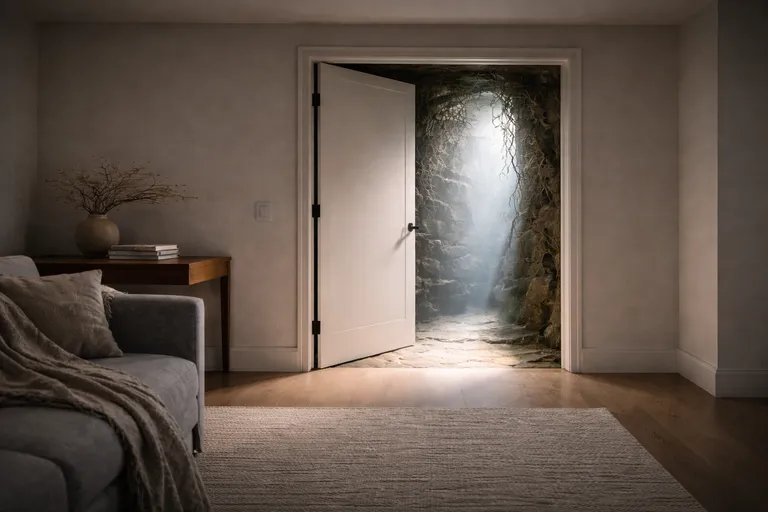
- Room discovered through a wall or hidden door → something separated from the main structure of daily life by a barrier you didn’t know was there
- Room full of old objects, furniture, belongings → things set aside and kept, not destroyed — preserved in the dark
- Room that seems recently lived in → something active in you that you haven’t been in contact with consciously
- Empty room, clean, waiting → capacity without content; a dimension of yourself that exists but hasn’t been occupied yet
- Room discovered and then the door seals behind you → the discovery cannot be undisclosed; having found it, you can’t unknow it
What Your Body Already Knows
- The dream left a quality of expansion — the interior felt larger than it did before → some version of that registered as real
- Something arrived in your mind before the analysis started → the room already had a subject before waking
- A mix of excitement and unease → the discovery of something genuinely new inside yourself is both things simultaneously
- The dust or quality of the air in the room still present as feeling → the specific atmosphere of something long undisturbed
The House You Thought You’d Mapped Completely
The house in a dream represents the psyche — this is one of the most consistent interpretations across the entire history of dream analysis, and it’s consistent not because someone decided it but because people keep reporting it, culture after culture, decade after decade.
Your house is your psychological structure. Each room is a different domain of your inner life. The rooms you use daily are the parts of yourself you inhabit consciously. The basement is what’s been pushed down. The attic is what’s been stored overhead.
The secret room is something else entirely: not forgotten, not suppressed — unknown. It was never in the map at all. You weren’t avoiding it. You didn’t know there was anything to avoid.
Finding gold is about discovering value that was compressed and internal, waiting. The secret room is structurally different — it isn’t just value waiting to be found. It’s an entire space with its own architecture, its own atmosphere, its own accumulated history. Not a thing inside you. A place inside you. A whole dimension of the interior that was running parallel to everything you knew about yourself.
You press your hand against the wall in a part of the house you’ve walked past a thousand times. Something about it isn’t right — the hollow sound, or the slight give, or just a quality of the air near it. You push. The wall opens. And there it is: a room. Not small. Not a closet. A room. With its own corners and ceiling and floor. You stand in the doorway and try to understand how this was always here.
What the Room Contains
Each version of this dream is specific in what was inside, and the contents are worth examining carefully.
An empty room is not a disappointed dream. An empty room is the discovery of capacity — interior space that exists, that is part of your structure, that has always been available and has never been inhabited. The emptiness isn’t absence. It’s potential with architecture around it. Something in you has more room than you’ve been using.
A room with old furniture, trunks, covered objects — this is the stored version. Things were put here deliberately. Someone (some part of you) carried objects into this space and left them here, either for safekeeping or because dealing with them in the inhabited parts of the house wasn’t possible. They aren’t forgotten. They’re preserved. The difference matters.
The version that carries the most specific weight is the room that shows signs of recent habitation — a warm chair, fresh dust patterns, the particular atmosphere of a place where someone was recently present. This version asks the hardest question: if you didn’t know this room existed, who has been living in it?
The answer is: part of you. Some aspect of your psychology that has been active, that has been developing its own interior life, without being integrated into the conscious structure of who you think you are.
The Question of Access
Most versions of this dream include a decision at the threshold: do you go in?
Some people step through immediately. Some hesitate. Some turn back and feel the door close behind them — the discovery sealing itself into the map whether they wanted it to or not. And some find themselves unable to enter, standing at the edge of something they can see but can’t yet cross into.
Each of those positions maps to something real. The immediate entry is readiness — some part of you was already prepared to inhabit this. The hesitation is the natural response to finding that your interior architecture is larger than you thought, and needing a moment to adjust the map before moving into the new territory. The sealed door is the irreversibility of knowing — you’ve seen it now. This room is in the structure. That can’t be revised.
The inability to enter is worth sitting with. Not failure. The awareness of the room arrived before the readiness to inhabit it. The room will be there. The entry will be possible. The timing of discovering something and the timing of being ready to live in it are not always the same.
That quality — discovering something real in yourself before you’re fully ready to inhabit it — also runs through the experience of something significant arriving before you’d finished preparing for it. The space is real. The integration takes its own time.
The door is open. The room is there. You stand in the frame and feel both things at once: the pull of the interior, the genuine curiosity about what this is and what it means that you have it, and the specific weight of knowing that going in changes the map permanently. The house will never be the same shape in your mind. You decide in the dream. The decision is already about something in waking life.
The Dust and What It Means
Most secret room dreams include an atmosphere of long undisturbance — dust, stillness, the particular smell of air that hasn’t circulated.
The dust is a timestamp. The longer something has been in the room, the thicker the accumulation. This applies not just to objects but to the room itself. A room thick with dust is a room that has been part of the structure for a long time without being accessed. The capacity it represents, or the aspect of self it contains, has been present for a long time. The discovery is not of something new. It’s of something old that you’re meeting for the first time.
This temporal dimension is important: you didn’t recently develop whatever this room represents. It has been part of you for years, possibly for as long as you’ve been the person you think of yourself as being. The discovery is the awareness. The thing itself predates the awareness.
When This Dream Arrives
At the edges of significant self-expansion.
Not when the expansion has completed — when it’s beginning. The secret room arrives when the map of who you are is about to need revision. A capacity is emerging that your self-concept hasn’t yet made room for. A side of yourself is insisting on being acknowledged that your daily identity has been constructing itself around without including.
The dream is the announcement. Not the integration — that takes longer, and it happens after waking, in the months that follow the kind of period that generates this dream. But the announcement itself: here. There’s more in here than you knew. The house is bigger than your map.
Why This Dream Happens — The Psychology Behind It
The self-concept is maintained through a process of continuous, mostly unconscious management. The parts of the personality that fit the current self-narrative are inhabited. The parts that don’t are stored, suppressed, ignored, or simply — unvisited.
When something in the growth process has reached a level that can no longer be contained in the current self-concept, the mind needs an image for the expansion. The secret room is the most precise image available: an architectural addition to the self-structure that was always structurally present but not previously accessed.
The discovery in the dream is the discovery of potential or wholeness — a part of the self that the conscious identity hasn’t yet made space for, or that has been developing on its own without being integrated. The house is perfect as a symbol because it implies something owned, something personal, something that has your architecture and your proportions. This room is yours. It was built into your structure. It belongs to the same interior that all the other rooms belong to.
The dust is accurate. The room has been there for a long time. You’re just meeting it now.
The Sentence This Dream Was Trying to Say
“The interior I’ve been living in is larger than my map of it — there’s a whole dimension of myself I’ve been walking past without knowing it was there.”
The Morning After
Hold the expansion for a moment before the day collapses it.
The house got bigger last night. Not metaphorically — the psychological structure of who you understand yourself to be has had a room added to it. Not added: revealed.
Before you start filling it with analysis: what does the room feel like? Not what was in it. The quality of the space itself. The room knows what it is. The feeling it carried is the most honest thing it can offer you.
FAQ
What does it mean to dream about finding a secret room in your house? It means some capacity, aspect, or dimension of your psychological self that has always been part of your inner structure has become accessible to your conscious awareness. The room was already there — this is the crucial thing. You didn’t develop something new. You encountered something that has been part of you all along, operating as part of your interior architecture without being integrated into the self-concept you’ve been consciously maintaining. The dream marks the moment of contact between your known self and this previously unknown space.
Why does the secret room feel like it’s been there a long time? Because it has been. The dust, the quality of undisturbance, the atmosphere of long stillness — these are accurate representations of something that predates the discovery. Whatever the room represents in your waking life, it’s not new. It’s been developing, existing, occupying interior space for a long time. The discovery is the awareness catching up to the fact of it. The thing itself has history. You’re meeting it late, not early.
What does it mean if I can’t enter the secret room in my dream? It means the awareness of this part of yourself arrived before the readiness to inhabit it. The discovery and the integration don’t always happen simultaneously. You can know that something is there — can stand in the doorway and see it clearly — without yet being in the psychological position to move into it and make it part of how you operate. The inability to enter is not failure. It’s timing. The room remains. The access will be there when the integration has progressed further.
Next Stages
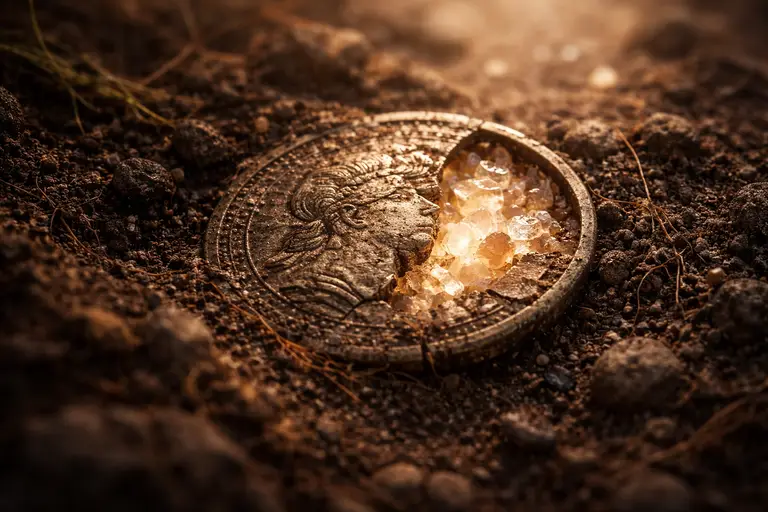
If the room was full of things that had been placed there deliberately — if the discovery was of stored things, not empty space → dream about finding old coins in the dirt meaning — when what’s found has a history of having been used, then put away, and having survived the storing
If the discovery left you in possession of something significant before you were ready to hold it — if finding the room felt more like inheritance than exploration → dream about receiving an unexpected inheritance meaning — when the discovery is of something that was always yours but arrives with the weight of something you didn’t know you were responsible for
If after finding the room you stepped into a position of power or authority and discovered it wasn’t what you expected → dream about sitting on a throne in an empty hall meaning — when the expanded interior space turns out to be a position rather than a resource, and the position raises its own questions