Spider Dreams

A spider doesn’t threaten you the way other things threaten you.
It doesn’t chase. It doesn’t bark. It doesn’t announce itself with sound or speed. It is simply there — motionless, aware, in a space it has no business being in. And your body registered it before you decided anything.
That specific compound quality — the alarm that isn’t quite fear and the wrongness that isn’t quite revulsion — is the thing that makes spider dreams unlike any other animal dream. Most animals in dreams activate one system. The spider activates two: the threat pathway and the disgust pathway simultaneously, producing a sensation that has its own neural signature and its own waking residue. After fifty books on sleep neuroscience, this was one of the things that surprised me most. The spider isn’t just scary. It’s contaminating. It’s the animal your brain reaches for when something in your life is both dangerous and wrong here at the same time.
It is not a symbol of creativity. It is not a symbol of feminine power. These things exist in mythology and I have read the mythology. What I found more useful, after years with Öhman’s evolutionary preparedness research and Rozin’s work on disgust as a distinct emotion, is this: the spider in your dream is encoding something in your waking life that has crossed a boundary it shouldn’t have crossed. Something that is in the wrong room. Something with both an alarm quality and a violation quality — and your nervous system has been tracking it, even if your waking mind was busy looking somewhere else.
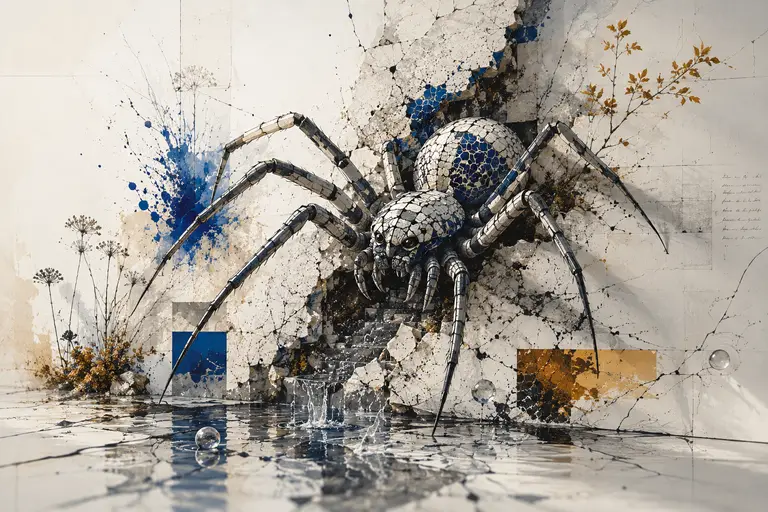
The spider doesn’t need to move to be threatening. That’s the specific quality. The stillness is part of it. The awareness is part of it. The fact that it is already where it is — already in the room, already in the space — before you noticed.
This cluster works with what spider dreams actually encode: the specific neural signature of dual-system activation, and the precise waking situations that generate it.