Someone Is Chasing You in the Dream — This Fear Is Following You

It’s behind you.
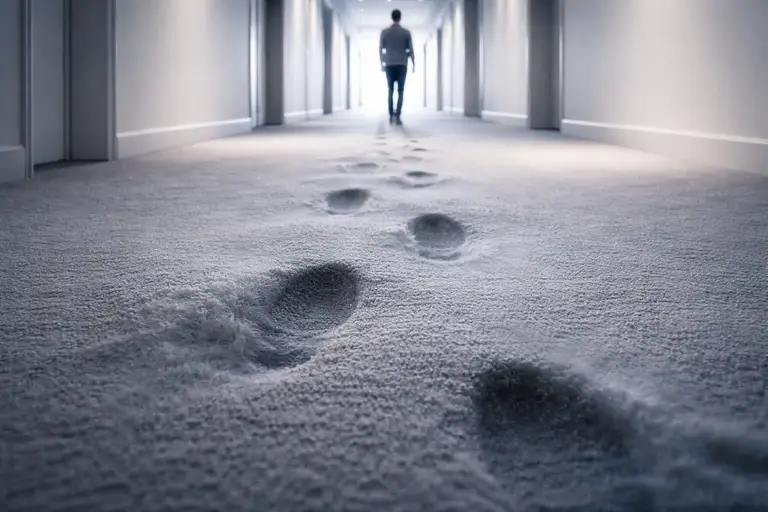
You know this before you turn around. You know it the way you know things in dreams — not from evidence, not from a sound, not from any specific signal, but from the total quality of the situation: the specific weight of the space behind you, the altered texture of your own movement, the way your body is already oriented toward speed before the threat has fully declared itself.
And then you are running.
The location changes across versions of this dream — a street at night, a building with wrong geometry, a familiar place turned wrong by dark or silence or the specific dream-quality of something that should be safe and isn’t. But the running is always the same. The particular urgency of movement that is somehow not fast enough. The legs that respond but not at the rate the fear requires. The distance behind you that doesn’t increase no matter how much effort goes into increasing it.
Most people, when they have this dream, focus on the thing that is chasing them. They try to identify it — who it was, what it represented, whether the pursuer had a face. This is understandable. The pursuer feels like the subject of the dream.
It isn’t.
The subject is the running. The thing behind you is what the running is made of. And the running has a specific origin: something in your waking life that you have been moving away from for long enough that the movement has stopped creating distance.
The pursuer didn’t come from outside your life. It came from the same direction you did. And it is precisely as fast as you have been slow to stop running.
Quick Answer
- The chase dream is the brain’s most precise image for the relationship between avoidance and its consequence — the thing you’ve been moving away from follows you at exactly the rate your avoidance has been running
- The pursuer is not an external threat — it came from the same direction you did; it represents whatever in your waking life has been requiring a response that running has substituted for
- The legs slowing down is neurologically accurate: motor cortex suppression during REM sleep produces the felt experience of reduced movement — but the brain also selects this image when avoidance is losing its effectiveness as a strategy
- The dream almost never ends — it suspends at maximum tension — because the underlying situation hasn’t resolved; the dream accurately reflects the status of its source
- When the pursuer has a face — when it is someone you recognize — the brain is being more specific: whatever the dream is built on has a known origin, a person or dynamic you can identify
- When the pursuer has no face — a shape, a presence, something felt rather than seen — the brain is mapping avoidance itself rather than its specific source; you are running from confrontation as a category rather than a specific thing
- The specific environment of the chase — where you are running — carries additional information: familiar places turned wrong indicate something close to your daily life, unfamiliar architecture indicates something more abstract or systemic
- Recurring chase dreams mean the avoidance has been running consistently; each recurrence is the nervous system reporting that the gap between you and the thing you’re avoiding has closed further
- You can’t outrun this dream because you can’t outrun avoidance — the pursuer’s persistence is mathematically proportional to how long the avoidance has been running
- The dream stops when the running stops — not when the pursuer is defeated, but when the waking decision to keep moving away from something is reversed
Common Scenarios
The pursuer has no face — you know it’s there without seeing it clearly. The most abstract version. The brain is mapping avoidance in its purest form — not running from a specific identifiable thing but from confrontation as a category. Something in your waking life requires direct engagement and is receiving only movement away. The formlessness of the pursuer is accurate: when avoidance has become the response pattern rather than a response to a specific thing, the brain generates a threat without a specific face.
The pursuer is someone you know — someone who shouldn’t be threatening. The specificity matters. When the brain assigns a face to the pursuer, it is being more precise about the origin. Someone familiar — a person from your waking life — is the brain reporting that the thing you’ve been moving away from has a known address. Not necessarily that this person is dangerous: they are the shape the unaddressed thing has taken. What is unresolved with this person, or in the territory this person represents, is what the running is about.
You are running but the distance behind you doesn’t change. The most common feature and the most diagnostic. The body is producing maximum effort and the distance is not increasing. This is the brain encoding the specific failure of avoidance as a strategy: you have been doing the equivalent of running as hard as you can and the gap has stayed the same or closed regardless. Something in your waking life has reached the point where continued movement away from it is no longer creating the separation it once did.
You try to hide — you find a room, a corner, a space to disappear into — and the pursuer finds you anyway. The transition from running to hiding is itself significant. Something has shifted from avoidance-in-motion to avoidance-in-concealment. The pursuer finding you despite the hiding is the brain encoding the specific experience of something that can no longer be avoided by either movement or concealment. Whatever requires your attention has reached your location regardless of what you did to prevent it.
You wake up before the pursuer reaches you — the dream ends at the moment of maximum proximity. The suspension is precise. The dream ends where the tension peaks — not because the scene concluded, but because the unresolved situation the dream is built on lives at exactly that point of maximum proximity between you and the thing you’ve been avoiding. The pursuer never catches you in the dream not because you escape, but because the source of the dream is the running itself, not what happens when the running ends.
The chase repeats across multiple nights with minor variations. The avoidance has been running consistently enough to produce a recurring signal. Each version of the dream is reporting on the current status of the same underlying situation. The minor variations reflect the accumulating pressure: as the avoidance continues, the dream doesn’t stay identical, it develops — the pursuer gets closer, the environment becomes more constricted, the legs slow further. These developments track the real trajectory of the waking situation.
What Your Body Already Knows
Woke up with the effort of the running still in the legs — a muscular quality that doesn’t match lying still in a bed → because the brain was modeling the physical mechanics of flight during the dream; the motor cortex was partially activated, producing muscle engagement even through the paralysis of REM sleep; the body stored the effort the way it stores any significant physical experience
Woke up with the specific quality of proximity — the feeling that something was very close even now that the room was ordinary → because the amygdala had been running at maximum threat-intensity and the threat state doesn’t immediately resolve when the episode ends; the proximity the dream encoded persists briefly as a somatic quality even after consciousness confirms the room is empty
Woke up and immediately thought of something specific — a person, a situation, a conversation, a decision — before any analysis had occurred → because the dream was always pointing somewhere precise; the pursuer was always a specific address; and the morning recognition of what it was is the waking mind arriving at what the amygdala already knew
Woke up exhausted in the way that comes from sustained effort, not from rest → because the nervous system was running its maximum threat-response protocol throughout the dream; the flight response — hormones, heightened attention, motor activation — is metabolically expensive; recurring chase dreams produce a cumulative tiredness that differs from sleep deprivation
Woke up relieved that it was over — and then noticed the relief dissolve as the day assembled, and the same background quality of something-unaddressed returned → because the dream is not the source; it is the report; when the report ends and the day resumes, the source is still there, still generating the same pressure that produced the dream; the relief of waking is temporary in exact proportion to how active the source remains
What Is Actually Behind You — The Neurobiology of Pursuit
The chase dream activates the threat-response system with a specificity that most people underestimate.
When the brain generates a pursuit scenario during sleep, it is not decorating the scene with arbitrary fear imagery. It is running a specific threat-model: a situation in which the thing requiring response is gaining on the thing that has been avoiding it. The amygdala — the brain’s threat-detection center — measures threat-relevance in part by the energy the waking system has been expending on not engaging with something. High consistent avoidance registers as high threat priority. High threat priority, during REM processing, produces the experience of being pursued.
This is the central precision of the chase dream: the pursuer’s velocity is a direct encoding of the avoidance’s duration and intensity. The thing behind you is not independently fast. It catches up because running has stopped creating distance. What the dream is showing you — with neurological accuracy — is not that something dangerous is approaching. It is that the gap between you and whatever you’ve been moving away from has closed to the point where the movement is no longer doing what you needed it to do.
The legs slowing down carries the same precision. During REM sleep, motor cortex suppression reduces the physical movement that the dream scenario calls for. But the brain also selects the slowing legs as the image for a specific waking experience: the diminishing returns of a strategy that is running out of effectiveness. The legs slow in the dream at the same rate that avoidance has been losing its efficacy in the waking life. You can’t move fast enough — not because your body is failing, but because the strategy itself is no longer producing the distance it once did.
You turn a corner and the street extends further than it should. The geometry of the place has something wrong in it — not violently wrong, the specific wrongness of a familiar place that has gained length, that has given the distance behind you more room than the distance in front of you. Your legs are going. You can feel them going. And the thing behind you is also going, at the same pace, and the gap between your going and its going has not changed for what feels like a long time. You are not being overtaken. You are being accompanied. And that — the keeping-pace, the persistence, the specific patience of something that doesn’t need to hurry because it is going exactly where you are going — is more specific than threat. It’s recognition.
Fear and Anxiety Dreams — What Your Mind Is Trying to Warn You About maps the full architecture of how avoidance generates fear dreams — what the nervous system is doing when it takes something you’ve been moving around and turns it into something that follows you.
The Specific Quality of Not Being Able to Outrun This
This is the section that matters most for people who have had this dream repeatedly.
You cannot outrun it. This is not a failing of your dream self. It is not a symbol of insufficient willpower or inadequate response. It is the brain encoding something that is neurologically true: sustained avoidance doesn’t reduce the distance between you and what you’re avoiding. It maintains it, at best. Usually, it closes it.
Here’s the mechanism. The nervous system tracks unresolved situations through what you might call an emotional tag — a marker attached to the unresolved experience that keeps it available for processing during REM sleep. As long as avoidance continues, the emotional tag remains active. An active tag means the amygdala will encounter it during each night’s processing cycle. The amygdala’s response to an active tag is to generate a dream — and specifically, to generate a dream that maps the relationship between the unresolved thing and the person avoiding it.
The pursuer’s speed maps the tag’s activation level. The pursuer’s persistence maps how long the tag has been active. The legs slowing down maps the accumulated cost of running — the fact that avoidance is a strategy that gets more expensive and less effective the longer it runs.
What would actually change the dream is not running faster. Running faster is the dream version of avoidance escalating — more of the same strategy that hasn’t been working. What would change the dream is stopping. Not in the dream — that’s incidental. In the waking situation. Turning to face whatever has been behind you.
Not all turnings are dramatic confrontations. Sometimes it is a decision made. Sometimes it is an acknowledgment — to yourself — of something you had been managing not to see clearly. Sometimes it is a conversation that has been deferred. The nature of the turning depends entirely on the nature of what’s been chasing you.
Dream About Being Chased by Something You Can’t See examines the version where the pursuer has no identifiable form — when the avoidance has become so consistent that the brain no longer attaches the threat to a specific source and the running is from confrontation itself.
When the Pursuer Has a Face — What Specificity Tells You
The version that deserves its own attention is the one where the pursuer is recognizable.
When the brain assigns a face to the pursuer — when the thing behind you is someone you know, someone from your waking life, someone who should not occupy the position of threat — it is being more precise, not less. The specificity is not an accusation. It is a reference.
The person in the dream is not being accused of wrongdoing. They are not necessarily the problem. They are the shape that the unaddressed thing has taken. The brain has reached for the most accurate available image for whatever in your waking life is behind you — and the most accurate available image has this person’s face because whatever requires your engagement is somehow associated with them, or with the territory they represent, or with the dynamic between you that has been receiving avoidance rather than attention.
What I find consistently: when people identify who the pursuer was and then ask themselves honestly what in their relationship to that person, or that situation, or that territory of their life, has been receiving avoidance rather than engagement — the answer arrives quickly. Not because the dream was an accusation. Because the brain was always making a precise reference, and the waking mind simply needed the question to be asked directly.
The pursuer with a face is a gift of specificity in a dream that could have been vaguer. The face is an address. What do you owe that address — in terms of a conversation, a decision, a change, an acknowledgment — that has been accumulating in the space behind you?
Dream Timestamp
The chase dream arrives when avoidance has been running long enough to accumulate → not the first day something is set aside — the thirtieth; by the time the chase dream begins, the strategy of not-engaging has a history and the nervous system has measured its length
The chase dream arrives after a period in which something felt more urgent but didn’t get addressed → acute pressure that wasn’t met with a direct response creates a spike in the emotional tag’s activation; the dream typically follows within days of the moment the urgency peaked without producing action
The chase dream arrives during periods when forward movement in other areas of life is happening but one area has stalled → contrast intensifies the signal; when most things are moving and one thing is not, the nervous system highlights the stationary thing more sharply
The pursuer gets closer across recurring versions of the dream → tracking the closing of the gap in real time; the dream is updating its model of the situation’s current status; closer pursuit means the avoidance has been running longer or harder without producing separation
The dream stops — or the pursuer stops gaining — when a concrete step is taken toward the source → the amygdala responds to actual changes in the emotional state of the source; a genuine move toward engagement, even small, updates the model and changes the dream
The Sentence This Dream Was Trying to Say
“What is behind you did not come from outside. It came from the same direction you did — and it has been following you at exactly the pace you’ve been running, for exactly as long as you’ve been refusing to turn around.”
The Morning After
You are awake. The room is the room. The thing behind you is not here, in this space, at this particular hour of the morning. You made it through the night.
And something is still in the body — not the panic, which has dissolved, but the specific quality of having been in sustained flight. The muscles hold a residue of it. The chest has a quality of recently-vacated alarm. The morning has a slightly different texture than mornings that didn’t have this in them.
Before you dissolve this into the day’s momentum, let the question the dream was actually asking have a few seconds of unmanaged attention.
The thing behind you — the thing the dream assigned as pursuer — is something you already know something about. Not necessarily everything. But something. The body usually knows what it is before the mind finishes asking. And the specific question isn’t what the pursuer represented or what it symbolized. The question is simpler and harder:
What have I been moving away from — and what would it take to stop the running long enough to turn and look at what’s actually there?
FAQ
The chase dream maps the relationship between avoidance and its consequence. The thing chasing you came from the same direction you did — it represents something in your waking life that has been requiring a response and receiving only movement away. The pursuer follows you at exactly the rate your avoidance has been running. It’s not gaining because it’s fast; it’s gaining because running has stopped creating real distance between you and whatever you’ve been avoiding.
Two mechanisms run simultaneously. During REM sleep, motor cortex suppression reduces physical movement — your body can’t actually run, and the felt experience of reduced mobility reflects this. But the brain also selects slowing legs as the image for a specific waking experience: avoidance losing its effectiveness as a strategy. The legs slow in the dream at the same rate avoidance has been running out of its capacity to create separation. Both are real; both are accurate.
When the pursuer has a recognizable face, the brain is being more precise about the source. The person in the dream is not being accused — they are the shape that the unaddressed thing has taken. Whatever in your relationship with this person, or in the territory they represent, has been receiving avoidance rather than engagement — that is what the dream assigned their face to. The specificity is an address. The question to ask is: what in the territory of this person or this relationship has been behind me for a while?
The dream ends where the tension peaks — which is where the unresolved situation lives. The brain doesn’t construct false resolutions for scenarios built on unresolved sources. The suspension at maximum proximity is not a failure of the dream to reach its conclusion; it is the dream accurately reflecting the point of maximum pressure in the waking situation. The dream ends there because that is where the unresolved thing lives — at the edge of what hasn’t yet been faced.
Not necessarily. Chase dreams are among the most common dreams globally and occur in people without any clinical anxiety diagnosis who are simply in sustained avoidance of something significant in their waking life. The presence of chase dreams is informative, not diagnostic. They indicate that something requiring a response is receiving avoidance instead. If chase dreams are frequent, escalating, and accompanied by significant daytime anxiety that impairs function, that combination is worth discussing with a professional — but the dream itself is not the measure.
By stopping the running in the waking situation. The pursuer in the dream tracks the avoidance in the waking life. When you make a concrete move toward whatever has been behind you — a decision made, a conversation had, an acknowledgment of something you’d been moving around — the emotional tag attached to the source begins to change. The amygdala encounters a different state during the next night’s processing, and the dream changes accordingly. A genuine move toward what you’ve been avoiding is more effective than any technique for managing the dream itself.
Next Stages
Dream About Being Attacked — What Your Mind Sees as a Real Threat — what happens when the running stops working — when avoidance escalates to impact and the thing behind you arrives
Dream About Running Away From Danger — What You’re Avoiding — the movement itself as the subject — what the running tells you about the specific shape of what you’ve been refusing to face
Dream About Hiding From Someone — Fear You Don’t Want to Face — when the running stops and concealment begins — the transition from avoidance-in-motion to avoidance-in-stillness
Why You Keep Having Anxiety Dreams — And Why They Don’t Stop — why this dream returns across nights — the mechanism that keeps generating the same pursuer until the waking situation actually changes