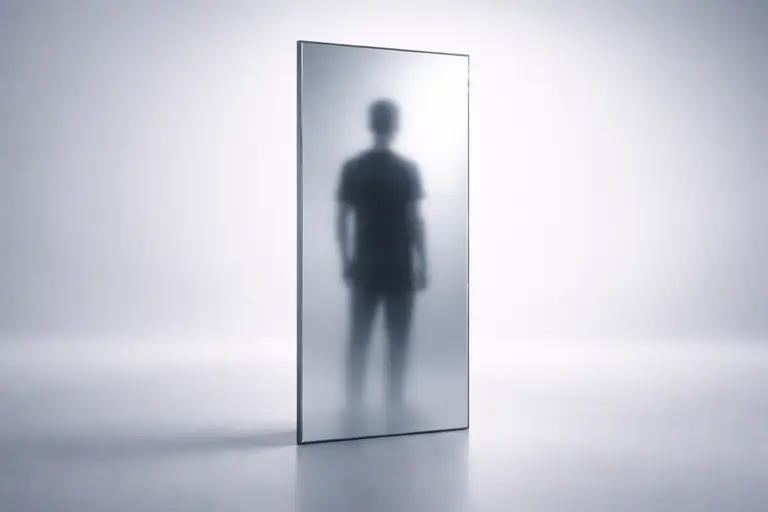
Someone Is Watching You — What Becomes Visible When You Stop Looking Away

You felt it before you saw it.
That’s always the order. The awareness of being watched arrives in the body — the shoulders, the back of the neck, the specific quality of your own movement suddenly becoming audible to you — before the eyes have confirmed anything. Before the scan of the room has returned a result. You felt it, and then you looked, and the looking confirmed what the feeling had already registered.
Someone is watching you. Not moving, not approaching, not threatening in any way that a threat-response could organize around. Just: attending. The gaze directed at you with the specific quality of gaze that is not casual or incidental but sustained and specific. You are the subject of the watching. This is not background attention. This is you.
Most people who have this dream assume it is about the watcher — about who or what is watching, what they want, whether they are safe. They spend the dream scanning for the source, trying to locate the gaze, attempting to identify the face or the form that is directing this sustained attention at them.
In my experience, the watcher is almost never the point. The watcher is the vehicle. What this dream is actually about is what the watcher might see.
The watching dream is not about surveillance. It is about visibility. Specifically: the visibility of something you carry that is not yet fully seen — by someone specific, by the world, or by yourself. The dread is not of being observed. It is of being accurately observed. Of the possibility that whoever is watching, with that specific and sustained gaze, might see the thing that you have not yet been fully transparent about. The thing that is true even though you haven’t said it. The version of the situation that is real even though you’ve been presenting a different version.
You are not afraid of being watched. You are afraid of being known.
Quick Answer
- The watching dream is about visibility, not surveillance — specifically, the visibility of something you carry that you haven’t been fully transparent about; the fear is of being accurately seen, not of being observed
- The watcher is almost never the point — they are the vehicle that externalizes your own awareness of something you haven’t fully faced; the dream uses their gaze as the mirror for your own knowledge
- The social monitoring network — the brain systems that track how you are perceived — activates at the same intensity as the physical threat response; being watched in a dream produces a genuine threat-response because social threat is neurologically equivalent to physical threat
- The body adjusts before the mind catches up: the shoulders tighten, the pace changes, the breath becomes slightly deliberate — these are the social monitoring network’s outputs, the body recalibrating its presentation to the gaze
- When the watcher has a face — when you recognize who is watching you — the brain has provided a specific address: whatever in the territory of this person you have not been fully visible about is the subject of the dream
- When the watcher has no face — a presence, a gaze, a quality of sustained attention without an identifiable source — the brain is encoding the felt experience of being potentially known by something that has no specific address, which is more frightening than any specific person
- The watcher that appears everywhere — in different rooms, in different contexts, maintaining the same presence — is encoding the quality of something you carry that follows you rather than something external that is following you
- The moment when being watched produces self-consciousness — when you become aware of how you are moving, how you look, how you are being seen — is the dream encoding the specific experience of managing your presentation for a gaze that might see through the management
- When you hide from the watcher rather than approach them, the dream is encoding avoidance of being-known; when you approach the watcher, the dream is encoding the movement toward whatever they represent
- The dream stops when the thing the watcher might have seen becomes visible to you directly — when you stop needing the externalized gaze to bring it to your attention
Common Scenarios
The watcher is at the edge of your awareness — you feel their gaze before you locate their position. The body knows before the eyes confirm. The social monitoring network has registered sustained directed attention before the visual field has localized its source. This sequencing — feel, then look, then locate — is the dream encoding the experience of carrying something that someone close to you may have already partially registered. The awareness precedes the evidence.
The watcher has a specific, sustained quality of attention — not glancing, watching. The difference between being glanced at and being watched is in the continuity of the attention. A glance registers and moves on. A watch settles and stays. The watching dream uses sustained attention specifically because what it is encoding requires sustained attention to reveal: not a quick impression but the kind of knowing that comes from continued observation. Whatever the watcher in this dream is positioned to know about you, it is not the kind of thing a glance would catch.
The watcher is someone you recognize. The most specific version and the most information-rich. When the brain gives the watcher a recognizable face, it is providing an address for what this dream is about. Whatever in the territory of this person — in your relationship, in the specific space between what is true and what you have presented — is what the watching is oriented at. Not an accusation. A reference. The question their sustained gaze is asking: what in this territory have you not yet been fully visible about?
The watcher appears in multiple contexts — different rooms, different situations, always the same presence. The ubiquity is the encoding: the thing this watcher might know is not locationally specific. It follows you through contexts because it is something you carry through contexts. The watcher who appears everywhere is the dream’s rendering of your own knowledge of something that is present in all the spaces of your life, waiting to become visible.
You adjust how you’re moving, how you’re standing, how you’re carrying yourself — and you know they see the adjustment. The self-consciousness version. The social monitoring network has activated the presentation-management behavior: the body is recalibrating how it moves in the field of sustained attention. And the specific horror of this version is the awareness that the adjustment itself is visible — that the attempt to manage the presentation has been registered by the watcher and reveals more than the original presentation would have.
You look back and the watcher meets your gaze. The most direct version. When the eyes meet, the avoidance-of-being-known strategy collapses: you cannot maintain the pretense of not being seen when being-seen is now mutual. This version of the dream tends to end before anything is said — suspended at the moment of mutual recognition. The meeting of gaze is the dream’s encoding of the threshold of full visibility: the moment before the thing being seen is fully visible.
What Your Body Already Knows
Woke up with the quality of being-attended-to still in the body — the specific alertness of someone who was being watched → because the social monitoring network was at full activation during the dream; the body was running the sustained-gaze-detection and presentation-management systems simultaneously; this combination has a specific residue that persists briefly after waking — a heightened awareness of your own visibility in the space you’re in
Woke up with the quality of movement being slightly deliberate — an awareness of how you are occupying space → because the dream was running the body’s presentation-management behavior; you were adjusting how you moved, how you carried yourself, how you appeared — and that adjustment continues briefly into waking as the social monitoring system hasn’t yet confirmed the watched-ness is over
Woke up and thought immediately of a specific person — not of what they want from you, but of what they might see → because the brain was making a specific reference to a specific territory; the watcher was always an address; and the waking recognition is the specific quality of knowing what aspect of your situation that person has access to
Woke up with the specific discomfort of having been caught in the middle of something — not doing anything wrong, being in a state of something not yet visible that was on the verge of becoming visible → because the dream was encoding the specific transitional quality of something that has been kept private beginning to become legible; the discomfort is not guilt, it is the specific feeling of the moment before a thing that wasn’t being shared becomes shared
Woke up and noticed you were less transparent in the first part of the morning — more managed, more careful about what you said and how you said it → because the social monitoring system was still slightly elevated; the behavior of presentation-management that was running during the dream persisted briefly; the increased care about how you appear is the dream’s management behavior extending into the day
What the Watching Dream Is Actually About — Being Seen vs Being Known
There is a distinction the watching dream is built on that most interpretations fail to make. It is the distinction between being seen and being known.
Being seen is ordinary. It happens continuously, in every space you occupy. People register your presence, your appearance, your behavior. This normal being-seen does not produce the quality of this dream. You move through the world being seen constantly and it is not frightening because it is shallow — it registers and moves on, it produces no accumulation, it captures the surface and nothing more.
Being known is different. Being known means being seen with continuity and depth — seen long enough, and carefully enough, that the seeing reaches past the surface to the things that are not being managed into visibility. The things that are true but not stated. The version of the situation that exists underneath the presented version. The self that operates when the presentation is not actively maintained.
The watching dream is about the possibility of being known. Not the certainty — the possibility. The watcher’s sustained gaze carries the specific threat of depth: this attention has been running long enough to get past the surface. This gaze has the quality of actually-seeing rather than merely-registering. And what it might see — what it might already be seeing — is whatever in the current situation has not yet been brought into full visibility.
I find that people who have this dream consistently are carrying something that has a split quality: a private truth and a presented version of that truth that differ in some significant way. Not necessarily deception — often the split is more benign: the thing they haven’t yet found the words for, the situation they understand differently inside than they’re able to explain outside, the self-knowledge that hasn’t yet been converted into legible information for the people around them.
The watcher has access to the gap. And the dream is asking whether that gap is going to close — whether the private truth is going to become visible — in a way that you control, or in a way that the watching controls.
You are moving through the space and everything is as it should be and then your back registers it before your eyes do. Not pain — information. The quality of the air behind you has changed. Someone is looking at you, not glancing, looking, with the specific sustained quality of attention that has a subject and the subject is you. You keep moving but the movement has changed — it has become slightly deliberate, slightly performed, slightly aware of itself. And then you realize: the awareness of your own movement is itself visible. The adjustment you’re making to account for being watched is exactly the kind of thing a careful watcher would notice first.
Fear and Anxiety Dreams — What Your Mind Is Trying to Warn You About maps the architecture of how the social monitoring network interacts with the amygdala — and why the watching dream produces a genuine threat response in the absence of any physical danger.
The Social Monitoring Network — Why Being Watched Is a Genuine Threat
The human brain did not evolve to treat social threat and physical threat differently. From the perspective of the amygdala, exclusion from the social group, damage to reputation, and being-seen-negatively are survival threats of the same order as physical danger. The same alarm activates. The same hormones release. The same physiological cascade runs.
This is why the watching dream produces a genuine threat response even though nothing threatening is happening. No one is chasing you. No one is attacking you. Someone is looking at you. And the body is running the equivalent of a maximum-alert response.
The social monitoring network — sometimes called the default mode network in its social-processing function — is one of the most metabolically expensive systems in the human brain. It runs continuously, tracking social standing, reputation, how you are perceived, how you are registered by the important people in your environment. This system never fully turns off during waking. During sleep, it loses the regulatory input of the prefrontal cortex and runs with greater amygdala influence — which means social threat signals, when they exist, activate without the modulation that waking provides.
The watching dream appears when the social monitoring system has accumulated enough material — enough awareness of a gap between private truth and presented version, enough registration of someone who might have access to the gap — to generate an alarm-level response during the unregulated space of REM sleep.
And here is the precise thing: the social monitoring network cannot distinguish between being watched by someone who sees you accurately and being watched by someone who sees you inaccurately. Its threat-response activates not because the watcher will judge you wrongly but because the watcher might see you correctly. The threat is accurate perception, not false perception.
The Watcher’s Face — When the Dream Provides a Specific Address
Not all watchers in these dreams have faces. Many are presences — felt without being specifically identified, a gaze without a source. These formless watchers are encoding a diffuse experience: the feeling of being potentially known by something or someone without a specific address, which the nervous system processes as a category-level threat rather than a specific one.
But the watchers who have faces — the ones you recognize — are the most information-rich elements in the entire dream.
When the brain assigns a recognizable face to the watcher, it is being neurologically precise about the territory of the vulnerability. Whoever is watching has access to a specific piece of your life — a specific relationship, a specific context, a specific space where the gap between private truth and presented version exists and matters. The face is the most efficient available encoding of which territory this dream is about.
This is worth sitting with directly, because most people experience the recognized watcher with disturbance rather than with the information-reading that is actually appropriate. The specific person watching you is not being accused of anything. They are the address. The question their face is asking is not: is this person a threat? It is: what in the space of this person is the thing I haven’t been fully visible about?
Feeling Anxious in Public — Hidden Social Fear maps the related territory of social-monitoring anxiety in a different register — when the vulnerability is not to a specific watcher but to the diffuse gaze of a social environment, and what the public-anxiety dream encodes about the relationship between self-presentation and the felt experience of being in collective space.
What Becomes Visible When You Stop Looking Away
This is the center of the dream.
There is something in your current situation — some truth, some condition, some version of your actual state — that has not been fully brought into visibility. Not necessarily secret. Not necessarily shameful. Simply: not yet visible. Not to someone specific, or not to yourself, or not in the way that would allow the private truth and the public version to align.
The watcher is the dream’s way of turning your own awareness of this gap back toward you. The gaze that the watching-figure is directing at you is, in a meaningful sense, your own awareness of the thing that hasn’t been seen, externalized and placed in the dream as a character who has the specific power to see it.
What the dream is asking — and what it keeps asking, recurring across nights when the answer hasn’t been found — is not: what will happen when you are seen? It is: what will you do about the gap, now that you know it exists?
The answer that closes the loop is not hiding from the watcher. The answer that closes the loop is becoming less dependent on the concealment. Bringing the private truth into visibility in some form — whether that means saying something that hasn’t been said, acknowledging something to yourself that hasn’t been fully acknowledged, or making visible to someone specific something that has been kept from them — removes the condition that the watching dream was built from.
When the gap closes — when the private truth and the presented version become the same truth — there is no longer anything for the watcher to see that you haven’t already seen. The watcher loses the specific power their gaze had. And the dream loses its subject.
Dream Timestamp
The watching dream arrives when the gap between private truth and presented version has been running long enough to accumulate social monitoring pressure → not the first day of carrying something privately; the watching dream appears when the accumulation has reached the level where the social monitoring system generates a sleep-level alarm
The watcher becomes more specific as the duration increases → early versions tend toward formless watchers; as the gap has been running longer, the brain provides a more specific face — the person who has most access to the gap, or whose perception of the gap matters most
The watching becomes more uncomfortable when the management strategy has become more active → when you are working harder to present the managed version, the gap itself is more clearly defined; a more clearly defined gap generates a stronger watching-dream signal
The dream resolves when the gap is acknowledged → not when it is explained to the watcher, necessarily; when it is acknowledged to yourself — when the private truth stops needing to be managed against visibility — the social monitoring network’s alarm level reduces
The dream becomes less frequent when the visibility becomes more deliberate → the watching dream tracks the involuntary visibility risk; when visibility is chosen and managed rather than feared, the threat level the social monitoring network generates during sleep drops
The Sentence This Dream Was Trying to Say
“You don’t fear being watched. You fear being seen accurately — and you already know what accurate seeing would find, because you’re the one who has been keeping it from view.”
The Morning After
You are awake. The room is ordinary. No one is watching you — not from any corner, not from outside the window, not from anywhere in the space you currently occupy.
And the specific quality of having been under sustained gaze is still slightly in the body. The heightened awareness of your own presence in the space. The slight deliberateness of movement that the dream left in the muscles. The social monitoring system running at a level just above its ordinary daytime baseline.
What I would say directly to anyone in this morning: the watcher in the dream was not an external threat. It was an externalization of something you already know — the awareness you have of a gap, of something not yet fully visible, of a truth that has a private version and a presented version that are not quite the same.
The dream doesn’t ask you to expose yourself recklessly or to force visibility where it isn’t warranted. It asks a simpler question: what is the gap — specifically, in your actual current situation — and what would it look like to begin to close it in a way that was yours rather than something that happens to you?
The question worth holding today, without the management that makes it easier to defer: what is the thing I have been making sure isn’t seen — by someone specific, or by myself — and what would it cost me to see it directly, compared to the cost of continuing to keep it at the edge of visibility where the watching dream lives?
FAQ
The watching dream is about visibility — specifically, the visibility of something you carry that hasn’t been fully brought into the open. The watcher is almost never the point; they are the vehicle for the real subject: the possibility of being accurately seen. The fear is not of being observed. It is of being known — of someone’s sustained gaze reaching past the managed surface to the thing that is true but not yet visible. The dream is your own awareness of a gap, externalized and placed in front of you as a watcher.
Because the brain does not distinguish between social threat and physical threat at the level of the amygdala’s alarm response. Being seen negatively, being judged, or being known more accurately than you’ve chosen to present yourself activates the same survival-level alarm as physical danger. The social monitoring network is one of the most metabolically expensive systems in the human brain, and during REM sleep it runs without the prefrontal cortex’s regulatory dampening — meaning social threat signals activate at their full intensity without modulation.
The recognized face is an address. When the brain gives the watcher a specific face, it is encoding the specific territory of the vulnerability: this person has access to the gap between your private truth and your presented version. Not an accusation — a reference. The question their gaze is asking is not whether they are dangerous but what in the space of your relationship with them has not yet been fully visible. The face tells you where to look in the waking life for what the dream is built on.
The social monitoring network’s output is presentation-management behavior: when it registers sustained directed attention, it activates the body’s self-presentation adjustment. The shoulders tighten, the pace becomes deliberate, the breath becomes slightly managed — these are the body recalibrating its visible behavior in the field of sustained gaze. The dream encodes this because the same behavior runs in the waking situation being mapped: you are managing how you appear, or managing what is visible, in the context of the person or situation the watcher represents.
A chasing dream encodes avoidance — something is gaining on you at the speed of your not-engaging with it. A watching dream encodes exposure — something has the possibility of seeing what you’ve been keeping from view. Chasing dreams require movement; watching dreams produce stillness and management. The chasing dream is about what you haven’t turned around to face. The watching dream is about what would happen if someone else’s gaze reached the thing you haven’t faced yourself. Different threats, different postures, different responses.
By reducing the gap the dream is built on. The watching dream tracks the distance between private truth and presented version. When that distance closes — when something that has been kept from visibility is brought into the open in some form — the social monitoring alarm that generates the dream loses its material. This doesn’t require wholesale disclosure; often a single concrete move toward visibility (an honest acknowledgment, a conversation had, a decision to stop managing something that has been managed) is sufficient to change what the dream is reporting on.
Next Stages
Being Trapped — The Pressure That Has Nowhere Left to Go — the spatial version of the same vulnerability — when what’s being kept from visibility has created a topology of avoidance that closes every available direction
Hiding From Someone — The Fear You Can’t Outrun and Can’t Conceal — the active avoidance of being-known — when the response to the watcher is to disappear, and why the hiding place never provides the safety it promises
Being Chased by Something You Can’t See — when the watcher begins to move — the transition from being-observed to being-pursued, and what it means when the potential knowledge of you becomes active
Someone Is Chasing You — This Fear Is Following You — the version where the watcher has a specific face and that face is following you at the speed of your avoidance — when being-known becomes pursuing