Dream About All Teeth Falling Out — Meaning & Interpretation
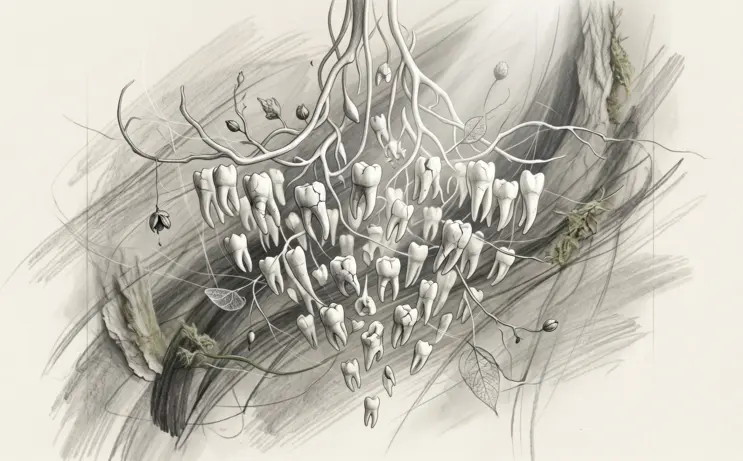
This isn’t the dream where a tooth loosens and you feel it coming. This isn’t the one that gives you time to register the first departure before the second one follows. This is the version where the architecture collapses all at once — where one moment the structure was intact and the next it wasn’t, and no amount of preparation would have changed what your hand is now holding.
The all is the thing. Every other teeth dream negotiates with you. This one doesn’t.
Quick Answer
- All teeth fall at once → not erosion, not sequence — total structural collapse, the body reporting a threshold that was crossed rather than approached
- You feel them go but watch yourself from outside → the dissociation was already in place before the loss; you’ve been managing this at a distance
- You try to catch them and some hit the floor → the part you caught is the part you’re still holding onto; the part on the floor is what the body already released
- Your mouth is empty and you feel your tongue running over bare gums → the inventory of absence — the body taking stock of what used to be structure
- There’s no pain when they fall → the severance completed before the dream arrived; what you’re witnessing isn’t the break, it’s the aftermath
- You feel horror first → the loss arrived ahead of your readiness for it; the body crossed the line before the mind signed off
- You feel a strange relief underneath the horror → two things are true simultaneously — something is gone and the body is lighter without it
- Someone witnesses the whole thing → the collapse isn’t private; the specific terror of being seen in total loss, not partial, not recoverable
- You wake and reach for your mouth → the body verifying the inventory, checking whether what fell in the dream is still standing in waking life
Common Scenarios
- You’re mid-conversation and they all leave at once, in the middle of a sentence → the voice fails completely, not partially; the instrument of speech and self-presentation goes out simultaneously with the loss
- You look in a mirror and watch it happen → you witnessed your own total unraveling; the mirror adds the element of self-confrontation — you couldn’t look away
- They fall into your hands and you’re left holding all of them → the body transferred the full inventory to you; the weight of what used to be structure is now something you’re physically carrying
- They fall to the floor and scatter → you can’t retrieve them; the dispersal adds the impossibility of restoration — the pieces went too many directions
- You’re in a room full of people when it happens → every variation of the public loss dream intensified; this isn’t one tooth in a professional context — it’s the complete collapse of social presentation
- You spit them all out in one motion → expulsion at total scale; not one thing being cleared but the entire structure being rejected at once
- The dream keeps going after they fall → the body isn’t finished with you; the image staying past the moment of loss means the integration is still in process
- You wake up immediately after → the psychic impact was enough to break the sleep cycle — the signal was urgent enough to interrupt the containment of dreaming
Physical Sensations
- Tongue moving across teeth before eyes open → the most consistent physical residue of this dream; the body running its first waking verification before the mind has finished arriving
- Jaw locked or sore → you were clenching before and during; the body was already doing structural work, and the dream is the report of that effort
- A strange hollowness in the chest, not the mouth → the loss registered somatically before it registered cognitively; the body is the first to know
- Heart rate elevated on waking → the nervous system treated this as a threat event — the physiological response doesn’t distinguish between the loss being real and the loss being dreamed
The Architecture That Fell All at Once
Every other teeth dream is a process.
The single tooth that loosens gives you a relationship with the departure — the sequence, the individual moments of each one going, the ability to track what’s being lost against what’s remaining. The crumbling dream runs its erosion slowly, incrementally, each fragment registering before the next one fails. Even the spitting dream is a body-led act with a specific direction and a specific moment.
This one takes all of that away.
The dream isn’t giving you a sequence to track. It’s giving you an outcome to face. The structure was intact — and then it wasn’t, completely, simultaneously, with no individual moment you can point to as the one where things began to go wrong. The full collapse happened faster than the comprehension of it. You’re not watching something erode. You’re standing in the aftermath of something that has already finished.
You don’t feel each one go. That’s the specific thing the dream gets right about this kind of loss. There’s no first tooth to brace against. There’s no second tooth that tells you something is seriously wrong. The moment of awareness and the moment of total loss are the same moment. The mouth is full and then the mouth is empty and the space between those two states has no duration in the dream at all.
What the dream is reporting is a threshold crossing — the specific register of a loss that wasn’t incremental but categorical. Not something that eroded past a point. Something that crossed one.
When the Body Already Knew Before You Did
Here is the thing about the all-at-once version that the sequential dream doesn’t contain.
The sequential dream lets you pretend, right up until the last tooth, that the loss might not be total. You’re counting what remains. You’re calculating what’s recoverable. You’re in a negotiation with the scale of it, and the negotiation runs in parallel with the departure until there’s nothing left to count.
This dream removes that negotiation entirely.
There is no period during which you’re managing the extent of the loss. There’s only before and after. And the specific psychological weight of this dream lands hardest on people who have been — in waking life — engaged in an extended negotiation with something that the body long ago completed its assessment of. The teeth falling out dream reports what the body registers as a loss of grip or control. This version reports the body delivering the final verdict on something that has been running too long on a verdict the body already issued.
The all-at-once is the dream of the person who has been managing around something — a relationship, a role, an identity, a truth — that the body stopped believing in long before the mind agreed to examine it. The collapse in the dream isn’t a warning. It’s a summary. The body is showing you the conclusion it reached months ago in the form that most efficiently communicates that a conclusion was reached.
Your mouth opens. The words are there — whatever the dream had arranged for you to be saying — and then the mouth is empty in a way that ends the sentence. You feel them in your hand before you understand what happened. All of them. The full weight of what used to be structure, warm and solid and wrong in the specific way that recently removed things are wrong — still carrying the temperature of the place they came from. You look at what you’re holding. And the first thought is: this was all of it.
The Public Version — When the Total Loss Has an Audience
The dream runs a different register when the collapse is witnessed.
A single tooth falling in public carries the fear of visible vulnerability — the sense that one failure can be seen. Losing all of them in public is categorically different. There’s no management strategy available for total structural collapse. You can’t redirect attention from something that level. You can’t frame it. You can’t hold your jaw shut and finish the sentence and address the one loosening tooth later. All teeth, all at once, in front of someone — or everyone — is the complete removal of every mechanism you use to maintain your presentation.
This version of the dream tends to run when the waking context is one where the gap between your presented self and your actual state is at maximum. The version of you that other people see — competent, intact, functional, holding everything together — and the version of you that the body is registering internally are separated by the furthest they’ve been. The dream resolves that gap the only way it knows how: total public collapse. The inside and the outside become the same thing at once. Involuntarily. In front of witnesses.
They’re all there. You’re aware of all of them at once — not the individual faces but the collective attention, the specific quality of a room where everyone has stopped what they were doing. You tried to speak and couldn’t. Your hand came up to your mouth automatically, the gesture that’s supposed to manage things, and there was nothing for it to manage. The floor was already holding what your hand arrived too late to catch. And the people in the room are still there, still watching, and the specific horror of it isn’t that they saw the loss — it’s that there was nothing left to protect after it.
The Mirror Version — Watching Yourself Lose Everything
When the mirror is present, the dream adds a layer that the other versions don’t carry.
Normally in loss dreams, you experience the departure from inside the experience. The mirror forces a second perspective — you become both the person losing and the person witnessing the loss. The self-confrontation this creates is specific: you can’t pretend it isn’t happening because you’re watching it happen. You can’t manage the extent of the loss because the mirror is giving you the full accounting in real time.
This version runs when the waking dynamic involves self-avoidance — when the person hasn’t been looking directly at what’s happening in their own life because looking directly at it requires accepting it. The mirror in the dream is the body’s mechanism for ending the avoidance. It puts you in the position of witness to your own total loss, removing every management strategy the mind uses to stay in the negotiation rather than arriving at the conclusion.
You watched yourself in the mirror. The dream made sure of it. Whatever you’ve been not looking at in waking life — the dream decided you were going to look at it this time, under the worst possible conditions, without anything left standing by the end.
When You Wake Up Holding the Question
The most common thing people report about this dream — more than the fear, more than the specific horror of the emptiness — is the question that stays.
Not: what does this mean?
But: what was that about?
There’s a specificity to the disorientation that the all-at-once version leaves behind. Unlike the sequential dream, which lets you locate the loss in a traceable series, this one doesn’t give you a thread to follow back. It gives you an outcome and asks you to work backward from it. The feeling on waking is the feeling of having been handed a conclusion without the argument.
This is precise information. The body already ran the argument. The dream is delivering the conclusion. The question the waking mind gets to answer is not what is falling apart — the body already told you that — but what are you going to do now that you’ve been told?
Why All at Once — The Neuroscience
The sequential version and the all-at-once version are neurologically distinct dream events. During REM sleep, the hippocampus — which handles sequential memory and the ordering of events over time — operates in a low-integration state, while the amygdala runs at near-waking levels. The sequential teeth dream uses the hippocampal trace to construct a narrative of incremental loss: each tooth a separate memory-analogue, each departure a discrete event. The all-at-once version bypasses that architecture entirely. It arrives in the amygdala as a single threat event — not a series of losses but one categorical rupture — which is why it so frequently triggers a full sympathetic nervous system response on waking. The body treats this dream as it would treat a single acute traumatic signal: total arousal, immediate orientation response, elevated cortisol without the ramp-up of a gradual stressor. The dream is running the neurology of shock, not the neurology of accumulation. And it does this because it is reporting on a psychological state that is closer to shock than to erosion — the specific register of a loss that was total, not sequential, regardless of how long it actually took in waking life to arrive at that totality.
Dream Timestamp
- After a relationship, role, or identity that has been failing for a long time finally reaches its end → not the gradual version of the loss, but the moment the body registers that the full accounting is complete
- During a period when the gap between your external presentation and your internal state is at maximum → the dream is the body collapsing that gap by force
- When something you’ve been maintaining through enormous effort finally stops being maintainable → the relief-horror compound on waking is the accurate emotional report of that specific moment
- When you’ve been avoiding looking at something directly because looking directly at it means you have to act on what you see → the mirror version arrives to make the looking unavoidable
The Sentence This Dream Was Trying to Say
Everything I was holding together through effort, through management, through the specific discipline of not looking at it directly — it let go all at once, and the body wanted me to know what it looks like when you’re no longer carrying it.
The Morning After
Your teeth are still there. The tongue already confirmed that, in the seconds before you were fully awake.
But the dream wasn’t random. It used the most total version of the most common human dream for a reason. Not one tooth — all of them. Not a process — a verdict.
Sixty seconds. One question, at the level of the body before the day’s management systems come back online:
What are you maintaining — a relationship, a role, a version of yourself, a truth you’ve been not-saying — that would feel, if you stopped, like losing everything at once?
Not what’s worth saving. Not what you should feel about it. Just: what is it? The dream already identified it. The sixty seconds is just you writing down what the body already knows.
FAQ
Why did all of them fall out at once instead of one at a time?
Because the thing the dream is reporting on isn’t a process — it’s a threshold. The sequential dream reports accumulating strain, the body tracking individual departures as they happen. The all-at-once version reports a categorical collapse: something that crossed a line rather than eroding past one. In waking life, this maps to the experience of something that seemed to be holding and then, at a specific moment, didn’t. The totality of the loss in the dream is the accurate rendering of how the collapse registered — not gradually, not traceably, but all at once, as a single event rather than a series of them.
Does this dream mean something is about to end in my life?
Not about to — the body’s report is almost always about something that is already in process, already registered at the level of somatic awareness, already complete enough that the sleeping brain could render the outcome. The dream doesn’t predict. It reports. The more useful question isn’t is something ending but what has the body already concluded that the conscious mind is still negotiating with?
Why does the horror feel different from other fear dreams?
Because this isn’t the fear of threat — it’s the fear of completion. Fear of threat runs an anticipatory signal: something is coming, the body is mobilizing to meet it. The all-teeth-falling dream runs something closer to the emotional signature of finality. The loss has already happened inside the logic of the dream, completely, with nothing recoverable. The body isn’t mobilizing to prevent something. It’s responding to something that’s done. That specific register — not threat but completion — lands differently in the nervous system, and the residue on waking carries that quality. It’s not adrenaline. It’s the specific weight of aftermath.
What if this dream keeps recurring?
Recurring dreams run when the thing they’re reporting on hasn’t been consciously addressed. The body doesn’t stop sending signals because the first one was ignored — it escalates frequency and intensity. If this dream is returning, the question to ask isn’t what it means — you already have the answer — but why the part of you that makes decisions in waking life is continuing to stay in the negotiation rather than reaching the conclusion the body has already reached. The dream will stop when the waking mind catches up to what the body already knows.
Next Stages
If the dream was sequential — if the teeth fell one by one and you tracked each departure — Dream About Teeth Falling Out — when the body is reporting incremental loss, each one traceable, the structure giving way piece by piece rather than all at once.
If the teeth didn’t fall but dissolved from within — if nothing departed cleanly but everything became structurally less — Dream About Teeth Crumbling — when the loss is erosion rather than collapse, the gradual failure of something that was never going to exit in a single moment.
If the damage was internal and organic — if the structure stayed in place but the integrity was lost through decay → Dream About Teeth Rotting — when the subconscious reports a slow withdrawal of life or health, focusing on the neglect that happens before the collapse.
If the collapse was total but you could feel it was tied to blood — if the loss had the temperature of something still alive at the point of severance — Dream About Teeth Falling Out With Blood — when the departure cost something real, when what fell was still attached to something living, and the body carries the record of that cost.
If the body wasn’t losing the teeth but expelling them — if the movement was outward and deliberate rather than a collapse inward — Dream About Spitting Out Teeth — when the body was performing a clearance rather than reporting a failure; when the exit was the body’s own decision rather than a structure giving way.