Teeth Crumbling Dream Meaning
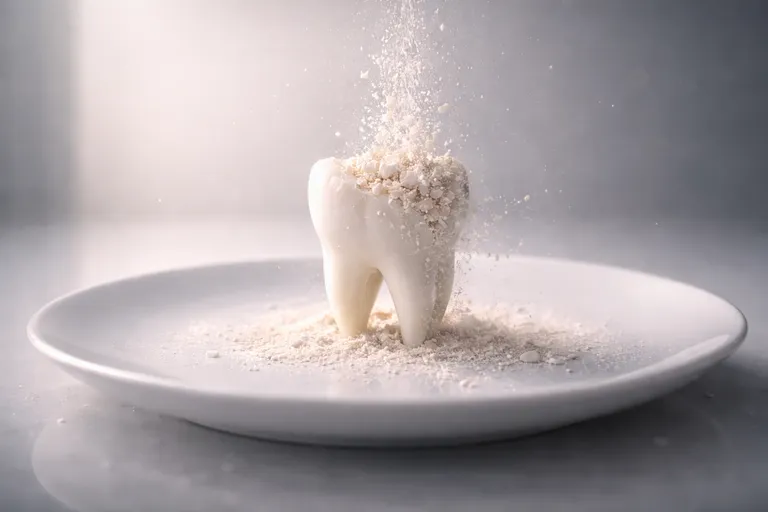
By the time you realized it was happening, you were already holding sand.
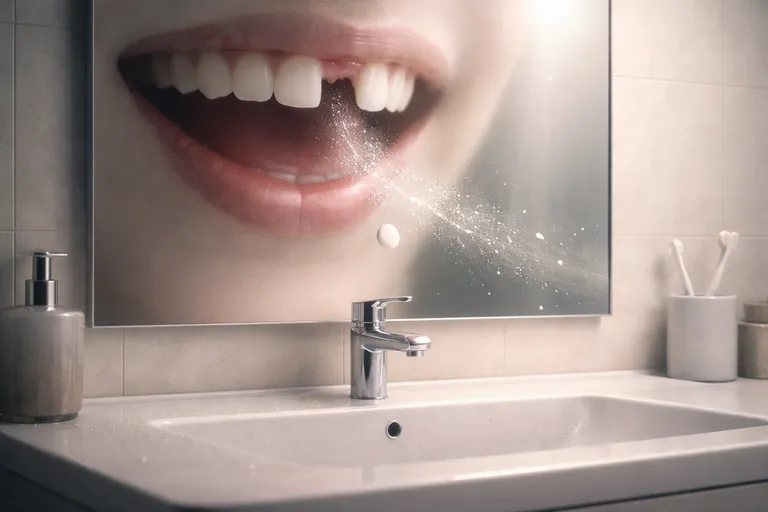
Not a tooth. Not even a fragment. Sand — the fine, pale grit of something that used to have structure. You felt it in your mouth before you registered what it was. The specific texture of dissolution: particles where there should be surface, powder where there should be solid. You moved your tongue and found a landscape that shouldn’t exist.
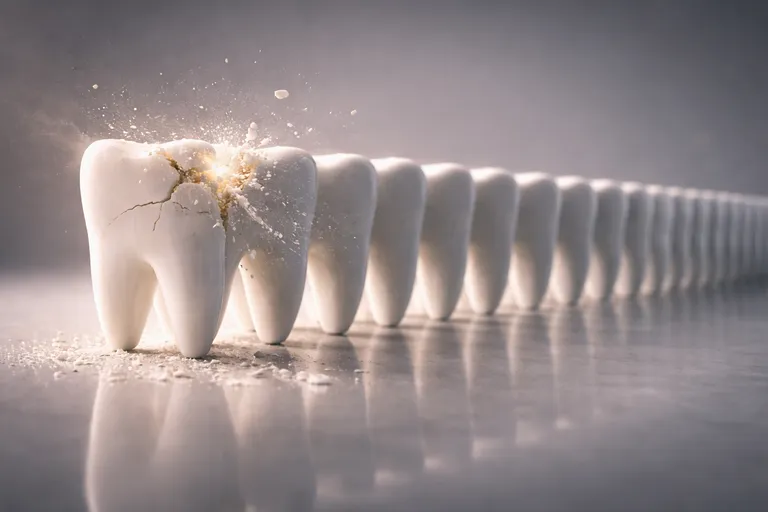
That’s the specific thing about crumbling that separates it from every other teeth dream. Teeth can break in a moment — a single threshold, a before and after. They can fall cleanly — a departure that was already decided. But crumbling has no moment. No threshold. No before and after. Just an ongoing process that was already running before you had evidence of it, and that will continue running after you’ve noticed it.
By the time you found the sand, the dissolution had been happening for a while.
Quick Answer
- Teeth crumbling in a dream means something has been losing its structural integrity gradually — not through a single event but through sustained exposure to conditions that dissolve
- The specific horror of this dream: it was already happening before you noticed; the crumbling preceded the awareness
- What makes this different from breaking (threshold) or falling (departure): crumbling has no end point; you’re always in the middle of the process
- The sand in the mouth is the most specific information — former structure that can’t be reassembled; dissolution that is final even though it happened slowly
- This dream corresponds to waking situations where something is eroding rather than breaking — sustained, gradual, without a single cause
Common Scenarios
Crumbling begins mid-conversation → the social structure is dissolving precisely in the context that most requires it to hold
You notice the texture before you see the damage → the interior process revealed itself through sensation before visual evidence arrived; the erosion was felt before it was seen
You try to hold the fragments in → the instinct to collect, to prevent the loss of each piece; maintenance as the dream’s central activity
The crumbling accelerates when you focus on it → awareness amplifying what it was trying to monitor; the watching making it worse
Each tooth goes, then the next → sequential dissolution; the structure failing in stages rather than all at once
You spit out grit → the body dealing with what the dissolution produces; what used to be solid becoming something you have to manage differently
What Your Body Already Knows
The grit that’s still in the mouth on waking → not a sensation the body actually has — a memory the body carries; the texture of that specific kind of dissolution is specific enough to persist
The exhaustion before you’ve fully assembled the day → crumbling dreams are tiring in a way other teeth dreams aren’t; the sustained management work ran all night
The specific tiredness of having been inside an ongoing process → not the shock of breaking, not the quiet of release — the fatigue of something that kept going and kept requiring attention
The absence of a clear event to point to → you wake knowing something happened but not when it started or when it ended; the process had no edges
Why It Was Already Happening Before You Noticed
This is the specific truth about crumbling that makes it harder to process than the other teeth dreams.
Breaking happens at a moment. You can point to it: here, this is when it crossed the line. The before and the after are both legible. The event is discrete.
Crumbling doesn’t work that way. Crumbling is the process that happens below the visible threshold for a long time before the evidence surfaces. The structural degradation is internal, sub-perceptual, running without any announcement. From the outside — from the surface — everything looks intact. The tooth is there. The structure appears solid. Until it isn’t, and by then the dissolution has been going on for long enough that what you find is not the beginning of the problem but its accumulated output.
You put your tongue to the tooth and something that should be surface is texture instead — fine, granular, wrong. You didn’t feel this starting. There was no moment of onset. The tooth looks intact in the mirror, it has always looked intact, and your tongue is telling you it is now sand inside the appearance of solid.
In waking life, this is the experience of something whose internal structure has been eroding while the external appearance remained stable. The relationship that looked functional while the foundation was losing its mineral content. The confidence that appeared intact while inside the micro-fractures were accumulating. The version of yourself that continued its performance while below the performance, the structure was quietly becoming something it couldn’t hold.
The hardest part of crumbling is that you cannot point to when it started, because it started below the level where starting is visible.
What Makes Something Crumble
Teeth crumble in reality when they lose the minerals that hold their structure — slowly, through sustained exposure to conditions that dissolve. Not one blow. Not one event. The sustained presence of what breaks down what holds together.
In dreams, this is exact.
Crumbling corresponds to sustained exposure. Not a single cause but a chronic condition. The accumulation of small things that individually don’t constitute a crisis but collectively have been dissolving what was solid. The sustained pressure of a situation that has been asking too much for too long. The ongoing presence of something corrosive — a relationship, an environment, an internal state — that has been working on the structure of something that used to be able to hold.
The texture under your tongue is the specific texture of something that has been absorbing pressure for a long time. Each piece that comes away is a small thing. It’s always a small thing. That’s what makes it impossible to stop: there’s never a large enough thing to confront. Just the continuous accumulation of small things, each reasonable, each manageable, each contributing to a process that was never going to announce itself dramatically enough to require a response.
This is the dream’s most specific piece of information: whatever is crumbling in your waking life isn’t crumbling from one thing. It’s crumbling from sustained exposure to conditions that have been dissolving its structure for longer than you’ve been tracking. There was no event to respond to. There was only ongoing presence.
The Exhaustion of a Process With No Ending
Breaking has an aftermath. The threshold is crossed, the break is real, and then you’re in the aftermath — dealing with the consequence of something that has definitively happened.
Crumbling doesn’t offer an aftermath.
You’re always inside the process. Each piece that goes reduces the structure slightly. Each fragment requires a response — catch it, collect it, account for it, manage the gap it left. But the process continues regardless of the management. You collect the pieces and more pieces come. You manage the current stage of dissolution and the dissolution keeps going. There’s no point at which the managing will have accomplished its purpose, because the purpose would require the crumbling to stop, and the crumbling doesn’t stop.
You spit out grit. More comes. You collect the fragments in your palm. More appear. You press what remains of the tooth against what’s adjacent, trying to use the structure that’s still there to stabilize what’s going. The tooth next to it begins to go. There’s no winning position inside this process. Only the sustained engagement with each stage of it.
This is the exhaustion that crumbling dreams produce that no other teeth dream quite matches. Not the sharp exhaustion of crisis. The chronic exhaustion of sustained engagement with an ongoing process that asks for continuous attention without offering resolution. The kind of tiredness that accumulates over weeks and months of managing something that keeps requiring management.
In waking life, this is the specific quality of situations that have no resolution within reach — only the ongoing management of their progression. The health condition being managed rather than resolved. The relationship dynamic that keeps requiring attention without changing. The professional situation that has been draining without crisis.
Sand Cannot Be Reassembled
Here is the specific quality of crumbling that separates it from breaking, and the thing that makes it the most permanent of the three forms.
A broken tooth has pieces. Large pieces, often, that could theoretically be put back together. The fracture is clean. The surfaces could meet again.
Sand cannot be reassembled. When something has crumbled to powder, the granularity is final. The components are the same — same material, same weight — but arranged now in a way that cannot return to the form it had. You can cup the sand in your hands. You cannot reconstruct the tooth.
You’re holding what was inside the tooth — the substance of it, the specific pale-yellow grit of dissolution. It’s heavier than you’d expect, for something this small. The weight of what used to hold something together, now loose in your palm. You could close your hand around it and keep all of it. The keeping doesn’t undo the form it’s lost.
This is what crumbling points to in waking life: dissolution past the point of reconstruction. Not damage that can be repaired. Not departure that can be reconsidered. The structural integrity that has been progressively lost to a point where the form that used to hold cannot be returned to through effort or reversal. The relationship that has not failed dramatically but has lost enough of its essential quality through sustained erosion that what remains is no longer the thing it was. The confidence that has been worn down through sustained undermining until what’s left is something with the same weight but a different structure.
The experience of watching something complete itself past the point where you can intercept it — watching the process run while the hands arrive too late, while the intervention comes after the dissolution has already become sand — is the crumbling dream’s closest waking correspondent. The process was already running. Your awareness arrived after it had produced enough evidence to be noticed.
Why You Couldn’t Stop It By Watching
Every version of this dream includes the same specific futility.
You noticed the crumbling. You watched it. You tracked each fragment. You tried to respond to what was happening — managed the pieces, adjusted your behavior, applied focus to the problem. And the watching made it worse. The attention accelerated the dissolution. The more precisely you monitored the crumbling, the faster it seemed to go.
This is not a failure of response. This is an accurate report on a real mechanism.
Some structures are maintained by not being watched too closely. The confidence that functions when you’re not analyzing it but starts to feel uncertain the moment you examine it directly. The relationship dynamic that works in flow but becomes awkward under focused attention. The aspect of your presentation that holds naturally but starts to wobble the moment you’re aware of presenting. These structures lose stability not from external assault but from the specific pressure of being the object of too much aware attention.
You try to stop touching it with your tongue. Your tongue keeps returning. You tell yourself: stop noticing this, stop tracking this, stop making it worse by noticing it. The noticing continues. The tongue finds the damage again. The crumbling accelerates under the observation. This is the specific feedback loop the dream is running: you cannot stop watching what you’re watching, and the watching is exactly what the structure cannot withstand.
The full account of what teeth represent — the social presentation, the apparatus of how we hold ourselves together in front of others — runs through all the teeth dreams. But crumbling specifically represents the kind of presentation damage that’s driven not by external attack but by internal sustained attention to the fragility of what you’re presenting. You made it worse by watching. The watching was inevitable. The worse was also inevitable.
When This Dream Arrives
During periods of sustained erosion that have no clear cause → not one thing, but the accumulated effect of many small things over time; the structure is going slowly
When something has been requiring continuous maintenance → the management itself is part of the problem; the sustained effort to hold what’s dissolving is both necessary and exhausting
When the internal state of something has diverged from its external appearance → what looks intact has been crumbling internally; the dream surfacing the interior truth
Why This Dream Happens — The Psychology Behind It
Crumbling dreams appear when the brain is processing sustained erosion — the kind that operates over time rather than through discrete events, that leaves no clear moment to point to, that is tracked as ongoing rather than resolved.
The brain reaches for crumbling specifically because crumbling maps the experience of structures that lose integrity through accumulation. Not failure — accumulation. The sustained presence of conditions that dissolve. The progressive weakening of what holds together under chronic rather than acute load.
The specific qualities of crumbling — the absence of a clear moment of onset, the irreversibility of what becomes sand, the feedback loop where attention accelerates dissolution — are all accurate to the waking situation the dream is processing. Something in your life is losing structural integrity through sustained exposure. The erosion preceded the awareness. The noticing is not reversing the process.
What the dream is offering is not a diagnosis of a new problem but an acknowledgment of one that has been running: the structure has been going for longer than the attention has been on it. The sand is the evidence. The evidence was always there; the dream made it visible.
Dream Timestamp — вставить перед The Sentence:
The teeth-crumbling dream arrives after sustained erosion has been running long enough to produce evidence that can no longer be managed below the threshold of awareness → not when the dissolving began — when the accumulated output has reached a level that the nervous system can no longer process as background noise; the dream surfaces the process after it has been running for a while, not at its onset
The version where it begins mid-conversation arrives when the social or relational context has been the specific site of the erosion → the dissolving starts in the place the structure is most required to hold; the dream is precise about context — whatever was crumbling was doing so specifically in the territory where its integrity mattered most
The version where awareness accelerates the crumbling arrives when the structure cannot withstand focused attention → things that work when not examined too closely destabilize under sustained monitoring; the dream is running the honest account of a specific mechanism: the watching and the eroding are connected, and more watching produces more eroding
The version where each tooth follows the next arrives when the erosion is systemic → not one thing losing integrity but a sequential failure across multiple structural points; one domain giving, then the adjacent domain giving; the scale of the dissolution is larger than any single point of failure
The recurring version means the conditions producing the erosion are still present and still active → the dream returns as long as the sustained exposure continues; unlike the breaking dream, which stops when the load reduces, the crumbling dream stops only when the conditions doing the dissolving are genuinely removed — not managed, removed
The Sentence This Dream Was Trying to Say
Something has been losing its structure from inside for longer than I’ve been watching — and by the time I noticed, it was already sand.
The Morning After
The grit is gone. The mouth is fine. The tooth that was dissolving in the dream is intact in the room.
But the process it was representing isn’t gone. Whatever has been crumbling in your waking life — whatever has been losing structural integrity through sustained exposure to conditions that dissolve rather than through a single cause you could name — that process is still running.
The dream didn’t create the erosion. It showed you what the erosion looks like from inside.
One question worth sitting with: what in your waking life has been losing its structure gradually — not from one thing, but from many small things over a sustained period? And is there a specific condition that’s been doing the dissolving that you’ve been managing rather than addressing at its source?
The management kept the pieces contained. It didn’t slow the crumbling.
FAQ
Something in your waking life has been losing its structural integrity gradually — not through a single event or threshold but through sustained exposure to conditions that dissolve. The specific detail that it was already happening before you noticed is the most important information in the dream. The erosion preceded the awareness. What you find when the dream surfaces the process isn’t the beginning of the problem — it’s the accumulated output of something that has been running for longer than the attention has been on it.
Breaking has a moment — a threshold, a before and after, a specific point where the load exceeded capacity and something gave. Crumbling has no moment. No threshold. No before and after. Just an ongoing process that was running before you had evidence of it. Breaking corresponds to acute structural failure under pressure. Crumbling corresponds to chronic erosion through sustained exposure. Breaking asks: what was the load? Crumbling asks: what conditions have been doing the dissolving — and for how long?
Because the dream is running an accurate mechanism, not a dramatic effect. Some structures are maintained by not being monitored too closely — they function in flow but destabilize under focused attention. The confidence that works when you’re not analyzing it. The relationship dynamic that holds naturally but becomes awkward under scrutiny. The presentation that continues until you become aware of presenting. The watching and the crumbling are connected. More watching produces more crumbling. The dream is honest about this feedback loop because the loop is real.
Former structure. Same material, same weight — arranged now in a form that cannot return to what it was. Sand cannot be reassembled into a tooth. The granularity is final. This is the specific quality of crumbling that separates it from breaking: a broken tooth has pieces that could theoretically be rejoined. Sand cannot. What the crumbling dream is pointing to in waking life corresponds to this quality — dissolution past the point of reconstruction, where the form that used to hold cannot be returned to through effort or reversal.
Because you’re always inside the process — there’s no aftermath, no resolution, no point at which the management accomplishes its purpose. Breaking has an aftermath: the fracture happened, now deal with it. Crumbling offers no aftermath. You collect the pieces and more pieces come. You manage the current stage and the process continues. The exhaustion isn’t the sharp exhaustion of crisis — it’s the chronic exhaustion of sustained engagement with something that keeps requiring attention without offering completion. That tiredness is what you carry out of the dream.
By addressing the conditions doing the dissolving — not managing the outputs, addressing the source. The management kept the pieces contained; it never slowed the crumbling. The dream returns as long as the sustained exposure continues. Unlike the breaking dream, which stops when the load reduces, the crumbling dream stops only when the conditions doing the dissolving are genuinely removed. The first question isn’t what to do about the sand — it’s what has been in sustained contact with the structure long enough to change it from solid to grit.
Next Stages
If the loss had a specific moment — if there was a threshold you crossed rather than a gradual dissolution → the acute form: teeth breaking in dream meaning — when the damage had a before and after, a specific point where it went from holding to broken
If the teeth went quietly with no drama — if the departure was clean rather than erosive → the release form: teeth falling out with no blood dream meaning — when the structure had already released its grip before the dream showed it leaving
If this dream keeps returning — if the crumbling is recurring and the process in the dream never completes → the mechanism of the recurring signal: recurring stress dreams and why they keep coming back — when the dream returns because the situation it’s reporting on hasn’t changed