WHAT IS THIS TOOL
What Is the Sensory Dream Mapper?
Most dream interpretation tools ask you what you saw. The Sensory Dream Mapper asks what you felt.
There is a difference — and that difference matters more than most people realise.
When you dream, your brain doesn’t just generate images. It generates a full somatic experience: thermal states, pressure signatures, tactile textures, sound environments, and localised physical sensations across the body. These signals are produced by the same neurobiological systems that regulate your waking stress response, your immune state, your emotional processing, and your proprioceptive awareness.
The problem is that most people wake up and immediately translate their dream into a narrative — what happened, who was there, what it might mean — and in doing so, they lose the most diagnostically valuable layer: the physical residue the dream left in the body.
The Sensory Dream Mapper was built to capture that layer before it disappears.
You don’t need to remember a story. You need to remember a sensation.
Was the dream cold or hot? Did it feel thick, sharp, fluid, or empty? Where in your body did you feel pressure or discomfort? What was the ambient sound?
From those inputs, the tool generates a Somatic Profile — a neurobiologically grounded classification of the physical state your nervous system was processing while you slept. Not a mystical interpretation. A functional one.
WHY IT WORKS
Why Somatic Dream Mapping Works Where Symbol Libraries Fail
Dream dictionaries are built on the assumption that dreams communicate through universal symbols. A snake means transformation. Water means emotion. Flying means freedom.
The problem with this model is that it ignores the body entirely.
Your nervous system doesn’t read archetypes. It reads activation patterns. Cortisol levels. Thermal regulation. Vagal tone. The tension in your jaw that you’ve been carrying for six days without noticing.
Research in sleep neuroscience has consistently demonstrated that the physical contents of dreams — not just the narrative — correlate directly with the body’s physiological state during sleep. Elevated skin temperature during REM is associated with sympathetic nervous system activation. Reports of heaviness or paralysis correlate with sleep architecture disruptions and hypnagogic states. Cold dreams with minimal somatic sensation frequently occur during periods of emotional suppression or low vagal activity.
Your body uses the dream state to process what it couldn’t process during the day.
The Sensory Dream Mapper makes that processing visible.
HOW TO USE IT — FULL INSTRUCTIONS
How to Use the Sensory Dream Mapper: Step-by-Step Guide
The best time to use this tool is within the first 10 minutes of waking.
Somatic memory — the physical residue of a dream — dissipates faster than visual memory. By the time you’ve checked your phone, made coffee, and started your day, most of it is gone. Keep a tab open on your phone or laptop before you sleep. Use it before anything else.
Set the Thermal State
Set the Thermal State
What it measures: The overall temperature of the dream environment and your body within it.
The vertical slider on the left maps dream temperature across a 7-point scale, from Glacial to Scorching. This is not about the weather in your dream. It is about the thermal feeling in your body during the dream.
Glacial / Frozen: The dream felt cold from the inside. You felt chilled, numb, or physically distant from your own body. This often corresponds to suppressed emotional states, low arousal, or dreams occurring in early sleep cycles.
Cold: A mild coolness. Slightly detached. The body present but not fully engaged.
Neutral: Neither hot nor cold. The body was present but in a regulated, ambient state.
Warm: A rising quality. Energy, tension, or emotional activation beginning to build.
Hot / Scorching: The body was running. Heat, urgency, pressure, or intensity. Often associated with high cortisol states, threat-response dreams, or physical discomfort during sleep.
Slide the control to the temperature that most closely matches what your body felt — not the temperature of the dream setting.
Select Your Tactile Signatures
What it measures: The dominant physical texture of the dream experience.
Tap one or more textures that describe the feeling of the dream. These are not metaphors. They are somatic descriptors — the way your nervous system encoded physical sensation during sleep.
Viscous — The dream felt thick. Movement was effortful. There was resistance, weight, or a sense of being slowed by something you couldn’t see. Associated with: enteric nervous system tension, vagal suppression, unresolved emotional holding.
Sharp — There was a cutting quality. Precision, intrusion, or pain — physical or emotional. Something arrived without invitation. Associated with: prefrontal hyperactivation, unresolved cognitive load, cervical tension.
Void — The dream felt empty from the inside. Not peaceful — absent. A hollowness where sensation should have been. Associated with: limbic suppression, protective downregulation, emotional avoidance states.
Gritty — Friction, abrasion, texture that shouldn’t have been there. The world of the dream felt wrong at the surface level. Associated with: exposure states, sympathetic arousal, social threat processing.
Fluid — Smooth, flowing, borderless. Movement without resistance. Boundaries between self and environment less defined than usual. Associated with: distal proprioceptive loosening, dehydration, peripheral nervous system disengagement.
You can select multiple textures. Many dreams carry more than one.
Map the Somatic Zones
What it measures: Where in your body you felt sensation, pressure, or discomfort.
The human silhouette shows 10 distinct somatic zones. Tap any zone where you felt something during or immediately after the dream — this includes pressure, discomfort, awareness, tension, pain, or even an unusual absence of feeling.
Zone
What to look for
Cranial / Prefrontal
Head pressure, cognitive weight, a sense of fullness or buzzing behind the forehead
Cervical Spine
Neck tension, stiffness, a held quality at the base of the skull
Thoracic / Chest
Chest tightness, breath restriction, pressure over the heart or sternum
Left / Right Brachial
Arm tension, numbness, a sense of reaching or restraint
Lumbar / Abdomen
Gut heaviness, abdominal contraction, lower back load
Left / Right Femoral
Leg tension, inability to run, heaviness or floating in the legs
Left / Right Distal
Feet and hands — numbness, tingling, loss of boundary definition
The Somatic Resonance Field below the silhouette updates in real time as you select zones. This hexagonal radar chart shows you the distribution of activation across your body’s six major somatic regions — giving you a visual map of where the dream was concentrated.
A dream where activation clusters in the Cranial + Thoracic zones tells a different story than one concentrated in the Lumbar + Distal zones. Both matter. Both point to specific physiological processes.
Select the Soundscape
What it measures: The ambient sonic quality of the dream environment.
This is not about specific sounds you heard. It is about the texture of the sonic environment.
Silent — The dream had no ambient sound, or sound was absent in a way that felt significant.
Hum — A constant, low, undifferentiated background noise. Present but not intrusive. The nervous system registering a held state.
Voices — Human speech, whether intelligible or not. The social threat processing system was active.
Chaotic — Sound was overwhelming, fragmented, or disorienting. The auditory environment did not hold together.
Read Your Sensory Profile
Once you have set all inputs, the Sensory Profile section will appear automatically.
Your profile includes:
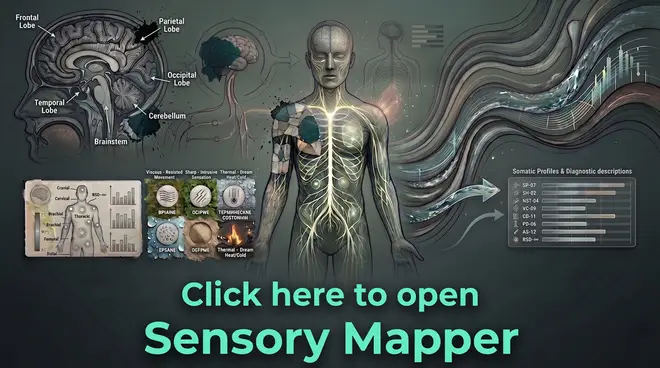
The Classification Name and Code — One of nine neurobiologically derived pattern types, each representing a distinct physiological state. Examples include Somatic Purgation (SP-07), Static Hypoxia (SH-02), Neuro-Somatic Tension (NST-04), and The Residue (RSD-∞) — the classification reserved for signals too specific to categorise.
The Diagnostic Description — A plain-language explanation of what the physical pattern indicates about your nervous system state. No mystical language. No archetype references. What the body was actually doing.
The Bio-Signal Meter — A live reading at the top of the page showing the overall intensity of somatic activation based on your inputs. The lamp brightens in real time. The higher the signal, the more physiological processing was occurring during sleep.
The Recovery Protocol — Three practical, evidence-informed suggestions for physical and nervous system recovery based on your specific profile. These draw from breathwork research, proprioceptive reset techniques, somatic movement practices, and sleep science.