Unable to Pay in Public — The Four-Second Window Where Private Becomes Social
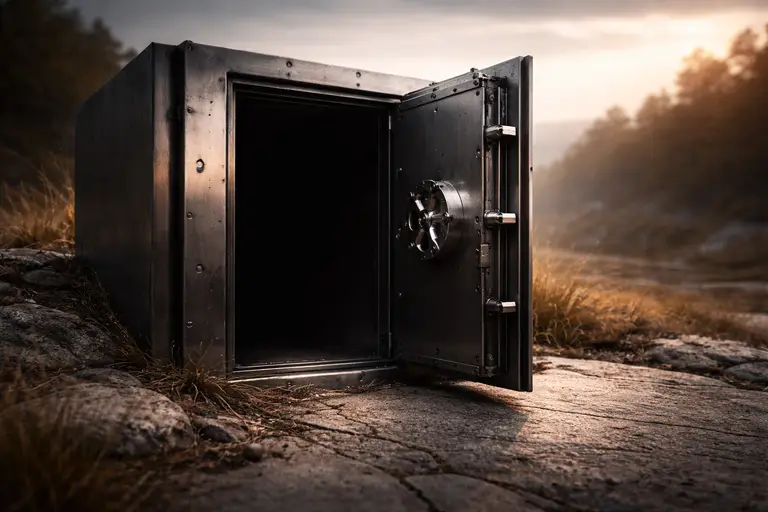
The safe is open.
That’s the first and most precise thing. Not broken into — opened. Not forced — accessed. The door that was designed to exclude everyone except the person with the combination has been opened, and what was inside is gone, and the safe itself is entirely intact. The lock mechanism is undamaged. The hinges are correct. The heavy door swings exactly as it was designed to swing. The container is structurally perfect.
The content is not there.
This is the specific horror of the empty-safe dream, and it’s worth naming precisely because it is not the horror of theft in the ordinary sense. The horror of ordinary theft is the violation — the forced entry, the damage, the evidence that someone came from outside and took what was yours. In the empty-safe dream, there is no violation. There is a perfect container, perfectly functioning, from which the thing it was built to protect has been removed through the door that was supposed to be yours alone.
The safe didn’t fail. The lock didn’t fail. The protection worked exactly as designed. What the dream is encoding is not a failure of protection. It is the specific experience of protection that was effective in every mechanical sense, from which the protected thing has nonetheless departed — which means it departed not by defeating the protection but through access to the combination.
In the years I’ve worked with this dream, what I find consistently is that it rarely tracks an external theft. It tracks an interior loss — something that was supposed to be most protected precisely because of where it was stored — in the most secure available container, behind the most protected available access — that is no longer there when the door is opened. And the intact structure of the safe is not reassurance. It is evidence. Evidence of the specific kind of access that was required.
Quick Answer
- The empty-safe dream encodes a loss from the most protected interior — not theft by violation but absence through the kind of access that bypasses the protection because it has the combination
- The intact structure of the safe is the most important diagnostic element: a broken safe would encode violated protection; an intact empty safe encodes access that worked within the system rather than against it
- The thing stored in a safe has a specific psychological character: it is the thing considered most worth protecting, most private, most important to keep secured from casual access; its absence is proportionally meaningful
- Bruce Schneier’s foundational work on security documents that the most sophisticated protection systems almost always fail not to external attack but to insider access — to the person who had the combination, the trusted party with legitimate means; the empty safe is the dream’s most precise image for this dynamic
- When you knew what was in the safe before opening it, the dream is encoding awareness that preceded the discovery — a knowledge that something was being removed from the protected interior before the formal acknowledgment of the loss arrived
- When you don’t know what was stored there, the absence has no specific name — something was in the safe, something considered worth maximum protection, and its identity is part of what the dream is asking you to name
- When the safe was never locked — when you find it open, having expected it locked — the protection was already gone before you arrived to check; the removal preceded your awareness of the removal
- When someone is present when you open the safe and the emptiness is witnessed, the loss has a social dimension alongside the interior one; the knowledge of the absence becomes shared knowledge
- When you find items of no value remaining while the valuable things are gone, the selection was intentional — whatever took what was there knew what to take and what to leave; the selectivity is the information
- The dream stops recurring when either the thing that was in the protected interior is restored, or the question of what the protected space now holds — and what should be stored there — is honestly addressed
Common Scenarios
You open the safe and it is simply, completely empty. The foundational version. You expected what you expected — the thing you put there, the thing that was supposed to be there, the thing the entire function of the safe was in service of protecting. And there is nothing. The emptiness is total. Not partially depleted — simply: the space that was occupied is not occupied. This version encodes the most complete version of the interior loss: whatever was being protected is entirely gone, and what remains is the space it used to occupy, perfectly preserved.
You open the safe and some things remain but what mattered most is gone. The selective version. The valuable things are absent; less valuable things remain. This selectivity is the dream’s most specific diagnostic: whatever took what was there knew what was in there, knew what mattered most, knew what to take and what to leave. The selection required knowledge of the contents. That knowledge was not broadly available. The selective absence encodes an interior loss whose source understood the hierarchy of what the safe contained.
You knew before you opened it. The pre-acknowledged version. You approach the safe with a specific quality of already-knowing. The opening is confirmation, not discovery. This version encodes the specific experience of awareness that precedes formal acknowledgment — the knowledge that something was departing from the protected interior before the moment of formal recognition of the loss. The opening is not the moment of revelation. The revelation already happened. The opening is simply the moment the already-known becomes formally visible.
Someone else is with you when you open it. The witnessed version. The absence becomes shared knowledge rather than private knowledge. The loss moves from interior experience to social fact. In waking life, this version arrives when a private loss — something held in the most protected interior of a life or relationship — becomes known to someone else, converting the experience from a private reckoning to a shared one.
The safe itself is broken — the door won’t close, the lock is damaged. The failed-protection version. A different dream from the intact-empty safe. When the structure itself has failed, the protection mechanism gave way — not the access through the combination but the physical integrity of the container. This version encodes external violation rather than insider access. The distinction matters: the broken safe points to protection that was defeated; the intact empty safe points to protection that was bypassed.
You find something inside that shouldn’t be there. The replacement version. The thing you stored isn’t there. Something else is. Whatever was placed in the protected interior in the thing’s absence — or whatever was found to be occupying the space when you expected to find what you stored — is the information. The dream is asking: what has taken the place of what was protected? What now occupies the space that was built for something else?
What Your Body Already Knows
Woke up with the specific quality of the opened-door moment still present — not the loss itself but the moment of registering the absence where presence was expected → because the brain’s prediction-error system was running the specific experience of arriving at an expected state and finding the state not there; this generates a distinct neurological signal — different from being told something is absent, different from witnessing something leave; the specific quality of arriving to find what should be there isn’t there has its own somatic signature
Woke up with the specific awareness of something having been in the most protected interior and no longer being there → because the safe is always a reference to the most protected-feeling domain of the waking life; whatever the brain placed in the protected container was drawn from the actual territory of what feels most secured, most private, most important to keep held; the awareness of its absence is the body carrying the finding out of the dream
Woke up examining something internally — not the lost object but the protection itself, asking how → because the intact safe generates the specific question of access: the protection worked, the thing is gone, therefore the access was through the combination; the waking mind runs the same question the dream was running: who or what had the combination? How did it leave through the door that was supposed to be mine alone?
Woke up with a specific relationship or context already present in consciousness → because the access was always specific; the combination was in specific hands; whoever or whatever was in possession of the access to the most protected interior — that is the address the dream was built on, and it arrived before deliberate thought
Woke up with something that wasn’t quite loss and wasn’t quite violation — something more specific, harder to name → because the empty safe produces its own emotional compound: the absence of what was protected, the intactness of the protection that couldn’t prevent the loss, and the specific knowledge that the departure was through access rather than force; this combination doesn’t resolve into a single clean emotion; the body holds it as its own distinct quality
When the Protection Works and the Thing Still Leaves
There is a specific category of loss that the empty-safe dream is encoding, and it is the most uncomfortable one to articulate precisely: the loss of something from inside the most protected space through the door that was designed to keep it safe.
Not violated. Accessed.
The distinction is everything. Violated protection produces a clear kind of pain — the anger of a perimeter breached, the clarity of an external threat located and named, the response that violation enables. When protection is violated, you know what happened. You know where the failure was. You can point to the broken lock, the forced entry, the mechanism that gave way.
When the protection is intact and the interior is empty, none of those responses are available. The mechanism didn’t fail. The security held. What the safe contained departed not by defeating the protection but through access to the means of the protection itself. Someone — or something — had the combination.
In my work with this dream, what I find consistently is that the combination is almost always in the possession of someone who was trusted with it. A partner in the most literal sense — someone with access to the most protected interior of a life who was trusted with that access for reasons that were once fully warranted. A professional context where what was most carefully built and protected was accessed by someone operating from within the organization rather than against it. A relationship where what was held most privately was shared — appropriately, at the time — and where the sharing later became the mechanism of the departure.
Bruce Schneier’s work on security design documents what he calls the insider threat as the fundamental challenge that no external protection can address: the most sophisticated security perimeter protects against everything except the person who has legitimate access. The lock that works perfectly against every external threat is irrelevant to the trusted party with the combination. The empty-safe dream is the neurological encoding of this specific loss dynamic: the protection that was designed for external threats was bypassed by interior access.
The door swings open. You expected the weight of what was inside to be present as resistance — that specific quality of a door that is held by its contents as much as its hinges. There is no resistance. The door opens immediately, without the heaviness you expected. You look. The interior is exactly as it was designed to be. The lining, the small shelf, the space that was carefully arranged to hold what you put there. Empty. Perfectly, completely, intactly empty. You reach in, as if touch might find what the eyes can’t. The back of the safe is exactly as far away as it always was. Nothing.
Dream About Money and Success — What the Brain Is Actually Asking maps the framework within which the safe dream operates — why the interior loss this dream encodes sits specifically at the intersection of the security question and the power question, where what’s been protected was considered most essential to the structure of the self.
What Was in the Safe — The Question the Dream Is Actually Asking
When you know what was stored there, the dream has half of its answer already visible. What you expected to find is what the dream is built on — the thing considered most worth protecting, most private, most important to keep secured from casual access.
When you don’t know what was stored there — when the emptiness is the whole fact, without a specific absent object — the dream is asking the harder question. What was in the most protected interior of your life that you may not have fully named, even to yourself? What was being held in the safe not because you had fully accounted for it, but because its value felt like something that needed to be secured rather than examined?
The safe in dreams has a psychological character that the wallet and the cash don’t quite have. The wallet is credentials — the everyday access instruments that allow participation in systems. Cash is resource — the circulating medium of value in exchange. A safe is the maximum-protection interior: the space reserved for the thing considered most worth keeping from casual contact with the world. What belongs in a safe is not what belongs in your wallet or your pocket. It is what belongs nowhere except the most protected available space.
Whatever the safe contained was the thing most carefully held. Its absence is proportionally meaningful. And the intact container — the perfectly functioning mechanism that couldn’t prevent the departure — is the evidence of the specific kind of access that was required for it to go.
The question the dream is ultimately asking is not only: what was in the safe? It is: who had the combination?
Being Robbed in Your Own Office — When It Came From Inside maps the professional territory of the same insider-access dynamic — when what was taken required intimate knowledge of where it was and what it was worth, and the source was already inside the perimeter.
Dream Timestamp
The empty-safe dream arrives when the awareness of the loss from the most protected interior has crossed the threshold of sleep-level processing → often with a delay from the departure itself — not at the moment of the thing’s leaving but when the accumulated weight of the absence has become large enough that the mind needs to stage the discovery directly
The pre-acknowledged version arrives when awareness preceded the formal recognition → when you knew before you opened it; the dream encodes the specific lag between knowledge and acknowledgment that characterizes losses from protected interiors — the period of knowing without being ready to fully know
The selective-emptiness version tracks the intentionality of the departure → when some things remain and the most valuable things are gone, the departure was purposeful and informed; the dream is encoding that what was taken was chosen by someone with knowledge of the contents
The recurring version means the access question is still unresolved → the dream returns as long as who or what had the combination — and how that access operated — hasn’t been fully examined; it stops when the question of the interior access is honestly addressed rather than managed around
The no-knowledge-of-contents version tracks the deepest layer of the unexamined interior → when the safe is empty but you don’t know what you expected to find, the dream is asking you to name what belongs in the most protected interior of the current life; the question is as much about what should be there as about what is gone
The Sentence This Dream Was Trying to Say
“The protection didn’t fail. What was inside left through a door that was supposed to be mine alone — which means someone or something had the combination. And the intact container is the evidence of that specific kind of access, not of my security.”
The Morning After
The door is still in the quality of having been opened. Not in any literal sense — in the specific awareness that something from the most protected interior has been found absent.
Before the day reassembles and the management of the loss resumes: two questions, held directly.
First: what was in the safe? What was being held in the most protected available interior of your waking life — the thing considered most worth keeping from casual contact — that is currently absent or diminished?
Second, and more important: who had the combination? What person, dynamic, relationship, or pattern had access to the most protected interior — access that was granted, not forced — and through which the departure happened?
The question the dream was asking is not how to build better protection. It is: who was trusted with the combination, and is that trust something that should be restructured?
FAQ
The empty-safe dream encodes a loss from the most protected interior — not through violated protection but through access that worked within the system. The intact safe’s perfect functioning is the most important detail: a broken vault encodes violated security; an intact empty safe encodes departure through the combination. Something held in the most protected space of a life or relationship — considered too important for casual access — has gone through the door that was supposed to be yours alone. Bruce Schneier’s security research documents that sophisticated protection almost always fails to insider access rather than external attack. The empty safe is the dream’s image for this specific dynamic.
The robbery dream encodes violated protection — external force that defeated the perimeter, evidence of breach, the anger and clarity of a named external threat. The empty-safe dream encodes bypassed protection — the mechanism worked perfectly, the thing is gone anyway, because access came through the combination rather than against it. Violated protection is addressed by identifying the external breach and repairing the perimeter. Bypassed protection requires a different question: who was trusted with the combination? These are different dynamics with different responses.
The most protected interior — the psychological equivalent of maximum security. Not what you carry in your wallet or keep in your pocket. What you consider too important, too private, too essential to allow casual access to. The safe in dreams holds what was deemed worth protecting specifically because of its value — the most carefully secured thing. Its contents therefore carry proportional weight: whatever was stored there was considered the most worth protecting, which makes its absence proportionally meaningful.
The selectivity is the most important information in this version. Whoever took what mattered most knew the hierarchy of what the safe contained — knew what to take and what to leave. This level of knowledge requires familiarity with the interior. Not a random act of opportunity but an informed selection from intimate knowledge. The selective absence encodes a departure whose source understood the value structure of what was held — which narrows considerably who had that level of access.
Awareness preceded formal acknowledgment. The departure from the protected interior was known — at some level, at some point — before the formal moment of recognition arrived. The opening is confirmation of what was already known, not discovery. This is the specific lag that characterizes losses from protected interiors: the period between knowing something is gone and being ready to fully acknowledge it, which the dream is encoding as the pre-acknowledged version of the empty safe.
By addressing the question the dream is building toward: who had the combination, and how should the access to the most protected interior be restructured from here. The dream tracks the unresolved question of the interior access — not the loss itself, but the unexamined dynamic of what access was trusted with, to what, and whether that trust structure should continue. When the access question is honestly engaged rather than managed around, the dream loses its source material.
Next Stages
Being Unable to Pay in Public — The Four-Second Window Where Private Becomes Social — what happens when the safe’s absence meets the public moment — when the thing that was most protected is discovered missing at exactly the moment the outside world presents its demand for it
Naked at a High-Level Meeting — The Gap the Performance Has Been Covering — the visibility version of the same interior loss — when what was being protected by the professional architecture is no longer there, and the room sees the structure without its contents
Falling From an Office Window — When the Position Gives Way — what follows when what was in the safe was the foundation of the professional height — when the interior loss produces the structural failure that the fall encodes
Climbing a Steep Glass Skyscraper — The Ascent That Never Stops Exposing You — what preceded the safe — the climb that built the professional height from which something was considered worth protecting; what the ascent was in service of