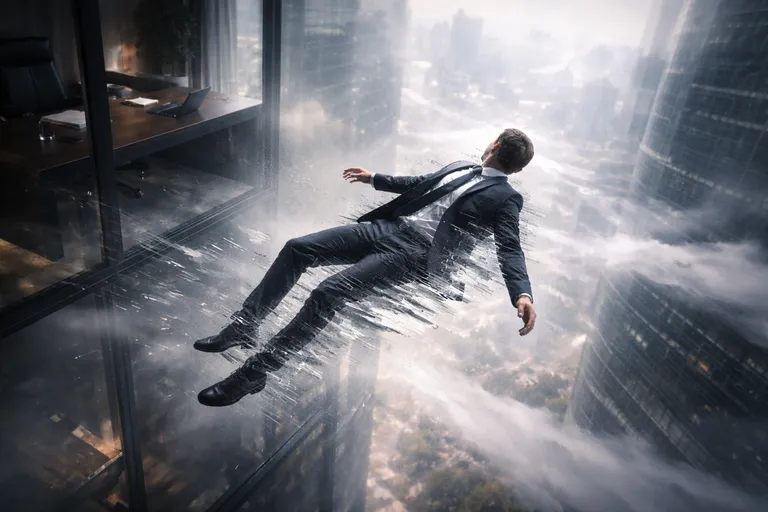
Climbing a Steep Glass Skyscraper — What the Outside Route Costs That the Elevator Doesn’t
The building was designed to be entered through the lobby.
You’re on the outside of it.
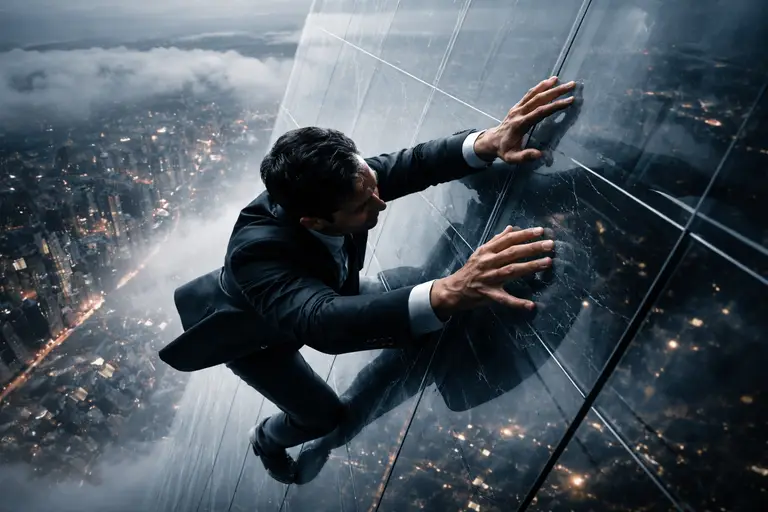
That’s the first thing. Not the height, not the glass, not whether you’ll make it — those come after. First: the specific position you’re in. The official route exists and has a form: the door, the security desk, the elevator, the formal ascent through the architecture of sanctioned access. You are not on it. You are on the facade, hands on glass, finding purchase where glass wasn’t designed to give it, moving up the exterior of something that was built according to rules you’re not using.
This isn’t failure. I want to say that directly, because the first instinct when you describe this dream is to frame it as something having gone wrong. Nothing has gone wrong in the way that framing implies. What is true is that the route you’re on asks more of you, at every inch, than the official route would have asked. The elevator requires you to belong. The facade requires you to climb. These are different demands, not a hierarchy of correctness.
Albert Bandura spent decades studying what he called self-efficacy — the specific belief that one’s own capacities are adequate to produce the outcomes one is working toward. His most important finding wasn’t about external assessment of capability. It was about the subjective experience of generating competence from within rather than having it externally validated. The glass skyscraper is precisely the image for the distinction Bandura was making: one route grants access on the basis of credential; the other generates access through the continuous application of capability. One requires you to have been authenticated. The other requires you to be, continuously, the person climbing.
What I find in people who have this dream is that they are almost always in the middle of something real — genuinely real, genuinely demanding, genuinely aimed at a level that is visible and attainable. The dream doesn’t appear for people who have given up on the ascent. It appears for people who are in it, actively, on the surface they have access to, sustaining grip that they generate themselves because the surface isn’t generating it for them.
Quick Answer
- The climbing-glass-skyscraper dream encodes ambitious ascent toward something clearly visible through a route that requires continuous self-generated effort rather than institutionally granted access
- The glass specifically does two things that no other building material does: it makes the goal transparent — the interior is visible the entire climb — and it makes the effort visible — the person on the outside is observed throughout the ascent
- The outside-of-the-building position is the central fact: not the wrong choice, a different route; one that asks more because it doesn’t provide the passive support of the institutional interior
- Albert Bandura’s research on self-efficacy establishes the psychological framework: self-generated competence is more durable than institutionally granted access, but it must be continuously maintained; the glass skyscraper is the image of exactly that dynamic
- The steepness encodes the stakes: at height, every lapse in effort has consequences proportional to the distance from the ground; the higher the climb, the more a fall would cost
- When looking through the glass at those already inside, the dream is processing the specific experience of visible proximity to a level occupied by people who got there differently — the comparison with those who used the lobby is part of the climb’s particular weight
- When the grip almost fails but holds, the climb has had setbacks without ending — each near-slip is the dream encoding a waking-life moment where the self-generated hold barely sustained the position
- When looking down produces the understanding of how far the fall would be, the height has shifted from motivation to stakes — the ascent has reached the level where what was the goal has become what can be lost
- When arriving at a level but unable to enter through the glass, the dream encodes the specific experience of reaching a height from the outside without the credential that would convert height into interior belonging
- The dream appears during the sustained middle of an ambitious pursuit — not at the beginning, when momentum carries, not at the end, when the question is whether to continue — but in the long middle, when the grip has been maintained through multiple near-slips and the question has shifted from how to climb to how long
Common Scenarios
Climbing steadily, maintaining grip with continuous active effort. The sustained-ascent version. The climb is working. Progress is real. And it is entirely maintained by continuous, non-relenting effort — no rest point, no structure that holds the position passively, no moment when the grip can ease without the position beginning to slip. This version maps the direct waking experience of an ascent that is going well at significant ongoing cost. Not failure. The specific quality of effort that the exterior route demands as its continuous price.
A near-slip — the grip briefly fails, catches again. The setback-and-recovery version. The position was lost for a moment. Not the fall — the catching. The near-miss. The specific quality of having felt the grip go and having found new grip before the loss became complete. This version is one of the most common and one of the most informative: the ascent has had genuine reversals that didn’t end it. The climb has survived what it had to survive. The near-slip tells you the terrain is real; the catch tells you the capability is also real.
Looking through the glass at people inside. The comparison version. The goal is visible — has always been visible through the glass — and so are the people already at the level you’re climbing toward. They arrived differently. The elevator brought them. The credential admitted them. And from the outside of the building, the distance between your position on the facade and their position in the climate-controlled interior is visible in both directions. This is the specific weight of the outside route: not just the physical effort but the ongoing visibility of the comparison with those who didn’t need to climb the way you’re climbing.
Reaching a level but unable to pass through the glass into the interior. The access-without-belonging version. The height has been reached. You are at the level. You cannot enter from the outside. The glass that has been transparent throughout the climb — showing you the interior, showing you the goal — is now a barrier at the exact moment of arrival. This encodes the specific experience of reaching a level through the exterior route without having the credential that converts height into interior access: being at the right floor without being through the door.
Looking down and realizing how far the fall would be. The stakes-awareness version. The height was the goal. Now it is the cost of failure. The shift from distance-climbed to distance-to-fall is the dream encoding the specific moment when ambition’s relationship to the height changes: what was motivation has become stake. This version tends to arrive when the climb has reached the level where the alternatives have been foreclosed by commitment — when the distance below is not just evidence of progress but the consequence of any failure from here.
The surface becomes more difficult as you climb higher. The escalating-demand version. The facade doesn’t get easier as you go higher. If anything, it gets more demanding — the wind is different at height, the angle is less forgiving, the margin for error is smaller. This is the accurate encoding of what ambitious ascent through non-standard routes tends to produce: the higher the level, the more the exterior route asks of you, precisely because the institutional mechanisms that the interior route provides become more pronounced at altitude.
What Your Body Already Knows
Woke up with the specific tension of the hands and forearms — not pain, a quality of sustained grip → because the somatosensory system was running the full experience of maintaining contact with a smooth surface under conditions that continuously required adjusting the hold; the motor system simulated the grip throughout the dream; what remains in the hands and forearms is the somatic residue of sustained, self-generated contact
Woke up with a specific quality of alertness — not anxiety, the particular vigilance of someone who cannot let their attention drift → because the glass climb requires continuous attentional focus; no rest from the assessment of the current hold, the next position, the contingencies; the vigilance that was running throughout the dream persists briefly into waking as its own quality of heightened, directed attention
Woke up with the specific awareness of being observed — even in the ordinary room, the morning carries a faint quality of visibility → because the glass is transparent both ways; the dream was running the experience of being watched throughout the ascent; the social monitoring system activated by that visibility continues briefly into waking before the context confirms that the observation has ended
Woke up and thought immediately of a specific level, a specific goal, a specific institution or context that is the building in the dream → because the skyscraper had an address; the brain assembled the building from actual waking material; whatever comes to mind before deliberate thought is the climb’s real subject
Woke up with a question that preceded any deliberate formulation: how long can this be sustained? → because the dream was running the sustainability question throughout; not whether the ascent is possible — it is ongoing — but whether the rate of self-generated grip maintenance is sustainable for the duration of the remaining climb; this question transferred out of the dream before the morning had time to suppress it
What Glass Does That Stone Doesn’t — The Surface That Asks Everything
Every surface you climb tells you something about the nature of the ascent.
Stone gives friction. The natural purchase of a rough surface — the ledges, the crevices, the places where the material meets you partway. You rest into stone. The surface has structure you can use. The material is not indifferent to the climbing.
Glass is different in a way that is specific and total. It’s smooth by design — not hostile to your presence on it, simply without any passive contribution to your hold. Whatever grip you find on glass, you generated. The angle of the hands, the pressure you maintain, the continuous micro-adjustments that keep the contact from failing — these come entirely from you. The moment you ease, even slightly, the hold begins to go.
Glass asks for continuous generation. Stone allows for moments of rest.
What this encodes in the waking life is the specific quality of an ascent that provides no passive support from the institutional structure — no friction from the environment, no natural purchase that comes from being inside the building, no rest in the architecture of the official route. The elevator doesn’t require this. The elevator does the work of the ascent once you’re in it, provided you had the access credential to get in it. The facade requires you to be the source of every inch of progress.
What Bandura’s research on self-efficacy establishes is that this route, as demanding as it is, produces something that the elevator doesn’t: competence that is internalized rather than externally validated. The person who was admitted to the elevator knows they have the credential. The person who climbed the facade knows they can climb. These are different kinds of knowing, and they have different relationships to what happens when circumstances change and the elevator is no longer available.
Your hands find the edge of a glass pane and the contact is made. There is no grip — there is only the angle and the pressure you are choosing to maintain. The surface gives you nothing. You generate everything. You move up an inch and immediately the calculation updates: the hand above needs to find the next position, the body below needs to redistribute, the whole arrangement recalculates in real time. You are never not working. This is the specific quality that makes this climb different from the lobby route: you cannot stop generating. The moment generation stops, the position begins to slip.
Getting a Job Promotion — Whose Recognition You’re Actually Waiting For maps the adjacent territory — when the recognition that the climb has been building toward is finally delivered by someone with the authority to evaluate what the outside route produced; what it means when the exterior ascent is formally acknowledged.
The Transparency Problem — What Can Be Seen Through Glass
The glass is transparent. This does more work in the dream than most people initially notice.
You can see where you’re going — the interior of the building, the levels above, the people at the floors you’re working toward. The goal is not hidden behind opaque material. It is visible, separated from your current position by the thickness of the glass, legible throughout the ascent. This visibility is part of what drives the climb: the destination is clear. The progress can be measured not just by how far you’ve come but by how close the interior is becoming.
But you can also be seen. The same glass that makes the interior visible to you makes the exterior visible from inside. The people in the building can observe the person on the facade. The comparison, which is one of the specific weights of the outside route, works in both directions: you can see those who arrived through the lobby, and they can see you on the glass.
This specific combination — transparent to the goal, transparent to observation — is what makes the glass skyscraper distinctively different from a solid-wall climb. A solid wall would require the climb without the visibility of the destination. The glass maintains the destination’s clarity throughout while simultaneously making the ascent’s alternative-route character continuously apparent.
The dream is honest about this: the outside route is visible. The effort is visible. The comparison with the inside route is visible. What it is producing — the competence, the progress, the specific kind of knowing that the exterior route generates — is also visible. Nothing about the glass climb is private.
Dream Timestamp
The glass-skyscraper dream arrives during the sustained middle of an ambitious pursuit → not at the beginning when momentum carries the effort and not at the end when arrival or its absence has resolved the question; the dream belongs to the long middle — when the grip has been maintained through enough real difficulty that the question has shifted from how to climb to how long
The near-slip version arrives when a genuine setback has been recently survived → the dream encodes the near-miss as the central content when something in the waking ascent recently almost failed and was caught; the catch is as important as the slip; the dream confirms that the climb continued past the setback
The looking-through-the-glass version arrives when the comparison with those inside is at its most active → when the waking mind is most directly processing the specific experience of watching others occupy the level through the official route while the exterior route continues to require everything
The looking-down version arrives when commitment has removed fallback options → when the height has been reached at which the alternatives have been closed by the investment in the climb; when the distance below is no longer just evidence of progress but the cost of failure from here
The arriving-but-unable-to-enter version arrives when height has been reached without the credential that converts height into interior access → when the performance of the ascent has succeeded but the formal admission to the level hasn’t followed; when being at the right floor from the outside hasn’t produced the access that would make the outside position equivalent to the inside one
The Sentence This Dream Was Trying to Say
“I am climbing something real toward something visible, on a surface that gives me nothing — every inch of this is self-generated, and the question I’ve been not quite asking is whether I can sustain this generation for the duration of what remains.”
The Morning After
The hands. That’s what stays — the specific quality in the palms or forearms, the residual tension of grip that was maintained through the night.
Before the day resumes and the climb continues:
Two honest questions. First: where are you on the building? Early in the ascent, with the ground still close enough that the height hasn’t yet produced the stakes-awareness? Sustained middle, where the grip has been through real near-slips and continued? Within reach of the level you’ve been working toward, where the interior is visible enough that the distance has started to feel like arrival?
Second: what would it look like to access the interior from here? Not to descend and try the lobby — to find whatever equivalent of a window or door is available at the current height. Because the facade gets you to the level. Getting into the building from the level is a different problem, and the dream is usually pointing at both: the ascent and the question of what access from height actually requires.
The grip is yours. It has always been yours. The question now is not whether you can climb. It is what climbing at this height, for this duration, on this surface, is costing — and whether what’s at the level you’re working toward is worth exactly that.
FAQ
Ambitious ascent toward something clearly visible through a route that requires continuous self-generated effort rather than institutionally granted access. The outside-of-the-building position is the central fact: not the wrong route, a different one — one that asks more because the institutional support of the interior isn’t available. Albert Bandura’s research on self-efficacy establishes the psychological framework: self-generated competence is more durable than credential-based access but must be continuously maintained. The glass skyscraper is the image of exactly that dynamic.
Glass does two things stone can’t. First, transparency: the goal is visible throughout the entire climb — you can see the interior, the level you’re working toward, the people already inside. Second, smoothness: glass provides no passive grip. Whatever hold you have on it, you generated. Stone gives friction, ledges, natural purchase. Glass gives nothing. Every inch of the glass climb is self-generated in a way that stone climbing is not. The material choice encodes both the visibility of the goal and the total self-sufficiency required of the ascent.
Because the lobby’s route requires credentials or starting position that the exterior route doesn’t. The outside climb isn’t the wrong approach — it’s the available one, given where the climb began. What it asks in place of credentials is continuous effort: every inch that the elevator would have provided automatically must be generated on the facade. This doesn’t make the outside route inferior. It makes it more demanding. And as Bandura’s research shows, the competence that comes from sustaining that demand is different in character from the access that credential-based entry provides.
The height that was the goal has become the stakes. The same distance that was evidence of progress is now the consequence of falling. This version arrives when the ascent has reached the level where alternatives have been foreclosed by commitment: the investment in the climb has removed the option to descend without cost. Not a bad sign — a stage sign. The height below is both the record of what the ascent has produced and what failure from here would cost. Both are true simultaneously, and the dream is honest about both.
The comparison is part of the climb’s specific weight. People at the level you’re working toward, using the institutional infrastructure of the interior, visible to you through the glass that separates your route from theirs. This is part of what the outside route asks: not just the physical effort but the ongoing processing of watching others occupy the level through a different mechanism. The dream is honest about the comparison because the comparison is real — and part of what the outside route produces is a specific kind of relationship to that difference.
No. The dream appears for people who are in the middle of a genuine ascent, not people who have given up. It’s about the nature and cost of the route rather than the outcome. What it’s asking is not whether you’ll succeed but whether the current rate of self-generated effort is sustainable for the duration of the remaining climb — and whether there’s a way to access the interior from the current height that doesn’t require returning to the ground.
Next Stages
Falling From an Office Window — When the Position Gives Way — what happens when the grip on the glass finally fails — when the sustained outside ascent reverses and the fall is what the brain has to process
Naked at a High-Level Meeting — The Gap the Performance Has Been Covering — what arrival looks like when the climb succeeded but the armor was left on the facade — when reaching the level means being in the room without the professional architecture the elevator route would have provided
Winning the Lottery — When the Change Arrives Without Being Earned — the opposite structure — when instead of generating every inch of height through the outside route, circumstances shift in a way that delivers what the climb was working toward without the climb
Being Robbed in Your Own Office — When It Came From Inside — what happens inside the building once the climb delivers you there — when the professional space that the exterior ascent was working toward is violated from within