Dream About a Dog in Your House
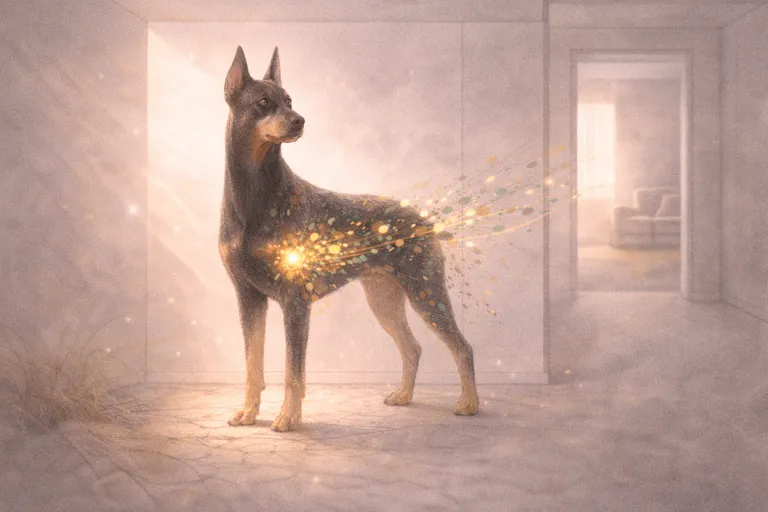
It was already inside when you arrived.
Not at the door. Not in the yard. Not approaching from outside. Already inside — in your rooms, in your space, among your things. Already past every threshold. Already where you live.
That’s the specific quality of this dream that separates it from every other dog dream. The attacking dog is a confrontation. The chasing dog is a pursuit. The dying dog is a loss. All of those happen out there — somewhere in the landscape of the dream, in a space that isn’t definitively yours.
But the dog in your house is inside the space that is you.
In dreams, the house is never just a house. The house is the self. The rooms are the internal geography — the private arrangements of how you live inside your own mind. The bedroom is where you’re most unguarded. The kitchen is where nourishment happens. The living room is where you negotiate between the private and the public. The locked room is what you’ve been keeping.
And the dog is already inside.
Not outside looking in. Already past the door you thought was closed. Already settled somewhere in the structure of your interior life. Already having access to the rooms you thought were yours alone.
The question the dream is asking is not whether this is good or bad. The question is: what does it know about you now that it’s inside?
Quick Answer
- A dream about a dog in your house means something has crossed from outside your emotional life to inside it — the threshold between external and internal has been passed
- Your house in the dream is your interior self, not a building; the dog being inside means something loyal, instinctive, and alive is now inside the space where you’re not managing what it sees
- Where the dog is in the house is the most specific information: the room tells you which part of your inner life has been entered
- Whether you let it in, whether you found it already there, or whether it got past you is the second most important detail
- Whether you want it to leave — genuinely want it to leave — is the question the dream is asking most directly
Common Scenarios
You arrive home and the dog is already there → the crossing happened below your conscious awareness; something got in without you registering the moment of entry; it’s been in longer than you realized
You let the dog in yourself → conscious choice; you opened the door knowing what was coming in; the question is whether you’re fully aware of what that access means
The dog moves through the house like it owns it → whatever this is, it’s completely at home inside you; the comfort is total; the integration has happened
The dog is in a specific room → location is the interpretation; bedroom = most intimate; kitchen = nourishment and care; the room it chose is the room to look at
The dog won’t leave when you try to make it go → something has settled inside you that isn’t ready to go; the question is whether you genuinely want it to leave
The dog is destroying something inside → what it represents is disrupting an existing internal structure; something in your inner arrangement is being altered by what’s now inside
What Your Body Already Knows
The specific temperature of the house in the dream → whether the house felt warmer or colder with the dog inside; warmth means something that belongs; cold means something that shouldn’t be there has entered
Whether you felt the need to watch it → the surveillance instinct; keeping track of where it was in the house; needing to know where it is at all times; the body holds the vigilance or the ease
What you did when you found it → froze, relaxed, moved toward it, started trying to get it out; the body’s first response before any deliberation is the most honest response
The specific quality of the space it had claimed → which room, which spot, how settled it was; the body holds the specific geography of what had been entered and by how much
The House That Is You
In ordinary waking life, your house is a building. It has an address. It contains furniture. The distinction between inside and outside is architectural and practical.
In dreams, the house is more specific. It’s the structure of the self — the internal arrangement of who you are when you’re not performing anything. The rooms of the dream house correspond to different regions of inner life. The state of the house corresponds to the current state of the self.
This is why the dog being inside is different from the dog being anywhere else in a dog dream. Outside, there’s distance. You can observe. You can choose your relationship to what’s there. Inside, the distance collapses. There is no observer position. Whatever is in the house is already in the structure.
You walk through the door and the house is as it always is — the specific layout you know, the arrangement you inhabit. And then: the dog. Already there. In the room. Not threatening, not announcing itself. Just present, in your space, among your things. You stand in the entrance and feel the specific quality of finding something alive inside a space you thought was entirely yours. Not necessarily wrong. Just — the house has a new fact in it. Something that wasn’t here is here now.
The dog in the house is whatever the dog represents — trust, loyalty, instinct, a relationship, a part of yourself — that has moved from existing in the world into existing inside you. It’s not outside to be considered or engaged at a distance. It’s inside. It now has access to the unmanaged version. To the rooms you keep.
Which Room Tells You Which Part
If you can recover the room, you have the most specific information the dream offered.
The bedroom — the innermost room. The place of sleep, of vulnerability, of the most unguarded hours. The place of intimacy. When the dog is in the bedroom, whatever it represents has entered the space where you’re least defended. Something has access to the version of you that exists before you’ve assembled the day’s management. This is the most intimate version of this dream, and the one that carries the most weight about the nature of the access.
The kitchen — where nourishment happens. Where the sustaining work of life is done. When the dog is in the kitchen, whatever it represents has entered the place where you feed yourself and the people close to you. Something is now present in the nourishing layer of your life.
The living room — the negotiated space. Where the private becomes somewhat public, where guests enter, where you present a version of yourself that’s more managed than the bedroom but more personal than the front door. When the dog is in the living room, something has moved past the outer threshold but hasn’t reached the most intimate center. It’s inside, but it’s in the social layer of the inside.
You find it in the bedroom. Of all the rooms. Not the hallway, not the living room, not somewhere neutral. The bedroom. And you stand in the doorway with the specific awareness that this room specifically means something — that the access it’s been given isn’t abstract, it’s precise. It’s in the room where you sleep.
The whole house — when the dog has moved through everything, has established itself throughout rather than in one specific room, the integration is total. Something has permeated the entire inner structure. Not just entered — settled across all of it.
A room you don’t recognize — when the dream shows you a room in the house that doesn’t exist in waking life, the dog has revealed something about the house you didn’t know was there. Like discovering a room in the house that had been locked — the dog’s presence revealed a space in your interior life that the dog knew about before you did.
Whether You Let It In or Whether It Got In
This is the distinction the dream makes with the most precision, and it’s worth recovering clearly from the dream if you can.
You let it in. You opened the door. You made the choice, consciously, to allow this inside. Whatever this trust or relationship or instinct represents, you invited it into the interior of your life. The question this version asks: did you fully understand what access means? What does it see now that it’s inside?
You found it already there. The crossing happened without you registering the moment. You arrived in the dream — or moved through the house — and discovered the dog was already inside. You don’t know when it crossed. You don’t know which door it came through. This version corresponds to something that has entered your emotional life gradually, below the threshold of awareness, until the presence became undeniable.
You don’t remember letting it in. You’ve been going through the rooms of your life, tending to what needed tending, and then: the dog. Already there. With the specific ease of something that has been here long enough to have chosen its spot. You try to remember the door. You can’t place the moment. It’s just — in. Has been in. For longer than you realized.
It got past you. You were aware. You maybe tried to prevent it. It entered anyway. This is the version that corresponds to a boundary crossed against your preference — not dramatically, not forcibly, but inexorably. Something that should have been kept outside has gotten in.
The distinction between these three versions maps three completely different waking situations and requires three different responses.
The Dog That Won’t Leave
This is the version of the dream that needs the most honest examination.
You want it to go. You open the door. You try to lead it out. It doesn’t go. It returns to its chosen spot. It lies down. It closes its eyes. It is, in every way it can be, settled.
Two completely different things can be happening here.
The first: you genuinely want it to leave and it won’t. The crossing was unwelcome. Whatever has entered your inner life did so without your preference and has now established itself in a way you can’t reverse through simple intention. This corresponds to something in your waking life that has gotten inside your emotional world in a way that resists your efforts to create distance.
You hold the door open. It looks at you from where it’s lying. There’s no aggression in it — it’s just settled. Entirely, comfortably settled. You call to it. It twitches its ear. It doesn’t move. And the distance between your wanting it to leave and the fact of it not leaving is its own specific weight.
The second — and this is the one the dream is most often asking you to examine: you’re trying to make it leave because you think you should want it to leave. But something underneath the trying is glad it stayed. Something in you, quieter than the part that’s trying to manage the boundaries, knows that what’s in the house belongs there.
The dog won’t leave. And something in you — not announcing itself, not asking permission — stops trying quite so hard.
Which of these is true is the question the dream is asking. And the body usually knows the answer even when the mind is still deciding.
What It Knows About You Now
Here is the specific consequence of the dog being inside the house that no other dog dream produces.
Whatever the dog represents — the trust, the relationship, the instinct, the part of yourself — now has access to the unperformed version of you.
Outside the house, you had some capacity to manage what it saw. You could present the version that was ready to be seen. But inside the house, in the rooms of how you actually live inside yourself, the management is off. The dog has access to the unwashed hours. The 3am version. The failed version. The version that exists before the day’s presentation has been assembled.
What dogs represent in their fullest form — the loyalty that is oriented toward your actual self rather than your managed self — now has access to the actual self, specifically, without the buffer. This is the specific intimacy the dog-in-the-house dream creates that no other dog dream creates.
The question is not whether this is comfortable. The question is: what does it know about you now that it’s inside? And what does knowing that mean for the relationship with whatever this dog is carrying?
Dream Timestamp
When something has recently crossed from external to central in your emotional life → the house dream arrives to mark the transition; something that was outside the interior has moved inside it; the dream is registering the crossing
When you’re uncertain about the degree of access you’ve given or allowed → the dog’s behavior inside the house corresponds to the current state of whatever has entered; settled means integrated; unsettled means still negotiating the access
When something has entered without you being fully aware of when or how → the finding-it-already-inside version; the crossing happened gradually; the dream surfaces the awareness
Why This Dream Happens — The Psychology Behind It
The house as the self is one of the most consistent and cross-culturally stable dream symbols. The brain uses the house to represent the internal structure specifically because houses have thresholds, rooms, kept and unkept spaces — all of which map the actual topography of interior life with a precision that abstract language rarely achieves.
When something in your emotional or relational life crosses from external to internal — when a relationship moves from “something I have” to “something I am,” when an instinct moves from suppressed to active, when a feeling moves from background to center — the brain processes this as architectural. Something is now inside the house.
The dog inside the house is the brain’s most direct available image for trust-already-inside: loyal, alive, warm, already in the rooms. The cognitive load comes from navigating the access this represents — what does it see, what does its presence change, is the access welcome, does it belong.
The dream is asking you to look directly at what’s in the room. To stop managing around the fact of it. It’s inside. Deal with what’s inside.
The Sentence This Dream Was Trying to Say
Something got inside the part of me that isn’t performing — and I’m still deciding whether that’s what I wanted or whether I want it to leave.
The Morning After
The dog is gone from the house. The house is yours again, in the ordinary waking sense.
But the question it asked hasn’t gone with it.
Before the day reassembles the ordinary management: which room was the dog in? What part of your inner life had been entered? And what has access to that part now?
The answer to “what was the dog?” is something you probably already know. The answer to “which room?” is the most specific piece of information the dream offered. And the answer to “do you want it to leave?” — genuinely want it to leave, not think you should want it to leave — is the most honest question the dream was asking.
Something is now inside the space where you’re not managing what it sees. That’s not necessarily wrong. Some things belong inside. The dream is asking you to decide which kind this is.
FAQ
What does a dream about a dog in your house mean? It means something — a relationship, an emotion, a trust, a part of yourself — has crossed from existing in the external world into existing inside your interior life. Your house in the dream is the self: the private arrangement of who you are when the management is off. The dog being inside means whatever it represents has access to that space. Where it is in the house (which room), how it got in, and whether you want it there are the three most specific pieces of information the dream offers.
Which room the dog was in — does it matter? Yes, significantly. The room is the address. Bedroom = innermost vulnerability and intimacy; kitchen = nourishment and sustaining; living room = the negotiated space between private and public; throughout the whole house = total integration. If you can recover which room the dog chose, that room is the part of your inner life that has been entered.
What does it mean if I can’t remember letting the dog in? It means the crossing happened gradually, below the threshold of awareness. Something got inside your emotional life without you registering the specific moment of entry. You moved through the rooms of your life and found it already inside. This is often the most unsettling version — not because anything threatening happened, but because the loss of awareness of when the boundary was crossed is its own kind of unease. The dream is bringing that to conscious attention.
What does it mean when the dog won’t leave? First: do you genuinely want it to leave, or do you think you should want it to? These are different. If you genuinely want it to leave and it won’t, something has settled inside your emotional life that resists your efforts to create distance from it. If you’re trying to make it leave because you think you should, but something in you is glad it stayed — the dream is asking you to be honest about which is true. The body usually knows.
Next Stages
If the dog inside your house was dark — if it carried something heavy in the space it claimed → when what’s inside carries the shadow layer: dream about a black dog meaning — when what has entered the inner space brings the unacknowledged with it
If the dog inside your house was barking — if what was inside kept sending a signal you couldn’t ignore → when the presence inside becomes insistent: dream about a dog barking at you — when what entered your space isn’t quiet about what it needs
If the dog in the house felt right — if the presence inside was the specific warmth of something that finally found its place → when the entering is completion: dream about a friendly dog meaning — when what came inside belongs there and the feeling of it being inside is the feeling of something coming home