Dream About Your Own Dog Dying
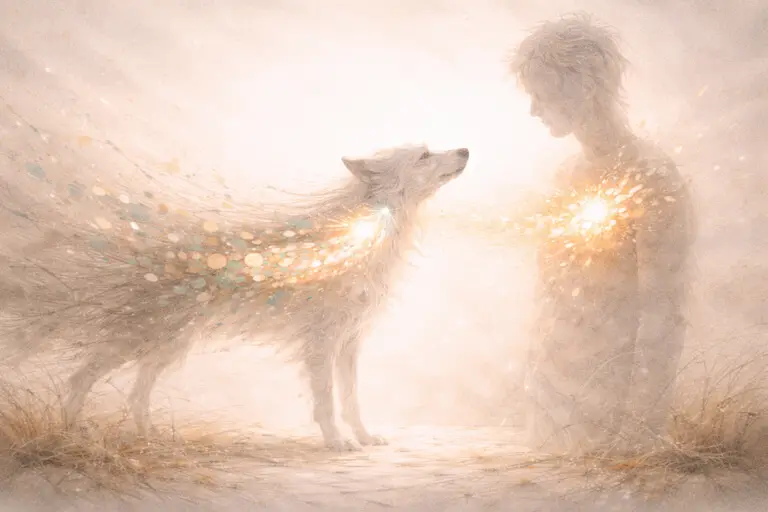
You reached for the dog before you were awake.
Before the room assembled. Before you knew which morning this was or what time it was or whether the dream was over. The hand moved first, to the spot where the dog usually is — the foot of the bed, the floor, wherever it sleeps. The motion was automatic. The nervous system running its own verification before consciousness arrived to tell it there was nothing to verify.
The hand found the dog, or didn’t, and the rest of you arrived into the room.
That reaching is the whole dream explained.
Not the content of what happened in the dream — the dying, the way it went, the specific moment when you knew. But the fact that your sleeping nervous system produced a grief complete enough, real enough, total enough that your body was already checking before your mind had finished deciding whether it was real. The dream ran the full signal. The body responded to the full signal. The reaching is the response.
This is not a dream about a dog dying. This is a dream about the specific relationship your nervous system treats as load-bearing. The one it would reach for first, before it had confirmed anything else. The one whose loss would require checking immediately, in the dark, before the morning had properly started.
Quick Answer
- A dream about your own dog dying means the relationship your brain treats as its most load-bearing has been subjected to a loss simulation — the brain rehearsed the irreversible thing to prepare you for the irreversibility
- This is not a premonition. The brain stress-tests the bonds it can least afford to lose precisely because it can least afford to lose them.
- The dying in the dream corresponds to something real: not the animal’s death, but a threat — perceived or real — to the specific quality of connection that only your dog holds
- Your own dog carries what no other relationship carries: the witness to the completely unmanaged version of you; the loss of that witness is what the dream is running
- The reaching you did when you woke — toward the spot where the dog sleeps — is more information than any symbolic analysis can provide
Common Scenarios
The dog dies in your arms → you’re holding on to something that has already started leaving; the weight has been shifting for a while; the hands know before the mind admits
The dog dies alone and you find it → you weren’t there when the loyalty needed you; the dream is processing the specific guilt of having been elsewhere when something permanent happened
The dog dies peacefully, you’re present → something is completing; the ending is real but it’s accepted; you knew before the dream showed you; the dream is confirming what you already felt
The dog dies violently → betrayal is the fear, not loss; not time or illness taking something, but something or someone crossing into the space where the dog lived and destroying what was there
The dog dies and then looks at you one last time → the hardest version; what stays isn’t the dying but the orientation at the end; the love that, in its last moment, turned toward you instead of away
You try to prevent the death and can’t → the helplessness of the dream is not about the dog; it’s about the specific exhaustion of trying to protect something from forces that don’t respond to trying
What Your Body Already Knows
The specific shape of the grief in the chest → not generalized sadness; the particular weight of having been in contact with the loss of something that was specifically yours; the body holds the specificity
Whether you checked before you were fully awake → the reaching, or the listening for breathing, or the specific silence that made you more awake more quickly — the body’s verification reflex; this is the most honest response to the dream
The way the dog felt in the dream → the body holds the specific sensory memory of the dog’s weight, the fur texture, the way it breathed — the dream used real sensory data; the body may still be holding it
Whether the grief felt like preparation or like it was already true → if it felt like preparation, the dream was running a simulation; if it felt like something already real, something in waking life has already been shifting in this direction
Why Your Dog Is Different From Any Dog
The dream about a dog dying is one thing. The dream about your own dog dying is another.
The difference is not sentiment. It’s specificity.
A dog dying in a dream corresponds to the loss of something loyal in your life — a relationship, a bond, a part of yourself that operated with loyalty. That’s real and significant.
Your own dog dying corresponds to the loss of something that knew the completely unmanaged version of you.
This is a different category of loss. In every other relationship in your life — every friendship, every partnership, every professional connection — there is some layer of management. Something you present differently than it is. Something you curate. Something you’re aware of performing. The performance is not dishonest. It’s just what it means to navigate social space.
Your dog knows none of this.
The dog has been in the room during the 3am hours. The sick hours. The failure hours. The hours when you couldn’t perform anything because you had nothing left. The hours when you were as small as you get and had no audience you needed to be larger for. The dog was there for those hours and it stayed. Not because you managed your image successfully. Because you exist, specifically. And the dog keeps choosing your specific existence.
You’re at your worst. You know you’re at your worst. There’s no version of this that makes you look okay. And the dog is there — head on your knee, weight against your leg — with no opinion about the worst of it. Not staying despite the worst of it. Just staying. Because staying is what it does. Because you’re the person. That’s all it needs.
That specific loyalty — the loyalty that doesn’t require a performed version of you — is what’s dying in the dream. Not just loyalty. The loyalty that saw through the performance to whatever is actually there.
The Dog That Is Still Trying to Look at You
There is a moment in many versions of this dream that stays longer than anything else.
The dying is happening. You know it. The dog knows it. And in the middle of the dying — in the specific middle of the exit — the dog is still trying to look at you.
Not at its own pain. Not at whatever is happening to its body. At you.
The breathing is shallow. You know what shallow breathing means here. And the dog’s head is heavy in your hands, the weight of something that won’t be this weight much longer. And its eyes find yours. That’s what stays — not the dying but the finding. That in the specific moment of the exit, the orientation is still outward. Still toward you. Still making sure.
This is what your dog carried that no other relationship carries: the love that, in its last moment, would turn toward you instead of away.
Most love is bilateral — it serves the self and the other. This love, in the dream, is showing you something specific about the nature of the loyalty you’ve been living with. The love that, even at the end, checked on you.
The dream is running this specific moment because the brain needs you to understand what you have. Not in the abstract. In the specific. What your dog’s particular love has the quality of.
What the Brain Is Actually Doing
The brain does not waste your deepest loyalty symbol on small threats.
When your own dog dying appears in a dream, the brain has selected the most load-bearing relationship available in your inner architecture and run a loss simulation through it. Not because the relationship is actually in danger. Because the relationship matters enough that the brain has classified it as something whose loss would require preparation.
This is not catastrophic thinking. It’s the nervous system doing what it does with the things it can least afford to lose: it rehearses.
Your brain asks: what would break you? Then it runs the simulation. Not to punish you. To tell you what you’re carrying. The grief you feel in the dream is the grief of the actual loss — not a version of it, the real thing. Your nervous system doesn’t generate dress rehearsals. It generates the event. And the event shows you the size of what you’re protecting.
The intensity of the grief in the dream is calibrated to the depth of the bond. If you wake up from this dream with your chest caved in, with the reaching already happening before you’re conscious, with a grief that takes several hours to fully leave — that intensity is the brain accurately representing the depth of the relationship. The dream is not exaggerating. It’s showing you the actual size of what this is.
What does the brain reach for when it needs to run its hardest loss simulation? That’s the answer to “what matters most to me right now.”
When the Dream Is About Something Else Entirely
The dog is specific. What the dog represents in this dream is also specific. But the two don’t always align.
Sometimes the dream is about the actual dog — the real animal, the real relationship, some real shift in the bond that the waking mind has been managing around without addressing.
Sometimes the dog is carrying something else. Someone in your life who has the specific quality of your dog — who sees the unmanaged version, who stayed through the worst hours, who never required the performance. The dream places the loyalty in the dog because the dog is the safest container for that quality. But the loss the dream is processing may be the threat to a human relationship.
Sometimes the dog represents a part of yourself. The instinctive part. The part that operates below social management — the part that doesn’t perform, that has its own responses, that you don’t have to curate because it runs on its own. When that part is under threat — when the life has become so managed that the instinctive self has started to recede — the dog may die in the dream.
The same grief that surfaces when someone you love is the subject of the loss simulation — the specific rehearsal of the loss of an irreplaceable relationship — runs through this dream. The brain uses the container that will produce the most accurate grief. For many people, that container is the dog.
What You Had That You’re Afraid to Lose
Every version of this dream is ultimately about one thing: the recognition of something irreplaceable.
Not just valuable. Irreplaceable. The specific thing that cannot be substituted. That would not be the same thing under any other name, in any other form, with any other history.
Your own dog is irreplaceable not because dogs are rare but because this dog has the specific history of having been there during the specific hours of your specific life. Another dog would be a dog. This dog is the one who was there when. The one who stayed through what. The one whose presence through those specific events is woven into what you’ve become.
You think about trying to explain to someone what it would mean to lose this. And the explaining keeps falling short. Not because the relationship isn’t real — because the realness of it lives in the accumulated specific hours, not in a description of the kind of relationship it is. You can say “my dog is deeply loyal.” You can’t say what it means that this specific dog was there on that specific night, and the next night, and the one after that, through all of it, without being asked.
The dream is running this because the brain has recognized the irreplaceability. And irreplaceable things produce a specific quality of fear: not “I might lose something valuable” but “this, specifically, cannot be replaced.”
What dogs represent in their fullest form — the oldest, most bodied, most loyal form of trust — reaches its most intimate expression in the dream about your own dog dying. This is the trust at its most specific. The loyalty at its most personal. And the fear in the dream is the accurate fear of losing something that cannot be replaced because its value is in its specificity.
Dream Timestamp
During periods when something feels uncertain about a primary relationship → the dog carries the fear about the relationship that can least afford to be lost; the dying corresponds to the threat to the relationship that has your deepest loyalty
When your own life has been under significant pressure → the brain stress-tests the load-bearing elements during periods of high stress; the dream is running the simulation because the overall load is high enough to activate it
After a close call with anything — your dog, a loved one, your own health → a real brush with loss activates the simulation; the brain rehearses what didn’t happen but could have
Why This Dream Happens — The Psychology Behind It
The brain generates this dream through a specific mechanism: the stress-test of the irreplaceable.
When the overall anxiety load is high — when too many things feel uncertain, when the sense of stability is under pressure from multiple directions — the brain applies the pressure to its most load-bearing relationships. Not because those relationships are actually at risk. Because they are the ones whose loss would be most destabilizing.
The cognitive load here is the holding of two simultaneous truths: this relationship is the most stable thing I have, and nothing is guaranteed. The tension between those two truths generates the simulation. The brain runs the loss to process the fear, to release the accumulated pressure, and to remind you — through the specific grief of the simulation — what you actually have.
The grief you feel in the dream is not fake grief. It is real grief, running at the full amplitude it would run if the loss were real. Your nervous system doesn’t generate approximations. The dream is the real thing, in a protected space, with the dog still alive when you wake up.
The reaching is the recovery from the real grief. And the dog being there when the hand arrives is the specific relief that the dream was designed to allow you to experience.
The Sentence This Dream Was Trying to Say
The one relationship that sees me as I actually am is the one I cannot imagine losing — and the dream made me feel exactly what that would be so I would know what I’m protecting.
The Morning After
The dog is alive. You know this now. The hand found it, or it’s on its spot on the floor, or you heard it, and the verification happened.
Hold that for a moment before you move on.
Not the gratitude exactly — though that’s real. The specific recognition that the relief you felt when the hand found the dog is the accurate measurement of what this relationship is worth. The relief is the inverse of the grief. And the grief was calibrated, by the dream, to the actual depth of the bond.
You know what you have.
That’s what the dream was actually for. Not to frighten you. Not to prepare you for loss. To show you, at full amplitude, what the loss of this specific relationship would actually mean — so that while the dog is still here, you know the size of what you have.
One question: when did you last be fully present with your dog, not in the managed way but in the unmanaged way — the way the dog has been present with you through your worst hours?
The dog has always been there for those hours. The dream is asking whether you can be there for the ones the dog has left.
FAQ
What does it mean to dream about your own dog dying? It means your brain has identified your dog as holding your most load-bearing form of loyalty — the relationship that knows the unmanaged version of you — and has run a loss simulation through it to process the fear of losing something irreplaceable. This is not a premonition. The dream is not predicting your dog’s death. It’s the brain’s way of stress-testing the most important bond. The grief in the dream is real grief, generated at full amplitude, so that you experience the actual size of what you’re protecting — and wake up with the dog still there.
Why does this dream produce grief that lasts for hours after waking? Because the nervous system generated real grief, not a simulated version of it. The brain doesn’t produce approximations during loss dreams — it runs the actual emotional sequence. The grief that lasts after waking is the residue of having been inside genuine loss for the duration of the dream. That residue takes time to clear for the same reason real grief takes time: the system ran the full signal, and the full signal requires time to complete its discharge.
What makes dreaming about your own dog dying different from dreaming about a dog dying? Specificity. A dog dying in a dream corresponds to the loss of something loyal in your life — significant and real. Your own dog dying corresponds to the loss of the specific loyalty that knew the completely unmanaged version of you. Your dog has been present for your worst hours without requiring performance. No other relationship in your life has that specific combination of full access and total loyalty. The grief of the dream is calibrated to that specific irreplaceability — which is why it’s heavier than other dog dreams.
What does it mean when the dog was still looking at me at the end? It means the dream showed you the specific quality of the loyalty: that even at the end, the orientation was toward you. Not toward its own pain — toward you. That detail is the dream showing you what you have. A love that, in its last moment, checked on you. That’s not grief the dream is producing — it’s recognition. The dream is telling you exactly what the relationship has the quality of.
Next Stages
If the dying was slow — if you held it through the process and felt the weight leaving → the gradual version of this loss: dream about a dog dying — when the loyalty ends slowly, in stages, and the grief has time to build before the end
If you tried to stop it and couldn’t — if you reached and it wasn’t enough → when the helplessness is the center: dream about saving a dog — when the response to the threatened loyalty is to try to intervene, and what the trying tells you about what you’re protecting
If the dream left you needing to verify that the dog is present, safe, in the house → when protection and fear become difficult to distinguish: dream about a dog in your house — when the boundary between keeping something safe and being afraid of losing it has collapsed into vigilance