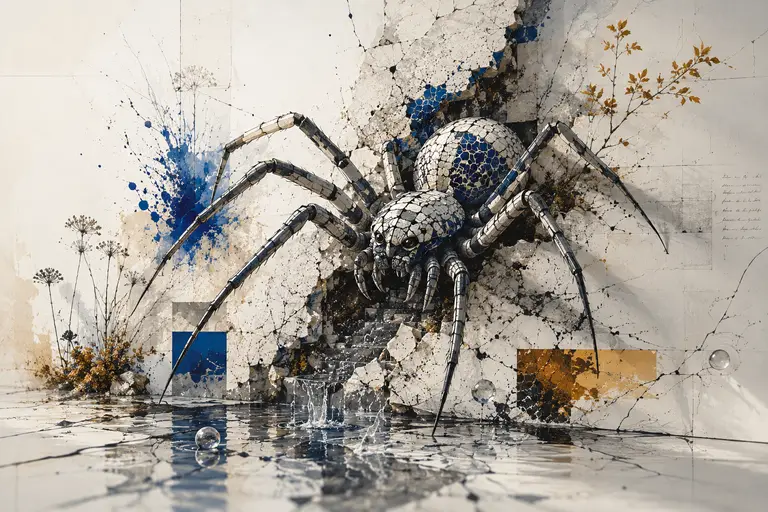
A Spider in Your Dream — What the Brain Was Actually Processing

You woke up and the room was ordinary. The light was the same. The floor was the same. The specific air of wherever you sleep was doing exactly what it always does.
And somewhere in your chest there was still the quality of that spider.
Not fear exactly. Something more specific than fear. A kind of wrongness that doesn’t quite have a word — part alarm, part skin-crawl, part the specific desire to be further from something than you currently are. The dream is already dissolving. The sensation is staying longer than the images did.
Here is the first thing I want to tell you, because it took me years of reading to understand it properly: your brain did not choose a spider at random. Of all the images available — and in five years of reading sleep neuroscience, I have come to understand just how many images the dreaming brain has available — your brain reached for a spider specifically. And the reason it did says something precise about what was happening in your nervous system that night.
The snake is about threat. The falling is about structural collapse. The exam is about evaluation. These each activate one system.
The spider activates two.
Arne Öhman and Susan Mineka documented this in a landmark 2001 paper in Psychological Review: spiders are processed by the human amygdala faster than almost any other stimulus, including neutral objects, and in many subjects faster even than snakes — not because spiders are objectively more dangerous, but because of what Seligman called biological preparedness: the human nervous system has been wired across evolutionary time to treat spiders as a category of thing that requires immediate response before assessment. You don’t decide to react. You’ve reacted before the decision is available.
But here is the part that no dream dictionary has ever told you: what makes spider dreams different from all other animal dreams is not the speed of the threat response. It is that the spider simultaneously activates the disgust system — the anterior insula, the neural architecture that evolved specifically to reject things that might contaminate, violate boundaries, or enter territory where they don’t belong.
Paul Rozin spent decades studying disgust as a distinct emotion. His finding: disgust is not fear with an aesthetic component. It is a separate system with a separate function: protecting the boundaries of the self from contamination and violation. And the spider — uniquely, specifically, in a way that is different from almost every other animal — activates both systems in the same moment. The amygdala fires its threat signal. The anterior insula fires its violation signal. Both at once.
That is the specific sensation you woke up carrying. Not pure fear. Something more complex. Something that has both an alarm quality and a wrong-in-here quality. Both systems, running simultaneously, producing the specific compound feeling that belongs only to spiders.
And both systems were pointing at the same waking-life situation.
Quick Answer
- The spider is one of the only images in the dreaming brain’s vocabulary that activates two separate alarm systems simultaneously: the amygdala’s threat detection and the anterior insula’s disgust response — the result is a compound feeling that is neither pure fear nor pure revulsion but both at once, which is why spider dreams leave a specific quality that other animal dreams don’t
- Öhman and Mineka’s research established that spiders are processed by the human amygdala faster than neutral stimuli and often faster than other animals — this is evolutionary preparedness (Seligman, 1971): not learned fear but biological wiring that predates individual experience
- Graham Davey’s research in the UK — where spiders are not objectively dangerous — found that spider fear correlates most strongly with disgust sensitivity, not danger assessment; the spider in your dream may be less about a threat to your safety and more about something that has crossed a boundary, contaminated a space, or violated the territory of the self
- The specific quality of a spider dream — that compound wrongness that feels like more than fear — is the physiological signature of two systems firing at the same time: LeDoux’s fast amygdala pathway running the threat response and the disgust pathway running the violation response simultaneously; they produce a specific compound that no other single image generates
- Which version of the spider dream you’re having is always more diagnostic than the general category: a spider that bites points to something different from a spider that watches; a giant spider points somewhere different from spiders everywhere; the specific action, size, and behavior of the spider is the part worth reading most carefully
- Stephen Porges’ polyvagal research explains the specific physical quality of disgust — the vagal withdrawal response produces a going-cold, a slight nausea, a pulling-back that is distinct from the cardiovascular arousal of fear; if your spider dream left you with a cold quality rather than a racing-heart quality, the disgust system was the more active of the two
- The spider dream is not about spiders — it is about something in the waking life that carries the same dual signature: something that is simultaneously threatening and contaminating, something that has both alarm quality and violation quality, something that is wrong in a way that is both dangerous and doesn’t belong
- Recurring spider dreams mean the waking situation they’re built from hasn’t resolved — Cartwright’s thirty years of longitudinal dream research established this clearly: the dreaming brain returns each night to emotionally activated material; the spider keeps returning because whatever it’s encoding hasn’t changed
- The most important diagnostic question after a spider dream is not “am I afraid of spiders?” but “what in my current life produces both a threat feeling and a violation feeling at the same time?” — something that isn’t just dangerous but also wrong in a contamination sense, something that has entered territory it shouldn’t be in
- Context determines everything: a spider in your home is different from a spider in unfamiliar space; a spider you observe is different from one that lands on you; a spider that is motionless is different from one that moves with intention — the specific context is the brain’s precision about which dimension of the waking situation it’s reporting on
Common Scenarios
A spider appears in your home — in the room where you live. The location is never incidental. The home in dreams is the dreaming brain’s most available image for the self — the territory of what is yours, what is familiar, what should be under your jurisdiction. A spider in the home is not an external threat. It is something that has entered the interior. The specific alarm quality of this version — different from encountering a spider outdoors — is the brain encoding a violation of the interior perimeter: something with both threatening and contaminating qualities has reached the space that is most private.
The spider is enormous — disproportionately large. Sapolsky’s research on cortisol and threat assessment documents how the brain amplifies the perceived size of threats in proportion to how long they have been present without being addressed. A giant spider in a dream is rarely about a large threat arriving suddenly. It is more often about a manageable-sized threat that grew in the dark while other things were being attended to. The disproportionate size is the brain’s report on the accumulated mass of something ignored: not that the thing is inherently giant, but that it became giant through the specific compounding that happens when something is left unattended.
There are many spiders — everywhere, multiplying. The shift from one spider to many is a specific encoding. One spider is a located threat: specific, addressable, with a single position in space. Many spiders is the same threat that has become a system — something that has moved from a specific point of concern to an ambient condition. What was one instance has become a pattern. What was manageable has become the environment.
The spider lands on you — on your skin. Paul Rozin’s research on contact disgust: contamination by touch is the most intense form of boundary violation the disgust system processes. The spider touching you activates the same neural pathway as the idea of something impure entering the body through skin contact. The dream is encoding something that has not just threatened from a distance but actually made contact — that has crossed the boundary between you and not-you and left something on the skin of the self.
A spider bites you. The violation encoded here is not just contact but penetration and injection: something has broken the boundary of the body itself and left something inside it. In the waking life, this version appears when something has not just threatened or even touched but has actually gotten in — through a relationship, a situation, a decision — and left a trace that is still present.
You kill the spider — and feel either relief or horror. Two very different dreams with the same literal action. Relief after killing points to a genuine resolution: something that was generating the dual-system alarm has been ended, and the ending felt like the end. Horror after killing points somewhere more complex — either that ending this thing came at a cost that wasn’t expected, or that the act of ending it produced a different kind of wrongness. The specific emotional quality after the act is the diagnostic information.
A black spider — you cannot see it clearly. Darkness in the dream context encodes ambiguity of threat. Öhman’s research on uncertainty: the threat-detection system responds more intensely and more persistently to ambiguous threat than to defined threat, because a defined threat can be calibrated and a potentially-present but unseen threat requires continuous vigilance. The black spider is the version where the dual-signal source in the waking life cannot be fully seen — is suspected rather than confirmed, felt rather than located.
What Your Body Already Knows
Woke up with a compound quality that isn’t quite fear and isn’t quite disgust but has elements of both running simultaneously → because the dream was running both the amygdala’s threat pathway and the anterior insula’s disgust pathway at the same time; the specific felt quality of both systems active together is unlike any single-system alarm; the compound is the accurate somatic record of what the brain was processing
Woke up wanting to check the room — not because you think there’s a spider but because the body is still running the threat-search → because the orientating behavior generated by threat perception carries briefly into waking; the looking-around is the nervous system completing the interrupted scan; it’s physiological, not irrational
Woke up with skin sensitivity — a heightened awareness of the surface of your body — even without any tactile dream content → because the disgust pathway’s body-boundary focus registers as increased somatic attention to the skin; the self-boundary system was activated during the dream and carries its activation briefly into waking
Woke up and knew — before any analysis, before coffee, before the day organized itself — what situation the spider was built from → because the dreaming brain was processing the specific waking situation with the dual-alarm signature; it arrived in consciousness before deliberate thought because the address was never obscure; the brain knew exactly what it was encoding
Woke up with the desire to clean something, move something, change the arrangement of a space → because the disgust system’s response to boundary-violation produces the specific behavioral impulse toward purification and re-establishment of cleanliness; the body is trying to restore the condition that the dream encoded as violated
What Reading Öhman Changed About How I Read Spider Dreams
I’ve been working through the neuroscience of animal dreams for several years — starting with the obvious ones, the snakes, the dogs — and the spider was the one that took longest to understand properly. Not because it was mysterious. Because the standard interpretation was so confidently wrong.
Every dream dictionary in existence will tell you that spiders symbolize creativity, manipulation, feminine power, entrapment, fear. Some will tell you all of these simultaneously. And none of them explain why the spider dream produces that specific compound feeling — that sensation that is neither pure fear nor pure anything else, that quality that stays longer in the body than most other animal dreams.
Öhman and Mineka’s 2001 paper in Psychological Review — “Fears, phobias, and preparedness: Toward an evolved module of fear and fear learning” — was where the piece I’d been missing finally appeared. What they documented was not just that spiders are processed faster than neutral objects. It was that spiders occupy a specific category in human neural architecture: prepared stimuli, objects for which the amygdala has a pre-built, pre-conscious detection mechanism that predates any individual’s experience with actual spiders. You don’t need to have been frightened by a spider to have this mechanism. You were born with it. It is older than language. It is older than culture. It is in the architecture itself.
But that only explained the threat component. It was Paul Rozin’s work on disgust — the work he had been doing since the 1980s, the Disgust Scale, the contamination studies, the research showing that disgust is not a variant of fear but a completely separate emotion with its own neural pathway, its own behavioral repertoire, its own evolutionary function — that explained the other half.
And then Graham Davey’s research in the early 1990s brought both together in a way I hadn’t expected. He was studying spider phobia in the UK, a country where no native spider species poses any real physical danger. If spider fear were about danger assessment — if the amygdala were responding to an actual survival threat — UK residents with no exposure to dangerous spiders should show low levels of spider fear. They don’t. What Davey found was that spider fear in non-dangerous spider environments correlates most strongly with disgust sensitivity: people who are more reactive to contamination, boundary violation, and the idea of impure contact are more reactive to spiders — regardless of whether they know or believe spiders to be dangerous.
The spider isn’t just a threat. It is a threat that also feels like a violation. Something that shouldn’t be where it is. Something that has entered the wrong territory. Something with both an alarm quality and a contamination quality — simultaneously.
You see it before it moves. It is in the corner of a room that is yours — familiar walls, the specific light of a place you know — and the spider is there with a quality that belongs to something that has no business being in that space. Not because it is large or because it is moving toward you. Because it is wrong here. Because the room and the spider and the quality of wrongness between them are pointing at something that isn’t about spiders at all.
A Dog Attacking You in a Dream — When Something Trusted Crossed a Line uses Freyd’s betrayal trauma research to explain what happens when the threat comes from inside the trusted perimeter — which shares the violation component of the spider dream but through a different neural pathway.
The Disgust System Is the More Diagnostic of the Two
This is the thing I find most useful, clinically and practically, when reading spider dreams — and the thing that separates a genuine reading from a dictionary answer.
When you wake up from a spider dream, there are two components to what you’re carrying. There is the fear component: the alarm, the elevated heart rate, the scanning of the room, the residual vigilance. And there is the disgust component: the going-cold, the skin-awareness, the specific wrongness that isn’t about danger but about something being in the wrong place.
The fear component tells you that something in your waking life has the alarm signature — something that requires response, that is generating urgency, that the nervous system has been tracking and flagging.
The disgust component tells you something more specific: that it’s not just threatening but wrong here. That it has crossed a boundary it shouldn’t have crossed. That it has a contamination quality — it’s not just dangerous from a distance, it has entered, or is about to enter, territory that should have been protected.
Davey’s research makes this reading precise: spider dreams, more than almost any other animal dream, are about the violation dimension. Not just “something threatens me” but “something that is wrong — that shouldn’t be where it is — threatens me from a position it was never supposed to occupy.”
What in your current life has that dual quality? Not just threatening, but also in the wrong place. Not just dangerous, but also contaminating — affecting things it touches, leaving traces, being present in territory that should have been protected.
Being Chased by Something You Can’t See maps the pure threat version of the animal-fear dream — when the amygdala generates urgency without the disgust system adding the violation dimension; the comparison makes the spider’s specific dual quality clearer.
What Happens When the Spider Is in Your Space
The location is never incidental. This is one of the things I keep coming back to after reading Damasio’s work on the body as boundary — on the self as something that has a perimeter, and on the specific neural significance of what happens inside that perimeter versus outside it.
A spider on a wall in a public space is one experience. A spider in your bedroom is a different kind of activation entirely. The same object, the same threat-and-disgust dual signal — but the location changes what the brain is reporting. Because the home in the dreaming brain’s vocabulary is the self. It is the most interior available space. What is in your home is in you.
When the spider appears in a room you recognize — your bedroom, your kitchen, the hallway of somewhere you live — the brain is encoding something that has reached the interior. Not a threat that is approaching from outside the perimeter. A threat that is already inside it. Already past every threshold. Already in the space that was supposed to be the furthest from whatever has both the alarm quality and the violation quality.
This is why the spider-in-the-home version wakes people up with a different quality than the spider-in-an-unfamiliar-space version. The unfamiliar space leaves alertness. The familiar space leaves something more specific: the particular disturbance of a violation that occurred somewhere that should have been protected. Not “there is danger somewhere” — “it got in.”
The question worth sitting with after this version is precise: what in your current life has gotten into the interior? Not what is threatening from a distance. What is already in the rooms where you live.
Dream Timestamp
The spider dream arrives when the dual-signal source is active in the waking life — something currently generating both the threat reading and the violation reading simultaneously → not when threat is present in the abstract but when a specific situation has both the alarm quality and the wrong-here quality at the same time
The first occurrence tends to arrive when the violation dimension is freshest → when the contamination of the boundary is recent; the initial spider dream is often the brain’s first attempt to process the specific combination before it becomes ambient background
The recurring version appears when neither the threat nor the violation has been addressed → Cartwright’s research is precise: the dreaming brain returns each night to emotionally activated material; the spider recurs because the dual-signal situation persists; it is not haunting you — it is waiting for the situation to resolve
The giant-spider version arrives when the unaddressed source has been accumulating → size in the dream correlates with duration of non-engagement; what was once a small wrong-here thing has grown, through accumulated non-attention, to something disproportionate; the brain’s amplification is accurate
The biting version arrives when the boundary has already been crossed — when it is too late for protective distance → the dream shifts from observation to contact when the waking situation has moved from potential violation to actual violation; something is already in
The Sentence This Dream Was Trying to Say
“Something in my current life has both threat quality and violation quality at the same time — it is not just dangerous but wrong here, not just alarming but contaminating, not just outside the boundary but inside it or moving toward the inside. Both systems are firing because both dimensions are real.”
The Morning After
The room is ordinary. Whatever was in the corner when you woke up was not a spider.
The compound quality — that neither-fear-nor-revulsion-but-both — will fade with the morning. What is worth keeping is the precision it was pointing at.
Two questions, before the day covers it:
First: what in the current life has both the alarm quality and the violation quality? Not just something threatening — something that is also wrong here, in the wrong place, carrying both a danger reading and a contamination reading at the same time. The spider dream requires both. If what comes to mind only has one, it’s not the source.
Second: which version was it? The size, the action, the location — these are the brain’s precision about which dimension of the situation is most active. A watching spider is different from a biting spider. A spider in your home is different from a spider in unfamiliar space. The specific scenario is the specific message.
Both systems fired. Both were pointing at the same thing. The dream was exact.
FAQ
Spider dreams activate two separate alarm systems simultaneously: the amygdala’s threat detection and the anterior insula’s disgust response. This dual activation — documented by Öhman and Mineka (2001) and Rozin’s disgust research — produces a compound feeling that neither pure fear nor pure revulsion alone would create. The spider in your dream is encoding something in your waking life that has both threatening and violation qualities: not just dangerous but wrong here, not just alarming but contaminating. The specific scenario — what the spider was doing, where it was, its size — tells you which dimension is most active.
Most animal dreams activate one primary system. A snake activates the threat system. A dog attack activates the betrayal-threat system. A spider uniquely activates both the threat system (amygdala) and the disgust system (anterior insula) at the same time. The result is the compound quality — that neither-fear-nor-revulsion sensation — that spider dreams are known for. Öhman and Mineka documented that spiders are processed faster by the human amygdala than almost any other stimulus due to evolutionary preparedness. Rozin’s work established that disgust is a completely separate emotion from fear, with its own neural pathway, activated simultaneously by spiders.
Graham Davey’s research in the UK found that spider fear in countries where spiders are not dangerous correlates most strongly with disgust sensitivity — not danger assessment. You don’t need to be afraid of actual spiders for your dreaming brain to use a spider as its most efficient available image for something in your waking life that has both threat quality and violation quality. The dream is not about spiders. The spider is the format. What it’s encoding is something in your current life that is simultaneously alarming and contaminating — something that has crossed a boundary it shouldn’t have crossed.
The biting spider is the most intense version because it encodes full penetration of the boundary: something has not just threatened or observed but has broken through the body’s physical perimeter and left something inside it. Rozin’s contact disgust research documents this: the disgust response reaches maximum intensity at the moment of boundary penetration. In waking life, the spider-bite dream tends to appear when something has not just threatened but actually gotten in — through a relationship, a situation, a decision that can’t be undone — and is currently affecting things from the inside.
Size in the spider dream is the brain’s encoding of accumulated duration, not inherent magnitude. Sapolsky’s research on cortisol and threat perception documents how the nervous system amplifies the perceived scale of unaddressed threats over time. A giant spider is rarely about something that arrived large. It is more often about something manageable that grew in the dark while attention was elsewhere — something with the dual threat-and-violation signature that was small enough to ignore at first and has been accumulating through the specific compounding that happens when something is consistently set aside.
Because the waking situation the dream is built from hasn’t changed. Rosalind Cartwright’s thirty years of longitudinal dream research at Rush University established the precise mechanism: the dreaming brain returns each night to emotionally activated material and will keep returning until the situation resolves. The spider keeps appearing not because you haven’t decoded it correctly but because the thing it’s encoding — the waking situation with both threat and violation qualities — is still present and unresolved. The dream stops when the situation changes, not when the interpretation improves.
The shift from one spider to many spiders is a specific encoding: the dual-signal source has moved from a single point to a system. What was one instance of something threatening-and-contaminating has become a pattern, an ambient condition, something present in multiple places rather than one addressable location. Sapolsky’s research on chronic versus acute stress explains the physiological difference: diffuse, multi-directional threat with no single point to address generates the most sustained cortisol response. Spiders everywhere in a dream corresponds to a waking life where the problematic thing has become the environment, not a specific event.
Next Stages
When the Spider Bites in a Dream — The Boundary That Was Already Crossed — the most intense version of the dual signal: not just threat and violation from a distance but actual penetration of the boundary; what it means when the waking situation has moved from threatening to inside
The Giant Spider — When Something You Ignored Became Impossible to Ignore — Sapolsky’s cortisol amplification and the specific way unaddressed dual-signal sources grow in proportion to how long they go unaddressed; the disproportionate size is always about duration, not magnitude
Caught in the Web — The Architecture of a Trap You Didn’t Choose — Porges’ freeze response when escape is structurally blocked; what it means when the dream moves from the spider itself to the structure it built around you; the web is the situation, not the threat
Spiders Everywhere — When One Problem Became a System — the shift from single-point threat to ambient condition; what happens neurologically when the dual-signal source is no longer locatable at one address but has become the environment
Killing the Spider in a Dream — Two Very Different Versions of the Same Act — LeDoux’s emotional regulation after threat elimination; why the same action produces opposite emotional signatures and what the specific quality after the kill tells you about the waking situation
The Spider on Your Skin — When the Boundary Between You and Something Else Dissolved — Damasio’s somatic markers and body-boundary theory; the specific neural quality of something crossing the skin and what contact-disgust research says about the waking situation it encodes
The Black Spider — The Specific Dread of a Threat You Can’t See Clearly — Öhman’s research on uncertainty amplification: ambiguous threat requires more sustained vigilance than defined threat; the darkness is the brain encoding a dual-signal source that is felt but not yet fully visible