The Black Spider — The Specific Dread of a Threat You Can’t See Clearly
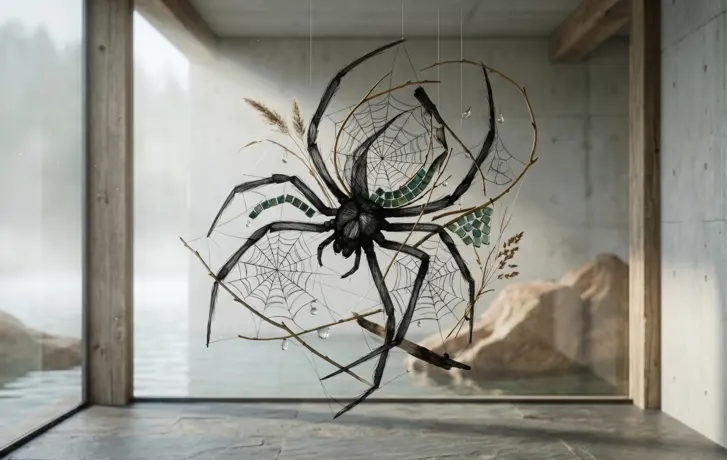
There is a specific quality to the black spider dream that no other version produces.
Not the compound wrongness of the watching spider. Not the accumulated weight of the giant one. Not the structural freeze of the web. This version carries something more particular: the specific dread of something that is completely present, completely visible, and completely illegible.
You could see it. That was never the problem. You could see the position, the stillness, the way it occupied the space. What the darkness withheld was something essential: the direction of its attention. Whether it knew you were there. Whether something had already been decided. Whether the stillness was before or after something was determined.
You could look directly at it and still not know what it was doing.
That is the entire reading. Not the spider. The darkness. And the darkness is not visual detail — it is the brain converting a specific waking-life quality into a visual property: something that has both the threat quality and the violation quality, but is additionally opaque. Present. Affecting the situation. Impossible to fully read.
I want to say something before going further, because this is one of the most misread versions in the spider category. People reach for “fear of the unknown” and “anxiety about dark things” — both approximately true in the way that “discomfort” is approximately true for both a splinter and a fracture. The black spider dream is specific. It is not about darkness in the abstract. It is about the particular experience of a threat whose nature, intentions, and next action remain unavailable despite your complete visual access to it.
The spider is there. You can see it perfectly. You just cannot read it.
Quick Answer
- The black spider is not the spider dream intensified by color — it is the spider dream with one additional specific encoding: the threat and violation signal is present but its full nature cannot be read; the darkness is opacity, not magnitude
- The defining quality of this version is calibration failure — normal threat-assessment requires being able to see a threat clearly enough to measure it; the black spider prevents this; the alarm stays elevated not because the spider is worse than others but because the assessment cannot complete
- Unpredictability and uncontrollability together are the two variables that most amplify the stress response — a threat whose next action cannot be predicted keeps the nervous system at maximum alert indefinitely; the black spider encodes both simultaneously
- The specific dread of the black spider is not the dread of something enormous or something that has already acted — it is the dread of not knowing; a threat that is present, visible, undeniable, and still refuses to reveal what it is doing
- The stillness of the black spider is more threatening than movement would be — a moving spider can be tracked; a still spider you cannot read could be doing anything; the stillness combined with the opacity produces the specific suspension of a decision that may or may not have already been made in the dark
- The waking-life address of this dream is always something currently present that has both the threat-and-violation quality and the additional quality of opacity — something affecting the situation whose intentions, next actions, or full nature remain unclear
- The black spider you can see but cannot interpret is different from the invisible pursuer that has no form — this one has a body, a location, a visible presence; the problem is not absence of form but absence of legibility
- Waking up with alertness that has nowhere to land — vigilant but unable to direct the vigilance anywhere specific — is the dream’s most accurate residue; the alarm ran all night at maximum and could not complete its assessment
- The black spider in familiar space encodes something more significant than the black spider in unknown space — familiarity should have made it more readable; the fact that it remains opaque in known territory makes the opacity more significant, not less
- The recurring black spider means the waking situation remains opaque despite continued exposure — something that has not become more legible over time, that keeps resisting full reading, that stays in the category of present-and-unclear
Common Scenarios
It is still, in a position you can see, and you cannot tell if it knows you are there. The fundamental version. Not movement, not action — the specific suspension of not knowing whether your presence has been registered. The spider is there. You are there. Whether it has noticed you, whether something has been decided, whether the stillness is before or after a determination — these cannot be answered because the darkness withholds the specific information that would resolve them. The alarm runs at maximum because the condition for calibration can never be met.
It moves and you lose it against a dark surface — and then you don’t know where it is. The located-then-lost version. You had it tracked — position known, presence confirmed. Then you lost it. The alarm that was running at high-but-stable moves to a different quality entirely: not just unreadable but unlocated. The last known position is the last certain thing. Everything between that position and you is now uncertain in a way it wasn’t before. This is the most acute version of the black spider dream.
It is enormous — and the size combined with the darkness is worse. The giant and the black spider together. Size amplifies opacity: the larger the thing you cannot read, the more territory its unreadable intentions cover. A large black spider that you cannot assess clearly fills more of the available space with its illegibility. This version appears when something both large and opaque is currently running in the waking life — where the accumulated unaddressed thing is additionally unclear in its nature.
You try to see it more clearly — you move closer, change the angle — and it remains dark. The effort version. You are not passive — you are actively attempting to gather the information the alarm requires, and the thing remains unreadable despite genuine engagement. This encodes a waking situation where you have been trying to understand something from multiple angles and it keeps resisting full clarity. The darkness is not a function of your effort. It belongs to the thing.
It is on you — but the darkness means you cannot see exactly where or what it is doing. Contact has been made but the nature of the contact cannot be assessed. You know something is on you. You cannot see it clearly enough to know what it is touching, what it is doing. The boundary violation of contact is compounded by the inability to read the violation itself. The most unsettling version because it combines two forms of not-knowing: where it is and what it intends.
There are several — none can be fully read — and you cannot determine if one is different. Multiple opaque threats simultaneously. Without being able to read any clearly, the normal process of prioritization fails. Everything requires maximum attention. Nothing can be addressed first because nothing can be assessed. This is the ambient-vigilance version — the version that produces the specific exhaustion of sustained maximum alert with no calibration ever completing.
What Your Body Already Knows
Woke up with alertness that has nowhere to land — vigilant but without a direction for the vigilance → because the threat-assessment ran at full intensity and could not complete; the alarm that would normally modulate once a threat is calibrated stayed at maximum because calibration was unavailable; the undirected alertness is the alarm still running, still looking for the information it needed and did not find
Woke up scanning — eyes moving through the room — with a quality different from the usual post-dream check → because the spider was visible but unreadable; the scanning behavior is the nervous system continuing the information-gathering the dream left incomplete; the eyes are looking for the clarity the dream could not provide
Woke up with the specific quality of suspended unease rather than resolved fear → because the dream never reached a resolution point; nothing happened to the spider, nothing was determined, the standoff continued; the suspension in the body is the residue of an assessment process that ran without completing; the unease has no sharp edge because nothing sharp occurred
Woke up and knew immediately which situation in the waking life this corresponded to — and the knowledge arrived as confirmation, not discovery → because the brain was processing a specific current situation with opacity as its defining quality; the connection was never obscure; what comes to mind in the first seconds is the honest identification
Woke up wanting more information — specifically wanting to understand what was actually happening in a situation that has resisted reading → because the dream encoded the information-need directly; the impulse toward clarity is the appropriate response; this is the morning for gathering information, not for acting on what isn’t yet known
What Darkness Does to the Alarm System
Let me explain what happens when the nervous system encounters an unreadable threat, because it changes the entire reading of this dream.
When a threat is visible and defined — when you can see it, assess its size, track its movement, read its direction — the alarm system calibrates. It takes the available information, matches it against what it knows, and assigns a response level proportional to the actual assessed danger. The response is organized. It has a direction.
When a threat is visible but cannot be fully read — when the information needed for calibration is unavailable — the alarm system cannot calibrate. And a threat-detection system that cannot calibrate does not default to low. It defaults to maximum. Not because the threat is necessarily more dangerous. Because the cost of under-responding to an unread threat is higher than the cost of over-responding to one. The uncertainty of whether it might be worse overrides everything else.
The black spider keeps the alarm at maximum not because it is the worst spider but because it is the least readable one. The alarm cannot find a reason to come down. The information that would allow it to proportion the response is exactly what the darkness withholds.
This is the specific exhaustion the black spider produces on waking. Not the acute alarm of something that happened. The sustained high-level activation of a system that ran all night without completing its assessment. The body has been running maximum vigilance around something that would not fully reveal itself, and the cost of that sustained running is what you carry out of the sleep.
This exhaustion is the thing worth naming directly. An unreadable threat of medium size that has been running continuously is often more physiologically expensive than a large clear one that is engaged and resolved. The clarity of the threat matters as much as the size of it. The black spider is not the biggest spider. It is the one that will not let the alarm rest.
A Spider in Your Dream — What the Brain Was Actually Processing maps the full architecture of why the brain specifically reaches for spider imagery when both the threat system and the disgust system activate simultaneously — and how the black spider represents the most sustained form of both systems running without resolution.
It is there, in the space that belongs to you, against the shadow where the light doesn’t quite reach. You can see it — the legs, the body, the specific quality of its stillness. What you cannot see is the direction of its awareness. Whether it knows you are here. Whether the stillness is before a decision or after one. You hold still because movement might change what it does — but you don’t know what it will do, because you cannot read it. And the not-knowing is the whole of it. Not fear of what it is. Fear of what it might be. Fear of a decision that may or may not have already been made in the dark.
The Difference Between Unseen and Unreadable
This distinction is the heart of this dream and the thing that separates it most precisely from the invisible pursuer.
The invisible pursuer has no form. There is nothing to see. The alarm is generated by something that has no visual presence — urgency without object. The fear of the invisible pursuer is the fear of something that cannot be located, cannot be found, cannot be faced in any direction.
The black spider is fully present. It has a body. It has a location. A form you can see with complete visual access. The problem is not that it is invisible. The problem is that seeing it fully does not tell you what you need to know.
You can look at it and still not know whether it is aware of you. You can observe it for the entire dream and still not know if it has decided something. You can be in the same space as it and still not know whether the stillness is patience or preparation.
The fear of the invisible pursuer is the fear of absence — of something with no form that cannot be faced. The fear of the black spider is the fear of presence without legibility — of something whose form is completely visible but whose nature remains enclosed in its own darkness.
Both are real. Both are precise. But they require completely different responses in the waking life. The invisible pursuer calls for stopping and letting the formless thing show itself. The black spider calls for something more specific: not courage in the face of absence, but the capacity to gather better information about something that is already present, already affecting the situation, already in the space.
The spider is there. You can see it. What you need is to see it more clearly.
Caught in the Web in a Dream — The Architecture of a Trap You Didn’t Choose maps the version where opacity becomes structural — when the unreadable thing has built a constraint around you that operates independently of whether you can see it clearly; reading both reveals what changes when illegibility stops being a property of the threat and starts being a property of the situation it created.
What the Waking Life Looks Like When This Dream Appears
I want to be direct about the waking-life situation this dream points at, because it is more specific than most people expect.
This is not a general anxiety dream. It is not the dream of overwhelm, or avoidance, or accumulated stress. Those have their own images — the giant spider for accumulation, the web for structural constraint, the spiders everywhere for systemic pattern. This one is for something more precise: a situation that is currently present in your life, that you can see in some form, that is clearly affecting things — and that you cannot fully read.
A person whose intentions are present but opaque. A situation that has developed to a visible state but whose next move is not clear. A dynamic in a relationship or a professional context where something is happening that you can feel and partially observe but cannot yet fully name. Something that is both threatening and contaminating in the spider way — but additionally dark in its nature, resistant to the kind of clarity that would allow you to know what to do.
The black spider is in your space. It is real. And you cannot read it.
The dream is doing two things simultaneously. It is validating the alarm — yes, there is something here that you cannot fully see, and the vigilance you have been carrying around it is the correct response to genuine unreadability. And it is asking a question: is the darkness a permanent property of the thing itself, or is there more information available than you have been able to gather?
The first is validation. The second is the morning’s work.
The One That Becomes Visible
I want to address one version specifically before closing, because it appears less often and carries more information than any other.
The black spider that becomes visible.
Not all at once — the dream doesn’t offer dramatic revelations. But at some point, a shift in light or angle or your position in the dream suddenly allows you to see it more clearly. The darkness reduces. The form becomes more specific. Something that was opaque becomes, briefly, readable.
This version tends to arrive when something in the waking situation is about to clarify — when information is in the process of becoming available, when the nature of the thing is beginning to show itself through accumulated evidence or a shift in circumstances. The dream is sometimes ahead of the waking life. The clarity in the dream precedes the clarity in the situation.
If you had this version — if the spider became lighter, became readable, even briefly — that shift in the dream is worth holding. Not as prediction. As the body’s report that something in the current situation is moving toward legibility. Something that has been dark is starting to show itself. The assessment that couldn’t complete before is getting closer to completing.
Dream Timestamp
This dream arrives when something present in the waking life has the opacity quality — not when a new unclear thing arrives but when something already operating has not yet become legible despite its clear presence → it is not an early-warning dream but a sustained-condition dream; it appears after you have been in proximity to something you cannot read for long enough that the nervous system has been maintaining maximum-vigilance response
The first appearance tends to arrive when the opacity first becomes undeniable → when you can no longer treat an unclear situation as simply unexamined; when the unreadability of something becomes its defining quality in your experience; the first black spider is the body reporting that a specific situation has entered the category of present-and-unreadable
The recurring version appears as long as the situation remains opaque → the dream returns as long as the darkness remains; when the situation becomes more legible — when intentions clarify, when the nature of the thing reveals itself, when enough information has been gathered for calibration — the dream changes or stops; the black spider becomes lighter or disappears
The version where the spider becomes visible at the end arrives when something in the waking situation is about to clarify → the dream is sometimes ahead of the circumstances; clarity in the dream can precede clarity in the waking life by days or weeks
The located-then-lost version arrives when something that was briefly more readable has become opaque again → you had better information and lost it; the alarm quality of this version is distinct from the standard black spider: not just unreadable but recently-readable-and-now-not, which is its own specific experience
The Sentence This Dream Was Trying to Say
“Something is here. I can see it. I cannot read it. The alarm that has been running around this thing is the correct response to genuine opacity — not overreaction, not irrational fear, but accurate vigilance around something that is present and real and has refused to fully reveal its nature. The darkness belongs to the thing. And the question this morning is not whether the threat is real — it is — but whether there is more information available than I have been able to gather yet.”
The Morning After
The alertness you woke up with has nowhere specific to go. That is the quality of this particular morning, and it is worth recognizing rather than immediately filling with the day’s ordinary noise.
The alarm ran all night around something that would not be read. It produced the correct response to the correct situation — genuine unreadability generates genuine sustained vigilance, and the body was doing exactly its job. What it could not do, because the dream could not provide it, was complete the assessment. Come down from maximum to proportional.
So the alertness is still running. Undirected. Waiting for something to calibrate against.
Two things before the day covers this over:
First — is the situation this dream was built from actually unreadable, or has it been treated as unreadable because reading it fully requires engagement that hasn’t happened yet? These are completely different. A genuinely opaque situation is one where information is unavailable regardless of effort. A situation treated as opaque is one where the information exists but facing it has been deferred. The black spider dream appears in both — but what the morning calls for is entirely different in each.
Second — what would make the spider lighter? Not eliminate it. Not address the threat before it’s been read. What information, if gathered, would allow the assessment to complete? What question, if asked, would reduce the darkness enough to let the alarm come down to proportional?
The room is ordinary. The corner where it was is empty. You can see the whole corner clearly. In the waking life the thing this dream was built from is still there, still in the space, still partially dark. But there is more light available in the morning than the dream had access to. There is always more light available in the morning.
FAQ
The black spider encodes opacity: a threat that is present and fully visible but cannot be completely read. Unlike a standard spider dream — which activates threat and disgust and can be assessed — the black spider adds one specific encoding: the nature, intentions, and next actions of the threat remain unclear despite complete visual access to it. The darkness is not aesthetic. It is the brain converting a waking-life quality directly into a visual property: something that is affecting the situation but whose full nature stays in shadow. The alarm the dream produces is the accurate response of a threat-assessment system that cannot complete its calibration.
Because the alarm system cannot calibrate against it. When a threat can be clearly seen and assessed, the nervous system proportions its response to the actual assessed danger. When a threat is present but cannot be fully read, the alarm defaults to maximum and stays there — because the cost of under-responding to an unread threat is higher than the cost of over-responding. The black spider is not necessarily more dangerous than a visible spider. It is less assessable. And an unassessable threat runs continuous undifferentiated alert in a way an assessed one — however large — cannot.
The invisible pursuer has no form at all — the alarm is generated by something with no visual presence. The black spider has complete visual form and a definite location. The problem is not absence but illegibility: you can see it fully and still cannot read its awareness, intentions, or next action. Different problems requiring different responses. The invisible pursuer calls for stopping and letting the formless thing show itself. The black spider calls for gathering better information about something that is already fully present and fully visible but not fully readable.
Stillness combined with opacity is more threatening than movement would be. A moving spider can be tracked — direction, speed, and intention become partially visible through the movement itself. A still spider that cannot be read could be doing anything: waiting, watching, before a decision, after one. The stillness removes the information that movement would have provided. The specific suspension of not knowing whether the stillness is before or after something has been determined is the precise quality of the waking-life situation this dream encodes — present, still, unreadable.
The located-then-lost version is the most acute form of the black spider dream. You had the threat tracked — position known, presence confirmed. Then you lost it. The alarm moves from high-but-stable to a qualitatively different state: not just unreadable but unlocated. The last known position is the last certain thing. Everything between that position and you is now uncertain. In the waking life, this encodes a situation that was briefly more legible and has become opaque again — something you had a better read on that has since moved into territory you cannot currently see.
Because the waking situation is still opaque. The dream returns as long as something present in the current life remains both threat-quality and unreadable in its nature or intentions. It stops when the situation becomes legible enough for the alarm to calibrate — when enough information has been gathered to produce a proportional response rather than sustained maximum alert. The dream does not stop when the threat is eliminated. It stops when the threat can finally be read. Opacity sustains the dream. Clarity ends it.
Next Stages
Caught in the Web in a Dream — The Architecture of a Trap You Didn’t Choose — when the black spider’s opacity becomes structural — not just a threat you can’t read but a structure it built that holds you inside it before you noticed
A Spider in Your Dream — What the Brain Was Actually Processing — the pillar — the complete dual-system architecture; why the brain reaches for spider imagery when both threat and violation systems activate simultaneously
The Spider on Your Skin — When the Boundary Between You and Something Else Dissolved — when the unreadable thing stops being at a distance and makes direct skin contact — opacity plus violation simultaneously
Spiders Everywhere in a Dream — When One Problem Became a System — when the single opaque threat multiplies across multiple areas of the waking life — the same unreadable quality in every room