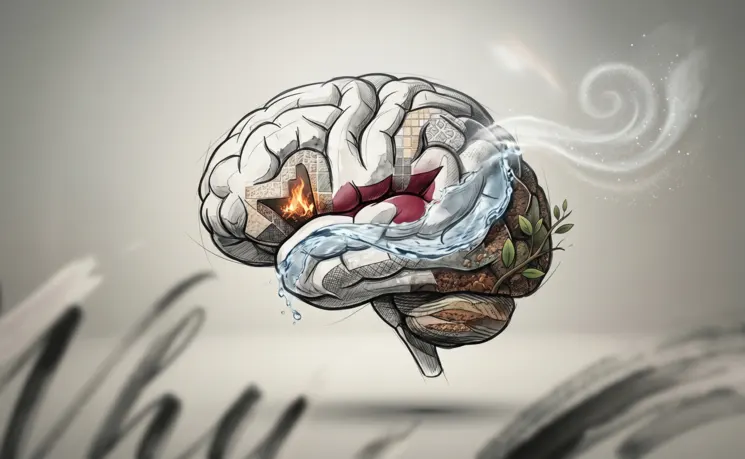
Why We Dream — What the Brain Is Actually Doing While You Sleep
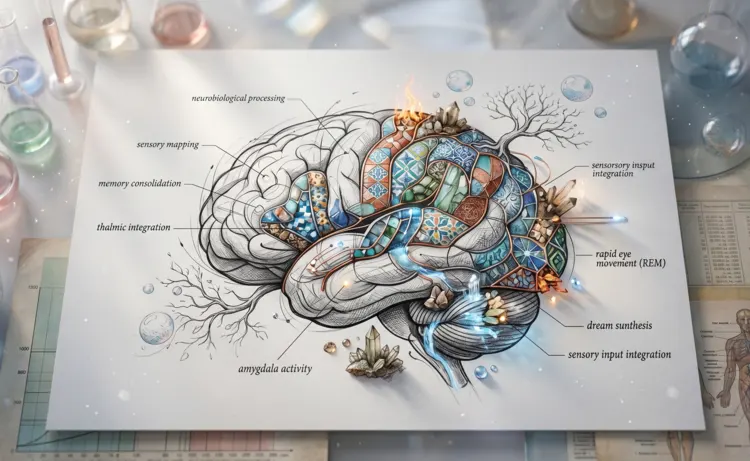
You’ve heard the explanations.
Processing memories. Simulating threats. Random neural noise that the cortex tries to make sense of. Freudian wish fulfilment. These answers have been passed around for so long that they feel like settled science — like something the question of dreaming has been answered by, and we can move on.
I spent five years reading the actual science. Not the summaries of the science. The books written by the researchers who ran the experiments — Walker, Solms, Cartwright, LeDoux, Damasio. And what I found is that the real answer is both more specific and more useful than anything the popular summaries tend to offer.
The brain doesn’t dream to process memories in the way a computer processes files. It dreams because it runs on a drive that never fully stops — and the images you remember in the morning are the story the cortex built around signals it didn’t choose and couldn’t ignore.
That’s a different thing. And it changes everything about how you read a dream.
Quick Answer
- Dreaming is not a single process — it is the product of multiple brain systems running simultaneously, with different systems contributing different elements: the brainstem generates the activation, the limbic system provides the emotional charge, and the cortex builds the narrative around both
- Mark Solms’ research established the foundational reversal: dreams are not generated by the cortex and experienced in the body — they are generated in the brainstem, in structures older than language and older than memory, and the cortex receives them and builds a story around them after the fact
- Matthew Walker’s research on REM sleep documented the emotional processing function precisely: REM sleep strips the emotional charge from memories while preserving the content — the dreaming brain is not replaying experiences but detoxifying them, running them through a neurochemical environment specifically designed to reduce their affective intensity
- The prefrontal cortex — the brain’s critical evaluation system, the part that says “wait, this doesn’t make sense” — is largely offline during REM; this is why dream logic feels completely valid during the dream; the editor isn’t running
- Rosalind Cartwright’s thirty years of longitudinal research established the most practically useful finding: the dreaming brain returns to the same emotional material each night until it resolves; recurring dreams are not mysterious repetitions — they are the brain filing the same report because the waking situation that generated it hasn’t changed
- The images in dreams are not symbols waiting to be decoded — they are the most accurate available rendering of a physiological state that was already running; LeDoux’s amygdala research shows the emotional alarm fires before the cortex has assembled a word about it; the dream image is the cortex catching up
- Acetylcholine peaks during REM — this is the neurochemical that encodes experience with unusual depth and vividness; it is why intense dreams feel realer than waking life, and why the physical residue of an intense dream — the racing heart, the chest tightness, the specific quality of what remains in the body on waking — is not a reaction to the dream but the dream’s most accurate content
- The brain is specific about which images it reaches for — it does not generate random content; it selects the most precise available image for the physiological state it is processing; a spider, a fall, an exam room, a specific person — each of these was chosen because it matched something running in the nervous system with more accuracy than any other available image
- The question that unlocks a dream is never “what does this symbol mean in general” — it is always “what in my current life has this exact physiological quality, and why did the brain need to process it at this specific intensity last night”
- Understanding why we dream changes the morning: not “what does this mean” but “what was the brain processing, at what intensity, and what in the current life is generating that signal”
Common Scenarios
You wake up from an intense dream and the feeling is still in the body before the image is. This is the sequence working correctly. The brainstem generated the activation. The limbic system provided the emotional charge. The cortex built the narrative. When you wake up, the narrative dissolves first — the images fade, the story becomes hazy. What remains is the physiological state that preceded all of it. The chest tightness, the specific quality of alarm or grief or wrongness, the temperature — these arrived before the dream had a face. They are the most primary content. Everything else was constructed around them.
You keep having the same dream. Not a different dream with similar themes — the same one, with the same quality, the same setting, the same specific feeling on waking. Cartwright spent thirty years tracking this. The brain returns to the same emotional territory each night not because the dream is important in itself but because the waking situation it was built from hasn’t changed. The dream is a report. The report keeps being filed because the situation it reports on is still running. It stops when the situation resolves — not when you figure out what it means.
You have a dream so real it takes several seconds after waking to confirm it didn’t happen. Acetylcholine is at peak concentration during late REM. The neurochemical that encodes experience as real and significant is running at maximum. The prefrontal cortex — which would normally evaluate and question — is largely offline. The result is experience with the full encoding weight of reality and none of the skeptical apparatus that waking life applies. The dream felt real because the system that decides what’s real was not running at the time.
You dream about something you haven’t thought about consciously in years. The brain maintains emotional files independently of conscious attention. A relationship from a decade ago, a context that preceded your current life, a person you would never deliberately think about — these remain active in the nervous system as long as their emotional signature is unresolved or as long as something in the current life carries the same frequency. The dream doesn’t retrieve the memory because you were thinking about it. It retrieves it because something running right now matches its emotional address.
You wake up and know — before analysis, before coffee, before the room fully assembles — what the dream was about. Not what it meant. What it was about. The waking-life situation it was built from arrives before the interpretation does. This is the brain telling you directly. The dream wasn’t encrypted. The address was always visible. The knowing that arrives in the first seconds is almost always correct.
What Your Body Already Knows
Woke up with a feeling that arrived before the memory of the dream → because the brainstem generated the activation first; the physiological state preceded the narrative; what remains in the body on waking is the primary signal, not the response to the signal
Woke up knowing something about a waking-life situation that you hadn’t fully named while awake → because the dreaming brain processes emotional material without the management layer that waking consciousness maintains; it had access to what the nervous system was actually registering, not what the mind was deciding to acknowledge
Woke up from a dream that felt more real than waking life → because acetylcholine encoding was at maximum and the evaluative system was offline; the dream was encoded at full reality weight with no skeptic present to question it; the vividness is neurochemical, not supernatural
Woke up tired in a specific way — not the tired of not sleeping enough, but the tired of having worked through something → because REM is metabolically active; the brain during dreaming is not resting; it is processing emotional material at significant neurological cost; the specific fatigue of an intense dream night is the body reporting on real work that was done
Woke up and the dream was already gone — you know something was there but can’t reach it → because the neurochemical window for dream consolidation is approximately 90 seconds after waking; norepinephrine, which suppresses during REM, begins returning immediately on waking and competes with the acetylcholine encoding; this is why writing a dream down in the first 90 seconds captures it and waiting until after coffee almost never does
What I Found in Five Years of Reading the Actual Research
I want to tell you what changed for me, specifically, because I think it is more useful than a summary of conclusions.
I started reading sleep neuroscience because I wanted to understand why the same emotional situations kept appearing in my dreams in different disguises. I had the standard explanations — processing, Freud, random activation — and none of them helped me read an actual dream better. They were frameworks that could be applied to anything and therefore explained nothing specifically.
The first thing that shifted was reading Solms. Not his summaries — his actual research on patients with brainstem lesions who lost the capacity to dream entirely, and patients with cortical damage who continued dreaming normally. This established something I hadn’t encountered in any popular account: dreams don’t originate in the thinking brain. They originate in structures so old they predate conscious experience. The cortex receives them. The cortex doesn’t generate them.
This changes everything. If the cortex were generating dreams, then dreams would be about what the thinking mind is thinking about. They would be narratively coherent. They would make the kind of sense that thinking makes. They would be about the things you’re consciously processing.
But the cortex isn’t generating them. Something older and more urgent is. The cortex is doing its best to make sense of signals it didn’t choose. The dream is the story the thinking mind built around an alarm that was already running.
That is why the dream image is always more accurate than it appears. It wasn’t chosen by the part of you that manages and explains. It was chosen by the part that simply registers what is real.
I read this at my desk at about eleven at night, several years into the project, and I remember sitting with it for a long time. Not because it was surprising — because it was the first explanation that actually matched what I had been observing in real dreams for years. The image is always more honest than the dreamer expects. Now I understood why.
The Emotional Processing Function — What Walker Actually Found
Matthew Walker’s research at UC Berkeley is the most practically relevant finding in sleep neuroscience for anyone trying to understand their own dreams — and it is almost always misrepresented in popular accounts.
The standard summary: REM sleep processes emotions. This is true but useless. What Walker actually documented is more specific and more strange.
REM sleep is the only state in which the brain’s neurochemical environment is depleted of norepinephrine — the neurochemical associated with stress and anxiety. During REM, the brain re-processes emotionally significant memories in a neurochemical bath that is specifically low in the molecule most associated with the charge of those memories. The result: the memory is accessed, run through full processing, and re-stored — but the emotional charge attached to it is reduced. The content is preserved. The pain of the content is diminished.
This is not metaphorical. Walker documented this in clinical populations. People with PTSD — where this nocturnal re-processing is disrupted — continue to experience memories at full emotional charge because the REM detoxification process fails to complete. The nightmare is not the brain processing trauma. The nightmare is the processing failing and the trauma firing again at full intensity.
For a normal dream, the implication is this: the emotional material the dream is built from is material that the brain is actively working to resolve. The dream is not the problem. It is the attempt at solution. When the dream produces distress, the distress is the processing — the brain running difficult material through the system that is designed to reduce its charge while the body is safe enough to do so.
When the dream keeps returning, the re-processing didn’t complete. Not because the brain failed. Because the waking life kept reloading the same charge the next day.
Why the Prefrontal Cortex Going Offline Changes Everything
This is the mechanism that explains more about the specific quality of dreams than almost any other single finding — and it is the one that most directly affects how you experience being inside a dream.
The dorsolateral prefrontal cortex is the brain’s critical evaluation system. It is the part that says: this doesn’t make sense. It is the part that checks experience against reality, applies skepticism, identifies implausibility, and maintains the narrative coherence that waking life requires.
During REM sleep, activity in this region drops dramatically. The system that would question the dream logic is largely offline.
The result is not just that the dream seems real. It is that every idea the dream generates arrives with complete authority. There is no part of you running to check whether the spider is actually the size it appears, whether the room is actually your childhood home, whether the person in the dream is actually who the dream says they are. The validator is asleep. Everything the dream presents is simply true.
This is why the entity in the dream that explains the nature of time sounds so convincing. This is why the exam room makes complete sense as a location even though you haven’t been in school for decades. This is why the dream’s emotional logic — the grief, the fear, the specific quality of the situation — feels more real than waking analysis ever produces.
The validator was asleep. What arrived did so with the full authority of unquestioned truth.
The morning is when the validator wakes back up. And sometimes the most useful question to bring to the morning is not “was the dream true” but “what did the dream know that the validator usually argues me out of.”
A Spider in Your Dream — What the Brain Was Actually Processing shows this mechanism in the most vivid available example — the spider activates both threat and disgust before the prefrontal cortex has formed a single word about it; the dual signal runs before any evaluation is possible.
The Image Was Always Specific
I want to address something directly because I think it is the most practically useful finding in everything I’ve read, and the one that most changes what you do with a dream in the morning.
The brain does not generate random images. This is not a mystical claim — it is a neurological one. The dreaming brain selects images from the available vocabulary of the nervous system based on a matching process: which available image most precisely encodes the physiological state currently being processed.
The snake was not random. The water was not random. The exam room was not random. The specific person who appeared was not random. Each was selected because it matched something running in the nervous system — a specific emotional frequency, a specific combination of alarm and memory and current-life situation — with more precision than any other available image.
LeDoux’s work on the amygdala establishes why: the emotional processing system evaluates and encodes threat signals before the cortex has a word for them. The amygdala has been tracking your current life, quietly and continuously, with a precision the conscious mind rarely matches. The dream image is the amygdala’s report — rendered in the most accurate available visual form.
The spider in the dream was chosen because something in the current life carries the exact dual quality of threat and violation that the spider encodes most efficiently. The falling was chosen because something in the current life carries the exact quality of structural support failing. The exam room was chosen because something carries the exact quality of being evaluated by a standard you didn’t set, with a verdict pending.
The image is always a report. The question is never what the image means in general. The question is always: what in the current life has exactly this quality?
Being Chased by Something You Can’t See maps this in the clearest possible form — the pursuer has no face because the brain is encoding the physiological state of sustained avoidance, not a specific threat; the specificity of the image is in what it doesn’t show as much as what it does.
What This Changes About the Morning
Every morning after a significant dream is a window. Not because dreams are messages from somewhere else — because the dreaming brain had access to something that the waking mind manages around, explains away, or simply hasn’t had time to fully process.
The dreaming brain doesn’t have the management layer online. It doesn’t know what you’ve decided to believe about how things are. It only knows what the nervous system is actually registering: what is generating alarm, what is generating grief, what is generating the specific compound quality that a spider or a fall or a person-appearing-changed encodes most precisely.
The morning is when the management layer comes back online. And the question worth asking — in the 90 seconds before it fully reasserts its ordinary interpretation of the current life — is whether what the dream was processing is something the management layer would rather not look at directly.
It usually is. That’s why the dream was doing it in the dark.
You Found Out in the Dream — What That Moment Actually Means maps the most precise version of this: the cheating dream as the brain running a full security audit on what the relationship is actually worth — a measurement the waking mind rarely produces with this accuracy.
Dream Timestamp
The brain dreams every night — the absence of dream memory is not the absence of dreaming → REM cycles occur four to six times per night regardless of recall; the 90-second memory window closes before most people reach full consciousness; what is remembered is the fragment that survived the neurochemical transition, not a representative sample of what was processed
The most emotionally significant material is processed in the later REM cycles → the brain’s REM architecture front-loads lighter material and reserves the deepest, longest REM periods for the early morning hours; the dream at 5am carries more emotional weight than the dream at midnight; this is why the vivid, significant dreams tend to arrive near waking
The recurring dream arrives at a specific moment in the waking situation → not at random; Cartwright’s research documented that recurring dreams correlate with the persistence of the unresolved waking situation; they begin when the situation becomes emotionally significant and stop when it changes; the timing is the brain’s report on when the situation became active
The dream that arrives during a major life transition carries specific content → the brain audits most intensely during periods of change; Walker’s research shows REM increases during transitions; the brain is processing the emotional implications of change that the conscious mind is still deciding what to think about
The Sentence This Dream Was Trying to Say
“The brain did not choose this image randomly. It chose the most accurate available rendering of something that has been running in the nervous system — something the waking mind has been managing around, explaining, or simply hasn’t had the space to look at directly. The dream is not a puzzle. It is the most honest available report.”
The Morning After
You don’t need to decode every dream. Most mornings the most useful thing is simpler: before the day reasserts its ordinary frame, before the management layer fully restores the story you’ve been telling yourself about how things are — notice what was still in the body when you woke up.
Not the narrative. The body’s report. The quality of what was running before the images faded. The chest, the jaw, the specific temperature of what remained. That was the primary signal. Everything the dream built around it was secondary.
The images are the story the cortex constructed. The body’s residue is what the brainstem was actually sending.
Solms spent years establishing this in clinical research. The dream begins in the body. It ends in the body. The story in between was the brain’s most honest available attempt to explain to itself what the body already knew.
FAQ
The most accurate current answer: the brain dreams because it runs on a drive that never fully stops, and dreaming is what happens when the oldest structures in the brain generate activation that the cortex then builds a narrative around. Walker’s research established the emotional processing function — REM sleep strips emotional charge from memories while preserving content. Solms established the origin: dreams begin in the brainstem, not the cortex. The cortex receives them and constructs the story after the fact.
Yes — but not as coded messages waiting to be decoded. Dreams mean something in the same way a fever means something: they are the body’s report on what the nervous system is processing. The image the brain chose is always the most accurate available rendering of a physiological state currently running. The meaning is in the match between the dream’s emotional quality and something in the current waking life that carries the same quality.
Multiple systems running simultaneously. The brainstem generates activation. The amygdala and limbic system provide emotional charge — running at higher relative intensity than during waking. The cortex constructs a narrative around both. The dorsolateral prefrontal cortex — critical evaluation, the part that checks whether things make sense — is largely offline. Acetylcholine is at peak concentration, encoding the experience with unusual depth and vividness. The result is experience that feels completely real, emotionally charged, and narratively coherent — because the system that would question it isn’t running.
The memory window for dreams is approximately 90 seconds after waking. During REM, norepinephrine — the neurochemical that supports memory consolidation — is suppressed. The moment you wake up, norepinephrine begins returning. Within 90 seconds it competes with and overrides the acetylcholine encoding that made the dream feel real. Writing down a dream in the first 90 seconds captures it. Waiting until after coffee almost never works — not because the dream is gone, but because the neurochemical window for reaching it has closed.
Because the waking situation the dream is built from hasn’t changed. Cartwright’s thirty years of longitudinal research documented this precisely: the dreaming brain returns to the same emotional material each night until the situation resolves. The recurring dream is the brain filing the same report because the same signal is still running. It stops when the waking-life situation changes — not when you understand the dream better, not when you stop thinking about it, but when what generated it actually shifts.
No. The activation-synthesis hypothesis — the idea that dreams are random neural firing the cortex tries to make sense of — was the dominant model for decades and is now considered incomplete. The brain selects images through a matching process: which available image most precisely encodes the physiological state currently being processed. The spider, the fall, the exam room, the specific person — each was selected because it matched something running in the nervous system with more precision than any other available image. The content is specific. The specificity is the point.
Because acetylcholine — the neurochemical that encodes experience as real and significant — is at peak concentration during REM, while the prefrontal cortex that evaluates and questions is largely offline. The dream is encoded at full reality weight with no skeptic present. Waking life has the validator running continuously, quietly reducing the felt weight of experience through evaluation and context. The dream has neither. The result is experience that arrives with the full force of unquestioned reality — which is precisely why the physical residue it leaves in the body on waking is real physiological data, not imagination.
Next Stages
Why Are My Dreams So Vivid — The Neuroscience of Intensity — acetylcholine, REM depth, and what it means when the brain encodes an experience at higher resolution than waking life
Why Do I Keep Having the Same Dream — Cartwright’s thirty-year finding in detail: the precise mechanism by which the dreaming brain returns to unresolved material each night
Why Do I Wake Up at 3AM — What the Brain Is Doing at That Hour — peak REM timing, cortisol rhythm, and why the most significant dreams arrive in the final hours before waking
Why Can’t I Remember My Dreams — the 90-second neurochemical window and why what you capture in the first minutes of waking is the only access you have