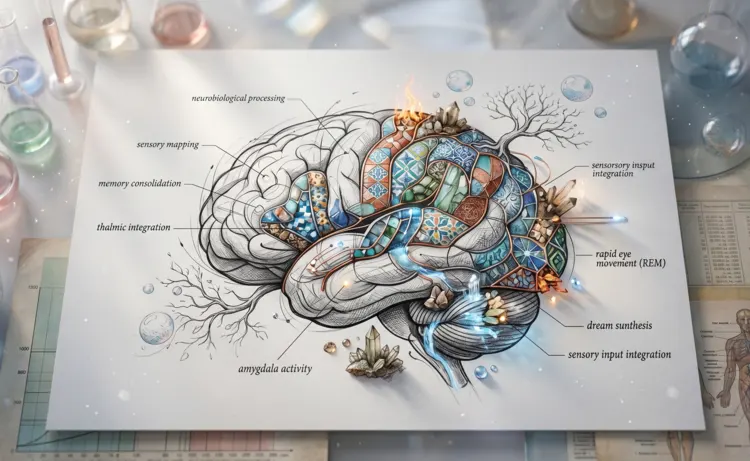
Why Do Dreams Feel So Real — What the Brain Does to Make It Convincing
You checked.
Maybe it was a few seconds after waking, maybe less. Before the room fully assembled itself, before you were certain of the year or the day or which life you were in — you checked. The hand that was injured, the person who was there, the thing that had happened. You checked because some part of your nervous system was not fully convinced that the check was unnecessary.
And then the room arrived. The ordinary light. The ceiling you actually live under. The specific quality of waking up and being, again, here — and not there.
But for those seconds, it was real.
Not in the way a vivid memory feels real, not in the way imagination feels real. In the way Tuesday morning feels real. The weight of the body in the situation was the weight of a body in an actual situation. The grief that arrived when you found out — in the dream — was not the grief of imagining something sad. It was the grief. The same physiological event. The same neurological signature.
I spent a long time trying to understand the specific mechanism that produces this. Not the general answer — “the brain is active during REM” — but the precise sequence of events that makes the dream register as reality with the conviction it does. What I found is that it isn’t one mechanism. It’s five. And they run simultaneously, reinforcing each other, producing something the brain has no available reason to question — because the part of the brain that does the questioning is the part that’s offline.
Quick Answer
- The brain uses five simultaneous mechanisms to make dreams feel real: acetylcholine peaks to maximum, the prefrontal cortex deactivates, the amygdala runs without its usual dampening, norepinephrine drops to its daily minimum, and the somatosensory cortex activates as if the body were physically in the situation — all five running at the same time produce an experience with the full neurological signature of reality
- Acetylcholine is the neurochemical that encodes experience as real and significant — it is the same molecule that is elevated during learning and memory formation; during REM it reaches daily peak concentration; the dream is encoded with the same neurochemical weight as the most important experiences of waking life
- The dorsolateral prefrontal cortex — the region responsible for reality monitoring, critical evaluation, and the recognition that something doesn’t make sense — shows dramatically reduced activity during REM; this is the region that would generate the thought “wait, this isn’t real”; it is not running; the dream presents with unquestioned authority because the authority-questioning system is offline
- The amygdala runs at or above waking levels during REM — the emotional intensity of the dream is not modulated by the prefrontal systems that normally regulate emotional response; what you feel in the dream is felt at full intensity, without the dampening that waking consciousness applies
- The somatosensory cortex — the region that processes physical sensation — activates during REM in patterns that correspond to physical experience; the body being touched, falling, running are encoded as physical events because the brain is generating the physical-experience signal, not just the visual narrative
- Norepinephrine, which supports the sense of being present in waking life and helps maintain the distinction between internal and external experience, drops to its daily minimum during REM; the system that normally signals “this is happening in your head” is not running
- The combination of these five creates something specific: experience with full emotional weight, full somatic encoding, full narrative conviction, no critical evaluation, and no “this is internal” signal — the result is indistinguishable from waking reality to the system that would make the distinction
- The dream feels more real than waking life sometimes because waking life has all five systems running in their normal state — with the prefrontal cortex evaluating, with norepinephrine marking experience as external, with emotional dampening applied; the dream removes the filters; what arrives is unmediated
- The physical residue after an intense dream — the racing heart, the specific chest weight, the phantom sensation of what was in the hands — is not imagination; it is the metabolic product of systems that ran at full activation; the body responding to a physical event it didn’t distinguish from reality
- Understanding this mechanism changes the morning: the physical residue on waking is the most accurate data available about what the dream was processing; not the narrative, not the images — the body’s physiological record of five systems that ran without filters
Common Scenarios
You woke up and needed several seconds to confirm it wasn’t real. Not a gradual fade from dream to waking — a specific transition during which both were simultaneously possible. This is the five mechanisms unwinding in sequence. The somatosensory activation clears first. The amygdala intensity reduces. The prefrontal cortex comes back online. Norepinephrine begins returning. Each system restoring in sequence, each restoration moving the experience further from reality-weight and toward memory-weight. The seconds of uncertainty are the systems coming back online, not the dream lingering.
The grief, the fear, the love in the dream felt as real as anything you’ve felt awake. Because the amygdala was running at full intensity without prefrontal dampening. The emotional response to the dream event was not a simulation of grief — it was grief. The same neural pathway, the same physiological signature, the same cortisol and adrenaline response. Eisenberger’s research on social pain established that the brain processes relational pain through the same circuitry as physical pain. The dream uses the same circuitry. The feeling was not metaphorical. It was the event.
You woke up and your body was still responding — heart rate elevated, breathing changed. Because the autonomic nervous system was activated by what the brain registered as a real threat or real event. LeDoux’s research: the amygdala activates the fight-or-flight response before the cortex has a word about what’s happening. During the dream, this activation ran without the cortex’s usual contextualisation. The body responded to the event as real because the system that would have noted otherwise wasn’t running.
The physical sensation from the dream was still in the body — the place where something touched you, the specific weight in the chest, the phantom quality of what was in the hands. The somatosensory cortex generated these sensations at full activation. The body’s sensory encoding ran the physical experience. When you woke up, the sensory systems were coming back to their baseline state — and the residue of their activation was still present, not as imagination but as the metabolic aftermath of systems that genuinely ran.
You dreamed something that hasn’t happened and were completely convinced it had — for hours after waking. The most intense version of the conviction effect. The dream was encoded with the full neurochemical weight of a real memory. Acetylcholine at peak, somatosensory activation complete, emotional encoding at full intensity. The resulting memory has the same neurochemical signature as a real autobiographical memory. The brain has no internal marker that distinguishes “this was dreamed” from “this happened” in terms of the raw encoding — the distinction comes from context, from surrounding memories, from the logical impossibility of what was dreamed. When the logical impossibility isn’t obvious, the conviction can persist.
The person who died appeared in the dream and was alive — completely, convincingly, unambiguously alive. And on waking, the grief of the loss was fresh in a specific way — not reopened but re-encountered, as if the loss were news again. Because the dream ran the full memory of this person, activated the full attachment system, and produced the full experience of their presence without any marker distinguishing “alive” from “dead.” The grief on waking is the brain updating its model — re-encountering the gap between the archived living version and the current reality. This is one of the most physiologically complete experiences the dreaming brain can produce.
What Your Body Already Knows
Woke up and checked something — a limb, a situation, a person — before deciding to → because the somatosensory systems hadn’t fully returned to baseline; the body was still running the physical encoding of the dream; the checking is the nervous system completing its reality-verification protocol on an experience it processed as real
Woke up and the emotional state was already running before the memory of the dream arrived → because the amygdala activation preceded narrative reconstruction; the emotion was the primary event; the dream content was secondary; what you felt before you remembered what you felt about is the most honest available signal
Woke up and the dream had the weight of a real memory for minutes or hours → because it was encoded with the same neurochemical signature as a real memory; the distinction between “this happened” and “this was dreamed” comes from contextual knowledge, not from the encoding itself; the encoding is identical
Woke up physically affected — elevated heart rate, specific chest quality, changed breathing — from something that didn’t physically happen → because the autonomic nervous system responded to what the brain registered as a real event; this is not psychosomatic in the dismissive sense; it is accurate; the body ran a real response to a real activation; the physical residue is physiological data
Woke up and the person who appeared in the dream felt more present than they do in waking memory → because the dream ran the full neurological version of their presence — somatosensory, emotional, auditory, visual — at full activation; waking memory is a fraction of this; the dream version is more complete, which is why it feels more real; this is also why grief can return fresh from a dream even years after loss
The Five Mechanisms — What Each One Does
I want to go through each of the five mechanisms specifically, because the popular account almost always names one or two and misses the rest. The reason the dream feels as real as it does is that all five run simultaneously. Removing any one of them would reduce the conviction significantly. All five together produce something the brain has no available mechanism to identify as not-real.
One. Acetylcholine at peak.
Acetylcholine is the brain’s primary encoding neurochemical — the molecule most associated with learning, memory consolidation, and the marking of experience as significant and real. During REM sleep, acetylcholine reaches its daily peak concentration. The experience of the dream is encoded with the same neurochemical weight as the most important experiences of waking life. There is no chemical marker within the encoding itself that says “this is a dream.” The encoding says: this matters. This is real. Remember this.
Two. Prefrontal cortex deactivation.
The dorsolateral prefrontal cortex is the brain’s reality-monitoring system — the region that checks whether things make sense, applies skepticism, identifies implausibility, and generates the thought “wait, that’s not right.” During REM, activity in this region drops significantly. The result is not just that dream logic goes unchecked. It is that every idea the dream generates arrives with complete authority. There is no internal voice that questions. Everything the dream presents is simply true.
I find this the most fascinating of the five. The prefrontal cortex isn’t just offline — its absence changes the character of experience entirely. Waking life has the constant low-level hum of evaluation running. Questions are automatically generated, implications are tested, impossibilities are flagged. Remove all of that and what remains is experience that arrives with complete, unquestioned authority. This is what the dream is. Not imagination. Unmediated experience.
Three. Amygdala at full activation.
The amygdala processes emotional significance and threat. During REM, it runs at or above waking levels — while the prefrontal systems that normally regulate its output are largely offline. The emotional intensity of the dream is not the brain approximating emotion. It is emotion, running without its usual management system. The grief is grief. The terror is terror. The love is love. At the same physiological intensity as the real thing, because it is the real thing — the same neural pathway, the same neurochemical cascade, the same body response.
Four. Norepinephrine at minimum.
Norepinephrine supports the brain’s ability to locate experience as external — to maintain the sense of being present in a real environment rather than generating experience internally. During REM, norepinephrine drops to its daily minimum. The system that normally signals “this is inside your head, not outside in the world” is not running. The dream is not marked as internal. There is no felt sense of the experience being generated rather than encountered.
Five. Somatosensory cortex activation.
The regions that process physical sensation — touch, proprioception, the sense of the body in space — activate during REM in patterns that correspond to physical experience. The body in the dream that is running, falling, being touched, holding something is not imagined. The somatosensory cortex is generating the physical signal. The body is encoding a physical event. This is why the residue of the dream is in the body, not just in memory — because a physical event, neurologically speaking, occurred.
Why We Dream — What the Brain Is Actually Doing While You Sleep maps the broader architecture — why these five mechanisms are all active simultaneously during REM and what the evolutionary function of an experience this convincing actually is.
Why Waking Life Sometimes Feels Less Real Than the Dream
This is the part that people find most strange to acknowledge — that sometimes the dream felt more real than Tuesday morning. Not just more vivid. More present. More weighted. More like the actual texture of experience.
The reason is not mysterious once you have the mechanism.
Waking life runs all five systems in their normal state. The prefrontal cortex is evaluating continuously. Norepinephrine is maintaining the sense of external reality. The amygdala is being regulated by prefrontal systems. Acetylcholine is at normal waking levels. The somatosensory cortex is processing real sensory input — which is accurate but also filtered, habituated, and normalized.
The result is experience that is real but managed. Filtered through evaluation. Dampened through habituation. Marked as external rather than felt as immediate. The coffee you drink every morning is real — but your nervous system stopped encoding it with the weight of a new experience a long time ago.
The dream removes the filters. What arrives is unmediated. The emotion at full intensity without prefrontal regulation. The experience encoded at maximum neurochemical weight. The physical sensation without the normalization of familiarity. And no evaluative system running to note that any of this is less than completely real.
This is why the dream can feel more alive than the morning. Not because the dream was more important. Because the brain, during the dream, was running without the systems that manage and reduce the intensity of experience. The world of the dream was not filtered. Tuesday morning is.
Why Are My Dreams So Vivid — The Neuroscience of Intensity maps what happens when these five mechanisms run at even higher than usual activation — when the dream doesn’t just feel real but feels more real than any waking experience has in months.
What the Physical Residue Actually Is
I want to address this directly because it is the thing that most people dismiss and it is the thing that is most worth attending to.
The racing heart after the dream. The specific quality of compression in the chest. The phantom sensation of what was in the hands, or on the skin, or in the stomach. The sense that the body went somewhere and came back.
This is not imagination. This is not the aftermath of a vivid idea. This is the metabolic product of physical systems that ran at full activation.
The amygdala activated the autonomic nervous system. The autonomic nervous system ran the stress response — cortisol, adrenaline, increased heart rate, changed breathing, altered muscle tone. These are not metaphors for emotional intensity. They are physical events that occurred in the body during the dream. The physical residue on waking is the body returning to baseline from a genuine physiological activation.
Damasio’s somatic marker research established that the body registers emotionally significant events at specific anatomical locations — the chest, the stomach, the hands — and that these registrations persist as somatic markers that inform future decision-making. The dream generates somatic markers. Real ones. With the same anatomical specificity as waking-life emotional events.
The physical residue on waking is not decoration. It is the most primary available data about what the dream was actually processing. Not the images — the body’s record.
This is what Oneirox begins with. Before the image dissolves, before the narrative fades, before the day imposes its frame on what happened in the night. The chest. The hands. The specific quality of what is still running in the body. That was the signal. Everything built around it was the story the brain constructed to explain it.
The story matters. But the signal was first.
Dream Timestamp
The most convincing dreams arrive in late REM cycles → acetylcholine concentration and REM depth both increase across the night; the 4-6am cycles produce the most neurochemically complete experience; the dreams that feel most real almost always arrive near waking
The conviction effect is strongest in the seconds immediately after waking → the five mechanisms are still partially running during the transition from REM to waking; full return to the waking neurochemical state takes 30-90 seconds; this is the window during which the dream and waking reality are simultaneously possible
The physical residue lasts longest after the most emotionally activated dreams → the autonomic nervous system activation that occurred during the dream takes time to return to baseline; the more intense the dream, the longer the physiological return; elevated cortisol from a high-activation dream can affect the first hour of the waking day
The conviction that something happened — the false memory quality — is most durable when the dream content was emotionally significant → acetylcholine encoding is stronger for emotionally charged material; the neurochemical signature of the memory is identical to a real autobiographical memory; the contextual knowledge that it was a dream is the only distinguishing feature
The Sentence This Dream Was Trying to Say
“What you felt was real. Not real as in true — real as in the same physiological event as anything you have felt while awake. The body ran the response. The nervous system ran the encoding. The brain made no distinction. The distinction is yours to make in the morning. What the body held while you were asleep was not imagination. It was signal.”
The Morning After
The dream felt real because the brain made it real — with specific mechanisms, running simultaneously, producing an experience that the system responsible for identifying “not real” was not awake to question.
That is not a flaw. That is the design.
The dreaming brain needs the experience to be convincing to process it at the depth it requires. A dream you knew was a dream while you were having it — a lucid dream — processes differently. The full emotional weight, the full somatic encoding, the full physiological activation — these require the conviction. The brain made it real because the processing required it to be real.
Which means: the physical residue you woke up with is the most honest available account of what the brain was processing. Not a residue of imagination. A residue of genuine processing, genuine physiological activation, genuine somatic encoding.
Before the morning covers it — not the narrative of the dream, not what happened in the story — but the body. Where the weight was. What was still running. What the chest knows that the mind is already beginning to manage around.
That’s where the signal is. The brain spent all night making it convincing enough to land there. It did its job. The question is whether you do yours.
FAQ
Because five brain systems run simultaneously to make them convincing: acetylcholine peaks to its daily maximum, encoding experience as real and significant; the prefrontal cortex — the reality-monitoring system — deactivates; the amygdala runs at full emotional intensity without its usual regulation; norepinephrine drops to its daily minimum, removing the signal that marks experience as internal rather than external; and the somatosensory cortex activates as if the body were physically in the situation. All five together produce experience with the full neurological signature of reality — and the system that would identify it as not-real is not running.
Yes — physiologically real. The amygdala activates the same neural pathway and produces the same neurochemical cascade as an equivalent waking emotional event. The grief in a dream is the same physiological event as waking grief. The fear is the same as waking fear. The prefrontal systems that normally regulate emotional intensity are largely offline during REM, which means the emotion runs without its usual dampening. What you feel in the dream is not a simulation of emotion. It is emotion — at full intensity, without the management layer that waking consciousness applies.
Because the amygdala activated the autonomic nervous system during the dream and the autonomic nervous system ran a real stress response — cortisol, adrenaline, increased heart rate, changed breathing. These are not responses to the idea of something threatening. They are physical events that occurred in the body during the dream. The elevated heart rate on waking is the body returning to baseline from a genuine physiological activation. It is not imagination. It is the metabolic product of systems that actually ran.
Because the dream was encoded with the same neurochemical signature as a real autobiographical memory. Acetylcholine at peak concentration encodes the experience with the same weight as the most significant events of waking life. The brain has no internal marker within the encoding itself that says “this was dreamed” — the distinction comes from contextual knowledge and logical impossibility. When the dream content isn’t obviously impossible, the conviction can persist for minutes or hours after waking. The memory feels real because, neurochemically, it was encoded as real.
Because waking life runs all five mechanisms in their managed state — with prefrontal evaluation, with emotional regulation, with experience habituated and normalized. The dream removes the filters. Emotion runs at full intensity without dampening. Experience encodes at maximum neurochemical weight without normalization. There is no evaluative system reducing the felt weight of what arrives. The result is experience that is unmediated — not more important than waking life, but more complete. The dream didn’t feel more real because it was more significant. It felt more real because the systems that manage and reduce waking experience were not running.
Because the somatosensory cortex generated those sensations at full activation during the dream. The physical experience of the dream — touch, proprioception, the sense of the body in space — was encoded as physical experience because the brain generated the physical signal. The residue on waking is the somatosensory systems returning to baseline from genuine activation. Damasio’s somatic marker research established that the body registers emotionally significant events at specific anatomical locations with persistent precision. The dream generates these markers. Real ones. At the same locations as waking-life emotional events.
Because the dream ran the full neurological version of their presence — somatosensory, emotional, visual, auditory — at full activation, with no marker distinguishing “alive” from “dead.” The grief on waking is the brain re-encountering the gap between the archived living version and the current reality. The attachment system ran the full experience of their presence. Waking up is the moment the brain updates its model. The freshness of the grief is not a sign that something is wrong. It is the sign that the brain ran an unusually complete version of the person — and that the loss is real enough to be re-encountered.
Next Stages
Why We Dream — What the Brain Is Actually Doing While You Sleep — the pillar — why these five mechanisms exist and what the evolutionary function of an experience this convincing actually is
Why Are My Dreams So Vivid — The Neuroscience of Intensity — when the five mechanisms run at even higher activation than usual — what makes some nights produce dreams that feel more real than any waking experience in months
Why Do I Keep Having the Same Dream — What Recurrence Actually Means — when the convincing dream keeps returning — what the brain is still processing and why the conviction keeps being necessary
Why Do I Wake Up at 3AM — What the Brain Is Doing at That Hour — why the most convincing dreams arrive in the final REM cycles before waking — the timing of the five mechanisms at peak