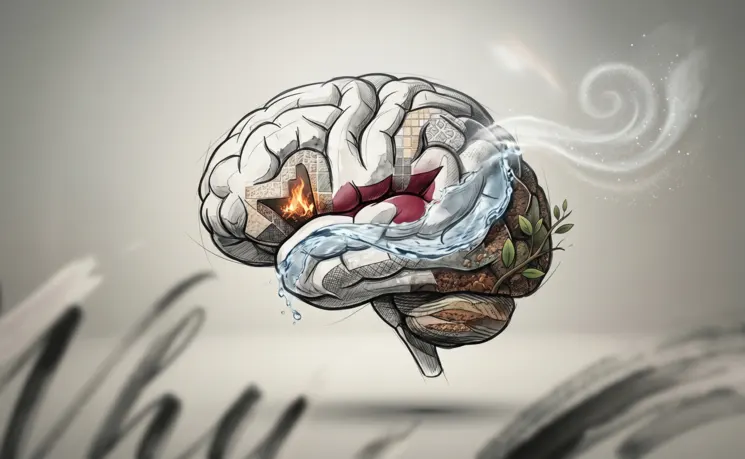
Why Are My Dreams So Weird — The Neuroscience of Strange Imagery
Your office was underwater. Or your mother had a stranger’s face. Or you were flying — not dramatically, just casually, the way you’d take an elevator — through a city that was yours but wrong in every specific. The buildings were familiar but the angles weren’t. The street was real but the light was from another season. Everything was almost right and slightly wrong in a way that, in the dream, you didn’t notice at all.
And then you woke up and thought: what was that?
Not frightening, necessarily. Not even particularly significant. Just strange in a way that doesn’t map onto anything the waking mind produces. The specific quality of things that don’t quite cohere but somehow carry emotional weight anyway. A narrative that keeps changing the rules. A person who is simultaneously two people. A place you’ve never been that you know perfectly.
I’ve spent a long time reading the neuroscience of strange imagery in dreams and the answer I found is the opposite of what most popular accounts suggest. The weirdness is not random. It is not noise. It is not the brain malfunctioning or running on loose associations without purpose.
The weirdness is what happens when an extremely sophisticated pattern-matching system runs without its editor — and starts making connections that the waking mind would never allow.
Some of those connections are the most honest things the brain produces all day.
Quick Answer
- The strangeness of dreams is not a malfunction — it is the product of pattern-matching systems running at full speed without the prefrontal filter that normally prevents unlikely associations from reaching consciousness; the weird combination is the brain finding a connection the editor would have blocked
- The dorsolateral prefrontal cortex — offline during REM — is the brain’s editor; during waking it continuously filters the associations generated by deeper systems, blocking the ones that are too loose, too remote, too implausible; during dreaming it is not running; everything that gets generated reaches experience
- The hippocampus changes its function during REM — instead of consolidating specific episodic memories in their original form, it begins recombining elements across memories, extracting patterns, testing associations; this is the mechanism that produces the composite person, the impossible place, the wrong-but-familiar context
- The dreaming brain prioritises emotional accuracy over logical accuracy — if a wrong face on a familiar body encodes the emotional quality of the person more precisely, the brain uses it; the logic that the face is wrong is not checked; the emotional truth is what the brain is encoding
- The combination of two people into one person in a dream is not confusion — it is the brain identifying a shared emotional pattern across two relationships and representing it as a single entity; the combined person is more emotionally precise than either original
- The impossible architecture of dream spaces — rooms that don’t exist, buildings with wrong physics, cities that are yours but wrong — reflects the hippocampus combining spatial memory with emotional meaning rather than reproducing accurate episodic geography
- The thing that is almost right but slightly wrong — the uncanny quality of many dreams — is the brain generating from templates rather than from specific memories; the template is accurate, the specific details are filled in from available material that matches the emotional frequency
- Verbal overshadowing research — Wilson and Schooler’s finding that putting experience into words changes and sometimes distorts the memory of it — runs in reverse during dreams; the dream produces experience that hasn’t been verbalized, hasn’t been managed by language, and carries qualities that language would have filtered out
- The weirdness is proportional to the distance between what the brain is processing and what the waking mind has been willing to acknowledge; a highly managed, highly edited waking life produces weirder dreams because the gap between what is registered and what is named is larger
- The specific dream images that seem most random — the detail that makes no sense, the object that has no business being there — are almost always carrying emotional information from an unexpected source; they are not decoration; the brain placed them with precision the conscious mind hasn’t caught up to yet
Common Scenarios
A familiar person has a stranger’s face — or is simultaneously someone else. The hippocampus extracted a shared pattern. Two people in the current life carry the same emotional dynamic — the same quality of authority, the same form of unreliability, the same specific combination of trust and exposure. The brain merged them because the merge is more emotionally accurate than either individual. The wrong face is not a mistake. It is the brain reporting that these two people are, emotionally, the same situation wearing different names.
A place you know is completely wrong — rooms that don’t exist, staircases to nowhere, your childhood home in a building that isn’t it. The hippocampus is not reproducing spatial memory. It is recombining spatial memory with emotional meaning. The childhood home template carries the self’s interior structure. The office building carries the current professional context. When these need to be processed together, the brain builds a space that holds both — architecturally impossible, emotionally precise. The impossible room is real. It contains something. The question is what the emotional combination requires a space for.
You are doing something completely ordinary in a context that makes no sense. Making coffee in a building that keeps changing. Having a conversation in a room that is clearly underwater. The ordinary action in an impossible context is the brain processing an emotional situation — usually one involving the current life — through a physical template that encodes the emotional quality of the situation. The underwater office is the ordinary routine that has been under pressure. The shifting building is the context that keeps changing around an activity that should feel stable. The strangeness of the context is the brain’s precision about the emotional quality of the waking situation.
A deceased person appears — and in the dream it isn’t strange that they are there. Because the prefrontal cortex is not running reality-checks. The person is present in the brain’s stored model with the same vivid specificity as any living person. Their presence in the dream doesn’t trigger a contradiction because the system that would notice the contradiction is offline. And they appear because whatever is happening in the current life is running on the emotional frequency of what they represented — not because of grief, not always, but because the nervous system’s file on this person is the most complete available reference for whatever is currently active.
The dream has a narrative that keeps changing the rules. The plot requires certain things to be true, and then they stop being true, and the dream continues without registering this. Multiple story threads run simultaneously and merge and separate without logical connection. Because the hippocampal system during dreaming is not maintaining narrative coherence — it is making associations. Each association generates the next scene. The logic of the previous scene is not being tracked. The result is a narrative that follows emotional logic, not causal logic. It always makes sense in the dream. The sense it makes is emotional, not sequential.
A detail in the dream that makes no sense but carries unusual weight. The red coat. The specific smell. The object that has no business being in the scene. The brain placed it with precision. It is not decoration. It is the intrusion of another memory or emotional file into the dream — pulled in by association with whatever the dream was processing, connected by an emotional thread the waking mind hasn’t identified yet. The detail that seems most random is almost always the most specific address.
What Your Body Already Knows
Woke up from a weird dream and felt the emotional residue clearly even though the content made no logical sense → because the brain encodes emotional accuracy, not logical accuracy; the strange content was the delivery mechanism for an emotional signal that landed precisely; the body carries the signal; the weirdness of the delivery doesn’t reduce the accuracy of what arrived
Recognised something in the dream without being able to explain what → because the brain made a connection that the prefrontal editor would have blocked; the recognition is the connection landing; the inability to explain it is the absence of the verbal framework that would have prevented the connection from forming; the recognition is real; the explanation will take longer
Woke up from a dream where someone was simultaneously two people and understood, in the dream, exactly who they were → because the merged person was emotionally more precise than either original; the brain’s synthesis was more accurate than either component; the waking mind’s confusion is the prefrontal cortex encountering a connection it never would have made and trying to understand it through the framework of ordinary identity
The wrong-but-familiar quality of the dream space stayed with you after waking → because the hippocampus encoded a spatial-emotional combination that exists in the nervous system but not in physical space; the space was real in the sense that the emotional combination it held is real; the waking mind’s confusion is the collision between the spatial impossibility and the felt reality of what the space contained
Woke up knowing the dream was about something specific without being able to name what → because the brain made an association that the editor would have blocked; the knowing is the association; the not-naming is the absence of the verbal processing that normally mediates such connections; trust the knowing; the naming can come later
Why the Editor Being Offline Is Not a Problem
I spent years assuming that the strangeness of dreams was a limitation — what happens when the brain runs without its quality control. The faces that are wrong, the places that don’t exist, the narratives that change the rules. The brain being loose, making errors, not quite working properly.
Reading the neuroscience of the hippocampus during REM changed this for me completely.
The hippocampus during waking life consolidates specific episodic memories in their original form. It is working to preserve the accuracy of what happened. The editor — the prefrontal cortex — is running continuously, ensuring that memories remain coherent, that associations don’t become too loose, that the narrative of experience remains causally sensible.
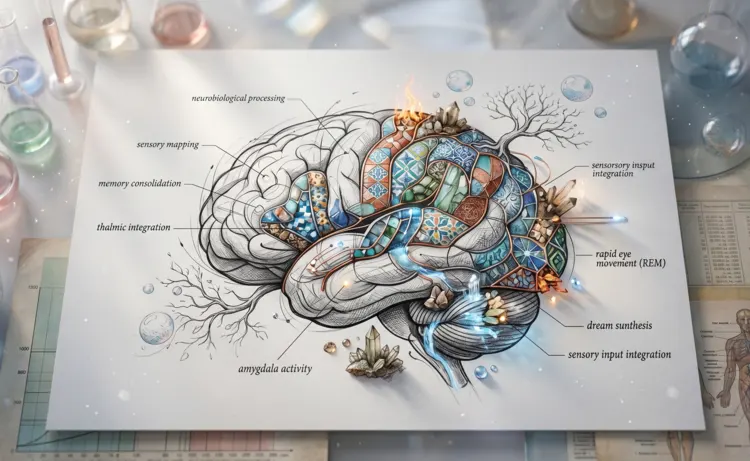
During REM, the hippocampus shifts function. It doesn’t just consolidate — it recombines. It extracts patterns across memories. It tests associations between experiences that waking life would never put in the same sentence. It asks: what does this have in common with that? What does the dynamic of this relationship share with the dynamic of that situation from three years ago? What emotional frequency does this new experience match in the archive?
The weird imagery is the output of this recombination. The face that is wrong is the hippocampus identifying a shared pattern across two people and representing both simultaneously. The impossible room is the hippocampus combining a spatial template with an emotional meaning from a different context. The person who is somehow also someone else is the brain finding what these two people have in common at a level beneath conscious categorization.
The editor would have blocked this. That is the editor’s job — to keep connections within the range of logical plausibility. But the connections the editor blocks are not always wrong. Some of them are more accurate than anything the waking mind produces in the course of a managed day.
I remember reading about hippocampal recombination at around midnight, and then lying awake for an hour not because I was troubled but because I was reorganising everything I had ever found confusing about the specific strangeness of dreams. The merged face. The wrong room. The completely illogical but emotionally correct detail. None of it was noise. All of it was the hippocampus doing something the waking mind is specifically designed to prevent.
Emotional Accuracy vs Logical Accuracy
This is the distinction that unlocks everything about weird imagery, and the one that the popular accounts almost never make explicit.
The dreaming brain does not prioritise logical accuracy. It prioritises emotional accuracy.
These are different targets. Logical accuracy asks: is this coherent? Does this follow from that? Is this representation correct? Emotional accuracy asks: does this encode the feeling? Does this capture the quality? Does this image most precisely represent the physiological state being processed?
When the face of a person you trust is placed on the body of someone who betrayed you, that is not a mistake. It is the brain representing the emotional truth that someone you trusted has started to carry the same feeling as betrayal. The logical error — wrong face — is the delivery mechanism for an emotional accuracy that the brain could not produce through logical representation.
When a place from childhood appears in a context from adult life, it is not confusion. It is the brain identifying that the emotional quality of the current situation matches the emotional quality of a childhood context — and representing both simultaneously because the representation is more accurate than either alone.
The brain is always being accurate in the dream. It is just being accurate about something different than what the waking mind is looking for.
This is the question that changes how you read a weird dream: not “what does this logically mean” but “what emotional truth required an image this strange to represent it?” The stranger the image, the wider the gap between what is being represented and what logical representation could have captured. The weirdness is proportional to the emotional complexity.
Why We Dream — What the Brain Is Actually Doing While You Sleep maps the full architecture of why the dreaming brain operates this way — and what the evolutionary purpose of a system that produces emotional accuracy at the cost of logical coherence actually is.
The Detail That Doesn’t Belong
I want to address the specific weird detail — the one that makes no sense in context, the object or person or image that has no business being in the scene — because it is the most consistently underestimated element of strange dreams and the one I find most revealing.
The dream is set in your current workplace. The meeting is happening. The people are the right people. And there is, in the corner, a specific object from your childhood — a toy, a coat, a piece of furniture — that has absolutely no logical reason to be there.
Most people dismiss this as noise. The brain reaching randomly, filling in background detail with whatever material is available. But the hippocampal recombination system doesn’t work randomly. It works associatively. It pulls in material by emotional resonance, not by availability.
The object from childhood is in the meeting room because something in the current professional situation carries the same emotional frequency as the memory that object is stored with. The object is the association, made visible. It is the brain saying: this situation and that memory are running on the same channel. This situation has the same emotional quality as whatever that object was part of.
This is one of the most precise pieces of information the dreaming brain can offer. The thing that doesn’t belong is the thing that belongs most specifically — not to the logical narrative, but to the emotional address of what the dream was built from.
The question it is asking is not “why is this here.” It is: “what does this room and this object have in common that the dreaming brain found significant enough to combine?”
Why Do Dreams Feel So Real — The Neuroscience of Intensity maps how the brain encodes these strange images with the same neurochemical weight as real experience — why the wrong face and the impossible room feel as real as any Tuesday, and why the emotional residue they leave is physiological data, not imagination.
The Most Common Form of Weirdness — and What It’s Encoding
There is a type of weird dream that appears more frequently in the data than any other, and it is the one that most directly reveals what the weirdness is for.
The dream in which everything is almost right.
Not wildly impossible. Not flying through space or transforming into animals. The dream in which you are at work, but the building is wrong. The dream in which your family is at dinner, but the house is the house from four apartments ago. The dream in which the conversation is the conversation you need to have, but the person you’re having it with has the wrong face.
Everything is almost right. Almost but not quite. Close enough that in the dream you don’t notice. Wrong enough that on waking you do.
This is the hippocampus generating from templates rather than from specific memories. The template is accurate — the emotional quality of work, of family, of the conversation that needs to happen. The specific details are filled in from available material that matches the emotional frequency. The building is wrong because the building isn’t the point. The emotional quality of the situation is the point. The brain built a container for that emotional quality from whatever spatial material was available.
The almost-right quality is the template without the specific. The emotional accuracy without the episodic precision. The brain telling you what the feeling is about, using the most available architecture to hold it, without being particularly concerned with whether the architecture matches the literal facts.
This is not a less honest form of dreaming than a more vivid, more realistic one. It is the same honesty in a different format. The emotional template is precise. The container is approximate. And the question the almost-right dream is asking is: what is the emotional situation that required this template? What current experience has the same quality as this combination of familiar and wrong?
Dream Timestamp
Weird dreams tend to intensify during periods of significant waking-life complexity → the hippocampus recombines more aggressively when more material requires pattern extraction; a life with more unprocessed emotional complexity produces stranger dreams as the recombination range widens
The specific images that are most strange tend to arrive in the later REM cycles → as REM deepens across the night, hippocampal recombination becomes more wide-ranging; the final cycles before waking produce the most remote associations and therefore the strangest imagery
Recurring weird imagery across multiple dreams is encoding a recurring emotional pattern → the same strange combination appearing on multiple nights is the hippocampus finding the same connection repeatedly; it is not stuck; the connection is genuinely present in the current life and is being returned to because it hasn’t been processed
The weird dream that stops being weird → when the emotional situation it was built from resolves, the hippocampus no longer needs to make the connection that produced the strangeness; the dream normalises as the source normalises; the weirdness was never aesthetic — it was functional
The Sentence This Dream Was Trying to Say
“The strangeness is not the brain getting confused. It is the brain making a connection the waking mind would never have permitted — because the editor was asleep. The wrong face, the impossible room, the detail that doesn’t belong — these are not noise. They are the most precise thing the brain produced all day. The question is what connection required an image this strange to represent it.”
The Morning After
The dream was strange. You remember that more clearly than you remember the content — the specific quality of things almost right, the person who was simultaneously someone else, the building that kept rearranging itself.
Before the day frames this as meaningless: the strangeness is the precision, not the absence of it.
The brain’s editor was offline. What got through were the connections the editor has been blocking — the associations between things the waking mind keeps in separate categories, the emotional threads between situations the conscious mind hasn’t connected, the patterns the hippocampus found across experiences the waking mind processes one at a time.
One question worth sitting with, specific and without rushing it:
What did the wrong face belong to? What emotional quality did the impossible room contain? What was the detail that had no business being there — and what does the place it came from have in common with the place it appeared in?
The strangeness is the address. The question is what the address leads to.
FAQ
Because the prefrontal cortex — the brain’s editor, the system that filters out implausible associations — is largely offline during REM. The hippocampus runs its pattern-matching and memory-recombination systems at full speed with no filter. Every association that gets generated reaches experience. The weird imagery is not noise or malfunction — it is the output of a sophisticated system making connections the waking mind would never permit. Some of those connections are more emotionally accurate than anything the edited waking mind produces.
Because the hippocampus identified a shared emotional pattern across two people and represented both simultaneously. Two people in the current life carry the same emotional dynamic — the same quality of authority, unreliability, trust, or exposure. The brain merged them because the merge is more emotionally accurate than either individual. The wrong face is not a mistake. It is the brain reporting that these two people are, at the level of emotional signature, the same situation in different forms.
The hippocampus combines spatial memory with emotional meaning. The impossible room holds an emotional combination that exists in the nervous system but not in physical space — two contexts merged because the brain needed a space that contained both their emotional qualities simultaneously. The architecture is impossible because no real space holds this combination. The brain built the only available container for what needed to be processed. The impossible room is real in the only sense that matters: the emotional combination it holds is real.
They are not random. The hippocampal recombination system works by emotional resonance, not availability. A detail from the past appearing in a current-life context means something in the current situation carries the same emotional frequency as the memory that detail is stored with. The object that doesn’t belong is the association made visible — the brain’s report that this situation and that memory are running on the same channel. The detail that seems most random is almost always the most specific emotional address in the dream.
Because the dream follows emotional logic, not causal logic — and the system that would notice the difference between them is offline during the dream. In the dream, each scene follows from the emotional state of the previous one, not from its causal content. This produces a narrative that is internally coherent to the emotional system and completely incoherent to the logical system. On waking, the prefrontal cortex comes back online and encounters a narrative it never would have permitted. The incoherence it finds is real. The coherence that existed during the dream was also real. Both are accurate accounts of different aspects of the same experience.
Because the reality-monitoring system that would flag the contradiction is offline. The person exists in the brain’s stored model with the same vivid specificity as any living person. Their presence doesn’t trigger a contradiction because the system that would notice the contradiction isn’t running. They appear because whatever is happening in the current life is running on the emotional frequency of what they represented — the brain reaching for its most complete available reference for that emotional dynamic. In the dream, their presence is simply true. The strangeness arrives on waking, when the prefrontal cortex comes back and does the check.
The opposite. The strangeness is proportional to the emotional complexity of what the brain was processing — and proportional to the distance between what was being represented and what logical representation could have captured. A dream that required an impossible room, a merged face, a detail from thirty years ago appearing in a current context — this dream was processing something the waking mind hasn’t had a logical framework for. The weirdness is the brain working harder than usual, not less. The stranger the image, the more specific the emotional address it was built to carry.
Next Stages
Why We Dream — What the Brain Is Actually Doing While You Sleep — the pillar — the complete architecture of why the hippocampus operates differently during REM and what the evolutionary function of unfiltered association actually is
Why Do Dreams Feel So Real — The Neuroscience of Intensity — the strangeness and the conviction together — why the wrong face and the impossible room feel as real as Tuesday morning, and what the neurochemical mechanism behind this is
Why Are My Dreams So Vivid — The Neuroscience of Intensity — when the weird imagery is also unusually intense — what acetylcholine amplification adds to hippocampal recombination in late REM cycles
Why Do I Keep Having the Same Dream — What Recurrence Actually Means — when the same strange combination keeps appearing — what it means when the hippocampus keeps finding the same connection on consecutive nights