Finding Old Coins in the Dirt — When the Age Is the Evidence
These survived.
That’s the first and most specific thing about this dream. Not the value, not the quantity, not where you found them or how deep you had to dig. The age. These coins predate you. They predate everyone you know. They have been through every condition the ground subjected them to — the freeze and thaw, the chemical changes, the weight of everything that accumulated on top of them over time — and they held their form.
Old coins don’t need to be verified. Time already did that.
This is what distinguishes the old-coins dream from finding gold, from an inheritance, from any of the other discovery dreams in this cluster. Gold encodes value that was always yours, waiting for excavation — the finding is about your specific relationship to the thing found. An inheritance encodes something transferred from someone else’s accumulation into your holding. Old coins are different from both: they encode value that has already proven itself through a duration that had nothing to do with you. The survival is the evidence. The age is the information. You are not discovering whether it’s valuable. You are finding something that has already demonstrated its worth through a test that extended across time you weren’t present for.
I want to stay with this distinction because it changes entirely what the dream is asking. The question gold poses is: will you reach what was always there? The question old coins pose is: will you recognize something that was forged before you arrived and has proven itself through survival? The first is about depth. The second is about lineage. The first is personal. The second is positional: where in a longer story than yours does this object place you?
Quick Answer
- The old-coins dream encodes something of proven, time-tested value — not new, not promised, but already demonstrated through survival across a duration that predates the dreamer’s personal history
- The age is the central information: what was found didn’t need to be verified in the present because time already performed the verification; its survival through everything that time subjected it to is the proof of its durability
- The distinction from finding gold is precise: gold encodes value that was always personally yours; old coins encode value that existed in a longer story than yours, that passed through many hands before reaching the moment of this finding, and whose survival is independent of any single relationship to it
- Marie-Louise von Franz, extending Jung’s analytical psychology, described what she called the ancestral pattern — qualities and capacities that precede the individual and are transmitted through lineages, requiring not creation but recognition; old coins encode exactly this
- The dirt is information about duration: what is in the ground is covered rather than gone; the act of finding it is the act of returning to territory that held something, and discovering the holding was effective
- The condition of the coins — weathered, corroded, worn, intact — encodes how much the thing they represent has already been through; the wear is evidence of reality, not of damage; only things that were used show what time does to them
- When the coins are so old you can’t identify their origin, you’re holding something whose full lineage cannot be traced — value whose complete history is larger than what can be reconstructed from this finding
- When there are many coins in one location, the accumulation represents not a single discovery but a convergence — multiple threads of proven value arriving at the same point, suggesting the thing found is richer in its sources than any single lineage
- When the coins begin to sink back before they can be fully claimed, the finding is not sufficient alone — the claiming requires a separate act; discovered value doesn’t automatically transfer into use; it requires the decision that this is now mine, in this present, for this moment
- The dream arrives when something from a longer story than yours has become relevant to your specific present — when the past has something to offer that the present has finally become ready to receive
Common Scenarios
You find a single coin while doing something else — not searching. The accidental-discovery version. The finding wasn’t the point. The coin surfaces at the edge of another activity, in the peripheral territory of your attention, not where you were looking. This encodes the experience of something proven and old becoming relevant through a context that wasn’t arranged for its discovery. A quality in a lineage you weren’t examining. A way of doing something from an earlier chapter of your own life that surfaces through a current situation that activates it. The coin was in the ground of your life all along. You weren’t looking for it until you were in exactly the right position to find it.
You find many coins in one place — an accumulation. The convergence version. Not one old thing but many. Multiple sources, multiple timeframes, all in the same location. The convergence suggests something richer in its origins than any single discovered thing: this ground held many things of proven worth, from many directions, and they have gathered here. In waking life, this version tends to arrive when multiple threads of established value — from different parts of a lineage, different phases of your own life, different sources of proven wisdom — have become simultaneously relevant.
The coins are so old you can’t read the inscription. The illegible-origin version. The coin is real — you can feel its weight, its substance, its having-survived. But the face on it is worn past identification, the date is smoothed away, the origin is unclear. This maps the experience of holding something of evident worth whose complete history cannot be traced. A quality in yourself whose origin you can’t precisely locate. Something you do that works, that has clearly been tested by time, whose provenance you can’t fully reconstruct. The illegibility doesn’t diminish the reality. The coin’s survival is the credential, not its inscription.
The coins are bright beneath the dirt — still shining despite burial. The preserved version. The ground covered it; it was not changed by the covering. Whatever this quality or resource or way of operating is — it went into the ground of your life, was covered by accumulation, and has emerged with its essential properties intact. Not untouched — the dirt was real, the burial was real — but not changed in its fundamental nature. The brightness beneath the earth is the dream’s most specific encoding of preservation rather than mere survival: it didn’t just endure, it retained what it was.
The coins crumble when touched. The fragility version, and the hardest. The age that was the proof of survival is also the source of fragility in this moment. The thing was preserved in the ground; the handling is what it couldn’t survive. This version maps a specific experience: something old and genuinely valuable, made fragile by the moment of recovery. The finding was real. The touching changed what was found. This encodes the specific care required by old things being brought back into use — the need to engage with what was found differently than the engagement that would be appropriate for something new.
The coins begin returning to the ground before you can collect them. The un-claimable version. You found it. It was real. And it begins to sink back before the claiming can complete. The finding is not sufficient alone. The gap between finding and claiming is the dream’s central tension in this version: discovered value doesn’t automatically transfer into active use. Something is required that the finding alone didn’t produce — the explicit, deliberate acknowledgment that this is now yours, in this present, for whatever this present requires.
What Your Body Already Knows
Woke up with the phantom weight and texture — the specific quality of small heavy objects held in the hand → because the somatosensory system was encoding the tactile reality of the coins throughout the dream; the weight and texture of old metal in the hand produces a distinct sensory signature, and the body preserves it after waking as a felt residue rather than a visual memory
Woke up with a quality of responsibility alongside the finding — not burden, something more like obligation → because old things found carry a different weight than new things created; what was handed forward through survival places the finder in a position of being the current carrier; the obligation is specific: what was preserved through time is now, in some way, yours to decide what to do with
Woke up thinking of a person — not any person, someone specific whose way of operating or whose quality you recognized in yourself → because the coins had lineage before you held them; the brain assembled the finding from actual sources; whoever comes to mind is the address of the thing found’s origin
Woke up with a sense of something having been confirmed rather than discovered → because old coins don’t need verification; what the dream produces is recognition of something already established, not surprise at something new; the body registers the confirmation quality differently from the discovery quality — quieter, more settled, carrying a sense of the thing’s prior reality
Woke up and something seemed different about a way of doing something — a quality or approach or capacity — that had been present but underutilized → because the dream was making a reference; the old coins had an address in the actual waking life; whatever quality or capacity seemed different corresponds to what the finding was always about
What Old Coins Are That Gold Isn’t — The Lineage Question
I want to be precise about this distinction because it changes everything about how to read the old-coins dream, and most people collapse it into the gold-finding dream without noticing what’s lost in the collapse.
Finding gold is a personal act. The gold was always yours — compressed into the ground of your specific life, waiting specifically for your excavation. Nobody else was supposed to find it. Its existence is tied to your particular arrival at that depth. The gold is an expression of individuation — Jung’s term for the process of becoming more fully what you specifically are.
Old coins are positional. They were someone else’s before they were yours. Many someone elses. Each coin in the dream has passed through hands you’ll never trace, in exchanges you’ll never reconstruct, in moments that history absorbed long before you arrived. When the coin comes to you, it comes already tested. Not by you. By everything that happened to it before the present moment.
Marie-Louise von Franz, who spent decades extending Jung’s framework into areas he didn’t fully develop, wrote about what she called the ancestral pattern: the qualities, capacities, and ways of being that exist in lineages — not as genetics but as psychological inheritance. These are things that the people who came before you lived and tested and passed forward through the texture of how they operated in the world. They are available to you not through conscious learning but through the recognition that what you’re already doing, or are capable of doing, has been done before — and that its having been done before, in the way it was done, through the conditions it was done through, is the proof of its worth.
What the old coins encode is exactly this: value whose testing predates you, whose survival is the evidence, whose age is the credential. You did not forge these. You did not earn them. You found them — which means the question is not whether they exist or whether they’re valuable, but whether you will recognize them for what they are and engage with what the finding asks of you.
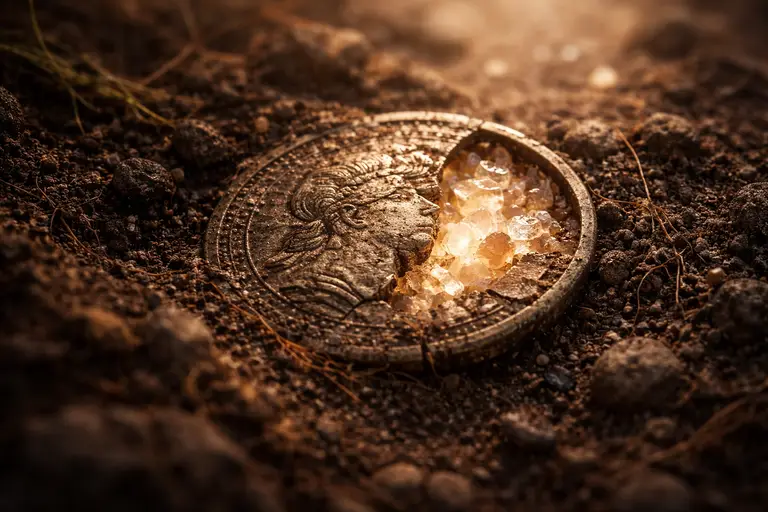
You clear away the dirt slowly. The texture beneath your fingers changes from earth to metal — that specific transition, unmistakable once you feel it. You lift the first coin. The weight is more than you expected. It’s small and it’s heavy, the way old things are heavy, with the specific density of something that has been compressed by time and pressure rather than built to be substantial. You look at the face. The image is mostly gone — a suggestion of a face, a shape that was once a profile, worn smooth by the hands that held it before yours. You don’t know who it depicts. You don’t know what it bought. You know it survived. That’s the whole of what you know, and it turns out that’s exactly enough.
Dream About Money and Success — What the Brain Is Actually Asking maps the framework within which the old-coins dream operates — and why the temporal dimension of survival that old coins encode sits differently from every other form of value in the money-dreams cluster.
The Wear Is Not Damage — What Survived the Handling
Old coins are not pristine. That’s the point.
They are corroded at the edges. The inscriptions are worn. The face on one side has been smoothed almost to suggestion by the thousands of hands that held it in the thousands of transactions that constituted its previous life. The metal has changed color in places where the surface chemistry encountered the acids and minerals of the various grounds it passed through. It is not in the condition it was when it was minted.
This is not damage. This is evidence.
A pristine coin that has never been circulated, kept in a sealed collection, protected from contact — that coin is valuable by the standards of numismatic assessment. But it has no history. Its condition is the condition of something that has been protected from reality. The wear on an old coin is the record of reality. Each handling left its trace. Each burial changed the surface chemistry. Each recovery scratched the face. The coin has been through what it has been through, and it is still a coin.
In the psychology of what old coins represent in dreams, the wear is the credential. The thing found has been used. It was real enough to be used, traded, valued, buried, and recovered. The idealized pristine version of it — the quality or capacity or wisdom that has never been tested, that exists only in theory, that has been protected from the conditions that would prove or disprove its worth — has no wear. Only what was actually real in the world shows what time does to it.
What the worn coin says is: this has been through conditions. It came through them. The coming-through is the proof.
Finding Gold in a Dream — The Recognition of Something That Was Always There maps the comparison — when what’s found has not been through many hands but was always specifically yours, waiting at a depth that required only your specific excavation to reach.
Dream Timestamp
The old-coins dream arrives when something from a longer story than yours has become relevant to the specific present → not when the lineage is being nostalgically honored — when what the lineage holds is actually needed, and the present has become quiet or specific enough to register that the past has something to offer it
The accidental-discovery version arrives when the relevance surfaces without being sought → the coin comes up through an activity whose purpose wasn’t the finding; the dream encodes that the old value became relevant through a context that positioned you to receive it rather than through a deliberate search for it
The illegible-origin version arrives when the lineage is present but incompletely traceable → when the quality or capacity can be recognized as not entirely self-generated but can’t be fully sourced; the dream is accurate about the obscurity; what you’re holding is real and its full history is larger than what you can reconstruct
The coins-sinking-back version arrives when the claiming hasn’t yet been completed → when the discovery has happened but the acknowledgment that this is now yours — for this present, through your own active decision — hasn’t followed; the dream stages the gap between finding and claiming as the thing that determines whether the found value transfers into use
The recurring version means the recognition is still partial → the dream keeps returning until what was found has been fully claimed and integrated into how you operate from it; finding it and knowing it was there is not sufficient; using it is what closes the loop
The Sentence This Dream Was Trying to Say
“What I found had already proven itself before I arrived. It didn’t need me to verify it. It needed me to recognize it — and to decide that its having survived all of this before reaching my hands is exactly the kind of evidence that should change how I move from here.”
The Morning After
The phantom weight of them is still in the hands. The specific density of old things held.
Before the morning takes over: what specifically did you find? Not in the dream’s imagery — in the waking territory that the dream was mapping. What quality, capacity, way of operating, or inherited wisdom has been present in the ground of your life — proven by having been through something, carried forward from before you, available to you through a lineage you’re part of rather than a discovery you generated?
And the second question, which is where the dream is actually pointed: have you claimed it? Not found it, not recognized it — claimed it. Decided that this is now yours, in this present, to use for what this present requires. The finding is the first step. The claiming is the one the dream keeps returning to ask about.
What was old enough to survive everything that happened before you arrived is old enough to be worth the act of claiming it as yours now.
FAQ
Something of proven, time-tested value has become available — not new, not promised, but already demonstrated through survival across a duration that predates you. The age is the central information: these didn’t need to be verified in the present because time already performed that function. Marie-Louise von Franz’s concept of the ancestral pattern describes exactly this — qualities and capacities that precede the individual and are transmitted through lineages, requiring not creation but recognition. The finding places you in a longer story than yours, as the current carrier of something whose worth was established before you arrived.
Gold encodes value that was always specifically yours — compressed into the ground of your personal life, waiting for your specific excavation. The gold is personal. Old coins are positional: they passed through many hands before yours, in exchanges you can’t reconstruct, and their survival is independent of any specific relationship to them. Gold asks: will you reach what was always there? Old coins ask: will you recognize something that was forged before you arrived and has proven itself through a test of time you weren’t present for? The first is about depth. The second is about lineage.
The opposite. The wear is evidence, not damage. Only things that were actually used show what time does to them. A pristine coin protected from reality has no history. The worn coin was real enough to be used, traded, buried, and recovered — it has been through conditions and came through them. In the psychology of the old-coins dream, the corrosion and wear are the credential: this has already proven itself through contact with reality. The idealized pristine version — the quality that has never been tested — has no equivalent wear. The wear is what confirms the real.
The finding alone isn’t sufficient — claiming requires a separate, explicit act. Old value doesn’t automatically transfer into active use just because it’s been recognized. The sinking-back is the dream staging the gap between finding and claiming: between knowing something old and valuable is there and making the active decision that it is now yours, in this present, to use for what this present requires. The dream will keep returning to this scenario as long as the finding has happened without the claiming following it.
The lineage is present but incompletely traceable. You’re holding something of evident worth whose complete history can’t be reconstructed from the finding. A quality in yourself whose origin you can’t precisely locate. Something you do that works, that has clearly been tested by time, whose provenance you can’t fully trace. The illegibility doesn’t diminish the reality — the coin’s survival is the credential, not its inscription. The dream is accurate about the obscurity: what you’re holding is real, and its full history is larger than what can be reconstructed.
No. The dream is not predictive in the external sense. What it’s pointing toward is internal and relational — a quality, capacity, way of operating, or inherited wisdom that has been present in the ground of your life and has become relevant to the current moment. The finding in the dream corresponds to a recognition in the waking life, not an external event. What has been proven through time and survival is available to you. The question the dream is asking is whether you’ll recognize it and claim it as something to operate from — not whether it will arrive externally.
Next Stages
Receiving an Unexpected Inheritance — What Arrives Through Someone Else’s Decision — the received version of the same proven value — when instead of excavating what was in the ground, what had been accumulated by someone else is transferred into your holding; the finding becomes a transfer
Counting Cash — The Audit That Never Produces a Final Answer — what happens when instead of recognizing what’s already proven, you attempt to verify it through measurement — the specific exhaustion of applying a counting instrument to something whose worth exists beyond the reach of counting
Winning the Lottery — When the Change Arrives Without Being Earned — the contrast — when value arrives not through survival and lineage but through external luck; what the mind reaches for when the past has nothing it’s ready to excavate and the present needs rescue from outside
Losing Your Wallet — When the Proof of Who You Are Goes Missing — the inverse — when instead of finding credentials that predate you, the credentials that currently establish your participation in the systems you move through disappear; the contrast between discovered lineage and lost present-tense verification