Sleep Paralysis — What Actually Happens When Your Body Freezes
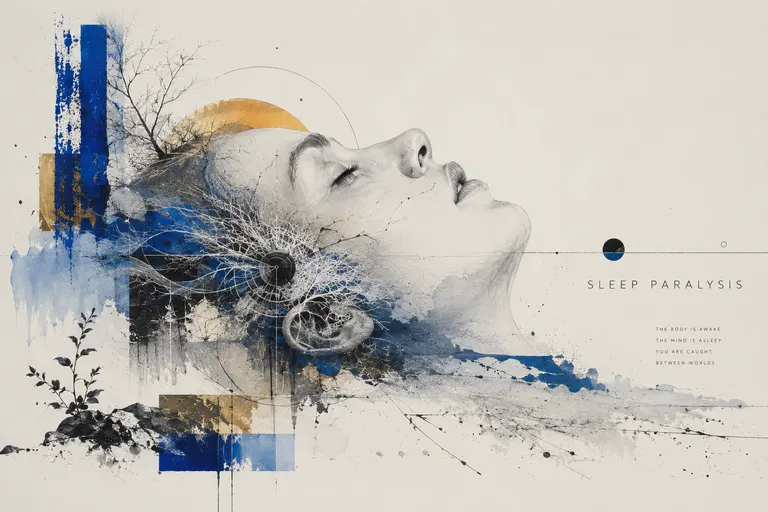
You are awake.
You know this because you can see the room — the ceiling, the edge of the door, the exact quality of darkness that belongs to this hour. You are aware of every detail. Completely, specifically aware.
You cannot move.
Not the slow heaviness of half-sleep. Not the confusion of waking too fast. This is something categorically different. The body is absent — not numb, not heavy, just severed. The signal between intention and motion has been cut at a point you cannot locate. You try to lift your arm. Nothing answers. You try to call out. Nothing comes.
And then — in almost every account I have ever worked with — something else arrives. Not fear, though fear is there too. Something more precise than fear. A presence. The specific, pre-verbal certainty that something else is in this room with you. Not a thought about this. The knowledge of it, already in the chest, already at the back of the neck, before any interpretation is possible.
This is sleep paralysis. And what almost nothing written about it will tell you is this: it is not a dream.
What is happening in those frozen seconds is categorically different from anything in ordinary sleep. You are not unconscious, dreaming of paralysis. You are at the threshold between two states the brain was never designed to inhabit simultaneously — and the presence, the weight on the chest, the figure at the edge of the room are not hallucinations in any ordinary sense. They are the brain doing exactly what the brain does when it faces something it has no protocol for: generating the most precise available explanation, using the most ancient available system.
The demon is real. Not in the way you feared it was. In a more interesting way.
Quick Answer
- Sleep paralysis occurs when consciousness returns before the brain’s REM muscle-suppression system has disengaged — you are fully awake inside a body that has not yet received the signal to move
- The paralysis is not a malfunction — it is a protective mechanism working correctly at the wrong moment, leaving a millisecond gap that stretches into seconds
- The presence, the demon, the figure in the corner is not supernatural — it is the amygdala generating a threat-cause for a state that has no other available explanation
- The chest pressure is a somatic hallucination: the brain creates the sensation of weight to explain why the body cannot move and why breathing feels labored
- Sleep paralysis is not dangerous — you cannot die from it, lose consciousness, or stop breathing; the respiratory muscles are specifically excluded from the suppression
- The same entity appears independently across every culture because it is generated by the same brain mechanism in every human — shared architecture, not shared mythology
- Hypnagogic paralysis (falling asleep) and hypnopompic paralysis (waking up) are two distinct neurological states with different signatures — most people only recognize one type in themselves
- Recurrence is driven by fragmented REM sleep: stress, sleep deprivation, and irregular schedules are the most consistent triggers
- The terror generated during the episode is biological alarm in response to real physiological constraint — it is not symbolic, not predictive, not evidence of mental illness
- Understanding the mechanism does not automatically stop recurrence — but it fundamentally changes what the body does with the experience in the hours after
Common Scenarios
You wake completely unable to move with full awareness of the room around you. The most common form. Hypnopompic paralysis — occurring as you exit REM. The brainstem’s motor suppression signal has not yet released while consciousness has already returned. You are not dreaming of paralysis. You are in the actual gap — the one that is normally invisible because it lasts milliseconds and you have crossed it thousands of times without noticing.
You are certain something is in the room before anything is visible. The amygdala has activated its maximum-threat protocol inside a body that cannot respond. No fight, no flight, no voice. The brain resolves this by generating a cause: something external is responsible for this state. The presence arrives as somatic certainty — in the chest, at the base of the skull — before any visual content forms. Because the alarm precedes the image by hundreds of milliseconds.
Something is sitting on your chest and you cannot breathe fully. The Old Hag of Newfoundland, the Kanashibari of Japan, the Mora of Slavic tradition, the Incubus of medieval Europe. The chest pressure is a somatic hallucination — the brain generates the sensation of weight to explain why the body cannot move and why breathing feels constrained. Every culture without neuroscience gave this weight a name and built a mythology around it.
You try to scream and nothing comes out. The vocal cords remain suppressed along with the rest of the voluntary musculature. Consciousness is trying to activate systems still locked by the brainstem’s signal. The silence is not metaphorical. It is the literal neurological state of the threshold. The voice returns as motor suppression lifts in sequence — and is often among the last to release.
A figure stands at the edge of your vision — at the door, in the corner, above you — and you cannot turn to look directly at it. Peripheral placement is not random. The figure appears where the brain can render it most efficiently — at the edge of focused attention, where presence is registered without the scrutiny that direct gaze would require. This positioning is consistent across accounts from people who have never spoken to each other because the mechanism is identical in every human brain.
It has happened multiple times — several nights in a row, or returning across weeks. Recurrence is not psychological damage and not unusual vulnerability. It is disrupted REM cycling. The body keeps entering and exiting REM without completing the transition cleanly. The question to ask is not what is wrong with you — but what is fragmenting your sleep.
What Your Body Already Knows
Woke up with chest heaviness that took longer to dissolve than the paralysis itself → because the somatic hallucination has a brief neurological latency after motor suppression releases — the sensation was already registered as real, and the body takes seconds to update that registration
Woke up with a terror that felt qualitatively different from nightmare fear — heavier, more biological, less narrative → because sleep paralysis fear is generated directly by the amygdala in response to actual physiological constraint, not by dream content — it is biological alarm, not symbolic dread, and the body registers the difference even when the mind doesn’t
Woke up with the absolute certainty that someone was in the room, even after checking every corner → because the presence-knowledge arrived before full waking and was logged as somatic fact before the rational mind had any information to counter it — checking with the eyes doesn’t undo what the back of the skull already registered as true
Woke up unable to speak or call out even when actively trying → because voluntary muscle control returns in sequence — the effort to speak was running faster than the system releasing, which is why the silence felt like something was actively holding the voice down
Could not return to sleep for a long time even though the paralysis had completely ended → because the amygdala registered a maximum-threat event and requires time to downregulate — the nervous system stays on elevated alert after this kind of alarm regardless of what the rational mind has concluded
Why Your Body Freezes — The Mechanism Behind the Paralysis
Sleep has a structural problem, and the brain solved it with one of the most precise mechanisms in human neurology.
During REM sleep, the brain is extraordinarily active. Heart rate changes. Breathing becomes irregular. The visual cortex fires images indistinguishable from real perception. The amygdala processes emotional material at full capacity. The brain is, in measurable metabolic terms, doing more during REM than during most waking activity.
If the body could move freely during all of this, the results would be catastrophic. A person physically acting out their dreams would injure themselves within the first night of adequate REM. And so the brainstem installs a circuit-breaker: during REM, it sends signals to the spinal cord that actively suppress voluntary muscle movement. Not relaxation. Neurological paralysis — engineered, targeted, and nearly complete, sparing only the eye muscles and the respiratory system.
This is REM atonia. People with REM behavior disorder — where this system fails — punch walls, fall out of bed, and injure their partners by physically enacting dreams. The suppression is not incidental. It is one of the most precisely calibrated protective systems in the sleeping brain.
Sleep paralysis is what happens when this system fails to disengage at the right moment.
Consciousness returns. The motor suppression has not yet received the signal to release. The gap between these two systems — normally invisible, measured in milliseconds, crossed thousands of times in a life without incident — stretches open. You are fully aware. The body is not yet receiving you.
That gap is sleep paralysis. Nothing supernatural. Nothing pathological. A timing desynchronization between two systems that are normally coordinated to a precision you never notice, in a threshold state the brain was never designed to experience while conscious.
What comes next — the presence, the weight, the figure — is not the paralysis itself. It is the brain’s response to the paralysis. The most powerful threat-generation system in human neurology encountering something it has no protocol for. And doing what it always does: generating the most precise available explanation.
You can see the ceiling. The room is the room — the door, the window, the angle of darkness from somewhere outside. Everything is where it should be. And you are in it, fully present, fully aware of every detail. Your hand is there. You know exactly where it is. And when you send the intention to move it — nothing answers. Not pain, not resistance, not heaviness. Absence. The signal leaves and returns with nothing. You try again. Again. And somewhere in the third or fourth attempt, before the mind has finished understanding what is happening, something else begins to arrive.
The Presence in the Room — What the Amygdala Generates When It Has No Other Answer
Every account of sleep paralysis I have worked with contains it. Not the paralysis, not the visual figure, not even the terror — the presence. The specific, pre-verbal, somatic certainty that something else is in the room, already aware of you, before anything is visible or audible.
It arrives in the chest. In the back of the neck. In the changed quality of the air — not temperature, not sound, something more primitive than either. The knowing that something has crossed a threshold you cannot see and is now here, in this space, with you.
I want to be precise about this because most accounts of sleep paralysis treat the presence as secondary — as something that sometimes accompanies the paralysis, one symptom among others. In my years of working with this experience, I have found the opposite to be consistently true. The presence is the primary event. The paralysis is the condition. The presence is the brain’s interpretation of that condition.
Here is the mechanism.
The amygdala operates approximately 300 milliseconds faster than conscious thought. It does not reason, does not weigh evidence, does not ask questions. It classifies. And when it classifies something as maximum threat, it activates the full protocol: stress hormones, heightened sensory attention, and — critically — the generation of a threat-cause. Something is doing this. Something is here.
Sleep paralysis hits every maximum-threat parameter simultaneously: cannot move, cannot flee, cannot fight, cannot call for help, cause unknown, sensory awareness complete, response capacity zero.
The amygdala’s resolution is as elegant as it is terrible: if the body cannot respond, there must be something causing this. Something external. Something present. Something that must be tracked even though the body cannot act.
The presence is that generated cause. The brain’s answer to its own alarm. Constructed with the full precision of the most ancient threat-detection system the human brain possesses — which is why it feels more real than the room, more certain than any ordinary perception. The amygdala does not flag its outputs for rational review. It registers them as ground truth.
You are flat on your back and you feel it before you see anything. Not from any direction — from everywhere, from the quality of the room itself, as if the air has a different density in one specific location that has not yet become visible. Your chest is held. Your head will not turn. And somewhere in the part of the room you cannot reach with your eyes, something has already registered you. Not threatening in the way that has a shape yet. Threatening in the way that certainty is, before it has an object. The back of your neck knew it first. Your chest is running the alarm before you understand what for.
Dream About Losing Control of Your Body — The Somatic Lockdown maps a related state — what happens when the brain produces the experience of physical powerlessness inside a dream, and why it selects that specific image under specific conditions.
The Old Hag, the Kanashibari, the Shadow — Why Every Culture Built the Same Demon
Every culture on earth, across every historical period that left records, independently documented the same entity.
The Old Hag of Newfoundland — an elderly woman who sits on the chest of sleepers, pressing them down. The Kanashibari of Japan — “bound in metal,” immobilization caused by a spirit at the threshold. The Mora of Slavic tradition — a night-pressing entity that arrives uninvited. The Incubus and Succubus of medieval Europe. The Karabasan of Turkey. The Phi Am of Thailand. The Pisadeira of Brazil. The Popobawa of Zanzibar.
Unconnected traditions. No shared mythology. No possible cultural exchange between medieval Japan and medieval Newfoundland. And yet the same entity — at the chest, at the threshold, at the periphery — with the same properties: pressing, watching, threatening, never quite directly visible. Producing the same experience: paralysis, constrained breathing, absolute certainty of presence.
What I find most striking about this is not the mythology itself — it is the precision of what the brain generates without it. Independently. From the same internal mechanism. In every human being who has ever had this experience across all of recorded history.
The shadow figure, the chest-presser, the watcher at the threshold are consistent across unconnected cultures because they are not cultural inventions. They are the brain’s standard output when the amygdala generates a threat-agent under these specific neurological conditions. Same brain architecture, same REM suppression system, same amygdala: same entity.
The brain places the threat at the periphery because that is where the partially-activated visual cortex can render it most efficiently — at the edge of attention, where presence is registered without the scrutiny that direct gaze would require. The weight on the chest explains the constrained breathing. The quality of watching explains the threat-directed attention that cannot be physically deflected. Every detail of the demon is neurologically logical. None of it is accidental.
A brain that produces — from nothing, in seconds — an entity precise enough to build a global folklore across every unconnected civilization is not making an error. It is demonstrating a level of generative precision that deserves to be understood on its own terms.
You can’t locate the figure exactly — only where it isn’t. Not to the left, where you have already looked. Not directly above, where there is only ceiling. Somewhere in the space that remains unexamined — the corner near the door, the darkness the light doesn’t reach. It is precisely there. You know this the way you know something when the body registers it before the mind gets involved. And if you could move — if the arm would answer and the head would turn — you are not certain you would want to confirm what the back of your skull already believes is there.
Dream About Darkness and Fear: The Unknown You Avoid explores what the brain does when it uses the specific quality of obscured perception to process something it cannot approach directly.
Why It Keeps Happening to You — What Your Nervous System Is Actually Telling You
Let me be direct about something, because most writing around sleep paralysis either catastrophizes it or dismisses it — and neither helps someone experiencing it with regularity.
Sleep paralysis is not a sign that something is wrong with your psychology. It is not evidence of unusual spiritual sensitivity, a disturbed unconscious, or unresolved trauma — unless other evidence already points there independently. It is a sign that the transition architecture of your sleep is under mechanical strain. The question it asks is practical, not metaphysical: what is disrupting your ability to move through sleep states cleanly?
The core condition is fragmented REM architecture.
REM sleep requires specific conditions to cycle smoothly: consistent timing, sufficient accumulated sleep pressure, low enough cortisol at the point of entry, physical conditions that allow full relaxation without interruption. When any of these are significantly compromised, REM becomes fragmented — the brain enters and exits the REM state without completing its normal arc. Every incomplete transition is a moment where consciousness and motor suppression can fall out of synchronization. The more fragmented the REM, the more of these moments exist.
What I see consistently in people who come to me with recurrent sleep paralysis: some combination of the following has been running for a while before the episodes begin.
Sleep deprivation is the most common single factor. The body, when it finally gets sleep after significant debt, enters REM aggressively — faster, harder, more chaotically — and the transitions at both ends of those compressed cycles are where the gap opens most easily. Recovery sleep after deprivation is one of the highest-risk periods.
Sustained stress that hasn’t been physically discharged. Cortisol at elevated levels disrupts REM cycling throughout the entire night — not just the cortisol of acute stress, but the chronic background cortisol of pressure that has nowhere to go. The sleep system is one of the first things this load compromises, and one of the last to recover.
Irregular sleep schedules. Shift work, travel, inconsistent bedtimes — anything that prevents the body from establishing stable REM architecture across the night. The transitions become unpredictable when the system cannot build a reliable map.
Sleeping on the back. The data on this is consistent enough to name clearly: supine sleeping increases the frequency of episodes. The mechanism isn’t fully resolved. The correlation is well-documented. If you notice this pattern in your own experience, it is worth addressing before looking for more complex explanations.
What I always tell someone sitting with recurrent sleep paralysis: the experience itself is not the problem. It is the report. Something in the architecture of your sleep is fragmented enough that the brain keeps catching itself in the gap. The question worth asking is not how to make the episode less terrifying in the moment — though that matters — but what is creating the conditions for the gap to keep opening.
Dream Timestamp
Sleep paralysis arrives in the second half of the night → REM sleep concentrates in the early morning hours; the majority of episodes occur between 3am and 7am, when REM periods are longest, most frequent, and transitions most complex
Sleep paralysis arrives after accumulated sleep debt is suddenly repaid → the body enters REM aggressively during recovery sleep, increasing transition frequency and the likelihood of desynchronization between consciousness and motor release
Sleep paralysis arrives during periods of sustained, undischarged stress → elevated cortisol disrupts REM cycling across the entire night — the more chronic the stress load, the more fragmented the architecture, the more transition moments exist for the gap to open
Sleep paralysis arrives when the sleep schedule has shifted significantly → jet lag, new routines, irregular patterns — anything that displaces normal REM timing creates instability the system hasn’t yet calibrated to
Sleep paralysis arrives when sleeping on the back after a period of compressed or poor sleep → the combination of compromised REM architecture with supine positioning represents the highest-frequency condition across documented accounts
The Sentence This Dream Was Trying to Say
“There was no demon — there was only a brain that woke before the body did, doing precisely what brains do when they face something they were never built to face consciously: generating an explanation so precise it became a religion.”
The Morning After
The paralysis is over. You can move. The room is exactly what it is — ceiling, walls, door, the particular quality of morning that belongs to this specific day. You have checked the corners. There is nothing. You know there is nothing.
And yet something in the body takes longer to revise than something in the mind. The certainty of the presence doesn’t dissolve on the same schedule as the paralysis. It metabolizes slower. The back of the skull logs things as fact at a level below rational argument, and rational argument — even correct rational argument — doesn’t reach that level on demand. This is not irrationality. This is the latency between the amygdala’s alarm state and the nervous system’s capacity to downregulate after a maximum-threat event. The stress hormone load from an episode like this does not clear in minutes.
What actually helps in that window: move through the morning in a body that is functional. Put your feet on the floor. Make something warm to drink. Let the nervous system accumulate evidence — body working, environment ordinary, presence absent — and trust that it is revising even when you cannot feel it doing so.
The question worth holding today — not to answer right now, but to carry through the morning and notice what it touches: what in my sleep — and what in the life that surrounds my sleep — has been fragmented enough that the transitions themselves became the event?
FAQ
Sleep paralysis occurs when consciousness returns before the brain has disengaged the REM muscle-suppression system. During REM sleep, the brainstem actively paralyzes voluntary muscles to prevent physical movement during dreams — a protective mechanism, not a defect. When you wake before this suppression releases, you are fully aware but unable to move. It becomes more frequent when REM sleep is fragmented by stress, sleep deprivation, or irregular schedules — conditions that multiply the transitional moments where consciousness and motor release can fall out of sync.
No. Sleep paralysis is not dangerous and you cannot die from it. The REM suppression system spares the respiratory muscles specifically — breathing continues throughout every episode without interruption. The terror you feel is generated by the amygdala in response to real physiological constraint, not in response to actual danger. Your body is working exactly as it should. Episodes end on their own as motor suppression completes its release, typically within seconds to a few minutes.
The presence is generated by the amygdala as a threat-explanation for the paralysis. When you are fully conscious and completely unable to move — with no available response — the threat-detection system activates at maximum intensity and generates a cause: something external is responsible for this state. The figure, the watcher, the entity at the threshold are that generated cause, experienced as real because the system producing them operates below rational review and registers its outputs as ground truth. This is why the same entity appears independently across every culture: shared brain architecture, not shared mythology.
Recurrence means your REM sleep is regularly fragmented rather than cycling cleanly through the night. Each incomplete transition is a moment where consciousness and motor suppression can fall out of sync. The most consistent triggers: accumulated sleep debt, sustained stress with chronically elevated cortisol, irregular sleep schedules, and sleeping on your back. If recurrence continues without an obvious life-circumstance cause, a conversation with a sleep specialist is worth having — not because the episodes are dangerous, but because what is fragmenting your REM architecture has its own name and its own solution.
The distinction is fundamental. A nightmare occurs during sleep — you are unconscious, inside a dream, and the fear is generated within that dream environment. Sleep paralysis occurs at the threshold of consciousness — you are awake, fully aware of your actual room, and the paralysis and presences occur in your real perceived space, not inside any dream. This is why sleep paralysis leaves a different residue than nightmares: the room you were afraid of is the real room, and the certainty of presence was generated in waking awareness, not in sleep.
During an episode: slow, deliberate exhalation activates the parasympathetic system and helps the nervous system begin downregulating the alarm. Attempting to force movement escalates panic without effectiveness — the motor suppression releases on its own timeline. To reduce frequency: consistent sleep scheduling — same bedtime and wake time including weekends — is the single most impactful change. Reducing accumulated sleep debt, managing pre-sleep stress, and avoiding supine sleeping if you notice a correlation are the interventions with the strongest consistent effect.
Next Stages
The Presence in Sleep Paralysis — what the amygdala builds when it cannot explain the paralysis any other way — and why the certainty outlasts every rational check of the room
Sleep Paralysis Shadow Figure — why the same entity appears in every culture, in the same position, with the same neurological function — and what that precision says about the brain that built it
Chest Pressure During Sleep Paralysis — the somatic hallucination that built a global mythology — what the weight on the chest actually is and why the brain generates it with such conviction
Why Do I Keep Getting Sleep Paralysis — what recurrence is signaling about your sleep architecture, and the specific conditions that keep reopening the gap
Sleep Paralysis When Falling Asleep vs Waking Up — two different neurological states that most people mistake for one — why the experience differs and what each version is telling you