Turning into a Statue of Salt or Stone: The Weight of Stagnation
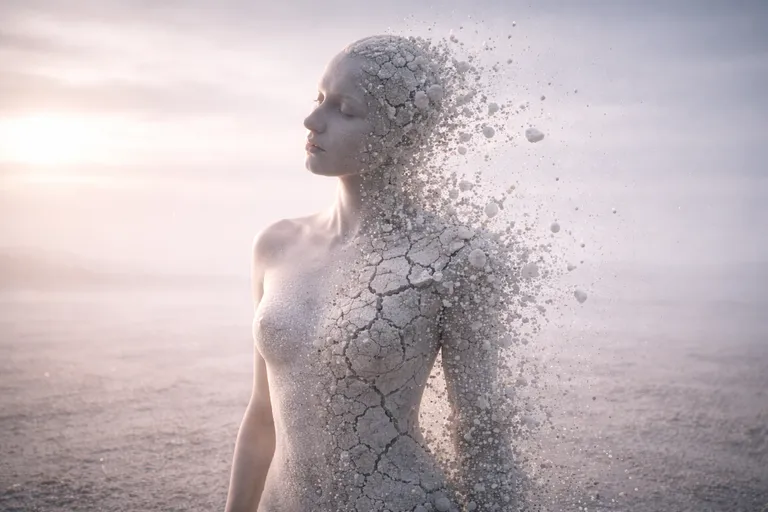
It starts at the feet.
Not with a sound, not with pain, not with any dramatic announcement. You notice it first in the quality of your stillness — that you’ve been standing in one position for a moment too long, and the moment has become longer than it should, and when you try to shift your weight the ground hasn’t released you the way it was supposed to. And then you look down and you understand. Something has happened to the surface of you. Something has hardened. The boundary between you and permanence has moved.
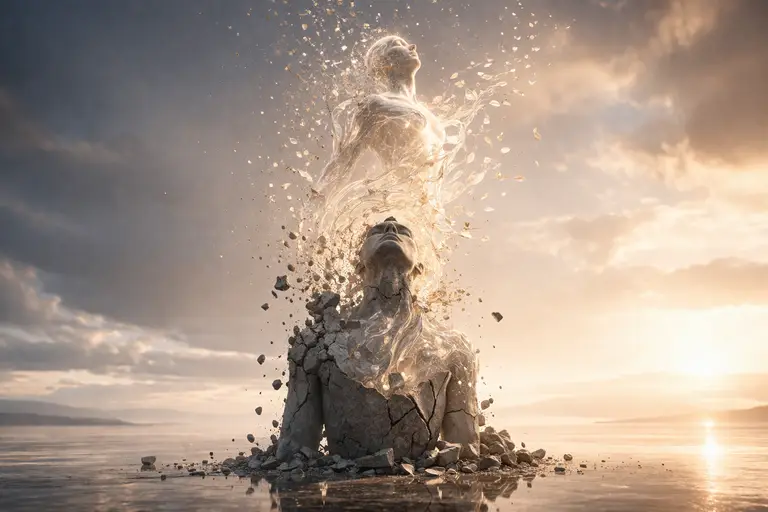
Salt or stone. The dream chooses. Both are forms of the same event: the living thing becoming the fixed thing. The body that moved through the world becoming a body that stands in it, visible, unchanging, no longer in motion.
What I find most precise about this dream is where it begins. Not the heart — that often stays warm longest. Not the mind — that usually keeps running even when everything else has stopped. The feet. The ground-contact. The part of the body that is supposed to be the instrument of leaving. The transformation seals itself at the point of departure first, as if the dream knows exactly where the leaving needs to be prevented.
Quick Answer
- A dream about turning into a statue of salt or stone means the capacity for movement — in some direction, in some domain of your life — has been suspended by a force that has hardened around it.
- The material matters: salt is grief crystallized, or the consequence of looking back. Stone is the deeper hardening — the armor that has become the body.
- Where the hardening begins tells you where the paralysis is entering from.
- Whether you resist the transformation or accept it is information about your relationship to what the hardening represents.
- The statue isn’t the end. Statues can be broken. But this dream is the moment before the breaking, when you’re fully in the fixed state.
Common Scenarios
- Hardening starts at the feet, moves upward → the capacity to leave, to move forward, is what’s being arrested first
- Turns to salt mid-flight or mid-escape → the backward glance is the cause; looking at what you’re leaving is what stops you
- Statue in a public place, others walk past → visibility without agency; you can be seen but cannot participate
- Half-stone, half-living → the transformation is incomplete; part of you is still mobile, part has locked
- The stone cracks at the end → the moment of breaking through what hardened; the transformation reversing
What the Body Registered
- The specific quality of weight — heaviness that isn’t muscle fatigue but something denser → the body ran the experience of becoming immovable
- A particular stillness that transferred after waking → the frozen quality of the statue is still in the limbs for a moment
- The awareness that something specific was behind you when you turned → the backward look, if that was the version, already had its object
- The cold of the material — salt or stone, both carry cold → the body temperature of something that has stopped generating heat
What It Means to Become Stone
Stone is the body choosing permanence over vulnerability.
Every movement through the world exposes you to the possibility of damage. You can be hurt by the things you approach, the decisions you make, the people you’re in proximity to. Stone doesn’t have that problem. Stone has traded the possibility of being hurt for the certainty of not being moved. It can be weathered. It can be chipped. But it cannot be hurt in the way living things can be hurt.
The transformation work this cluster addresses involves movement — through endings, through the spaces between forms, through the disorientation of genuine change. Stone is what the body generates when movement has become too costly. Not a decision made consciously. The nervous system’s final response to accumulated exposure: stop moving. Become fixed. Let the world flow around you rather than through you.
In waking life, this maps to the specific experience of a life that has calcified around a point. The relationship where neither person moves anymore, where both have become fixed in positions they’ve held for so long they’ve stopped questioning whether those positions are chosen. The professional situation where the going-through-the-motions has been happening long enough that the motions have become the substance. The emotional posture — the specific way of being toward the world — that has hardened from a response into an identity.
You feel it happening and you understand what it is before you have a word for it. Something in you has been going in this direction for longer than the dream knows — the dream is just the moment the process crossed the threshold from metaphor to image. You have been becoming this. The dream is showing you the completion of a process that started earlier than you noticed.
Where the Hardening Begins
Salt is the specific material of preserved grief.
Salt is what remains when water has left. When the sea withdraws, when the tears dry, when the ancient ocean of feeling has evaporated, what’s left behind is the crystalline residue of what was once liquid. Salt is grief that has sat long enough to change state — from the flowing form that grief is supposed to take as it moves through you, into the fixed form of something that stopped moving.
The Lot’s Wife reference — the biblical figure who looked back at what she was fleeing and became a pillar of salt — is one of the oldest versions of this image, and it’s precise in a way that deserves attention. The backward glance. Not the leaving itself, not the direction she was heading, but the moment of turning back to look. The look is what caused the solidification.
In waking life, this maps to the version of staying-stuck that involves sustained attention to what was left behind. Not grief that’s being processed — grief that’s being maintained by looking. The relationship that ended and the continued attention to its absence that has become its own structure. The version of yourself that was supposed to have moved on but keeps turning back to what was. The past that would be the past if you let it go and instead has become the present by remaining in your sight.
You’re moving away from something. Or you were. At some point in the moving, something made you turn. The turn felt reasonable — a final look, an acknowledgment, a way of honoring what you were leaving. And in the turning, the salt began. What the dream is precise about is this: the becoming-salt started at the moment of the look, not at the moment of the leaving.
Where the Hardening Begins
This is the dream’s most specific spatial information.
When the transformation starts at the feet, the paralysis is at the level of leaving. Your capacity to exit, to move forward, to depart from where you are — that’s what the hardening is sealing first. Whatever the situation, the dream is saying that the instrument of departure has been compromised. You can see the direction. You cannot yet take the step.
When the hardening starts at the hands, the paralysis is at the level of action. The ability to reach, to create, to build, to change — that’s what has gone rigid. You can feel and think and perceive. You cannot act.
When it starts at the face or the throat, the paralysis is in expression. The ability to be seen, to speak, to be present to others — that’s the place of the hardening. What’s becoming fixed is the capacity for contact.
When it starts in the chest — rare, but specific — the paralysis is emotional. The living center is becoming the fixed center. The part that was supposed to remain soft is calcifying.
Where it starts in your version of this dream is where to look in your waking life.
The Half-Stone Version
The most uncomfortable version is the one that leaves you in between.
Half of you is stone. Half of you is still living. The stone doesn’t hurt — stone doesn’t feel pain, which is part of why the hardening is sometimes chosen or at least tolerated. But the living half does. The living half is attached to the stone half. The living half can feel everything the stone half can no longer feel for itself.
This version maps to the specific experience of being caught between two states — the old form and the new one — without completing the transition in either direction. Part of you has hardened into the old arrangement: the role you’ve been in, the position you’ve occupied, the version of yourself that was supposed to have changed but didn’t completely. Part of you is still alive, still responsive, still capable of motion. The two halves are attached. Neither is fully in control.
The discomfort of this version isn’t just the stone. It’s the awareness that the living part can feel the stone’s weight. That the half that still moves is carrying the half that doesn’t.
That experience — part still mobile, part locked — also lives in the specific exhaustion of transformation that is incomplete. Something is being shed. The shedding hasn’t finished. The new form and the old form coexist. Both are real. Neither is complete.
When This Dream Arrives
During periods of genuine stagnation — not chosen stillness, but the kind that has accumulated past the point of choice.
The statue dream is not the dream of someone who has decided to pause. It’s the dream of someone who started to pause and the pause became structural. The difference is important. Rest is chosen immobility. The statue is immobility that has become self-sustaining, that no longer requires a decision to continue.
The dream arrives when the hardening has reached the level of the image — when the metaphor of being stuck has become concrete enough to render as literal stone.
The Psychology Behind It
The freeze response — the third option after fight and flight, the one that activates when neither of those is possible — is a genuine neurological state. The body stops moving, the heart rate drops, the systems go still. In the original evolutionary context, this was the prey animal becoming invisible to a predator through absolute immobility.
In the modern psychological context, it activates when a situation has become too large or too complex for any available action to feel adequate. The system doesn’t fail — it freezes. The freeze is protective, in the short term. It becomes the problem when it persists.
The dream generates stone as the image for the freeze that has persisted. What was supposed to be a temporary cessation of movement has become a structural fact. The person hasn’t been moving. The not-moving has been going on long enough that the not-moving has acquired mass.
Salt is the specific variant for preserved grief. Stone is the specific variant for the defensive freeze. Both are the same event from different causes.
The Sentence This Dream Was Trying to Say
“I stopped moving long enough that the stopping became my shape.”
The Morning After
The weight of it is still there. Not quite heaviness — more like density. Something in the limbs that remembers being fixed.
Before you move into the day: what’s been fixed? Not what has stopped — what has stopped so long that it stopped feeling like a stop and started feeling like a state?
The dream showed you the statue. The statue is you at some point in this. The question is whether that point is now, or soon, or already past.
FAQ
What does it mean to dream about turning into a statue of salt or stone? It means the capacity for movement in some area of your life has been suspended long enough to become structural — not a pause you’re in, but a shape you’ve taken. Stone represents the defensive freeze, the hardening that trades vulnerability for permanence. Salt represents grief that has crystallized by being looked at rather than moved through. Both are the living thing becoming fixed. The location where the hardening begins — feet, hands, face, chest — tells you where the paralysis is entering your life from.
What’s the difference between turning to salt versus turning to stone? Salt is the material of dried grief — what remains when the liquid form of feeling has evaporated through sustained exposure or through turning back to look at what was supposed to be left behind. Stone is the defensive material — the armor that accumulated through enough exposure that it stopped being armor and became the body. Salt says: you’ve been looking back at something. Stone says: you’ve been protecting yourself for long enough that the protection has become the problem.
What does it mean if only half my body turns to stone? That the transformation is incomplete — you’re caught between the old form and what needs to come next. Part of you has hardened into what you’ve been; part of you is still mobile and responsive. The stone half is the part of your life that has locked: the role, the position, the way of being that isn’t changing. The living half is what’s still capable of movement. The discomfort of this version is specific: the living part can feel the stone’s weight. You’re mobile enough to feel the immobility.
Next Stages
If what followed the petrification was the stone cracking — if the statue broke and what was underneath emerged as something different → dream about skin peeling off to reveal metal meaning — when the fixed surface finally breaks and what’s underneath is harder and different from what anyone expected
If the stone was in a public place and the isolation of being visible but unmovable was the dominant experience → dream about being the last person in a dead city meaning — when the monument stands in a world that moves around it without making contact
If the stillness of the statue was a reaction to your foundations vanishing — if you turned to stone because the ground you were built on was no longer there → childhood house crumbling into the sea: the dissolution of origin — when the petrification is a defense mechanism against the total loss of your earliest psychological anchors.
If the turning to salt happened while looking back — if the backward glance was what caused the solidification → dream about being chased by a killer meaning — when the act of keeping the threat in sight is what prevents the escape from completing