Being the Last Person in a Dead City: The Apex of Isolation
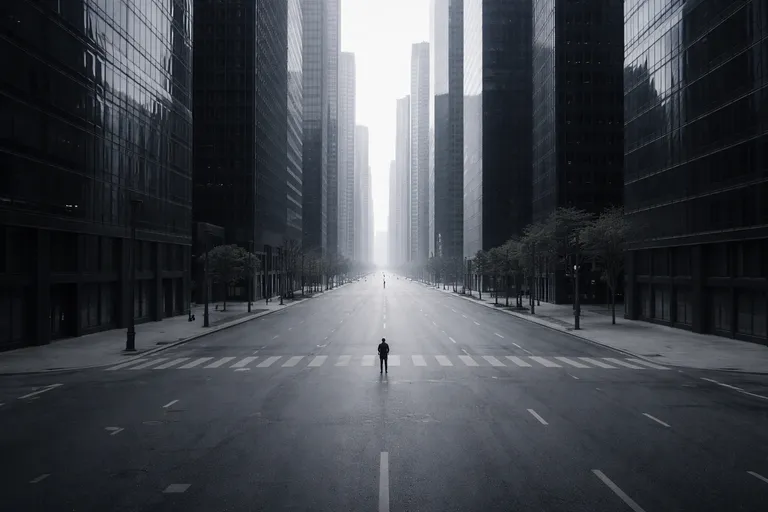
The buildings are still there.
That’s what stays with you after this dream. Not the absence — the presence. Everything human-built is intact: the glass towers, the streets, the traffic lights still cycling through their sequences, the storefronts still displaying what was put there for people who are no longer coming. The infrastructure of a shared life, complete and functional and waiting.
And no one.
This dream has a specific quality that distinguishes it from other isolation dreams. Being alone in nature is one experience — a forest without other people is still a forest, organized around its own logic. A city without people is a different thing entirely. A city is built for people. Every dimension of it — the scale of the buildings, the width of the sidewalks, the rhythm of the signals — is calibrated to human presence. When the people leave, the calibration remains and the thing it was calibrated for doesn’t.
You’re standing in the center of an environment that was built around connection, and the connection is gone, and somehow you are still here.
I’ve worked with this dream long enough to know where it reliably appears. Two different situations produce it, and they look very different from the outside but feel the same from the inside. The first is the person who has achieved so much, focused so hard, and advanced so far in a specific direction that the movement took them past where the people they started with still travel. The second is the person who has become so alienated — from their work, their relationships, their sense of what they’re doing in the world — that the social fabric has stopped feeling real. Both are in the dead city. Both are the last one there.
Quick Answer
- A dream about being the last person in a dead city means the social infrastructure of your life is intact — the structures, the roles, the architecture of connection — and the human presence that was supposed to fill it is gone, or feels gone.
- The city is built for people. Empty city = the framework exists, the life it was supposed to house doesn’t.
- Whether you’re searching for others or simply walking through the emptiness tells you how you’re relating to the isolation.
- The condition of the city matters: pristine and empty means the structures are maintained but hollow; crumbling means the maintenance itself has stopped.
- This dream is not about depression. It’s about the specific experience of having the form of a connected life without the connection.
Common Scenarios
- Walking through empty streets alone → the social world continues its structures without requiring your participation
- Calling out and no one answers → the readiness to reconnect exists; the connections aren’t available to receive it
- City is pristine, perfectly maintained but empty → the form of the life is perfect; the content has been evacuated
- Driving through, every light green, no friction → forward movement without resistance or feedback — a life without anyone to push back
- Finding evidence someone was just here — warm coffee, recent newspaper → the presence was recent; the departure is fresh
What the Body Registered
- The specific quality of the silence — not peaceful, architectural → a silence that has the shape of all the sounds that should be there
- The clarity of detail in the dream — everything unusually sharp → the absence of people makes the objects more vivid, not less
- The particular loneliness that isn’t about being sad → something more fundamental than sadness, closer to the experience of being a species of one
- Something about your current social life was already present on waking → the dead city already had its address
Why a City and Not a Forest
This is the question that opens the dream’s psychology.
An empty forest is nature doing what nature does. The trees don’t need people. The space isn’t organized around human presence. Being alone in a forest is a relationship with something that exists independently of you.
An empty city is impossible. Cities are human artifacts — every dimension of them is built for the presence of people. The scale of the doorways. The spacing of the seats. The height of the counters. The width of the aisles. All of it is calibrated to a body, to groups of bodies, to the continuous flow of human activity that was supposed to be happening here.
When the people leave and the buildings remain, the calibration stays. The city is still arranged for people. It’s just arranged for people who aren’t there.
The transformation this cluster is about involves something similar: the form of a life remaining after what was supposed to fill it has changed. The career structure is there. The relationship patterns are there. The daily architecture is intact. The thing that was supposed to be living inside that structure has moved, or died, or evacuated, and the structure is still standing.
You walk down the center of a street that was built for thousands of people moving through it simultaneously. You have it entirely. The traffic lights change for you — green, yellow, red, green again — performing their function with complete fidelity to a pattern that requires other cars to make sense. The city is doing exactly what it was built to do. There’s just no one here to receive it.
The Architecture That Stays After the People Leave
What remains in a dead city is human effort without human purpose.
The buildings took people years to build. The systems — water, electricity, the underground infrastructure — took generations to develop. The stores arranged their displays for eyes that would never come. The offices still have the furniture arranged for meetings that won’t happen. Every surface is the residue of intentional human activity organized around the assumption of continued human presence.
This is the most specific thing the dead city dream is pointing at: the investment without the return. The structures you built, or the structures you’re inside — professional, relational, social — were built for a human content that has either departed or never fully arrived.
A person who worked for years to reach a level of professional success and arrived to find that the people who were supposed to be there at that level don’t speak the same language they do. A person who maintained a relationship structure long after the relationship’s living content had changed. A person who built their life around assumptions about connection that turned out not to match what connection actually requires.
The dead city is the life-structure still standing after the living content has left.
Searching for a Single Face
This version of the dream carries its own specific weight.
You’re in the empty city, and you’re not simply present in the emptiness — you’re searching. Calling out names. Looking into buildings. Checking streets you haven’t checked yet. The search is real and urgent and the urgency has a specific quality: you need to find someone, not anyone, someone specific.
In waking life, this version maps to the readiness for reconnection that has arrived before the reconnection itself. Something in you has opened to contact, or to the possibility of being seen, or to the specific person whose absence is the address of the dream. The searching is the readiness. The empty streets are the current state of the situation.
The specific desperation of searching in a place that doesn’t return your call is one of the more precise emotional images available in the dream vocabulary. You’re not passive in this version. You’re actively looking. And the city’s silence is the gap between the looking and the finding.
The Pristine Version and the Crumbling Version
These two versions of the dead city say different things.
A pristine dead city — perfect architecture, clean streets, everything maintained, just empty — is the version where the form of the social life is still being kept up. The routines are intact. The external presentation is in order. The calendar has appointments. The appearance of a connected life is being maintained perfectly and the connection itself has been evacuated.
This version tends to appear for people who have continued performing the external structure of engagement while the internal experience of it has become hollow. The meetings still happen. The relationships still have their scheduled contact. The life looks, from the outside and from the maintenance perspective, exactly as it should. And no one is home.
A crumbling dead city is a different stage: the maintenance itself has stopped. The structures are going. The city is being reclaimed by whatever comes next. This version tends to appear further into the process — after the performance of the intact life has also given out, when the structures themselves are starting to show the strain.
The glass coffin buried underground is the individual version of the same experience. The dead city is the collective version: not just my life that has been evacuated of its living content, but the entire social world I was supposed to be inside.
The Green Lights and No Traffic
This is one of the more specific and unsettling versions.
You’re driving. Or moving through the city in some way that normally requires navigation — stopping, waiting, responding to what other people and vehicles are doing. And you realize: every light is green. No stops. No waiting. No friction. The whole city is frictionlessly navigating you toward wherever you’re going because there’s nothing else in it to create resistance.
The frictionless experience is wrong in a specific way. Friction in daily life is what other people are. The person who disagrees with you in a meeting. The relationship that requires you to adjust. The friend who tells you something you didn’t want to hear. The professional environment that pushes back. Friction is the evidence that other people are real and present and have their own weight.
When the green lights never stop, all of that is gone. The world is offering no resistance because there’s nothing in it to offer resistance. And the absence of resistance, in this dream, is the most specific image for the absence of genuine human contact.
When This Dream Arrives
At the point where the social isolation has become total enough to generate a landscape.
This isn’t the dream of an introverted person enjoying solitude. This is the dream of a level of social disconnection — through achievement, through withdrawal, through the gradual divergence of what you understand from what the people around you understand — that has become spatial. The interior experience of being socially unreachable has become a city.
The dream tends to appear after extended periods of one of two things: extreme singular focus that required the suspension of social engagement for long enough that the engagement infrastructure atrophied; or a gradual, quiet disconnection where the daily interactions continued but something in the actual contact was no longer occurring.
The Psychology Behind It
The human nervous system is calibrated for social presence in a fundamental way. Not just preferring it — the baseline regulatory functions of the autonomic nervous system operate differently in the presence of other people than in their absence. The co-regulation of two nervous systems in close proximity is a real physiological event, not a metaphor.
When the social environment has been absent for long enough, or has become sufficiently hollow, the regulatory functions that depend on genuine presence start to run at a deficit. The brain generates the dead city as the image for this deficit — not because you’re sad about being alone, but because the regulatory systems that require other people to function are running without their required input.
The city’s calibration for human presence that isn’t there is the dream’s precise representation: a nervous system calibrated for social co-regulation running in an environment that isn’t providing it.
The Sentence This Dream Was Trying to Say
“The structures of my life are intact — and the human presence that was supposed to fill them has been gone for longer than I’ve been willing to say.”
The Morning After
The silence is still there. The specific quality of being inside something that was built for more than one.
Before the day’s social obligations reactivate the performance of connection: what is the dead city in your life? Not the metaphor — the actual arrangement. Where have the structures of connection remained while the genuine contact inside them has thinned or gone?
The city isn’t asking you to demolish anything. It’s asking you to notice what it’s been like to be the only person in it.
FAQ
What does it mean to dream about being the last person in a dead city? It means the architecture of your social life — the structures, roles, and environments built around connection — is intact, and the human presence that was supposed to fill it is absent. The city is the key symbol: unlike natural solitude, an empty city is a tragedy of calibration — everything built for people, no people there. In waking life, this corresponds to having the form of a connected life without the genuine content of connection: relationships that maintain their structure without their living quality, professional environments where the interaction happens but the contact doesn’t, social arrangements that continue without the actual meeting of people inside them.
Why does everything look so clear and sharp in this dream? Because the absence of people makes the objects more vivid, not less. When other people are present, attention is distributed across faces, conversations, movement, the constant micro-adjustments of social navigation. In their absence, the objects gain all the attention that would normally be distributed among people. The hyper-clarity of the empty city is the perceptual consequence of total social absence: the world becomes extremely visible at exactly the moment it becomes uninhabited.
Does dreaming about an empty city mean I’m depressed? Not necessarily. The dead city dream is specifically about the form of social life persisting without its content — it maps to a particular kind of disconnection that can occur without clinical depression. However, if the dream is recurring and accompanied by a persistent sense that the social world has evacuated, or that you’re performing the structures of connection without experiencing the connection itself, that’s worth paying attention to. The dream is not a diagnosis. It’s an honest image of a current condition.
Next Stages
If the dead city had inhabitants — but they weren’t speaking, weren’t responding, were present only as silent figures → dream about dead person alive but silent meaning — when the city isn’t quite empty but the presence in it has become unreachable
If wandering through the dead city led you to a medical building that was also empty — if the architecture of care was present and unmanned → dream about walking through a hospital with no staff meaning — when the infrastructure of help exists and there’s no one in it to provide the help
If the dead city was the result of a hardening — if the emptiness was preceded by a period of closing off, of making yourself unreachable — the city as the consequence of the statue → dream about turning into a statue of salt or stone meaning — when the isolation wasn’t something that happened to you but something that formed around a choice to stop being reachable
If the dead city wasn’t just silent, but the very light of your future went out — if the darkness reached the highest point of your drive → sun turning black: the eclipse of ambition — when the subconscious signals that the collapse has reached your core goals, marking a total cooling of the energy that once powered your path.