Fighting a Dead Version of Yourself
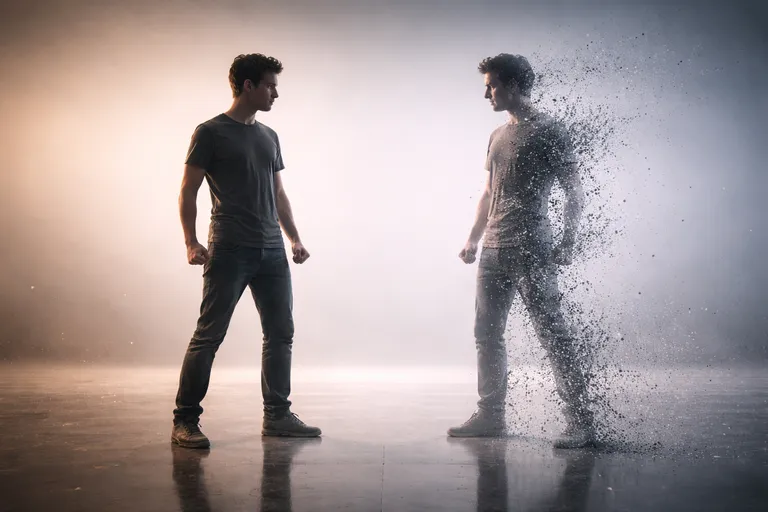
The worst part isn’t the fighting. It’s that the other person knows every move.
You know your own hesitations — the half-second of doubt before a decision, the specific way you pull back when something is about to cost you. Your opponent knows all of it too. Because it’s you. It was you. It has your muscle memory, your instincts, your exact vulnerabilities. The fight is the most impossible kind: against something that understands you from the inside.
I’ve encountered this dream in people who are genuinely in the middle of significant change — who have done real work, made real decisions, committed to a different direction. And the dead version shows up not because the change has failed, but because the change is real and the old version is not as finished as the new version needs it to be.
That’s the specific psychology of this dream, and it’s worth saying plainly: the fight isn’t a sign that something is wrong with you. It’s a sign that you’re in a genuine transition between a form that should have ended and a form that is trying to fully take its place. The fighting is what the transition feels like from the inside when neither version is willing to concede.
Quick Answer
- A dream about fighting a dead version of yourself means the transition between who you were and who you’re becoming hasn’t completed — the old form is still active enough to contest the new one.
- The dead version is dead for a reason: it represents a version of yourself that was supposed to have ended, that had its time and its function and should have been put down.
- It fights back because identity doesn’t change without resistance. The old form has its own survival instinct.
- Who is winning tells you where the transition currently stands: you winning means the new form is dominant; the old version winning means the past still has more force than the present.
- The endless brawl — where neither side wins — is the stalemate of a transition that has been genuinely stuck.
Common Scenarios
- You’re winning and the dead version is going down → the transition is succeeding; the new form is displacing the old one
- The dead version is winning, pinning you → the old patterns, the old psychology, the version you were supposed to have left — all of it has more force right now than the current version
- Neither of you can win → the stalemate of genuine ambivalence; some part of you is still uncertain whether the old version should have died
- The dead version says something specific → the old self has a message; what it says is the most important thing in the dream
- You recognize what the dead version is wearing → the specific version being fought can be identified by the period it’s dressed from
What the Body Registered
- The physical exhaustion of the fight transferred out of the dream → the body ran the full conflict response and it cost something real
- A specific version of yourself — period, appearance, behavior — was already identifiable on waking → the dead version already had an identity before the analysis started
- The specific quality of fighting someone who knows you → not the fear of a stranger but the specific discomfort of being opposed by something that has intimate knowledge of your weaknesses
- The emotional texture of it — anger, grief, something between → what you felt toward the dead version is information about your relationship to who you were
Who Is the Dead Version
Not the version of you from last year. Not the person you outgrew gradually and naturally. The dead version is specifically the form that was supposed to have ended — was put down, or attempted to be put down, or needed to end and didn’t fully — and is still moving.
The transformation this cluster works with is about the complete ending of forms that have served their purpose. When a form ends cleanly, it stays ended. The dead version in this dream is the form that didn’t stay ended. It got up. It has your face and your history and none of the updates you’ve made since it was supposed to die.
In waking life, this corresponds to a very specific and recognizable experience: the old psychology that was supposed to have changed coming back active. The anxiety pattern you spent a year in therapy with, which was genuinely better for a long time, and which has been flaring again. The relationship dynamic you deliberately left, which you recognize showing up in a new relationship. The way of making decisions you identified as harmful and changed, which you caught yourself using again in a moment of stress.
The dead version is dead because it was supposed to be. And it’s fighting you because change isn’t always complete just because it was decided.
It has your face and it moves like you and when it swings it aims at exactly the places you know to protect, because they’re the same places you always aim at when you’re fighting something you know well. The familiarity is what makes it hardest. You’ve practiced protecting against this opponent your whole life. The opponent has been practicing on the same schedule.
Why the Fight Is the Transition
This dream is not a sign that you’ve failed at changing.
It’s a sign that you’re in the middle of changing. The fight is the process.
When a version of yourself ends cleanly — when the transition is complete and the old form is genuinely finished — there’s no fight. The dead version stays dead. The dream generates the fight specifically when the transition is active and contested. When the new form hasn’t fully established itself and the old form hasn’t fully conceded.
I’ve paid attention to when this dream stops appearing for people. It’s not when they finally defeat the dead version in a dream. It’s when, in waking life, the specific pattern or psychology or way of being that the dead version represents stops getting activated. The dream doesn’t stop because you won the fight. It stops because the thing that was generating the fight has finally settled.
The fight is not the problem. The fight is the work.
The Specific Clothes It’s Wearing
Most people who have this dream remember what the dead version was wearing.
Not the general appearance — the specific period of clothing. The clothes of a specific time in their life. Sometimes the worst time. Sometimes a time that was formative in a particular way. Sometimes a version of themselves they haven’t thought about consciously in years, suddenly dressed and present and fighting back.
The clothes are the dream’s most specific piece of identification. The version of yourself it has reconstructed corresponds to the version that was alive during that specific period. The psychology of that time. The ways of coping that were used then. The specific survival strategies that were developed to manage what was happening.
What the dead version is wearing tells you which version of yourself is still active enough to fight. Not which version you’re most afraid of. Which version is still running.
You look at what it’s dressed in and you recognize it immediately — not the clothes themselves, but the period they’re from. You know when this was. You know what this version was trying to survive. And you understand, with the specific clarity that comes in dreams, that this version never entirely accepted the verdict that it was over.
What Happens If You Lose
The dead version winning is the most disturbing version of this dream and the one people are most reluctant to describe.
If the dead version is winning — has you pinned, is choking, is stronger — the dream is being honest about a current imbalance. The old psychology has more force right now than the new one. The version that was supposed to have ended is more operative than the version that was supposed to have replaced it.
This is not a verdict on your character. It’s a status report on the current state of a genuine battle. Battles have phases. The phase where the old version is winning is a phase. What it requires is not despair but information: what specifically is giving the dead version its advantage right now? What conditions in your current life are activating the old psychology at the expense of the new?
The dead version wins in stress, in familiarity, in situations that resemble the original environment that built it. The dead version knows how to win in the conditions it was designed for. The question is what’s making those conditions feel current again.
The experience of being overwhelmed by something from inside that was supposed to have been dealt with has the same quality: not an outside threat, but an internal thing that has more force than expected.
The Stalemate
Neither of you dies. Neither of you wins. The fight goes on indefinitely, both of you exhausted, both still swinging.
This version is the most emotionally specific. The endless brawl is what happens when the transition has genuine ambivalence at its center — when some part of the new version is not actually certain that the old version deserved to die.
Maybe the old version was built for a reason. Maybe what it protected against was real. Maybe the characteristics that made it toxic are the same characteristics that made it functional in its original environment. The ambivalence about killing it isn’t weakness — it’s the recognition that the old version had its own logic, its own integrity, its own reason for being.
The stalemate is what happens when you haven’t yet decided that the old version’s time is fully over. Not because the change was wrong. Because some part of you is still grieving what it cost.
When This Dream Arrives
During periods of genuine, sustained work on changing a fundamental pattern.
This dream doesn’t appear at the beginning of the intention to change. It appears during the actual change — when the new form is real enough to be in conflict with the old one, and the old one is real enough to fight back. It requires both versions to be simultaneously present and operative.
It also appears during periods of regression — when a pattern that had been significantly improved has flared again, when the dead version has been activated by circumstances that resemble its original conditions.
The Psychology Behind It
The consolidation of a new identity requires the deactivation of the competing old one. This isn’t metaphorical — it’s neurological. Old patterns have established neural pathways, reflexive responses, ways of processing information that run automatically. When a new pattern is being developed, both pathways are simultaneously available. The new one can be deliberately accessed. The old one activates under stress, familiarity, or in environments that resemble the original.
The dream generates the fight as the spatial representation of this neurological contest. Two identity-architectures simultaneously active, each with genuine claim on the same body. The fight is both versions responding to the other’s activation. The winner in the dream reflects which architecture is currently more dominant. The stalemate reflects the genuine equipoise of two architectures that are each too well-established to easily override the other.
The dead version is dead in the sense that it was supposed to have been retired. It is not dead in the sense that its pathways no longer exist. They exist. They fire. The work of transformation is the gradual strengthening of the new pathways to the point where the old ones are rarely recruited. The dream charts that progress.
The Sentence This Dream Was Trying to Say
“The version of me that was supposed to be finished isn’t finished yet — and the version that was supposed to replace it hasn’t fully won.”
The Morning After
The exhaustion of it is still present. The specific tiredness of fighting something that knew every move.
Before the day replaces the intimacy of the dream with the management of ordinary life: what is the dead version? Not abstractly — specifically. Which version of yourself, from which period, in which set of clothes?
Because the dead version came back for a reason. It got activated by something in the current circumstances of your life that resembled what it was built for. The dream is pointing at both the version and the trigger.
Both pieces of information are available to you this morning.
FAQ
What does it mean to dream about fighting a dead version of yourself? It means the transition between an old form of yourself and the person you’re becoming hasn’t completed — both versions are active simultaneously, and the old one is contesting the new one’s dominance. The dead version is dead in the sense that it was supposed to have ended, was supposed to have been retired, doesn’t serve the life you’re currently trying to live. It fights back because identity transitions aren’t completed by decision alone. The old architecture has its own survival instinct. The fight is the work of the transition, not evidence that the transition has failed.
What does it mean if the dead version of me is winning? It means the old psychology currently has more force than the new one — not permanently, but in the current period. The dead version wins when circumstances resemble its original conditions, when stress activates familiar responses, when the new identity isn’t yet robust enough to override the old one under pressure. This is a phase, not a verdict. The information it offers is specific: what in your current circumstances is activating the old architecture? What resembles the environment the dead version was built for?
Why does the fight never end in some versions of this dream? Because the ambivalence about the transition is real. The stalemate appears when some part of you hasn’t fully decided that the old version deserved to die — when the recognition of why it was built, what it protected against, what it cost to become it, generates genuine uncertainty about whether its ending was right. The endless brawl is not weakness. It’s the honest image of a transition with unresolved grief at its center.
Next Stages
If after fighting the dead version it spoke to you — if the conflict shifted from physical to communicative → dream about dead relatives talking to you meaning — when the dead thing finally stops fighting and starts talking, which is a different and usually more productive encounter
If the combat ended not in a blow, but in an eruption — if the conflict forced you to expel something sharp or precious from within → vomiting diamonds or broken glass — when the fight transitions from external resistance to the visceral necessity of purging what you’ve been carrying, whether it’s a hardened truth or a fragmented trauma.
If watching yourself fight produced the experience of observing your own conflict from outside → watching your own funeral from the crowd meaning — when the internal conflict becomes visible enough to be witnessed from a distance, which is the beginning of perspective on it
If the dead version finally went down — if the fight completed and the old version was finished — and what followed was the emptiness that comes after an ending → dream about your own death meaning — when the victory over the dead version produces the specific quality of having ended something that was also part of you