Losing Balance and Falling Repeatedly
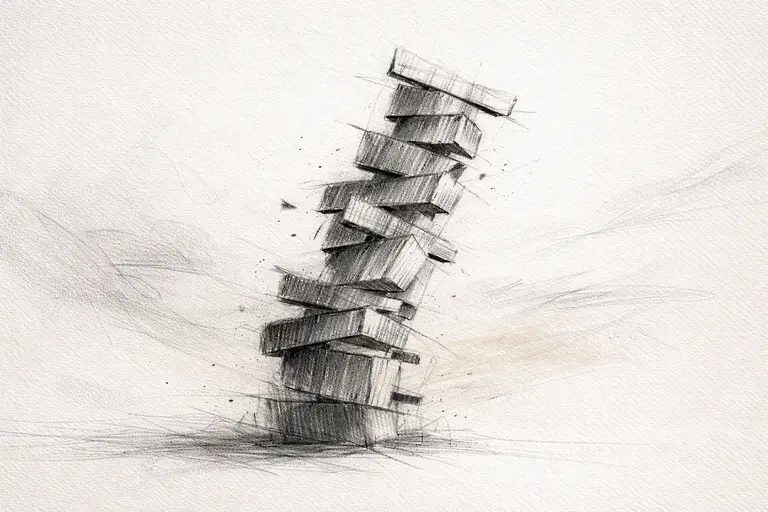
You stand up. You fall. You stand up again.
The specific cruelty of this dream isn’t the falling. One fall would be manageable — a single event, a specific cause, a moment you could identify and learn from. This dream is about the repeat. Each time you manage to get upright, the ground has a different answer. The floor tilts. The footing shifts. The thing that was supposed to hold you doesn’t. And you fall again.
The repetition is the message. Not: something happened that knocked you down. But: the conditions are consistently not supporting your ability to stay upright. Whatever you’ve been doing to find stable ground hasn’t been finding it. And the dream is making you feel, physically, the accumulative experience of that — the specific exhaustion of someone who has been getting up and falling and getting up and falling and getting up and falling.
What I’ve noticed about when this dream appears is the quality of what was lost before it arrived. Not one destabilizing event. A period. A period during which the things that were supposed to provide stable ground — a relationship, a professional situation, a sense of self — have been consistently less reliable than they were. The floor keeps moving. The feet keep going out.
Quick Answer
- A dream about losing balance and falling repeatedly means the conditions for stability in some domain of your waking life are consistently absent — not because you fell once, but because the ground keeps not holding.
- The repetition is specific: this isn’t about a single event but a pattern of instability that has been running long enough to become the baseline.
- What the floor is made of in the dream — ice, tilting deck, shifting sand — tells you what quality the instability has.
- Whether you fall alone or with people watching changes the dream’s weight significantly.
- The hypnic jerk that wakes you from this dream is the body’s own evidence that the fall was real to the nervous system.
Common Scenarios
- Stand up, immediately fall again → stability is consistently unavailable; the conditions don’t support staying upright
- Floor tilts or liquefies as you try to stand → the foundation has become active rather than passive — it’s working against the standing
- Grab for a handhold and find nothing or it breaks → external support structures that should be available aren’t
- Others standing normally while you keep falling → the instability is specific to your current coordinates, not universal
- Finally find a stable surface after many falls → something has been found that holds; the dream is registering that shift
What the Body Registered
- The hypnic jerk — the sudden full-body snap awake that this dream produces → the vestibular system ran a genuine fall protocol and the body responded
- The specific quality of the floor under the feet — its texture, the moment it gave way — still present briefly → the body mapped the instability in real spatial terms
- The exhaustion of repeated getting-up, not of a single fall → the body registered the accumulation
- Whatever was unstable was already identifiable before waking → the instability already had its address
What Balance Is Before It Goes
Balance is something you usually don’t think about because it’s automatic.
The vestibular system — the body’s balance mechanism — runs continuously in the background, making constant micro-adjustments that keep you upright without conscious attention. You don’t think about balancing while walking. The system does it. The ground provides reliable resistance, the body adjusts, stability is maintained without effort.
The dream takes that away. Not by making the body heavy or slow — by making the ground unreliable. The automatic mechanism can’t work when the surface it’s working against keeps changing. The same adjustment that would have kept you upright on stable ground produces a fall on shifting ground because the ground changed while the adjustment was being made.
The losing control cluster maps forms of agency failure. The falling dream is specifically about this: the failure of the reliable surface that agency requires to function. You can try, you can work, you can apply the right approach — and if the ground keeps changing, the right approach produces the wrong result.
In waking life, this maps to the experience of operating in a context where the basic conditions for stable functioning keep shifting. Not one destabilizing event but the sustained experience of adjusting to new instability before the previous adjustment has settled. The professional environment that keeps reorganizing before you’ve found your footing in the current arrangement. The relationship that keeps introducing new dynamics before the previous one was integrated. The sense of self that keeps requiring adjustment before the previous version felt settled.
You make the adjustment that would have worked a moment ago. The floor has already moved. The adjustment that corrects for what the floor was doing sends you in the wrong direction for what it’s doing now. You fall. You understand, somewhere in the dream, that the adjustment was right. The problem is that the ground is not.
The Specific Quality of the Floor
What the dream makes the floor out of is information about the nature of the instability.
Ice — smooth, frictionless, visually indistinguishable from solid ground until weight is applied — is the instability that looks like stability until the moment of commitment. The surface appeared trustworthy. It isn’t. In waking life, this is the situation or relationship that presented as reliable and revealed otherwise at the moment of full investment.
A tilting deck or shifting surface — something that was level and has begun to angle — is the instability that develops over time. The floor didn’t start wrong. It moved. Something that was stable has become unstable through a process you may or may not have been able to see coming. The current instability has a history.
Liquid or dissolving ground — floor that becomes something that can’t be stood on — is the most complete version: the surface has changed its fundamental nature. It’s not just unreliable, it has stopped being the kind of thing that supports standing. In waking life, this is the situation that has changed at a fundamental level — not temporarily difficult but genuinely no longer what it was.
The Hypnic Jerk and What It Means
The hypnic jerk deserves specific attention because it’s one of the only places where a dream produces a measurable, involuntary physical response.
During REM sleep, the vestibular system can be activated by dream content — the brain genuinely runs the falling protocol. When the fall is real enough in the dream’s terms, the brain interprets it as an actual fall and sends an emergency correction signal to the muscles: prevent the landing. The body snaps awake, the muscles fire, the jolt occurs.
This means the dream was real to your nervous system at a level that produced physiological response. Not just imagery. An actual activation of the emergency balance-recovery system. The body believed the fall was happening.
In waking life, this corresponds to the specific quality of certain forms of instability: not just felt, but processed at the level of threat. The nervous system isn’t treating the instability academically. It’s treating it as a genuine physical danger to the self. The hypnic jerk is the body’s evidence that the falling the dream generated was registered at the same level as actual falling.
Why You Can’t Stay Up
The repeated falling contains specific information that the single fall doesn’t.
If you fell once, the message would be: something knocked you down. But you keep falling. You stand, you fall, you stand, you fall. The falling isn’t a response to a single destabilizing event — it’s a response to conditions that consistently don’t support staying upright. The ground keeps changing. Each attempt to stabilize produces another instability.
What this reflects in waking life is the experience of a situation that is actively dynamic rather than passively difficult. Not a single challenge to be overcome. A context that keeps introducing new instabilities faster than the adaptation to the previous one is complete. The adjustment is real. The ground has moved again.
This is why the dream produces exhaustion more than fear. Fear is the response to threat. Exhaustion is the response to sustained unresolvable effort. The body has been trying to balance something that keeps not being balanced, and the trying keeps being required, and the result keeps being the same.
When This Dream Arrives
When instability has been the sustained condition rather than a temporary disruption.
Not after a single significant change — after a period during which the conditions have been consistently unreliable. The ground has been moving for long enough that the brain has registered it as the current state of the environment rather than an anomaly.
It also appears during periods of rapid simultaneous change — when multiple systems that were supposed to be stable are shifting simultaneously, and the adaptation to one is being interrupted by the shift of another before it can complete.
The Psychology Behind It
The vestibular system and the stress-response system share activation pathways. When psychological instability is sustained at a high level — when the sense of reliable footing in life has been consistently absent — the brain can recruit the vestibular system’s actual falling protocols to represent the psychological experience.
This is not metaphor at the neurological level. The brain runs the falling protocol with genuine vestibular components. The body responds with genuine balance-correction attempts. The hypnic jerk is the most visible evidence of this — the body’s emergency response to a fall the brain made real.
The repeated falling, rather than a single fall, is the brain’s representation of the duration of the instability. Each fall is a unit of the pattern. The pattern is what the dream is reporting: not an event but a condition.
The Sentence This Dream Was Trying to Say
“The ground I’ve been trying to stand on keeps changing faster than I can adjust — and the falling keeps happening because the surface keeps not being what standing requires.”
The Morning After
The floor is stable now. You know because you’re in your ordinary morning with gravity working normally.
Before the day resumes its demands: what has been the ground?
Not one event — the condition. What has been consistently shifting under your attempts to find stable footing? The relationship, the professional situation, the sense of self that has been requiring adjustment before the previous adjustment could settle?
The dream showed you the pattern at the physical scale. The question is whether the pattern has a name yet.
FAQ
What does it mean to lose balance and fall repeatedly in a dream? It means the conditions for stable functioning in some domain of your waking life are consistently absent — the ground keeps changing faster than your adaptation to it can settle. This is specifically about the repetition: not a single fall but a pattern of instability that has been running long enough to become the baseline. Your attempts to find footing are real and correctly applied. The surface keeps moving before they can work.
What causes the sudden jolt that wakes you from a falling dream? This is called a hypnic jerk. The vestibular system — the body’s genuine balance mechanism — can be activated by falling dream content. When the brain runs the falling protocol with sufficient intensity, it sends an emergency correction signal to the muscles to prevent the landing. The body snaps awake. This means the dream was processed at the level of an actual physical threat, not just imagery. The nervous system ran the genuine fall-response and used the body to stop it.
Why does the floor keep changing in this dream instead of just being slippery? Because the instability the dream is representing is dynamic rather than static. A slippery floor is a fixed condition — learn to deal with it and the adjustment holds. A floor that keeps changing is a condition that defeats adaptation: each correct adjustment becomes wrong when the floor changes again. The dream generates the shifting floor specifically when the waking situation is actively generating new instabilities rather than maintaining a fixed difficult condition.
Next Stages
If the falling was connected to something being taken away while you fell — if the instability produced a loss of grip on something important → dream about trying to control something that keeps slipping — when the falling and the loss of hold happen simultaneously
If the loss of balance shifted from your posture to your tools — if you tried to act but found your own body refusing to execute the command → hands not obeying you: instrumental paralysis — when the anxiety moves from “where you are” to “what you can do,” signaling a deep breakdown in your perceived agency.
If the repeated falling was happening while others watched without response → dream about being watched but unable to react — when the instability is witnessed but the witnessing produces no help
If the falling eventually produced a complete loss of any stable position — if it led to the full somatic failure rather than just repeated balance loss → dream about not being able to move meaning — when the falling becomes the floor: total suspension of the capacity for any stable position