Time Moving Too Fast to Control
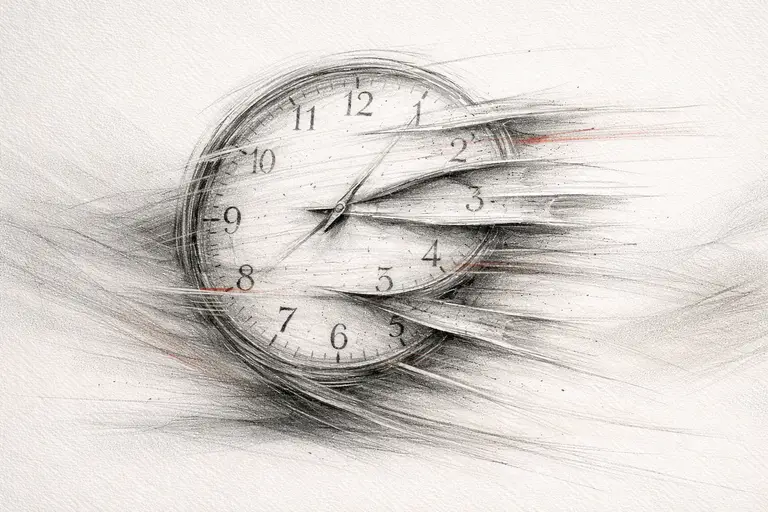
You blink and the day is gone.
Not the ordinary feeling of a busy day moving quickly — something more extreme. The sun crossed the sky while you were reaching for something. The month changed while you were in the middle of a sentence. The year ended while you were still trying to start the thing that was supposed to define it. The clock isn’t running fast. Time itself has become something you can’t inhabit at the pace it’s moving.
What makes this dream different from the dream of being late — which is about a gap between your pace and a specific event’s requirements — is the scale. The late dream has a destination you can see. This dream has no specific destination. The failure isn’t that you’re late to something. The failure is that time itself has stopped being the medium you can move through and has become the thing that’s moving through you. You’re not running behind. You’re being left behind.
The specific quality people describe after this dream is a particular kind of vertigo — not the spinning of balance lost, but the spinning of a reference point lost. If time moves too fast for you to live in, then the before and after that give events their meaning also move too fast. Things happen and are already history before they’ve been experienced. The present keeps becoming the past while you’re still trying to arrive in it.
Quick Answer
- A dream about time moving too fast to control means the pace of change in your life has exceeded the pace at which you can process and respond — you’re not just behind, you’re being outrun by time itself.
- This is different from being late: the late dream is about a specific event’s closing window. This dream is about time in general — the medium of all events — becoming unnavigable.
- The specific form of the speed matters: sun crossing the sky, clocks spinning, months collapsing — each points to a different temporal scale being lost.
- The exhaustion after this dream is the exhaustion of having been in a constant catch-up that couldn’t be won.
- The dream appears when the rate of change has outpaced the rate of integration — when more is happening than can be processed.
Common Scenarios
- Sun crossing the sky in seconds → the largest scale of time has become uncontrollable; months and years are the unit being lost
- Clock hands spinning → the mechanical measure of time has broken; the reference system for tracking duration has failed
- Events happening and already being history before they’re experienced → the present is collapsing into the past mid-occurrence
- You try to do something and the moment for it is already past → the window for each action closes before the action can be completed
- Other people moving at normal speed while you can’t keep up → the temporal dissociation is specific to you; the world is maintaining its pace while yours has broken
What the Body Registered
- The jet-lag quality after waking — the exhaustion of someone who traveled too far in too little time → the temporal acceleration was real enough to register as a physical cost
- The specific disorientation of not knowing where in the sequence you are → the reference points that locate you in time have been disrupted
- A felt sense of things already having passed that you were supposed to have done → the dream’s temporal pressure transferred as a real sense of lateness
- The specific anxiety of not having enough time — present before the analysis — already had its address → the too-fast time already knew what it was measuring against
What Happens When Time Becomes the Problem
Most control dreams are about specific mechanisms failing.
The losing control cluster maps different forms of agency failure. The door won’t open — access is blocked. The voice produces no sound — communication has failed. The legs won’t run — movement is prevented. Each of those is about a specific mechanism.
Time moving too fast is different. Time isn’t a mechanism you use. It’s the context in which all mechanisms operate. When time fails, the failure is comprehensive by definition: everything that was going to happen within time now has to happen within something that has become unnavigable.
The dream of being late imagines a specific door closing on a specific thing. This dream imagines the context itself — the medium through which everything happens — running at a rate that the self can’t inhabit. You’re not late to something. You’re late to the experience of your own life.
In waking life, this maps to the specific experience of a pace of change that has exceeded the pace of integration. Not just busy — overwhelmed at the level where the processing of what’s happening can’t keep up with the happening of it. Events occur and are already requiring response before they’ve been fully understood. Changes compound before the previous change has been integrated. The present keeps being replaced by new present before the current present has been lived.
You look up and the light has changed. You look again and the season has changed. You understand, in the way the dream makes you understand things, that the mechanism which was supposed to hold time at a pace you could live in has stopped working. You’re still here. The time is elsewhere. The two things are no longer synchronized.
The Three Speeds of This Dream
The specific rate and unit of the temporal collapse tells you something about where the loss is operating.
When seconds become hours — when you reach for something and the day is already dark — the temporal loss is operating at the level of daily life. The unit of time that was supposed to allow you to complete a day’s actions has been compressed to the point where completion is impossible. What was supposed to fit has stopped fitting. In waking life, this is the experience of a pace of daily demand that has exceeded what a day can contain.
When months and years blur together — when the sun races across the sky multiple times in a minute — the temporal loss is operating at the level of life trajectory. The seasons, the milestones, the phases of development that give a life its shape are compressing. Things that were supposed to take years are being measured in moments. In waking life, this is the experience of a life phase passing without the sense of having inhabited it — of looking back at a period and finding it already history before it was fully lived.
When time moves so fast that cause and effect break down — when an action no longer precedes its result because the gap between them has collapsed — the temporal loss is at the level of agency itself. If there’s no time between action and outcome, then there’s no room for the action to be directed, adjusted, or controlled. Everything that happens is already happening before it can be steered. In waking life, this is the specific experience of a situation changing faster than any response can be formulated.
The Specific Exhaustion
Most dreams produce fear or frustration. This dream produces exhaustion.
The exhaustion is specific: it’s the exhaustion of someone who has been trying to keep pace with something that cannot be paced with. The effort to catch up with time that’s moving too fast is unwinnable by definition — you cannot run faster than the medium you’re running in. But the effort continues. The brain keeps trying. The body keeps activating the urgency response. And nothing reduces the gap.
That effort — full engagement against an impossible rate — is what produces the jet-lag quality of waking from this dream. The brain didn’t rest. It spent the night trying to inhabit time that was moving too fast to be inhabited. The result is the specific exhaustion of genuine, sustained, unsuccessful effort against a problem that couldn’t be solved by effort.
This is the dream’s most honest piece of information: the approach of trying harder isn’t what this situation needs. More speed in the same direction doesn’t solve the problem. The problem isn’t the speed of the response. It’s the speed of what the response is trying to keep up with.
What the Spinning Clock Is Saying
The clock is the reference system.
Clocks exist to make time legible — to give the continuous flow of time a readable structure that allows coordination, planning, and the orientation of action. When the clock spins in the dream, the reference system has broken down. It’s not just that time is fast. It’s that the mechanism for reading time has become useless.
In waking life, this maps to a specific form of temporal overwhelm: the loss of reference points. When everything is changing at once — when the professional landscape, the relational dynamics, and the personal situation are all shifting simultaneously — the reference points that would normally allow you to locate yourself in time stop being reliable. You can’t read the clock because the clock is spinning too fast. You can’t locate yourself in time because the temporal landmarks have all moved.
The spinning clock is the mind’s honest image for the experience of not knowing where you are in the sequence — not just being behind, but having lost the instrument that would tell you how far behind.
When This Dream Arrives
When the rate of change has sustainably exceeded the rate of integration.
Not during a single overwhelming event — during a period of sustained accumulation that has been running faster than the ability to process it. Deadlines compound before previous ones are completed. Transitions follow transitions before the previous one has been absorbed. Changes require response before previous changes have been understood.
It also appears during periods of existential temporal pressure — when the felt sense of time running out, of milestones passing, of life moving too fast toward its natural end has become acute enough to produce the image at its most compressed.
The Psychology Behind It
The brain’s perception of time is genuinely elastic — it’s not a fixed registration but a constructed experience. During high-stress periods, the stress hormones affect the neural systems responsible for time perception in specific ways: the sense of time pressure increases, the felt duration of difficult moments extends while the felt duration of unattended time compresses.
During REM sleep, when cortisol is elevated from chronic stress, the brain’s time-perception systems can generate experiences of extreme temporal compression. The dream of time moving too fast isn’t metaphor — it’s the actual experience of a time-perception system that has lost its calibration under the weight of sustained high-demand processing.
What the brain builds the content around is specific to the waking situation: which events are compressing, which milestones are passing, which aspects of life are moving too fast to be inhabited. The temporal acceleration is the mechanism. The meaning is the dreamer’s own.
The Sentence This Dream Was Trying to Say
“The pace of change has outrun the pace at which I can process it — and I’ve been using up everything trying to catch something I can’t catch.”
The Morning After
Time is moving at its normal pace now. The seconds are seconds.
Before the day resumes its accumulation: not what’s due or what’s behind — what has been passing without being inhabited? Not the deadlines. The life. The experiences, the relationships, the periods of your own existence that have been moving through you at the rate of events rather than being lived at the rate of experience.
The dream wasn’t about running out of time. It was about being unable to be present in the time that was there.
FAQ
What does it mean when time moves too fast in a dream? It means the pace of change in your waking life has exceeded the pace at which you can process and respond to it. Not just busy — overwhelmed at the level where the medium of experience itself has become unnavigable. You’re not late to something specific. The context in which everything happens is running faster than the self that’s supposed to be living in it. In waking life, this corresponds to periods when events compound faster than they can be integrated, when changes require response before previous changes have been understood.
Why does this dream leave me so exhausted? Because the brain spent the night trying to inhabit time that was moving too fast to be inhabited — which is an impossible task that generates full activation of the urgency and effort systems without allowing any of that effort to produce results. The sustained, unsuccessful attempt to keep pace with unkeep-pace-with-able time is metabolically real. The exhaustion is the direct cost of genuine engagement with an impossible rate. The brain tried. It couldn’t win. It kept trying anyway.
Is this dream about aging or mortality? Sometimes. When the temporal scale is the largest — when years are collapsing into moments, when the sun races through multiple seasons in seconds — the dream can be engaging with the felt experience of life moving too fast toward its end. But this is one version of a broader experience: the sense that time is moving at a rate that prevents full presence in it. Whether that rate is generated by the pace of daily demands or by the felt acceleration of aging, the experience in the dream is the same: time has become something you can’t inhabit.
Next Stages
If the fast-moving time produced a specific deadline panic — if the temporal acceleration was specifically about arriving somewhere before a window closed → dream about being late meaning — when the too-fast time has a specific destination attached to it, when the speed is toward something closing
If the temporal acceleration led to losing all footing — if time moving fast became balance becoming impossible → dream about losing balance and falling repeatedly — when the too-fast time destabilizes the physical ground rather than just the schedule
If the speed made everything stop responding — if time moving too fast led to the complete breakdown of cause and effect → dreaming that everything stops responding around you — when temporal collapse becomes systemic collapse, when being outpaced by time becomes being excluded from reality’s response loop