The New Room Dream — It Was Always There
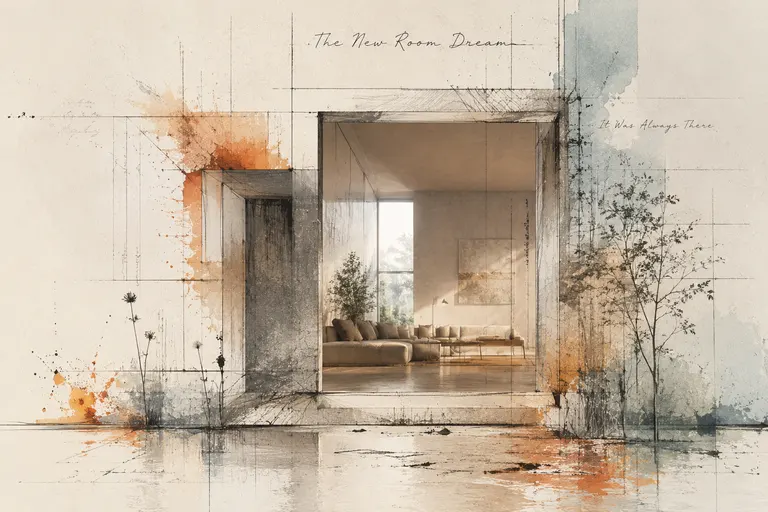
You found a door you’d never opened.
Or a corridor that led somewhere the house shouldn’t have had room for. Or you simply turned a corner in a space you knew completely — had known for years, had moved through thousands of times in the specific way you move through places that have stopped surprising you — and there was a room. A whole room. Real, specific, furnished with its own particular quality of light and air, carrying the distinct sense of a space that has its own history even though you’d never been inside it.
And the feeling the discovery produced was not fear. Not confusion. Something closer to the specific, quiet shock of recognition — the particular quality of encountering something that is entirely new and somehow, simultaneously, entirely yours.
That feeling is the most important information the dream delivered. And it is telling you something that the fear-based reading of house dreams entirely misses.
In all my years of working with the architecture of dreams, the new room dream is the one I find most worth sitting with. Not because it is rare — it is one of the most commonly reported house dreams across every culture and context. But because what it reveals is the most specific and the most consistently underestimated information the brain produces about the self.
The new room was not invented by the dream. It was always in the house. The brain did not create it for you to discover. It revealed it — found the conditions finally sufficient to open the door to something that has been part of the architecture of the self for longer than the conscious mind knew.
The room didn’t appear. You finally found it.
Quick Answer
- The new room in your house dream is among the most significant and most positive dreams the brain produces — it is the discovery of a part of yourself that has always existed but has not yet been consciously entered or inhabited
- The room was always there — the brain did not invent it; what the dream is reporting is not the creation of something new but the revelation of something that was already present in the architecture of the self, waiting for the conditions to be sufficient for its discovery
- The specific quality of the room — its size, its light, its condition, what it contained — is information about the nature of the part of the self that has been found; a large, well-lit room is different from a small, dusty one
- The feeling of recognition rather than surprise is the most specific information the dream delivers — it is the self acknowledging something it already knew, at a level below the conscious management of daily life
- The new room dream arrives when conditions have changed in a way that makes what was previously unavailable now accessible — not because the self has grown into something new, but because something in the current circumstances has opened access to what was always there
- If the new room was in the childhood home, the capacity that has been found is foundational — it was present in the original formation and has been part of the architecture since the beginning
- If the new room was in an unfamiliar house that felt like yours, the brain is showing you a part of yourself that belongs to a version of the self still being formed — a capacity in the self that is becoming available as the self develops
- The recurring new room dream — returning to the same undiscovered room or finding new rooms each time — is the brain reporting that the self continues to exceed its own current self-conception; there is more available than the conscious version has access to
- If the room was locked or inaccessible despite being discovered, the brain has located the capacity but the conditions for full entry are not yet present — the room has been found, the full inhabiting waits
- The question the new room dream always asks is not what the room means — it is what in the current life corresponds to a room that has always been there, that belongs entirely to you, that you have never yet fully entered
Common Scenarios
- You found a room you had never noticed in a house you knew completely. The brain is reporting something specific: there is a part of you that has been present throughout — through all the years of knowing yourself in the current form — that the conscious version of the self hasn’t accessed. Not a new development. A consistent presence that the conditions of the current life haven’t yet made fully available. The shock of finding the room in a familiar house is the shock of encountering in the self something you thought you knew completely.
- The new room was beautiful — large, full of light, better than you expected. The brain is showing you a self that exceeds its current self-conception. The room’s quality is not aspirational fantasy — the brain doesn’t generate wishful architecture. It generates what it is actually processing. What it is processing is a capacity, a dimension, a part of the self that has more substance and more quality than the current conscious version has been operating from. The beauty is accurate. The room is real.
- The new room was dusty, neglected, clearly unused. The brain has found a capacity that has been present but not maintained — a part of the self that exists in the architecture but hasn’t received the conditions it needed to develop. The neglect is not judgment. It is an accurate report on what is there and what state it is in. The discovery is still the discovery. What follows discovery is what happens to the room next.
- The new room was in the childhood home — in the house that was the original formation. The capacity that has been found is foundational. It was part of the original architecture, encoded in the earliest version of the self, and has been present in the structure since the beginning. This is one of the most complete versions of the new room dream: it is not a new development but an original one, finally accessible after years of being unlocated.
- You found multiple rooms — one opening into another, a whole wing of the house that shouldn’t have been there. The self is larger than its current map. Not one undiscovered capacity but several — a whole territory of the self that the conscious version hasn’t been operating from. This version arrives when the current life has been significantly smaller than the actual self for long enough that the accumulation of undiscovered rooms has become the more accurate image.
- You found the room but couldn’t fully enter — the door opened, you saw it, but access was incomplete. The brain has located the capacity. The conditions for full inhabiting aren’t yet present. Something — in the current circumstances, in the current stage of development, in what the self still needs to build or resolve — hasn’t yet created the full conditions for entry. The finding is real. The full access is approaching.
What Your Body Already Knows
- The feeling in the dream was recognition rather than surprise → because the room was always there; the self always had this; what the dream produced was not the encounter with something foreign but the encounter with something owned; recognition is the accurate response to finding what was already yours
- Something expanded in the chest when you found it → because the body registered the discovery before the mind finished processing it; the expansion is the nervous system’s response to the self becoming more available to itself; it is the somatic signature of finding more room
- The specific quality of the room stayed with you after waking → because the brain encoded the discovery at the resolution it deserved; what the room contained, its quality of light, its particular atmosphere — these are information about the nature of what was found; the staying is the dream asking you to read the room
- Something in the current life came to mind when you thought about the room → because the dream had a precise address; the room corresponds to something specific in the waking life; what surfaced is the connection between the capacity found and where it belongs in the current moment
- The dream felt like it mattered more than ordinary dreams → because it did; the new room dream is among the most significant reports the brain produces about the self; the mattering is accurate; the brain is showing you something real about what you contain
The Room Was Always There
This is the thing that changes how you receive this dream — and it requires saying directly, because the conventional reading gets it wrong.
The new room dream is not about discovering something you didn’t have before. It is not the brain generating a capacity, a dimension, a part of yourself from nothing and placing it in the house as a gift or a possibility. The room was always in the house. The self always had this. What the dream is reporting is not creation but revelation.
Think about what the brain is actually doing when it generates this dream. It is not building architecture that didn’t exist — it is accessing the archive of the self and finding something that has been there, encoded, part of the structure, throughout the period of the self’s existence. The room has been in the house through every version of daily life. Through the years when it wasn’t found. Through the ordinary management of a self that was operating from a smaller floor plan.
The conditions changed. Not the room — the conditions. Something in the current moment made what was previously inaccessible available. Something about where the self is now — what it has built, what it has resolved, what it has become or is in the process of becoming — has opened the door to a part of itself that was waiting.
This is the most important thing to understand about the new room dream: the capacity it reveals is not aspirational. It is not what you might develop if circumstances were right. It is what you already have. What you have been carrying without knowing you were carrying it. What the self contains that the conscious version of the self hasn’t yet been operating from.
Your House in Dreams Is Never Just a Building maps the complete architecture of what the house represents in dreams — why every room is a territory of the self, and why the rooms that haven’t been found are as specific as the ones that have.
You turn the corner. The house is the one you know — the familiar proportions, the specific quality of the light in the hall. And there is a door. Not hidden, not obscured — simply there, in a place where there wasn’t a door before, or where you never looked, or where you somehow always forgot to look even though you have been through this hallway more times than you can count. You put your hand on the door. And the knowing arrives before the door opens: this is yours. This was always yours. Whatever is on the other side has been waiting, specifically, for this moment — not because it is new but because it has always been there and you have finally arrived at the turn in the hallway where it is possible to find it.
What the Room Contains
The specific contents of the new room are the brain’s most direct report on the nature of what has been found.
An empty room — spacious, clean, available — is a capacity that is present and ready for use but not yet filled. The self has the space. What goes in it is the next question. This version invites rather than reveals: the room is found and what it will hold is still being determined by the waking life.
A room full of objects — things that feel familiar, things that carry the specific quality of belonging to you — is a capacity that has been active below awareness. The self has been building this space without knowing it. The objects represent what has been developing in the undiscovered territory: insights, capacities, forms of expression or understanding that have been assembling themselves in the part of the self that the conscious version hasn’t been accessing.
A room with a view — windows that open onto something unexpected, a perspective that wasn’t available from the rest of the house — is the specific capacity of a new way of seeing. The room is not a container but a vantage point. What the window showed you is what the newly discovered capacity allows you to see that the previous floor plan of the self didn’t provide access to.
A room that leads to more rooms — a discovery that opens onto further discoveries — is the brain’s report that the self is significantly larger than its current self-conception. Not one undiscovered capacity but a whole territory. The rooms keep opening because the available self keeps exceeding the map.
Why This Dream Arrives Now
The new room dream doesn’t arrive randomly. It arrives when conditions have changed in a specific way — when something in the current life has shifted enough to make accessible what was previously beyond reach.
Sometimes the shift is developmental: the self has worked through enough of what was blocking the door to finally arrive at the room. Something that was keeping the capacity unavailable — an unresolved weight, a limitation of the current circumstances, a developmental stage not yet completed — has shifted. The door became available because the self became ready.
Sometimes the shift is circumstantial: something in the current life has activated the capacity by presenting a situation that requires it. The room was always there, but it is the current moment’s demands that created the conditions for its discovery. The self found the room because the present needed what was inside it.
Sometimes the shift is both: the self is at a stage of development where the current circumstances are aligned with what the capacity requires. The internal and the external arrived at the same moment. The door opened from both sides simultaneously.
What matters in all three cases is the same: the room is real. The capacity is genuinely present. The discovery is not aspirational — it is an accurate report on what exists in the self and what has become available. The new room dream is the brain’s most direct available way of saying: you are larger than your current self-conception. And the evidence is in the room you just found.
The Childhood Home Dream works with the related territory — the original formation and what was encoded there, the foundational capacities that have been present since the beginning and that the brain accesses when the current self needs what the original archive contains.
Dream Timestamp
- Dream arrives during a significant developmental period → the self has reached the stage where something previously unavailable has become accessible; the room is the brain’s report on what that development has made findable
- Dream arrives when the current circumstances are making new demands → the situation has activated a capacity that was present but not previously needed; the room appeared because the present required what was inside it
- Dream arrives repeatedly, finding new rooms each time → the self consistently exceeds its own current self-conception; the recurring discovery is the brain’s sustained report on a self that is larger than the version being operated from
- Dream arrives after a major resolution or completion → something that was blocking access has been removed; the door opened because what was in front of it has been cleared; the room was waiting on the other side of what was resolved
- Single occurrence with great clarity → the discovery was specific and complete; the brain made a precise finding and reported it at full resolution; the clarity is the precision of the report
The Sentence This Dream Was Trying to Say
“The room was always in the house. The self always contained this. What changed is not what you have — what changed is that you finally turned the corner in the hallway where it was possible to find it. The door was there the whole time. So was everything on the other side of it.”
The Morning After
The room is still specific in your mind — its quality, its contents, the particular feeling of finding something that was always yours. Before the ordinary floor plan of daily life reinstalls itself, stay with the discovery.
Not to analyse what the room means in general. To notice what it corresponds to specifically. The room was precise. The brain opened a door to something real that has been part of the architecture of the self — a capacity, a dimension, a form of the self that exists and is now more available than it was before the dream.
One question before anything else: what capacity, what dimension, what form of yourself does the room correspond to — and what would it mean to begin operating from that room, to inhabit it in the waking life, to stop living only in the floor plan that was already mapped and start using what the dream just showed you that you have?
The room is yours. It was always yours. The morning after is the first morning you know it exists.
FAQ
Finding a new room in your house is among the most significant and most positive dreams the brain produces. The room was always there — the brain didn’t create it. It revealed it. The dream is reporting the discovery of a part of yourself that has been present in the architecture of the self throughout, waiting for the conditions to become sufficient for its finding. It is not a new capacity arriving. It is an existing capacity becoming accessible.
Yes — consistently and specifically. The new room dream is the brain’s most direct available report on a self that exceeds its current self-conception. It arrives not when something is going wrong but when something has become available — when the conditions have shifted enough for a part of the self that was previously beyond reach to become findable. Whatever the room contained, the finding itself is the significant event. The self is larger than it knew.
Because the self consistently exceeds its own current self-conception. The recurring new room dream is the brain’s sustained report that the floor plan being operated from is smaller than the actual floor plan of the self. Each room found is a specific capacity, a specific dimension, a specific part of the self becoming accessible. The discovery keeps happening because there is more to discover — not as aspiration, as the accurate account of what the self actually contains.
The brain has found a capacity that has been present but not maintained — a part of the self that exists in the architecture but hasn’t received the conditions it needed to develop. The neglect is not judgment. It is an accurate report on what is there and what state it is currently in. The discovery is still the discovery. The room exists. What follows discovery is what happens to the room next — and that next part belongs to the waking life.
The brain has located the capacity but the conditions for full inhabiting aren’t yet present. The finding is real and significant — the room has been discovered, its existence acknowledged. The full access is approaching. Something in the current circumstances, the current stage of development, or what the self still needs to build or resolve has not yet created the complete conditions for entry. The door is known. The full opening waits for what is still being assembled.
The room corresponds to a capacity, a dimension, a way of being or expressing or understanding that has been present in you but not yet consciously inhabited. It could be a creative capacity that hasn’t been given space. A relational depth that hasn’t been expressed. A form of intelligence or sensitivity or strength that exists in the architecture of who you are but hasn’t been operating from. The specific quality of the room — its size, contents, light — tells you what kind of capacity it is. The waking question is: where does this belong in the actual life?
Next Stages
House on Fire Dream — the counterpoint to discovery — when the structure transforms rather than expands, and what the fire reveals that was underneath the old architecture
Someone Breaking Into Your House Dream — when what enters the house is not discovered from within but crossed from outside — the boundary version of the house dream
Dream About Your Childhood Home — the foundational rooms — what was encoded in the original house and why the brain returns to the archive when the current self is in question
Dream About House Collapsing — when the structure that the self has been standing on can no longer hold — the floor beneath the new room and what happens when it fails