Your House in Dreams Is Never Just a Building
You knew the house.
Not in the way you know addresses or floor plans — the way you know a place that has been part of your internal architecture long before you could name it. The rooms were yours. The light was specific. The particular quality of the air in that hallway, or the weight of that door, or the specific sound the stairs made — familiar in the way only the places the brain has been carrying can be familiar.
And something was wrong with it. Or something had changed. Or there was a room you had never seen before, or a room you recognized but couldn’t enter, or the structure itself was different from how it should have been — not dramatically, just differently enough that the wrongness registered before you could locate it.
You woke up with the house still present. Not as a memory — as a weight. The specific quality of a place that mattered staying in the body after the sleep had dissolved. You’ve been carrying it since.
Here is what you need to understand before anything else.
The brain didn’t show you a house. It showed you yourself. Not as a metaphor — as the most precise available architectural survey of your current internal state. The rooms that appeared and the rooms that didn’t. The condition of the walls. The doors that opened and the doors that wouldn’t. The new room you found and the basement you didn’t go into. Every detail was a specific report on the structure of who you currently are and what is currently happening inside that structure.
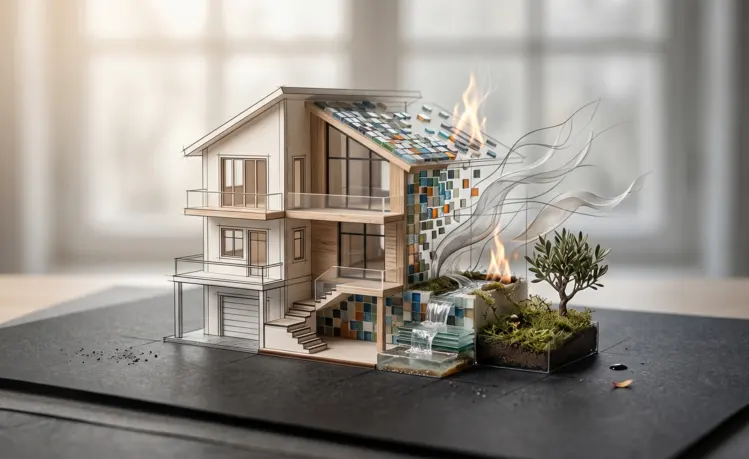
The house in the dream is the brain’s most complete available image for the self. Not because psychology said so — because the brain built it that way. The home is the only place in human experience that is simultaneously built and inhabited, constructed and lived in, chosen and known from the inside. The brain uses it because it is the only available image that is both architecture and self simultaneously.
The dream didn’t build a metaphor. It filed an inspection report.
Quick Answer
- The house in your dream is almost always a representation of yourself — not your personality or your thoughts but the structural reality of your current internal state, rendered in the most complete architectural image available to the brain
- The condition of the house is the condition of the self — crumbling walls are not a symbol of instability, they are the instability rendered directly; a locked room is not a metaphor for something hidden, it is the location of something known but not yet approached
- The rooms that appear in the dream and the rooms that don’t are both information — what is accessible tells you what is currently available in yourself; what is locked or missing tells you what has been placed beyond the current reach of conscious attention
- A house you recognize but that seems wrong is the brain reporting that something in your internal structure no longer matches the map you were using — something has changed that the conscious mind hasn’t fully updated to
- A room you’ve never seen before is not a malfunction of the dream — it is the discovery of a capacity, a dimension of yourself, that existed but hadn’t been entered; new rooms are among the most positive dreams the brain produces
- A house on fire is transformation at the level of structure — not the loss of the self but the burning away of what the self no longer needs to carry; the brain reaches for fire when what needs to change cannot be repaired, only transformed
- An intruder in the house is a boundary that has been breached — something from outside the self has entered the inside; the specific nature of the intruder and how the dream responds to it tells you what the breach is and how the self is currently handling it
- A house flooding is emotion that has exceeded the container — not controlled expression but overflow; what was stored below the surface has reached the level where the structure that was separating it from the rest of the house is failing
- A collapsing house is the brain’s report on structural integrity — something that was being stood on or relied upon can no longer hold its current form; not a prediction of catastrophe, a report on what is already in the process of failing
- The childhood home is the original archive — the specific, intact record of who you were before you chose who to become, preserved at the resolution it was encoded at and accessible in sleep at full precision
Common Scenarios
- The house was yours but something was wrong — not dramatically, just differently enough that the wrongness registered before you could locate it. The brain is reporting a change in the internal structure that the conscious mind hasn’t fully processed yet. Something in how the self is organized has shifted — a room feels different, the proportions are off, a familiar hallway leads somewhere unexpected. The wrongness you felt was accurate. Something has changed. The dream is showing you the change before the waking mind has finished naming it.
- There was a room you had never seen before — a door you’d never opened, a corridor that led somewhere the house shouldn’t have. This is among the most significant house dreams the brain produces. The new room is a part of yourself that has always existed but has not yet been entered. A capacity, a dimension, a form of self-expression or understanding that the current version of your life hasn’t accessed. The discovery isn’t random. The brain opened that door because conditions are now sufficient for what’s inside to be approached.
- The house was your childhood home — the specific house, with the specific rooms, carrying the specific quality of that time. The brain is accessing the original archive — the record of who you were before the choices that created the current version of yourself. The childhood home appears when the current self is under question, when something about how you became who you are is being revisited, when the brain needs the most complete available record of the person before the person was decided.
- Someone was in the house who shouldn’t be there — inside, moving through it, occupying spaces that belong to you. The boundary between self and world has been crossed. Something from outside — a person, a dynamic, a force — has entered the internal space. The dream is documenting the breach. How the intruder moved through the house, which rooms they entered, whether they were threatening or not — each detail is specific information about the nature of what has gotten inside and how it is currently being processed.
- The house was on fire. The brain reached for the one force that transforms by consuming. Not destruction — transformation. Something in the structure of the self can no longer be maintained in its current form, and the process of its change has a quality of totality to it. What the fire was consuming specifically — which rooms, which walls, which parts of the structure — is the most specific information the dream provides.
- The house was flooding, or collapsing, or the foundation was failing. The structural reports are the brain’s most direct communication about integrity under pressure. Water represents what has been held below consciousness — emotion, knowing, the material that was being contained. When it floods the house, the container has failed. Collapse is the report on what can no longer hold. In both cases: not a prediction of catastrophe. A structural survey that has found something that cannot continue in its current form.
What Your Body Already Knows
- Woke up with the house still present — not as a memory but as a weight, a specific quality of a place still occupying the body → because the brain accessed one of its most loaded archives and the access doesn’t dissolve instantly; what the house contained is still being processed; the weight is the processing
- The specific quality of the light or the air in the dream was more precise than ordinary memory → because the dream accessed the archive at full resolution, without the attenuation that waking memory applies; what you felt was the place as it was encoded, not as it is recalled
- Something about your waking life came to mind immediately after the house — before you had decided to think about it → because the dream had a specific address in the present; the house was being used to process something current; what surfaced is the connection between the house and what is currently happening in the self it represents
- The specific room in the dream stayed with you more than the rest → because that room carries the most specific information; whatever is in that part of the house is what the brain was most directly processing; the staying is the signal
- You felt, in the dream or immediately after, that the house being wrong was somehow about you rather than about the house → because it was; the brain was not dreaming about architecture; it was showing you yourself; the feeling of it being about you is the most accurate response available
The House Is the Self — More Specifically Than You Think
The idea that the house in dreams represents the self is not a modern psychological theory. It is one of the oldest consistently documented interpretive principles in recorded dream history — appearing independently in cultures separated by thousands of miles and centuries, arriving at the same conclusion not through influence but through the consistent accuracy of the observation.
But the version of this idea that circulates — “the house represents the self, the basement is the unconscious, the attic is memory” — is incomplete in a way that misses the most useful part.
The house doesn’t represent the self in general. It represents the current structural state of the self specifically. Not who you are as a fixed thing. What the architecture of who you are looks like right now, in this moment, under the current conditions.
A building inspector doesn’t come to a house with a list of what houses mean. They come with a checklist of what this house currently is: what is intact, what is failing, what has been modified without permits, what is stable and what is under stress. The inspection report doesn’t tell you about houses in general. It tells you about this house, today, under these conditions.
The dream is the inspection report.
And the report is specific. The condition of the walls tells you something about the current integrity of your boundaries — not symbolically, but in the direct correspondence between what structural integrity means in a building and what structural integrity means in a person. The locked room tells you something about what exists in you but is not currently being approached. The new room tells you something about what has become available. The fire tells you something about what is in the process of transforming.
The specific house, in the specific condition, with the specific rooms accessible and inaccessible — this is the brain’s most complete available rendering of where you actually are inside yourself right now.
Each Room Is a Territory
The house the brain generates has rooms. And the rooms are not randomly placed.
The basement — or whatever is below — is the territory of what has been stored out of immediate awareness. Not because it is dangerous or shameful but because it required containment — because it was too large or too complex or too unresolved to be carried in the daily architecture of the conscious life. What is in the basement is real. It is accessible. The dream that places you in it, or near it, or aware of it without entering, is the brain surfacing what has been stored there and asking what you want to do with it now.
The attic is the archive. The older material, the memory, the versions of yourself that existed before the current one. Not forgotten — stored. The attic in a dream carries a different quality from the basement: it is above rather than below, lighter in weight, more accessible if you go looking. The attic appears in dreams about the past — specifically, the version of the past that is still being carried as part of how the current self was made.
The bedroom is the territory of the most intimate self — what is known about you that is known to almost no one else. The kitchen is nourishment and sustenance and the daily provision of what keeps the self functioning. The living room is the social self — the version presented to others, the space where the interior becomes available for company. Each room carries its specific territory. And the condition of each room carries information about that territory specifically.
You’re standing in a room you know. The proportions are right. The light is the specific quality of that light, at that time of day, in a place you stopped living in years ago. And the knowing arrives not as a thought but as a physical sensation — the specific weight of being in this room, in this house, as the version of yourself that existed here. You haven’t been this person for a long time. The dream brought you back to them not as a memory but as a present-tense fact. They are here. You are them. The room is real. And something in the room — something you haven’t looked at yet — is why the dream brought you back.
Why the Same House Keeps Appearing
If you have been dreaming about the same house repeatedly — returning to it across different dreams, across months or years — the brain is returning to the same structural report because the same structural condition persists.
Not because you can’t stop thinking about it. Not because the house itself has significance that requires processing. Because whatever the house is representing in your internal architecture is still in the same state it was when the first dream arrived. The self the house maps is still in the same condition. The room that was locked is still locked. The crack in the foundation is still there. The new room is still unexplored.
The recurring house dream is the brain filing the same inspection report because the inspection consistently finds the same result.
This is the most specific information recurring house dreams provide: not just what is present, but that it has been present for long enough to establish a pattern. Something in the architecture of who you are has been in a particular state for long enough that the brain has developed a consistent image for it. The house is accurate. The condition it keeps showing is accurate. The dream recurs because the condition persists.
When the condition changes — when the locked room is opened, or the foundation is addressed, or the new room is entered, or the fire completes its work — the dream changes. The house appears in a different form, or with different rooms accessible, or in better condition, or not at all. The inspection report updates when the building updates.
The Cheating Dream — Why Your Brain Runs This Simulation works with a related mechanism — how the brain uses its most precise available images to report on the current state of something significant, and why the report keeps arriving until the underlying condition changes.
The House You Don’t Recognize That Feels Like Yours
This is one of the most specific and most commonly reported variations of the house dream — and the one that produces the most productive confusion.
The house is unfamiliar. You haven’t been there before. The rooms don’t match any floor plan in your actual experience. And yet in the dream you know, with the specific certainty of dream-knowledge that requires no explanation, that this is your house. That you live here. That this is the place that belongs to you.
The brain is showing you a version of yourself that hasn’t been fully inhabited yet.
The unfamiliar house that is somehow yours is the brain’s image for a self that is in the process of becoming — a version of you that is forming, that is more complete or different or expanded than the current version, that you haven’t yet fully moved into. The floor plan is unfamiliar because you haven’t lived there yet. The knowing that it’s yours is the brain’s recognition that it belongs to you regardless — that the development of this version of yourself is already underway, even though the conscious mind hasn’t finished understanding what it’s becoming.
If the unfamiliar house was large, or beautiful, or had rooms that were better than what you were expecting: the brain is showing you a version of yourself that exceeds your current self-conception. Not wishful thinking — the brain doesn’t generate wishful architecture. It generates what it is actually processing. What it is processing is a development already in progress.
Dream Timestamp
- House appears in good condition, accessible, familiar → the self is in relative structural integrity; the dream is maintenance rather than emergency; what is accessible is accessible in the waking self as well
- House in poor condition, crumbling, neglected → something in the structure of the self has not been attended to; the neglect is specific — which part is failing tells you which territory of the self has been without the attention it required
- House locked or inaccessible → the self is protecting something that has not yet been approached; the locking is not permanent — it is the current state of the boundary around what is not yet ready to be entered
- Unfamiliar house that feels like yours → a version of the self is forming that hasn’t been fully inhabited yet; the development is in progress; the dream is showing you the floor plan before the move-in
- Same house recurring across months or years → a structural condition of the self has been persistent; the inspection keeps finding the same result; the condition is real and has been real for long enough to become a consistent image
The Sentence This Dream Was Trying to Say
“This is what you look like from the inside right now. Not the version you present. Not the version you intend. The actual current structural state — the rooms that are open, the rooms that are locked, the rooms you didn’t know existed, the walls under stress, the foundation. The house is the most honest available floor plan. The dream gave you the inspection report. The question is what you do with it.”
The Morning After
The house is still present. The specific quality of it — the rooms, the condition, the particular version of yourself that was inside it — hasn’t dissolved completely with the morning.
Before the day’s architecture reinstalls itself — before the managed version of who you are resumes its ordinary forward movement — stay with the house for a moment. Not to decode it. Not to look up what each room means in a symbol dictionary. To notice what the dream was showing you about the current state of your own structure.
One question before anything else: what is the room in the dream that carried the most specific weight — the one you entered, or couldn’t enter, or discovered for the first time, or found in unexpected condition — and what in your actual life currently has the same quality as that room?
Not what it symbolizes. What it corresponds to. The house was built from your actual material. The room is a location in something real.
The inspection report has been delivered. The morning after is when you decide whether to read it.
FAQ
The house in your dream is almost always a representation of yourself — not a symbol that requires decoding, but the brain’s most complete available rendering of your current internal state. The condition of the house, which rooms are accessible, what is locked or in disrepair or newly discovered — each detail is a specific report on the architecture of who you currently are and what is currently happening inside that structure. The brain uses the house because it is the only available image that is simultaneously built and inhabited — both architecture and self at once.
Because the structural condition the house represents hasn’t changed. The brain returns to the same house when the same inspection finds the same result — the locked room is still locked, the crack in the foundation is still there, the new room is still unexplored. The recurring house dream is the brain filing the same report because the underlying condition persists. When the condition changes, the dream changes with it. The recurrence is the most specific information it provides: not just what is present, but that it has been present long enough to become a consistent image.
Each room carries a specific territory of the self. The basement holds what has been stored below immediate awareness — what was too large or unresolved to carry consciously. The attic is the archive — older material, memory, earlier versions of yourself. The bedroom carries the most intimate self. The living room is the social self — what is available to others. The kitchen is sustenance and daily provision. What matters most is not the fixed meaning of each room but the specific condition of the room in your dream — that condition is the report.
Finding a new room in a house you know is among the most significant and most positive dreams the brain produces. The new room is a part of yourself that has always existed but hasn’t yet been entered — a capacity, a dimension, a form of expression or understanding that the current version of your life hasn’t accessed. The discovery isn’t random. The brain opened that door because conditions are now sufficient for what’s inside to be approached. New rooms in house dreams are the brain’s report on a self that is larger than its current use.
The childhood home is the original archive — the intact record of who you were before you chose who to become, preserved at the resolution it was encoded at. It appears when the current self is under question, when something about how you became who you are is being revisited, or when the brain needs the most complete available record of the person before the person was decided. The childhood home isn’t nostalgia. It is the brain accessing the version of the self that existed before the current construction began.
The unfamiliar house that is somehow yours is the brain’s image for a version of yourself that is forming but hasn’t yet been fully inhabited. The floor plan is unfamiliar because you haven’t lived there yet. The knowing that it’s yours is the brain’s recognition that this development belongs to you regardless — that the next version of yourself is already under construction, even though the conscious mind hasn’t finished understanding what it’s becoming. If the house was larger or better than expected, the brain is processing a self that exceeds the current self-conception.
Next Stages
Dream About Your Childhood Home — the original archive — who you were before you chose who to become, and why the brain returns to that version now
House on Fire Dream — when the structure needs to change at the level of foundation — what the brain reaches for when repair is no longer the answer
Someone Breaking Into Your House Dream — when the boundary between self and world has been crossed — what got inside and what the breach is documenting
New Room in Your House Dream — the most hopeful house dream — a part of yourself that has always existed but hasn’t yet been entered
Dream About House Flooding — when emotion has exceeded the container — what breaks through when what was stored below finally overflows
Dream About House Collapsing — when the structural integrity of something you’ve been standing on can no longer hold — the report on what is failing
Dream About Moving to a New House — the transition dream — leaving one version of yourself for another, and what the quality of the transition reveals