Kitten — The Asymmetry You Said Yes To
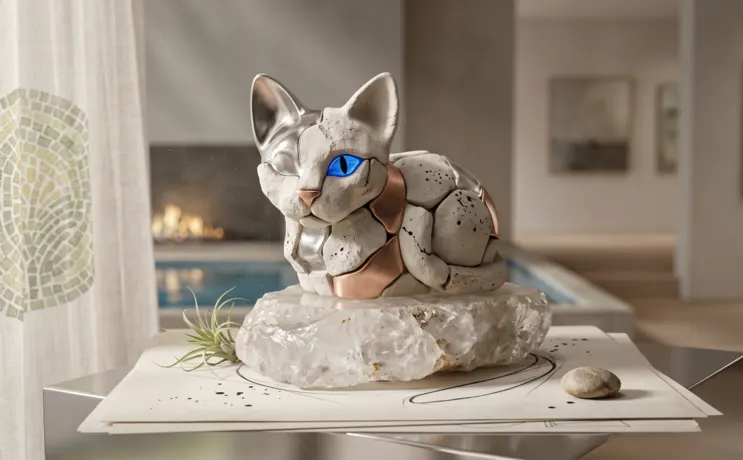
It fits in your hands.
That specific weight — almost nothing, impossibly warm, the particular density of something alive that is fully dependent on the fact of your hands being where they are. It fits in the cup of the palm in the way that communicates need before any sound is made. You can feel its heartbeat if you hold it correctly. You can feel the full weight of what it requires of you through the soles of your palms before you have assembled a single thought about what this is.
This is not a dream about innocence. Most people who have this dream expect innocence — the kitten as symbol of new beginning, of something tender and hopeful, of the gentle arrival of possibility. The cultural script around kittens is relentlessly soft. And the kitten in the dream is soft. But softness is not the subject.
The subject is what the kitten needs. And what it can return.
A kitten needs everything. Not metaphorically — specifically, completely, without apology or awareness of its own demand. It needs warmth. It needs feeding. It needs the body heat of something larger to regulate its own temperature. It needs to be carried. It needs to be found when it has gotten itself somewhere it cannot get back from. It needs the full attentional resources of something that understands what it cannot yet understand about itself. It needs and it needs and the needing is genuine and innocent and entirely real.
And it cannot give back. Not yet. Not in proportion. The warmth is real — the specific warmth of a kitten in the hands is one of the most somatic experiences available, and the brain encodes it accurately. But the exchange is not balanced, and the kitten does not know it is not balanced, and the not-knowing is part of the tenderness and part of what makes the dream arrive.
In my experience, this is the dream that comes when someone has said yes to an asymmetric arrangement — not with awareness of the asymmetry, but before it, or in the middle of discovering it. Something requires more than it can return. And the question the dream is asking is not whether the arrangement is wrong. It is whether the yes was informed.
Quick Answer
- The kitten is the brain’s most precise image for an asymmetric arrangement — something that genuinely needs more than it can currently return, and that cannot itself register the imbalance
- The tenderness is real — the brain is not criticizing the kitten or the warmth; both are accurate; the question is whether the asymmetry was entered with full knowledge
- If you were caring for the kitten, the brain is mapping an active caregiving position in which you are giving significantly more than is returning
- If the kitten was lost or in danger, something that depends entirely on you is in a precarious position — and the body is processing the specific weight of being the only available protection for something that cannot protect itself
- If you found the kitten unexpectedly, something arrived in your life that immediately established itself as needing, before you had assessed whether you could give what it needed
- If there were multiple kittens, the asymmetry has multiplied beyond what was originally understood when the first yes was given
- If the kitten grew into a cat in the dream, the brain is processing a transition from asymmetric dependency to the arranged-on-its-own-terms relationship — a completion
- The kitten that won’t stop crying is the brain mapping the specific quality of something whose need is continuous and louder than your capacity
- The dream is almost never a verdict on the kitten — the kitten is not wrong for needing; the dream is asking whether you chose the position of primary provider with the complete information you now have
- This dream tends to arrive not at the beginning of an asymmetric arrangement but in the middle — when the weight has been running long enough that the body has something to report
Common Scenarios
You are caring for the kitten — feeding it, warming it, holding it — and the care is continuous. The active-asymmetry version. The brain is mapping a current position: you are the primary resource for something that needs everything and can give back warmth, need, and the specific dependency that activates the caregiving circuits. The care is genuine. The imbalance is also genuine. The dream is not asking you to stop caring. It is asking you to see the accounting clearly.
The kitten is lost or stuck somewhere and you have to find or rescue it. The responsibility-without-reciprocity version. Something that depends entirely on you has gotten into a situation it cannot navigate out of alone. The body is processing the specific weight of being the only available response to need that cannot help itself. Not resentment — the kitten couldn’t help where it ended up. The specific quality of sole responsible party for something that has no other options.
You find the kitten unexpectedly — it arrives, and immediately it needs you. The unasked-for-dependency version. There was no preparation, no considered decision. Something arrived and the needing was immediate and the body produced the warmth-response before any assessment was possible. This version tends to arrive when an asymmetric arrangement established itself faster than the evaluation of it could run — when you were already in the position of primary provider before you had asked whether this was the position you were choosing.
There are more kittens than you can hold. The proliferation version. What was once a manageable asymmetry has multiplied. The original yes was given to a quantity that the body could manage, and something — time, circumstance, the natural growth of dependency — has multiplied the need beyond the original understanding. The body is reporting: this is larger than what was originally agreed to.
The kitten is yours and you love it completely — and the love doesn’t resolve the weight. The love-and-cost-simultaneously version. Both are true and both are present simultaneously, and neither cancels the other. The love is genuine. The cost is genuine. The brain is not asking you to choose between them. It is asking you to hold both without editing either one toward the more comfortable story.
The kitten grows into a cat within the dream. The transition version. Something that was asymmetrically dependent is in the process of developing into something that operates on its own terms — moving from the position of needing everything to the position of an autonomous presence with its own agenda. This version tends to carry a quality of watching something complete a stage — the specific quality of something that needed you fully becoming something that needs you differently.
What Your Body Already Knows
Woke up with the weight of the kitten still in the hands — the specific warmth and almost-nothing density of something alive and dependent → because the somatic encoding of holding something that needs you is one of the most persistent available; the body carries the weight of dependency longer than it carries most visual information; what you were holding, and what that holding required, is what the nervous system preserved
Woke up tired in a specific way — not sleep-deprived tired but a softer, more specific exhaustion → because the caregiving circuits and the resource-management circuits were both running in the dream; the brain was simulating the ongoing cost of a position that gives continuously without equivalent return, and that simulation produces a specific quality of depletion that is different from other kinds of dream-tiredness
Woke up with the kitten’s need still present as a pull — the specific quality of something that required and could not release you → because the dependency encoding persists into waking: the body was in the position of primary provider and the release from that position is not instant; the pull of what needed you continues briefly after waking, like a hand that was held for a long time retaining the impression of the hold
Woke up with a question you couldn’t immediately name — something between tenderness and weight → because the kitten dream almost never produces a single clean feeling; the tenderness and the cost arrive together, and the body is holding both without a clean word for the combination; the unnamed question is the combination itself, waiting for you to develop enough language for it
Woke up and thought immediately of a specific person or situation that needs more than it currently returns → because the brain was always making a precise reference; the kitten was specific, not general; and the morning recognition of what it was pointing to is the waking mind arriving at what the body already reported in the night
What a Kitten Actually Represents — The Neurology of One-Sided Dependency
The human brain has two distinct caregiving circuits, and they do not map cleanly onto each other.
The first is the attachment circuit. It activates in response to specific sensory cues: small size, high-pitched sounds, large eyes relative to head size, warmth, vulnerability, the particular density of something young and alive. This circuit activates the protective response — the warmth, the reaching toward, the impulse to shelter and provide. It activates reliably and it activates fast, often before any assessment of the situation is complete.
The second is the reciprocity circuit. It tracks the exchange — what goes out, what comes back, whether the balance over time is something the nervous system can sustain. This circuit runs more slowly, operates more consciously, and is frequently overridden by the attachment circuit in the early stages of any caregiving relationship.
A kitten activates the first circuit at maximum intensity. The small size. The specific sound. The weight. The warmth. The absolute dependency. Everything that triggers the attachment response is present and concentrated.
It does not activate the second circuit. A kitten cannot reciprocate. Not yet, not in proportion, not in the currency the reciprocity circuit runs on. The warmth it produces is real — the body-warmth of a living thing that has settled into you is a genuine somatic experience. But warmth is not reciprocity. The exchange is not balanced, and the kitten has no capacity to register that it is not balanced.
This is the neurological precision of this image. The brain reaches for the kitten specifically when something in waking life has activated the attachment circuit without engaging the reciprocity circuit — when something has produced the warmth-response and the impulse to give and the impulse to protect, without the corresponding return that would make the position sustainable over time.
You are holding it and the warmth of it is specific — the particular weight of something that has placed itself entirely in the cup of your hands and is neither asking nor needing to ask because the needing is complete before the asking. Its eyes are on you. Not with gratitude — it doesn’t have the apparatus for gratitude yet. With the specific look of something whose world is currently the size of your hands. You hold it. It needs. The warmth is real. The weight of the needing is also real. And somewhere underneath the tenderness is the question you haven’t asked yet: how long does this last, and what do I give while I wait for the answer?
The Specific Weight of Being the Only Available Return
There is a particular neurological state that the kitten produces that no other dream image quite replicates.
The kitten cannot help itself. This is not a moral statement about the kitten — it is a description of its actual current capacity. It is not choosing to be dependent. It is not aware of the asymmetry. It is simply at a developmental stage in which it requires everything from the available larger presence and has not yet developed the capacity to give back in proportion.
This creates a specific position for the person holding it: sole available resource for something that cannot find alternative resources. Not temporary caretaker — primary provider for something that, at this stage, has no other option.
The body responds to this position with a complex mixture. The attachment circuits produce warmth, protectiveness, the impulse to give. The resource-management circuits simultaneously register the continuous outflow: this is expensive, this is ongoing, this does not currently have a return cycle. Both run at the same time. Neither cancels the other.
What I find consistently in people who have this dream is that the specific weight of it — the thing that stays in the body — is not the warmth of the kitten, though the warmth is real. It is the specific quality of a position where you are the only available return for something that genuinely needs. The responsibility without option to distribute it. The giving without a timeline on when the exchange will rebalance.
This is not resentment. The dream is almost never resentful — the kitten is not doing anything wrong, and the body knows this. It is the weight of a specific position: primary and indispensable and the giving happening before the return is visible.
Cat in Your House — It Was Already Inside maps what the arrangement looks like when something has established itself fully in your intimate territory — and what the body feels standing in the room with something that has become interior without formal decision.
The Question Underneath the Tenderness
The kitten dream is the most tender in the cluster. It is also, quietly, one of the most demanding.
Because the question it is asking is not comfortable.
You said yes. Whether explicitly or implicitly, whether in a single moment or in the accumulation of small yes-es that added up to the position you now occupy — you said yes to this arrangement. You were the one with the capacity. The kitten was the one with the need. The arrangement established itself around that asymmetry. You are inside it.
The dream is asking whether the yes was informed.
Not whether the yes was wrong. Not whether the kitten is unworthy of the warmth you’ve been giving it. Not whether you should have said no. The kitten is what it is — genuinely small, genuinely warm, genuinely in need of what you are providing. None of this is in question.
The question is whether you knew, when you said yes, that this was the weight of it. Whether the asymmetry was visible to you before the attachment circuits activated and made the question feel ungracious to ask. Whether you are currently in a position that you chose with full information or a position that your attachment circuits chose before your resource-management circuits had the chance to complete their assessment.
This is not a verdict. It is not asking you to leave the kitten. It is asking you to stand in the full accounting of the position — warmth and cost simultaneously, no editing toward the version that feels more acceptable — and to consider whether you would choose it again now, with everything you now know about what it requires.
Dream About Cat — What Your Body Already Knew maps what the arrangement looks like when the kitten grows — when what was asymmetrically dependent becomes something that operates in your intimate space on its own terms, with its own agenda, on its own schedule.
When the Return Date Is Unclear
This is the section I find most people need most, and most interpretations provide least.
An asymmetric arrangement is not necessarily a wrong arrangement. Parents give to children who cannot reciprocate — this is not pathology, it is the structure of development. Friends support each other through periods of crisis where the support is necessarily one-directional — this is not exploitation, it is how care works. The asymmetry is not in itself the problem.
What the nervous system needs in order to sustain a one-directional position is some clarity about the arc. Not a date — not “this ends on Thursday.” But some orientation toward a horizon: this is a stage, not a permanent structure. The giving is appropriate to a developmental moment that has a direction. The direction is visible even if the arrival point isn’t.
The weight becomes specific when the direction isn’t visible. When the asymmetry has been running for long enough that the nervous system is no longer carrying it as a transitional stage but as an established condition. When the question of “when does this balance” has stopped being asked because there is no available answer, and the not-asking has become the management strategy.
The kitten dream arrives most specifically here. Not in the cute early stage of the asymmetry, when the warmth is new and the cost is manageable. In the middle — when the cost has accumulated enough to constitute information, when the body has been the primary resource for long enough that it has something to report, when the warmth is still real and the weight is also real and both need to be acknowledged simultaneously.
What the dream is asking: do you know where the horizon is? Not when — just whether there is one. Whether the current asymmetry has a direction or whether it has become the permanent shape of the arrangement. And if the answer is that you don’t know, whether it’s time to ask that question directly rather than continuing to manage around its absence.
Dream Timestamp
The kitten arrives when the asymmetry has been running long enough to constitute information → not at the beginning of the caregiving position, when the warmth is new and the cost is theoretical; in the middle, when the cost has accumulated enough that the body needs to report it
The kitten arrives when the attachment circuits activated before the resource-management assessment was complete → specifically when the warmth-response and the giving-impulse ran ahead of the question of sustainability — when you were in the position before you had finished asking whether it was the position you were choosing
The kitten that grows into a cat arrives when a developmental stage is completing → the brain is marking a transition: what was asymmetrically dependent is becoming something with its own terms; this version tends to carry a specific quality of watching something complete a stage, with all the mixed feeling that completion produces
The multiple kittens arrive when the original asymmetry has exceeded the original understanding → what was agreed to has expanded; the body is reporting that the current scale is larger than what the yes was given to
The lost kitten arrives when the responsibility feels most total → specifically when the thing that depends on you has gotten itself into a situation it cannot navigate without you; the body is processing the weight of being the only available return for something with no other option
The Sentence This Dream Was Trying to Say
“The warmth is real. The weight is also real. And the question the body has been holding — the one underneath all the tenderness — is whether you knew what you were saying yes to when you said yes.”
The Morning After
The kitten is gone. The hands are empty. The specific warmth of something small and alive and entirely dependent has faded from the palms, but the quality of the position — primary provider, ongoing asymmetry, the specific weight of giving more than is currently returning — is still somewhere in the chest.
This is a morning that asks something quiet of you. Not action — not an immediate decision about what to do with the arrangement. Something quieter: the willingness to hold the accounting without editing it toward the more comfortable version.
The tenderness was real. Let it be real. The cost is also real. Let it be real too. Both of these can be true simultaneously, and the arrangement you are in deserves the full account — not the one that emphasizes the warmth at the expense of the weight, and not the one that emphasizes the weight at the expense of the warmth.
What I would say to anyone sitting with this in the particular quality of this morning: you are not a bad person for feeling the weight of a position that costs you. The kitten is not wrong for needing. The arrangement is what it is. The only question worth adding to the accounting is the one about the horizon — whether the asymmetry has a direction, and whether you know where the direction goes.
The question worth holding today — specific, unhurried, honest: what am I giving that isn’t currently being returned — and do I know where the arc of this is going, or have I stopped asking because the question has no available answer?
FAQ
A kitten in a dream is the brain’s image for an asymmetric arrangement — something that needs more than it can currently return, and that cannot itself register the imbalance. Not innocence, not new beginnings — those are cultural associations with kittens that don’t map onto what the brain is actually doing with this image. The tenderness is real; the brain encodes it accurately. And simultaneously, the brain is reporting on the weight of being in the primary-provider position for something that genuinely cannot give back in proportion yet.
The good-sign framing doesn’t fit this dream accurately. The kitten is the brain’s image for a specific arrangement — asymmetric dependency — which is neither good nor bad in itself. An asymmetric arrangement can be entirely appropriate (parents and young children, people supporting a friend through crisis) or it can be running at a cost that deserves acknowledgment. The question the dream is asking is not whether the arrangement is right or wrong, but whether the yes given to it was given with full information about what it would require.
Caring for the kitten in the dream is the brain mapping the active position of primary provider — the continuous giving that characterizes an asymmetric arrangement. The care is genuine; the brain is not criticizing it. And the brain is simultaneously running the resource-management assessment: what is going out, what is coming back, whether the current outflow has a visible return horizon. The caregiving itself isn’t the subject; the question of whether the caregiving is sustainable and whether you know where its arc goes is.
The lost or abandoned kitten is the brain mapping the responsibility-without-reciprocity position at its most acute: something that depends entirely on you has gotten into a situation it cannot navigate without you, and you are the only available return. The specific weight of this version is not guilt about having lost something — it is the specific quality of being the sole responsible party for something that has no other options. The body processes this as a particular kind of responsibility-load that’s worth looking at directly.
The transition from kitten to cat in a dream marks a developmental shift in the arrangement itself. Something that was asymmetrically dependent — requiring everything, returning very little — is becoming something that operates on its own terms, with its own agenda, on its own schedule. The asymmetry is resolving into a different kind of relationship. This version carries the specific quality of watching something complete a stage: mixed feeling is normal here, because what was needed by you is becoming something that will not need you in the same way, and that transition is genuinely complex.
The asymmetry has exceeded the original terms. The original yes was given to a quantity, a scope, a scale of need that the body could manage. What is currently being asked has grown beyond that original understanding — more kittens, more need, more outflow than the yes was given to. The body is reporting a scale-mismatch: what you agreed to and what you are currently holding are not the same thing. The too-many-kittens dream is the brain’s way of making visible what has been accumulating below the threshold of the waking mind’s accounting.
Next Stages
Black Cat — The Presence That Won’t Be Read (/dream-about-black-cat-meaning/) — what the kitten becomes when it grows but doesn’t become legible — the arrangement that is inside your space and still won’t show you what it actually wants
White Cat — What Is Now Fully Visible (/dream-about-white-cat-meaning/) — the moment when the asymmetry finally shows itself completely — when what you’ve been giving and what you’ve been receiving is fully in the light
Dead Cat — The End of an Arrangement (/dream-about-dead-cat-meaning/) — when the kitten that needed everything doesn’t need anymore — and what the body feels when an asymmetric arrangement finally completes
Cat in Your House — It Was Already Inside (/dream-about-cat-in-house/) — what comes after the kitten stage — when what needed everything has grown into something that is simply inside your intimate space now, on its own terms, settled