Dream About White Cat — What Is Now Fully Visible
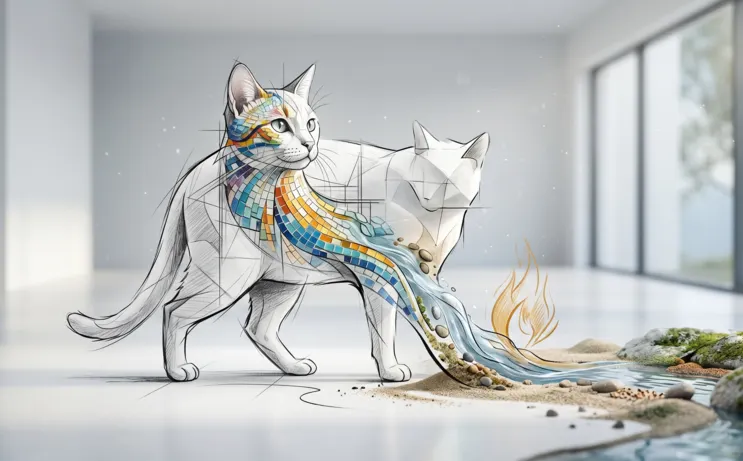
You can see it completely.
Not the way you can see most things in dreams — the blurred edges, the approximate rendering, the visual shorthand the brain uses when it doesn’t need precision. This cat is in full light. Every detail legible. The expression readable, the texture of the fur visible at a resolution that doesn’t usually exist in dreams, the body language available to you in its entirety. You can see exactly what it is.
That visibility is the subject of this dream. Not purity, not spiritual meaning, not the cultural shorthand of white as innocence or goodness. The brain is not running symbolism. It is running precision. White is the color that returns the maximum amount of light — that makes everything visible, surfaces every expression, hides nothing. In every sensory register available to the dreaming brain, white maximizes information.
The white cat in dreams is the brain’s most precise available image for something in your intimate life that is now fully showing itself. Not something new — something that has been in your space, possibly for a long time, that is now visible at a resolution you haven’t had before. You can see it. All of it. The question the dream is asking is whether you are ready to look at what the full visibility is showing you.
Most interpretations of white cat dreams reach for purity, spirituality, or good omens. These interpretations are historically understandable and neurologically irrelevant. The brain didn’t reach for white because it symbolizes purity. The brain reached for white because white is the maximum-information color — the one that removes the softening that partial light provides and shows everything without remainder.
Quick Answer
- A dream about a white cat is not about purity or good fortune — it is about visibility: the brain rendering something in your intimate life that is now showing itself at full resolution
- White maximizes information in the visual field: every expression readable, every signal available, no detail obscured by color or shadow
- The white cat in dreams is the opposite of the black cat — maximum legibility vs maximum opacity, everything available vs nothing translatable
- If the white cat was clean and bright, the brain is processing something that is showing itself clearly and completely, without ambiguity
- If the white cat had marks or stains, the visibility is showing you something specific — the marks on white are what the full visibility reveals, what the partial-information state was protecting you from seeing
- The white cat is almost never about something new — it is about something that has been in your space for a while now making itself fully known
- The demand of full visibility is real and different from the comfortable partial-information state most intimate arrangements operate in
- The dream tends to arrive when you have recently received full information about something you had previously had only partial information about
- The white cat in the body carries a different quality than the black cat: not unease but something more like the weight of clarity — of no longer being able to claim you didn’t see
- What the dream is asking is not a passive question — it is asking whether you will now act on the full information that has become available
Common Scenarios
The white cat was simply present — bright, fully visible, in your space. The clearest version. Something in your waking life is now visible to you at full resolution. You can see it completely. The dream is not delivering new information — it is registering that the information arrived. The white cat in this version often corresponds with a recent moment of clarity: something that was previously partially known is now fully known, and the body is adjusting to that.
The white cat had marks on it — stains, injuries, something that the brightness showed rather than hid. This is the version where full visibility reveals something specifically. White shows everything that lands on it. The marks on the white cat are what the full legibility makes visible — the things that the comfortable partial-information state had allowed to remain in the background. What was obscured by partial seeing is now clear. This version tends to arrive when something became fully visible that was not easy to see.
The white cat looked directly at you — held your gaze, made itself entirely available to your attention. The mutual visibility version. Something in your waking life is not only visible to you — it is making itself visible intentionally, presenting itself for your full attention. This carries a different quality than the passive presence of the white cat: something is actively showing itself to you, asking to be seen completely.
The white cat was in your house — already inside, moving through your intimate space in full light. What was inside the perimeter has become fully visible. Something that was in the arrangement — perhaps for a long time — is now showing itself at a resolution you haven’t had before. The full light reveals what the arrangement actually is, now that you can see it completely.
The white cat was beautiful but the beauty made you uncomfortable. The difficulty-of-full-visibility version. Full information is not always comfortable. The beauty of the white cat in this version carries the specific discomfort of something too clear — too fully present, removing the buffer that partial information provides. The brain is mapping the specific quality of something being more visible than the comfortable management of partial knowing allows.
You were trying to keep the white cat clean and it was difficult. White shows everything that touches it. The effort of maintaining the white cat — of keeping the full visibility unsullied — is the brain mapping the specific work of maintaining a presentation, a self-image, or a story about an arrangement that the full visibility is now complicating.
What Your Body Already Knows
Woke up with the specific quality of the white cat’s visibility still present — not a memory of seeing it but the felt sense of something fully revealed → because the brain encoded clarity as a somatic state rather than just a visual one; the feeling of full information about something has a specific weight in the body, different from the ambient partial-knowing state
Woke up with something settled — not comfort, but the specific quality of something that can no longer be claimed as unknown → because the amygdala’s uncertainty-response partially closes when full information arrives; the unease of partial knowing resolves into a different state — not easier, but more complete
Woke up knowing the dream was about a specific person or situation without needing to interpret → because the brain was always making a precise reference; the white cat was never a symbol about cats — it was the most accurate available image for a specific something, and the waking mind arrives at what the dream knew
Woke up with the marks on the white cat more present in memory than the cat itself → because the brain specifically encoded what the full visibility revealed — the marks are the information the maximum-light rendering was there to show; the cat is the vehicle, the marks are the content
Woke up with the weight of something you can no longer claim not to see → because full visibility changes the epistemic position — you cannot return to partial knowing once the complete picture has arrived; the specific weight of being unable to claim unknowing is what the body carries from this dream
Why White Is the Most Demanding Color — Not Purity, Visibility
The visual cortex does not process colors symbolically. It processes them informationally.
Color carries signal data. The markings of an animal tell you about its health, its age, its emotional state. The pattern of light and shadow across a face tells you about expression, intention, micro-movement. Color contributes to the legibility of what you’re looking at — your ability to read what you need to read in order to understand what you’re dealing with.
White changes this calculation completely. A white object — particularly a white animal in good light — reflects the maximum available light. Every detail surfaces. Every expression becomes readable at full resolution. Every mark shows immediately. Nothing is absorbed into darker coloring or lost in shadow. White is the most information-rich color available in the visual field, specifically because it hides nothing.
This is the neurological reason the brain reaches for white when it wants to render full visibility. Not because of cultural association with purity or innocence. Because white maximizes the information available in the image — makes everything legible that could potentially be legible, removes the softening that partial light and intermediate color provide.
The black cat removes information. The white cat maximizes it. These are not symbolic opposites — they are informational opposites, and the brain uses them with precision.
When the white cat arrives in a dream, the brain is using the maximum-information rendering to report on something in your waking life that is now available to you at full resolution. Something you can see completely. The demand of that visibility is real: you can no longer manage what you’re looking at with the protection of partial knowing.
The cat is white and the room has the quality of everything being in its correct light. You can see the cat’s face completely — the eyes, the micro-movements around the mouth, the position of the ears in their most precise available language. You can read it. You know what it wants. You know how it feels about you. You know exactly what kind of arrangement this is. The information is complete and available and there is no remaining ambiguity in the reading. And the specific thing the body registers — different from fear, different from relief — is the weight of full information. Of something finally fully known.
Dream About Cat — What Your Body Already Knew maps the full architecture of the cat dream — why the brain reaches for this animal when something occupies your intimate space on its own terms, and what the terms of that arrangement actually are.
The White Cat and the Black Cat — Two Registers of the Same Arrangement
Understanding the white cat fully requires understanding what it is the opposite of.
The black cat dream is about illegibility — something present and intentional in your life whose content you cannot access. The monitoring state is open and running, the attention is directed, and the information is not coming back. The specific quality of being in proximity to something you can feel but cannot read.
The white cat is the informational inverse of this.
Where the black cat removes legibility, the white cat maximizes it. Where the black cat leaves you monitoring without receiving, the white cat provides everything the monitoring was trying to obtain. Full expression, full signal, full clarity about what the thing actually is and what it wants and how it is oriented toward you.
This is not necessarily easier. The comfortable middle ground that most intimate arrangements operate in — enough information to navigate, not so much that navigation becomes confrontation with the full picture — is where the black cat and the white cat bracket between them. The black cat is below that comfort zone: too little information, the unease of not knowing. The white cat is above it: too much information, the demand of full knowing.
The white cat dream tends to arrive after a moment of clarity rather than before it. Not the dream of someone who is about to understand something — the dream of someone who has just received full information and whose nervous system is adjusting to the position of no longer being able to claim partial knowledge.
Dream About Black Cat — The Presence That Won’t Be Read maps the other end of this spectrum — what the brain reaches for when something in your intimate space is present but opaque, intentional but unreadable.
Why the Brain Can See Fully and Still Operate on the Old Map
There is a specific neurological phenomenon that makes the white cat dream more complex than it first appears.
The visual cortex processes what it receives. The prefrontal cortex integrates that information into decision-making. But the structures that generate behavior — the deep neural networks that drive habitual response, the accumulated priors built from long experience with a situation — update on a different timeline than the perceptual system does.
In cognitive neuroscience terms: you can receive complete information about something and still continue to operate on the old map. Not because you haven’t seen the full picture. Because the behavioral architecture built around the partial picture hasn’t been updated to integrate what the complete picture contains.
This is what makes the white cat demanding in a way that goes beyond the simple discomfort of full information. It is not enough that the visual cortex now has the complete rendering. The behavioral patterns, the automatic accommodations, the habitual responses that were structured around the partial-information version of this situation — these are encoded in different, slower-updating systems. Seeing something completely does not automatically revise everything the nervous system built around seeing it incompletely.
The prefrontal cortex argues with itself. The new information says one thing. The entrenched priors say another. The body is navigating between a map it built with partial information and a territory it can now see completely, and these two are no longer the same shape.
What the white cat dream is asking is not simply: do you see? The perceptual system already answered that. It is asking whether you are willing to let the full perception reach all the way down into the behavioral architecture built around the partial perception — whether the update the visual cortex received is going to be allowed to revise the entire structure, not just the top layer.
That is slower work than seeing. And it is the actual work the dream arrived to initiate.
Dream Timestamp
The white cat arrives after a moment of clarity — when partial information resolved into full information → the brain registers the transition from partial knowing to full knowing; the white cat dream is the encoding of that transition, arriving in the processing period after the complete picture became available
The white cat arrives when you have been managing partial information for long enough that it has become a habit → the dream sometimes arrives before the clarity moment, as the nervous system signals that the partial-knowing management is approaching its limit — that the full information is coming whether you’re ready or not
The white cat with marks arrives when the full visibility revealed something specific → the marks are the content; the dream is encoding what the maximum-light rendering revealed, not the rendering itself; the specific marks are what the partial-information state was protecting you from having to address
The white cat arrives when someone in your intimate life is now showing themselves completely → when a person who was previously partially known has made themselves fully legible, intentionally or otherwise — the dream is the body’s registration of that full showing
The white cat at night — white in darkness, highly visible against a dark background — arrives in high-stakes visibility moments → when something is showing itself in a context where it is particularly visible, where the contrast between the white cat and the dark makes the full legibility even more complete
The Sentence This Dream Was Trying to Say
“White doesn’t mean clean. White means visible. And what you saw in this dream is something you can no longer claim not to have seen.”
The Morning After
Clarity has a specific weight in the body that is different from either fear or relief. It is heavier than partial knowing. The morning after a white cat dream tends to carry that specific quality: the weight of having seen something completely, of being in the position where the full picture is available and the partial-knowing buffer is gone.
What I would say to anyone sitting with this: the white cat was not giving you new information. The brain already had the information. What it was doing in the dream was confirming the resolution — showing you what it has been processing, making the full picture available to you in a form you couldn’t look away from.
The discomfort of full visibility is real. The comfortable middle ground that partial knowing provides is a genuine protection, and losing it has a real cost. The dream is not unsympathetic to that cost. It is simply reporting that the cost has been paid — that the information is now complete, that the position of ambiguity is no longer available to maintain.
What you do with full information is a different question from what you do with partial information. The morning after a white cat dream is the morning where that question becomes the actual question.
The question worth holding today — not comfortably, but honestly: what is it that I can now fully see — that I couldn’t claim not to see even if I tried — and what does having complete information actually require of me?
FAQ
A white cat dream is about visibility — the brain rendering something in your intimate life at maximum information, fully legible, without the softening that partial knowledge provides. Not about purity or good omens; those are cultural associations that have nothing to do with what the brain is doing with this image. White maximizes the information available in a visual rendering, making every expression readable, every signal available, nothing obscured. The dream is reporting that something is now fully visible to you.
The good/bad framing doesn’t fit this dream accurately. The white cat is about full information — which is neither good nor bad in itself, but demanding. Full visibility is more complete than partial visibility and often more uncomfortable. Whether what the full picture reveals is welcome or difficult depends on what the arrangement actually is. The white cat is the condition of complete information; what that condition requires of you depends on what it is you can now see completely.
The marks on the white cat are the content — what the full visibility reveals that the partial-information state was allowing you to not see clearly. White shows everything that lands on it. The brain uses the white rendering specifically because marks on white are unmissable; they cannot be softened by color or shadow. The marks in this dream are the precise information that the maximum-legibility rendering was there to show you. What specifically the marks were — their location, quality, how they made you feel — is what the dream was actually pointing at.
They are informational opposites. The black cat removes legibility: something present and intentional but unreadable, whose content you cannot access despite attending to it. The white cat maximizes legibility: something fully visible, every signal available, nothing obscured. Both are about something in your intimate space on its own terms — the black cat is that something when you have too little information to read it, the white cat is that something when you have complete information and can no longer maintain partial knowing.
Because full visibility is genuinely demanding. The comfortable middle ground that most arrangements operate in — enough information to navigate, not so much that navigation becomes confrontation with the complete picture — is a real protection. Full information removes that protection. You can no longer maintain the partial-knowing position that allows a certain kind of non-action. The discomfort of the white cat dream is not the discomfort of threat; it is the discomfort of seeing something completely and knowing you can’t claim you didn’t.
Mutual visibility — something showing itself completely to you, and the act of looking back making the full visibility bidirectional. Something in your waking life is not only visible to you now; it is presenting itself for your complete attention, showing itself intentionally. The gaze in this version is not threat — it is the specific quality of something making itself fully available to be seen, asking to be recognized at full resolution rather than managed at partial information.
Next Stages
Dream About Cat Attacking You — When What You Trusted Had an Edge — what full visibility sometimes reveals — when seeing the arrangement completely includes seeing the scratch
Dream About Dead Cat — The End of an Arrangement — what happens when the thing you could now finally see completely ends — and what that ending means
Dream About Cat in Your House — It Was Already Inside (/dream-about-cat-in-house/) — the arrangement before full visibility arrived — when it was inside the space but not yet fully in the light
Dream About Kitten — The Asymmetry You Said Yes To (/dream-about-kitten-meaning/) — the version where what you see completely is the gap between what you give and what returns