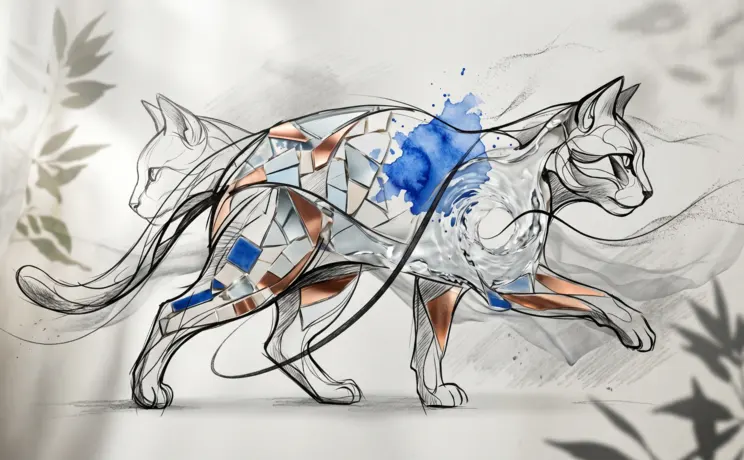
Cat in Your House — It Was Already Inside

You didn’t let it in.
This is the specific thing about this version: you didn’t make the decision. There was no moment where the door opened and you assessed and chose. The cat is simply in your house — in the kitchen, in the hallway, in the room you thought was entirely yours — occupying your domestic space with the particular confidence of something that has already settled the question of whether it belongs here. It decided. You are finding out.
The specific quality of this dream is not the cat. It’s the already.
Already inside. Already past the front door, past the second threshold, past whatever internal geography marks the difference between the parts of your home you share and the parts that are entirely private. Already in the space where you don’t maintain the monitoring that you run for things that are still outside. Already in the room where you thought nothing was except you.
And the thing the body registers before the mind has assembled any interpretation — before you’ve decided what you feel about this — is not fear. Not exactly. Something quieter than fear and more persistent. The specific quality of finding that something is already inside the space you thought was only yours.
In my experience, this is the dream that arrives when someone has been in the process of gradual entry for long enough that the entry is complete before it is recognized. Not a dramatic crossing — the door didn’t slam, no threshold was visibly broken. The crossing happened in increments, in the small accumulated adjustments and accommodations and made-rooms, until one day the thing is simply inside and the question of the threshold seems retrospective, almost quaint. It was already there. You just hadn’t looked at it yet.
Quick Answer
- The cat in the house is the brain’s image for something that has already entered your most intimate space — past every threshold, without a formal invitation, without a moment where you explicitly decided yes
- The specific weight of this image is the already — not something approaching or at the door, but something that has already settled the question of its own presence
- If the cat was in a room it shouldn’t be, the brain is mapping the specific experience of discovering that something has reached further inside than you realized
- The way the cat looks at you when you find it — as if your surprise is the thing that’s new, not its presence — is the brain encoding something that has been operating in your space longer than you acknowledged
- If there were multiple cats, something has been establishing itself in more than one internal territory simultaneously
- If the cat was comfortable, settled, clearly at home, the brain is reporting that the entry isn’t new — the accommodation has been running for a while
- If you were trying to remove the cat and it kept returning, the brain is processing the specific experience of something that has integrated itself deeply enough that removal requires more than a single decision
- If the cat was in your bedroom specifically, something has reached into the most private available space — the territory that carries the most intimate version of your daily life
- The question this dream is asking is not how it got inside. The brain has already moved past that question. It’s asking: what do you feel now that you know it’s there?
- This dream tends to arrive not when the entry is happening but when the recognition of the entry is finally occurring — when the brain is marking a fact that has been true for longer than the waking mind was willing to see
Common Scenarios
The cat is in your house and you have no memory of letting it in. The essential version. No breach, no broken lock — the cat is simply there, settled, as if it has always been there. The brain is mapping a situation in which something entered your most intimate space in increments, through the accumulated small decisions that feel like nothing individually and add up to everything. There was never a single moment where you said yes to this. There were only the many small moments where you didn’t say no.
The cat is in a specific room it shouldn’t be — your bedroom, your study, the room that is most privately yours. The penetration-depth version. The brain selected not just the house but the specific room to mark how far inside the entry went. The most private available territory. The space where you are most entirely yourself, least organized around any external presence. Something is there now. And the body registers this differently than finding the cat in the kitchen — the room matters, the depth matters, the specific intimacy of the territory that has now been entered.
The cat looks at you when you find it — holds your gaze, entirely unbothered by your surprise. The unbothered-presence version. Your surprise is the thing that’s new, not its presence. It has been here. It looks at you with the specific equanimity of something that settled the question of belonging some time ago, and is simply waiting for you to catch up. This version produces a specific quality of disorientation — not fear, not anger, the particular feeling of being the last one to know something about your own interior.
You try to remove the cat and it returns. The deep-integration version. The entry wasn’t surface-level — the cat has integrated into the domestic structure of the space thoroughly enough that removal is not a single action. Each removal is followed by return. The brain is processing something that has established itself deeply enough in the architecture of your daily life that extracting it requires dismantling pieces of the architecture itself, not just carrying something back to the door.
There are multiple cats in the house — you find them in different rooms. The multiple-entry version. What entered your intimate space wasn’t a single thing — it’s a pattern, a dynamic, a set of related presences that established themselves in multiple territories simultaneously. The brain is mapping something systemic rather than specific: not one element that crossed your threshold, but a way of operating, a relationship pattern, a set of accommodations that have spread through more of your interior than you had realized.
The cat is in the house and you feel, unexpectedly, okay about it. The accepted-entry version. The brain is processing an entry that — now that you have looked at it directly — you find yourself not wanting to reverse. Something crossed into your intimate space without formal invitation, and when you stand in the room with it, the body produces not the disturbance you expected but something quieter: the recognition that you don’t mind. That maybe the absence of a formal crossing was not negligence but the body knowing in advance what the mind hadn’t caught up to yet.
What Your Body Already Knows
Woke up with the specific quality of having found something already in a space that was supposed to be only yours — a feeling that doesn’t translate cleanly into either fear or recognition → because the discovery of a crossed threshold activates a specific response that isn’t threat-fear (the thing isn’t attacking) and isn’t welcome-relief (you didn’t choose this) — it’s the specific disorientation of finding that the map of what’s inside and what’s outside has already been revised without your input
Woke up with the image of the specific room — not the cat, the room where you found it → because the brain encoded the territorial penetration depth as the central information; the room matters more than the cat because the room tells you how far inside something got before you registered it
Woke up with the feeling that you should have noticed sooner → because the body always knew — the small accumulations of entry were registered in the nervous system even when the conscious mind was still categorizing things as outside; the dream is the moment the nervous system delivers what it has been accumulating
Woke up and the cat’s gaze was what stayed — the way it looked at you when you found it, entirely unsurprised by you → because the brain encoded the specific quality of something that had already settled its own belonging before you arrived at the question; that gaze — unbothered, already certain of its right to the space — is the image of something that entered and established itself before you had organized a response
Woke up with the impulse to check — the rooms, the specific spaces, the territory of your daily life that you now needed to account for differently → because the dream shifted the interior map, and the body’s immediate response is to perform a new survey: what do I know about what’s inside now that I know the threshold was already crossed?
The Threshold Map — What “Already Inside” Actually Means in the Body
Every person carries an interior map.
Not a conscious map — not something you could draw on demand. A neurological one. The body maintains a continuous, below-threshold register of what is inside and what is outside: what has access to the most intimate version of your daily life and what doesn’t. Your home. The rooms within your home. The spaces within those rooms that are most entirely yours. Each layer carries a different quality of interior-ness, a different level of de-monitored presence, a different degree of this-is-where-I-am-when-I’m-only-myself.
This map is not static. It updates as people and dynamics are incorporated into the interior. As things that were once outside become inside — through relationship, through repeated proximity, through the accumulated small decisions of accommodation. The update is usually gradual, usually below conscious awareness, usually not registered as a crossing until something — a dream, a moment of recognition, a conversation that says aloud what the body has known — makes the new map legible.
The cat-in-the-house dream is the moment the new map becomes legible.
The cat is already inside because the entry already happened — in the accumulation of small adjustments, in the gradual making-room, in the incremental de-monitoring that occurs when something moves from outside-and-noticed to inside-and-assumed. By the time the dream arrives, the question of the threshold has already been answered. The cat didn’t just enter the house in the dream. The cat entered the interior map some time ago. The dream is the registration of what the body has been carrying.
You are moving through your house and the light is the specific light of your house — the particular quality that belongs to this space and no other. And then you are in a room and the cat is there. Not threatening, not moving, not asking anything. Just there with the quality of something that has settled the question of its own presence. You look at it. It looks at you. And the thing you feel — before you have assembled any thought about it — is not surprise at the cat. It’s surprise at yourself. At the fact that you didn’t know. At the specific weight of finding out that your interior was revised before you had consciously signed off on the revision.
How It Got Past Every Door — The Architecture of Gradual Entry
This is the part most people don’t want to look at. Not because it’s painful — because it requires acknowledging their own participation.
Nothing crosses every threshold of someone’s intimate space without some cooperation from the person whose space it is.
Not dramatic cooperation — not a moment of deliberate decision. The cat didn’t force any door. The doors were opened, or left open, or gradually became the kind of doors that didn’t feel like they needed closing for this particular presence. Each small accommodation made the next one easier. Each made-room signaled: this is someone who goes here now. Each de-monitoring decision — this doesn’t require my vigilance anymore, I know what this is — quietly moved something from the category of outside-and-assessed to inside-and-assumed.
This is how gradual entry works, in dreams and in waking life. Not through force but through accumulation. Not through a single crossing but through the way that repeated small crossings eventually add up to a different interior architecture than the one you thought you were maintaining.
The cat-in-the-house dream arrives when the accumulation is complete enough to see. When the body has been carrying the new interior map for long enough that the nervous system needs to deliver the recognition consciously: something is inside that you may not have formally chosen to let this far in. The question isn’t blame. The question is: looking at the interior map as it actually is now, is this the arrangement you want to be living in?
Cat in Your House connects directly to what happens when that arrangement ends. Dead Cat — The End of an Arrangement maps what the body produces when something that entered your most intimate space finally completes — and why the response is almost never only one thing.
Not How It Got In — What You Feel Now That You Know It’s There
The brain, by the time it produces this dream, has already moved past the question of entry. The how is historical. The map has been updated. What the dream is actually asking is something different and more immediate.
It is asking you to stand in the room with the cat and notice what you feel.
Because the feeling — whatever it is — is the most accurate available account of the current state of the arrangement. And it is almost never simple.
Some people feel the specific comfort of something that belongs — the cat is in the house and the body produces a quality of rightness, of a space that has organized itself around something warm and present, and the discovery is not disturbance but recognition. Something is inside, and inside is where it should be, and the body knew before the mind did.
Some people feel the specific discomfort of something that has crossed further than the explicit agreement extended to — the cat is in the room that was supposed to be only yours, and the body produces the particular quality of a boundary that was softer than you knew, a perimeter that had more permeability than you had consciously understood.
Both are accurate. Both deserve to be felt rather than edited toward the one that seems more appropriate.
What I find consistently: the feeling that arrives when you find the cat in the room is the feeling you’ve been carrying about the arrangement in waking life, carried at a level below the management of it. The dream simply gives it the space to surface without the immediate pressure to do something about it. Stand in the room. Let the feeling arrive. It has been waiting.
Dream About Cat — What Your Body Already Knew maps the full architecture of what the cat represents — why the brain reaches for this animal when something in your intimate space operates on its own terms, and what it means to have accommodated something without reading the full terms.
Dream Timestamp
The cat-in-the-house arrives when the entry is already complete — when something has been inside longer than the waking mind has been willing to acknowledge → not the moment of crossing but the moment of recognition; the dream delivers what the body has known for a while
The cat-in-the-house arrives in the specific room it appears in — and the room is the information → the bedroom means the most private daily territory; the kitchen means the domestic infrastructure; the study means the intellectual or creative interior; wherever the cat is tells you what level of intimacy the entry reached
The cat-in-the-house appears when the accommodations have become invisible through repetition → what was once a choice has become background; the dream arrives when the background needs to become foreground again
The cat-in-the-house arrives when you are starting to ask whether the interior map is still the one you want → the dream tends to arrive precisely in the period before conscious decision — the body’s way of laying out the current architecture for examination before the mind commits to a direction
The unbothered cat arrives when the entry is deep — when the thing inside has settled into full confidence of its belonging → the deeper the integration, the more settled the cat; the degree of the cat’s comfort is a direct report on how long the entry has been running
The Sentence This Dream Was Trying to Say
“It didn’t knock. It’s been inside for longer than you acknowledged. And the question isn’t how it got there — the question is whether the interior it settled into is still the one you want to be living in.”
The Morning After
The house in the dream is your house — the actual architecture of your daily intimate life. And the cat is still in it, even now that you are awake, in the sense that whatever the cat represented in the dream is still inside the actual territory of your waking life. The dream didn’t create the situation. It revealed it.
What I find most worth sitting with in this particular morning: the specific room where the cat was. Because the room is not incidental. The brain was precise about where in your interior the entry reached. The kitchen is different from the bedroom. The bedroom is different from the study. The room tells you something about the depth of the entry — how far inside something got before you looked directly at it.
Before the day reasserts itself and the dream recedes, sit with what the body felt when it found the cat in that specific room. Not the thought about it — the felt quality of it. Because that feeling — whatever it was, however complicated — is the most honest account of the current arrangement that you have access to.
The question worth holding today, the one that has teeth: what crossed into my most private space without a formal invitation — and how do I feel, standing in the room with it now, about the fact that it’s already there?
FAQ
The cat in the house represents something that has already entered your most intimate space — past every threshold, without a formal invitation or a single moment of explicit decision. The brain is delivering the recognition that the interior map has been revised: something is inside that the waking mind may not have fully acknowledged being inside yet. The specific room where you find the cat carries additional information about how deep the entry went and into which territory of your intimate life it reached.
Because it is stranger. The house is not neutral space — it is the architecture of your most intimate daily life, the territory where you maintain the least monitoring because it is supposed to be entirely yours. Finding something already inside that space activates a specific kind of disorientation: not threat-fear, not welcome-recognition, but the specific quality of discovering that the boundary between inside and outside was more permeable than you thought. The body knows the difference between a cat in the world and a cat in the space that was supposed to be only yours.
The unbothered cat has already settled the question of its belonging. Your surprise is the thing that’s new, not its presence. The brain is encoding something that has been operating in your intimate space for long enough to have established itself fully — something that no longer registers its own presence as requiring permission or justification. The more settled the cat, the longer the entry has been running. The gaze that meets yours without apology or explanation is the specific image of something that has become interior without your explicit acknowledgment of that becoming.
The bedroom is the deepest available private territory. Finding the cat there means the entry reached all the way — past the shared spaces, past the intermediate territories, into the space that carries the most intimate version of your daily life. Not just inside the perimeter of your home but inside the innermost available room. The brain selected this location to encode how far into your interior something has reached — and the question it’s asking about that depth is one worth sitting with before the day reasserts its ordinary momentum.
The integration is deep enough that removal requires dismantling the architecture, not just carrying the cat to the door. Something has established itself so thoroughly in the structure of your daily intimate life that extracting it means revising multiple accommodations, not making a single decision. Each return of the cat after removal is the brain mapping the degree of integration: how many of the daily structures were organized around this presence, how many small adjustments would need to un-adjust, how much of the interior map has been written around something that is being asked to leave.
The body is reporting that the entry was right — that what crossed into your intimate space belongs there, even though no explicit formal decision was made. The absence of a threshold-moment wasn’t negligence; it was the body knowing in advance what the mind hadn’t caught up to yet. The okay-ness is accurate data. Something entered your most private space on its own terms and the body, when standing in the room with it, produces not disturbance but a specific quiet recognition. That recognition deserves as much attention as disturbance would.
Next Stages
Black Cat — The Presence That Won’t Be Read (/dream-about-black-cat-meaning/) — ты нашёл его внутри — и всё равно не можешь прочитать что оно хочет. Это про то что происходит когда “уже внутри” и “всё ещё непрозрачно” существуют одновременно
Cat Attacking You — When What You Trusted Had an Edge (/dream-about-cat-attacking-you/) — что происходит когда то, что уже внутри твоего дома, производит рану. Вред который приходит не снаружи — из самой архитектуры которую ты построил вокруг присутствия
White Cat — What Is Now Fully Visible (/dream-about-white-cat-meaning/) — когда то, что было внутри в полутьме частичного знания, показывает себя полностью. Переход от “уже внутри но непонятно” к “теперь в полном свете”
Kitten — The Asymmetry You Said Yes To (/dream-about-kitten-meaning/) — что то, что пересекло каждый порог, нуждается от тебя. Когда “уже внутри” означает “уже требует всего” — и ты стал основным ресурсом до того как понял что им стал