Body Moving Without Your Control
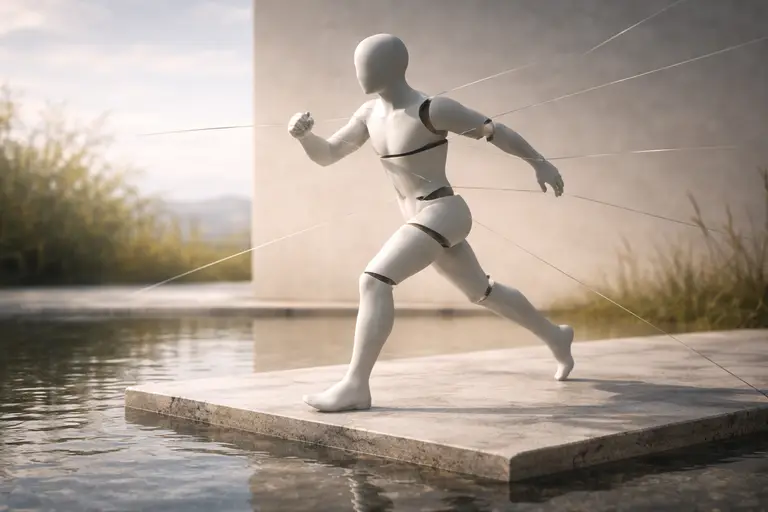
You’re watching yourself from the inside.
That’s the specific quality that sets this dream apart from every other version of the control-loss cluster. It’s not that you can’t move — you’re moving. It’s not that the body has stopped — the body is very much active. The problem is that the activity isn’t coming from you. You’re present for everything, aware of everything, and you are not the one directing it.
Your arm reaches for something. You didn’t tell it to reach. Your legs take you somewhere. You didn’t choose the direction. Your mouth forms words. You hear yourself speak and the words are not what you would have said. The body is executing. The authorization for the execution is somewhere you can’t access.
What makes this dream feel like a violation rather than just a malfunction is the intimacy of it. The body is yours. You know every one of its movements because you’ve been the one making them your whole life. When someone or something else is making them, you recognize the wrongness immediately — the specific quality of your own gestures being done by something that isn’t quite you.
Quick Answer
- A dream about your body moving without your control means the authorization for your own actions has shifted — what you do is no longer fully determined by what you intend.
- This is different from not being able to move: the body is active, not still. The problem is direction, not capability.
- Who or what seems to be directing the body is the most specific information in the dream.
- The specific actions the body performs — what it reaches for, where it walks, what it does — correspond to something in waking life that has been happening without your full conscious authorization.
- The observer quality — watching yourself from the inside — is the dream’s most honest image for a specific dissociation that can happen in waking life.
Common Scenarios
- Body walking toward something you didn’t choose → you’re being moved in a direction by something — obligation, expectation, habit — that you didn’t consciously authorize
- Hands reaching for things or performing actions you find wrong → what you do with your capacity for action has become detached from your values or intentions
- Mouth speaking words you didn’t decide to say → your communication has developed its own script, separate from what you actually mean
- Body performing in front of others while you watch → the performance of yourself for an audience has become automatic, happening without your full presence
- Small movements you try to stop that continue anyway → the finest grain of agency — the micro-decisions — has been distributed away from you
What the Body Registered
- The specific quality of watching yourself from a position that’s slightly behind your own eyes → the observer-self position transferred as a faint unreality
- The actions the body was performing were specific before the analysis → the dream already knew what unauthorized behaviors it was staging
- The feeling of trying to stop something that continued → the body registered the resistance and the continuation
- The wrongness was felt before it was understood → the body registered the dissociation as incorrect before the mind named what was wrong
The Distance Between You and Your Own Actions
Normally, the gap between deciding to do something and doing it is invisible.
You decide to lift your hand and your hand lifts. The gap exists — there’s a neural sequence, a motor command, a muscular response — but it’s so fast and so consistent that the experience is seamless. Decision and action feel like the same thing.
This dream stages the gap as a space you can inhabit. You’re on one side of it — the deciding side, the intending side, the side where you know what you want to do — and the body is on the other side, doing something else. The gap has become a room. You’re in it. The body is doing its thing outside.
The losing control cluster works through different forms of agency failure. Frozen body is the gap closing entirely — no action on either side. Body moving without control is the gap opening — action happening, authorization absent. Both are versions of the same rupture between intention and behavior. This one is the active version.
In waking life, this maps to the experience of actions that are happening without full conscious authorization. Not impulsive decisions made in moments of emotion — those are yours, chosen in a state of elevated feeling. The actions the dream is pointing to are the ones that have become scripted. The behavior that runs on autopilot in situations the body has learned to navigate without asking the owner for input. The role that performs itself because it’s been performed often enough to become independent of deliberate choice.
Your hand reaches. You feel the impulse to stop it and the impulse doesn’t connect to the hand. The hand does what it’s doing. You’re here — fully present, fully aware — and you’re watching your own hand do what you didn’t tell it to do. The distance between the watcher and the hand is small enough to be disturbing.
What the Body Is Doing and Why It Matters
The specific actions the body performs in this dream are not random.
When the body walks toward something — a person, a place, a situation — the direction it’s moving is the direction some force in your life is taking you regardless of your stated intention. The obligations, the expectations, the accumulated momentum of commitments made a long time ago, pulling the body toward their fulfillment while the conscious mind would rather stop and reconsider.
When the hands perform actions — reaching, building, holding, working — the body is doing the work that has become automatic. The professional functions that happen without full presence. The relational gestures that have become so practiced that the body performs them without waiting for the decision to perform them.
When the mouth speaks words that aren’t yours — the most disturbing version — the communication has developed its own script. The answers you give automatically. The reassurances that come out before you’ve decided whether to give them. The performance of a version of yourself so consistent that it has begun to operate independently.
What the body is doing while you watch tells you which part of your waking behavior has gone the most autonomous.
The REM Reality Underneath
There’s genuine physiology worth naming here, because this dream has one of the most direct connections between what the body does during sleep and what the mind experiences.
During REM sleep, the brain issues a signal that inhibits the voluntary muscles — this is the standard protective mechanism that prevents you from physically acting out dreams. When this inhibition is complete and working, the body is still. When it’s incomplete, or when consciousness begins to surface before the inhibition lifts, the result is felt directly: the body is trying to do something the sleeping mind is experiencing as dream-action, and the partial execution of it feels like the body moving without your authorization.
What’s psychologically significant is not the physiology itself but what the mind builds around it. The narrative the brain constructs to explain the movement it’s experiencing — who or what is directing the body, what it’s doing, the emotional quality of being directed — that comes from real waking-life experience.
The REM mechanism is the biological substrate. The specific content of the dream — which actions, which direction, which audience — is drawn from the actual experience of living in a life where behavior has become, in some domain, more automatic than chosen.
The Observer Who Can’t Intervene
The most specific and most distressing quality of this dream is the observer position.
You’re fully present. Fully aware. You understand what’s happening. You can see everything the body is doing. And you cannot intervene. The awareness is complete and the agency over what the awareness is observing has been suspended.
In waking life, this observer-who-can’t-intervene quality maps to the specific experience of watching yourself do things you’re not entirely happy about and being unable to stop the behavior in the moment. The response that comes out before you’ve finished deciding whether to give it. The habit that runs before you’ve decided to let it run. The performance of yourself that continues even when the part of you that isn’t performing is watching from just behind the eyes and would like very much to stop.
The observer position isn’t passive. It’s acutely present. Which is what makes it the specific experience it is: you’re not absent from your own actions, you’re present for them while being unable to direct them.
When This Dream Arrives
When the gap between what you consciously intend and what your behavior actually produces has become large enough to constitute a real discrepancy.
This dream doesn’t appear when behavior is slightly off-script. It appears when the autopilot has been running long enough that the conscious self has become primarily an observer of its own conduct rather than an active director of it. When enough of daily behavior has become automatic, habitual, obligated, or externally scripted that the experience of choosing it has diminished.
It also appears during periods of genuine REM disruption — stress, irregular sleep, illness — when the physiological substrate for the experience becomes more available.
The Psychology Behind It
The sense of being the author of your own actions — what researchers call the sense of agency — is maintained through a feedback loop between intention and action. You intend something, the action happens, the action matches the intention, the sense of authorship is confirmed.
When that loop breaks — when actions happen that don’t trace back to clearly felt intentions — the sense of agency degrades. The brain, needing a narrative for what’s happening, generates one: if I am not doing this, something else is. The something else takes on whatever form the current content provides — an external force, an invisible puppeteer, the body itself as a foreign entity.
The dream is making this experience maximally concrete. The narrative the brain generates to explain automatic behavior in waking life — “I just did that without thinking,” “I’m on autopilot,” “I don’t know why I do that” — gets rendered as spatial, physical, fully sensory experience. You’re watching your body do things. The watching is real. The inability to intervene is real. The specific actions are real.
The Sentence This Dream Was Trying to Say
“My behavior has developed a direction of its own — and the part of me that observes it has lost its ability to redirect it.”
The Morning After
The observer quality is still faintly there. The slight sense of being behind your own eyes, watching.
Before the day reloads the autopilot: which actions happened yesterday without full authorization? Not the big ones — the small ones. The responses that came out before you decided to give them. The behaviors that ran before you decided to let them run. The performance of yourself that continued while the observing part of you watched.
The body was moving on its own in the dream. The question is where it was going.
FAQ
What does it mean when your body moves without your control in a dream? It means the authorization for your own actions has shifted — what you do is no longer fully determined by what you intend. The body is active, not frozen. The problem is that the activity isn’t coming from the conscious, choosing part of you. In waking life, this corresponds to behavior that has become automatic, scripted, or externally directed: actions that happen before you’ve fully decided to perform them, performances of yourself that run on momentum rather than conscious choice, behaviors that are yours but are no longer fully authorized by you in the moment they occur.
Why does this dream feel like a violation? Because the body is yours. You know every one of its movements — you’ve been the one making them. When the movement comes from somewhere you can’t access, the recognition of wrongness is immediate. It’s not a stranger invading a space; it’s your own most intimate possession behaving as though it belongs to something else. The intimacy is what makes the violation specific. A malfunction in someone else’s machine is different from a malfunction in the one you live inside.
Is this connected to sleep paralysis? Related but distinct. Sleep paralysis is the experience of consciousness arising while the body’s REM-sleep motor inhibition is still active — you’re awake, you can’t move. The body-moving-without-control dream is the inverse: the body is executing movements (or the brain is experiencing the intention of movements) while the sense of conscious authorization hasn’t followed. Both come from the same REM-sleep mechanism — the partial disconnection between consciousness and motor control — but they produce opposite experiences. One is frozen, one is moving. Both are the gap between the self and the body becoming experienceable.
Next Stages
If the unauthorized movement was specifically the body freezing rather than acting — if what was lost was the ability to move rather than the ability to stop moving → dream about losing control of your body meaning — when the dissociation goes the other direction: present, immobile, watching
If the body’s unauthorized movement happened specifically in front of others — if the audience was what made it most specific → dream about being ignored meaning — when the body is performing for an audience that doesn’t register the person behind the performance
If the unauthorized action was part of a broader loss of all agency — if the body moving was one of many systems that stopped responding to your input → dream about losing control meaning — when the body’s autonomy is one version of a comprehensive failure of the connection between intention and result