Buying Something with Fake Money — The Four Seconds Before They Look
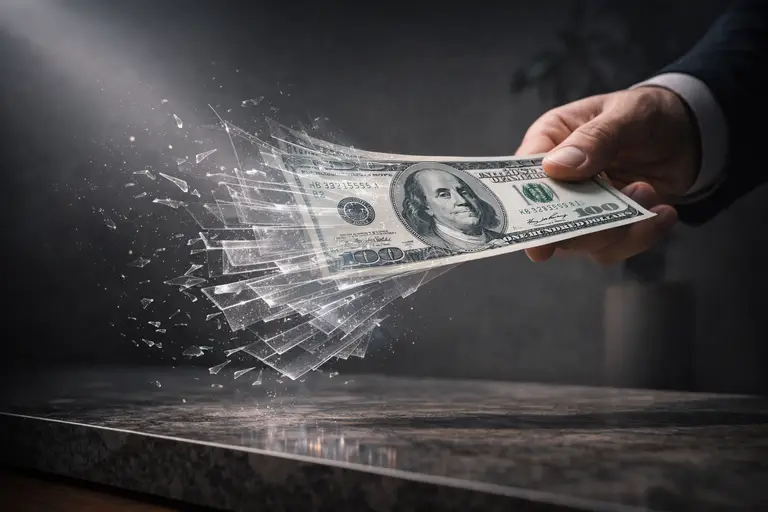
You’re waiting for them to look up.
That’s the whole dream. The money is already on the counter — already out of your hands, already in the position of being examined, already committed to the transaction. The thing you want is right there on the other side of the exchange. And you are standing in the specific four-second interval between the moment the currency left your hands and the moment the person across from you is going to look at it, look at you, and make the determination that you’ve been suspended in dread of.
This is what most people miss when they try to interpret this dream: the crime, if there is one, happened before the dream began. The fake money was in your possession before you chose to use it. The dream doesn’t show you acquiring the counterfeit or deciding to pass it. It shows you the moment after the decision — the suspended moment of already-committed, already-in-motion, waiting for the verdict on something you know about and they don’t yet.
Leon Festinger’s research on cognitive dissonance — the psychological state of holding two incompatible beliefs or acting in contradiction to one’s self-concept — documented what he called the most uncomfortable state the mind can maintain. The dissonance isn’t between knowing the money is fake and using it anyway. The dissonance is between the person you understand yourself to be and the exchange you are currently participating in. You are someone who offers genuine value. You know what you placed on the counter isn’t quite that. The gap between those two truths is what produces the specific quality of waiting in this dream.
The most important thing I’ve found in working with this dream is that it rarely appears in people who are consciously deceiving. It appears most consistently in people who were genuine once — who had the authentic version of what this exchange requires — and who have slowly, without deciding to, become a performance of what they used to be. Not fraud. Something more ambiguous and harder to name: the gradual drift from the real thing to the maintained version of it, with the specific knowledge that the drift has happened even while the external presentation has continued to imply the original.
Quick Answer
- The fake-money dream is not about deliberate fraud — it is about the gap between what you’re presenting in an important exchange and what you’re actually delivering; the distinction from impostor syndrome is precise: impostor syndrome asks am I adequate? this dream asks what am I actually offering here?
- Festinger’s cognitive dissonance research explains the specific quality of the waiting: the mind cannot comfortably maintain the simultaneous knowledge that the currency isn’t real and the active participation in an exchange that treats it as real; the dissonance has a cost, and the dream surfaces it
- The four seconds of waiting — the suspended interval before the verdict — is the dream’s most specific encoding of the psychological state of maintained inauthenticity: you know, they don’t yet, and the whole thing lives in the not-yet
- When the cashier accepts without looking, the exchange proceeds but nothing resolves; the currency is still what it is; the next transaction will require the same currency; acceptance without examination just defers the moment
- When the cashier looks and knows, the dream has staged the confrontation with discovery — often the most useful version, because the discovery, even when unwanted, ends the suspension
- When you try to use real money but can only find fake, the genuine resource ran out before you noticed the depletion; the inauthenticity isn’t chosen — the authentic version simply isn’t available in the form this exchange requires
- The thing you’re buying is as important as the currency you’re using: what you want from the exchange tells you what the inauthentic currency is being used to purchase — belonging, recognition, a position, the continuation of a relationship
- Robert Cialdini’s research on commitment and consistency illuminates the compulsive quality of this exchange: once a presentation has been committed to, the psychological pressure to maintain consistency with it is powerful even when the presentation has moved past its accurate territory
- When the bills change color or become obviously fake at the worst moment, the inauthenticity is revealing itself through the transaction it was supposed to sustain — the thing the performance was maintaining has finally produced a moment that exceeded the performance’s capacity
- The recurring version means the exchange is ongoing and the currency is still the maintained rather than the genuine version; the dream returns as long as the transaction continues in this form
Common Scenarios
You place the money and wait — the cashier hasn’t looked yet. The foundational version. Everything is in suspension. The transaction is committed, the currency is placed, and the interval before the verdict is the entire psychological content of this dream. Not the crime, not the aftermath — the four seconds of knowing without the other side knowing. This is the state that the dream is encoding: the specific quality of being inside an exchange where what you know about the currency differs from what the other party is about to be asked to accept.
The cashier accepts without checking. The reprieve version, and the least resolved. The exchange went through. The transaction continued. The relief is real and incomplete simultaneously. Nothing about the currency has changed. Nothing about the next transaction has changed. The acceptance simply moved the known-but-unexamined gap forward to the next moment of potential examination. The dream uses this version to encode the experience of maintaining an inauthentic exchange through another cycle — successful in the immediate sense, unresolved in every other sense.
The cashier looks up and knows. The confrontation version. The currency is being examined and found lacking. What happens next in the dream — the specific quality of the moment of discovery — is the most diagnostic detail. If the confrontation produces collapse, the discovery was catastrophic in the dream’s staging. If the confrontation produces something more ambiguous — a quality of something finally visible, something finally out in the open — the dream is processing the specific relief that comes when the sustained maintenance of an inauthenticity ends, however uncomfortably.
The bills change to something obviously fake at the moment of exchange. The exposure version. Not the examined currency — the self-revealing currency. What was being maintained as real has revealed itself at the moment of highest stakes. The performance finally produced a moment that exceeded its capacity. In waking life, this version arrives when something about the maintained version of the exchange has finally become visible to the other party — not through their examination but through the situation’s own demand exceeding what the performance could supply.
You reach for real money and find you only have fake. The depletion version. You wanted to pay correctly. You wanted the transaction to be honest. You reached for something genuine and found the counterfeit — not because you chose it but because the real ran out somewhere between the first use of it and now. This version encodes something specific about the nature of the inauthenticity: it isn’t deliberate. The genuine resource was real once. It’s been depleted by the demand of the ongoing exchange, and what remains is the form of it without the substance.
The transaction succeeds and you’re holding what you bought, and the holding doesn’t feel right. The hollow-acquisition version. The exchange completed. The thing is now yours. And the specific quality of holding something obtained through inauthentic currency is different from holding something obtained through real exchange. What you have is real. How you got it isn’t. The holding carries the knowledge of the gap, and that knowledge doesn’t clear just because the transaction succeeded.
What Your Body Already Knows
Woke up with the specific tension of monitored exposure — a quality of being in a situation that might at any moment require what you’re not certain you can deliver → because the dream ran the social-threat system at full activation throughout; the amygdala processed the potential discovery as a genuine survival-level threat; this activation has a somatic residue that the morning carries as a specific quality of alertness — the same alertness that runs in the waking-life situations where the maintained exchange operates
Woke up with a guilt-adjacent feeling that doesn’t have a clean target → because the guilt analog this dream produces is specific: not for something done wrong but for something being done — the ongoing participation in an exchange where the currency is known to be less than what it presents itself as; this feeling doesn’t resolve by identifying a discrete wrong act because the act isn’t discrete; it’s a state
Woke up and a specific exchange — professional, relational, social — was already present in consciousness before any analysis → because the transaction in the dream had a waking-life address; the counterfeit currency was always being used in a specific context; whatever arrives before deliberate thought is the address
Woke up and the relief of realizing it was a dream wasn’t clean — something continued from the dream into the morning → because what generated the dream is still ongoing; the fake money is still in use in the waking exchange; the dream’s content was fictional; the state that generated the dream is not; the unclean quality of the relief is the body accurately reporting that the source hasn’t resolved
Woke up checking something internal — not the dream but a specific situation — the way you’d check a wallet you weren’t sure about → because the self-assessment system was activated by the dream; it’s running the same check the dream was running: what is the actual status of the currency in this exchange, and is there a version of real available, and how long has the maintained version been substituting for it?
The Distinction the Dream Is Making — Inauthenticity Is Not the Same as Inadequacy
This is the distinction most people miss, and understanding it changes the entire reading of the dream.
Impostor syndrome says: I am not what I appear to be. The fear is that the observer will see through the presentation to the underlying inadequacy. The question is about capacity — whether the real version of you, if seen clearly, would be found insufficient for the situation.
The fake-money dream says something more specific and more uncomfortable: I am actively exchanging something that I know isn’t what it’s presenting itself as. The question is not about capacity. It is about the current authenticity of what’s being offered. The distinction is between feeling unqualified (impostor syndrome) and knowing that the currency you’re currently using has drifted from the genuine to the maintained.
This distinction matters because the response is different. Impostor syndrome is addressed by evidence — by accumulating proof of genuine capability that challenges the self-assessment. The fake-money dream is not addressed by evidence of capability. It’s addressed by examining the specific exchange and asking: when did the genuine version of what I’m offering begin to be replaced by the performance of it? And is the genuine version available — is it something I can return to — or has the performance been running long enough that recovering the genuine version requires more than simply deciding to?
Robert Cialdini’s research on commitment and consistency documented the psychological mechanism that keeps people in exchanges past the point where they would have chosen to exit: once a presentation has been publicly committed to, the pressure to maintain consistency with it becomes its own motivating force, independent of whether the original basis for the presentation still holds. You committed to being a certain version of yourself in this exchange. The version has drifted. But stopping the presentation requires acknowledging the drift — which is what the sustained maintenance has been successfully postponing.
The fake-money dream is the postponement’s alarm system.
The bills are on the counter. You know their texture — there is something wrong about it, too uniform, the weight slightly off. You’ve known since you picked them up. You cross to the counter anyway. You place them down. You wait. Not because you forgot what they are. Because stopping the transaction would require being in a different version of this situation than you’re currently in. And you’re not ready for that yet. So you wait.
Dream About Money and Success — What the Brain Is Actually Asking maps the framework within which authenticity in exchange operates — and why the fake-money dream sits at the specific intersection of the recognition and freedom questions, where what’s being exchanged is the right to participate in a context rather than any simple financial transaction.
What You’re Trying to Buy — The Currency and Its Object
The thing on the other side of the counter is as important as the currency being used to obtain it.
Whatever you’re purchasing in the dream already has a waking-life address. You are using inauthentic currency to obtain something real — which means there is something you want from this exchange that you’re either unable or unwilling to offer genuine currency for. This isn’t moral judgment. It’s diagnostic information.
The list of things people buy with fake money in the most common versions of this dream is specific: belonging in a context that requires a version of you that no longer quite corresponds to the current version. Recognition from a relationship or institution that was calibrated to an earlier or different presentation. The continuation of a professional identity that was once fully earned and is now partially maintained. A position in someone else’s life that requires the performance of a quality — availability, enthusiasm, investment — that has become the performance of itself.
None of these are shameful desires. All of them are real needs. The problem the dream is encoding isn’t the wanting. It’s the specific currency being used to satisfy the wanting — the maintained version rather than the genuine one, offered in a transaction that will ultimately require genuine currency to sustain.
The cashier who hasn’t looked yet represents whoever is on the other side of the exchange in the waking life. They have accepted what you’ve been offering. They haven’t yet examined it closely enough to notice the difference. The dream is staging the specific experience of being inside that not-yet, knowing what you know, waiting.
Giving Away Large Amounts of Cash — What Happens When Generosity Becomes Drainage maps the other direction of the same currency question — when instead of the inauthenticity of what’s being offered, the question is about whether the rate of the giving is sustainable, and what it means when you can’t stop.
Dream Timestamp
The fake-money dream arrives when the drift from genuine to maintained has been running long enough to constitute its own cognitive load → not the first day of presenting something that isn’t quite accurate — when the maintenance has become an ongoing project whose cost the mind has been carrying alongside everything else; the dream appears when that cost has crossed the threshold of sleep-level urgency
The acceptance-without-examining version arrives during the periods of highest maintenance success → paradoxically: when the performance is working best, the dream is most likely to appear in this version; the better the counterfeit is accepted, the more clearly the mind registers the gap between what’s being offered and what’s being received as offered
The exposure version arrives when something in the waking situation has changed in a way that makes examination more likely → when circumstances have shifted to the point where the maintained version is being asked to perform beyond its capacity; when the cashier is about to look not by choice but by necessity
The depletion version arrives when the genuine resource ran out without a clear moment of noticing → when the drift from authentic to maintained happened gradually enough that there was no identifiable moment of decision; the depletion version is the dream’s encoding that the genuine version isn’t currently available in the form the exchange requires
The recurring version means the exchange is still running in this form → the dream returns as long as the gap between what’s being presented and what’s being delivered remains active and unaddressed; it stops when the exchange is either restored to genuine currency or honestly restructured
The Sentence This Dream Was Trying to Say
“I’ve been offering something in an important exchange that I know has drifted from the genuine version — and the transaction keeps going because the other side hasn’t yet had occasion to look closely at what I’ve been handing them.”
The Morning After
The four seconds of waiting have ended. The verdict that the dream was suspended in hasn’t arrived — not because the examination didn’t happen but because you woke up before it did, which is the brain’s accurate encoding of where you are: still in the not-yet, still before the looking, still in the interval of maintained inauthenticity that the dream was mapping.
Before the day begins and the maintenance resumes: name the exchange. What is the specific transaction — the relationship, the professional context, the social role — where what you’re offering has drifted from the genuine to the maintained? And: when did the drift happen? Is there a version of the genuine available to return to — something that would restore the currency to what it used to be — or has the maintenance been running long enough that what’s needed is a different kind of restructuring?
The question worth bringing to this morning: if the cashier looked up right now and saw what I’ve actually been handing them — what would they find? And is that something I’m willing to be seen offering?
FAQ
This dream encodes the gap between what you’re presenting in an important exchange and what you’re actually delivering. Not deliberate fraud — more often, the gradual drift from a genuine version of what an exchange requires to a maintained performance of it. The fake money is the currency of that drift: something that looks like what the exchange needs, that you know has moved away from the genuine, that you’re using anyway while waiting to see whether the other side notices. Festinger’s cognitive dissonance research explains the specific quality of the waiting: the mind can’t comfortably maintain the simultaneous knowledge that the currency isn’t real and the active participation in treating it as real.
No — and the distinction matters. Impostor syndrome is about internal doubt: am I adequate? It’s the gap between self-perception and external presentation, and it’s addressed by evidence of genuine capability. The fake-money dream is about something more specific: active participation in an exchange where what you’re offering has drifted from genuine to maintained. The question is not whether you are adequate — it is whether what you’re currently offering is the real version of what this exchange requires. The response to impostor syndrome is evidence. The response to the fake-money dream is examining when and how the drift happened.
The transaction went through — for this cycle. The relief is real and the resolution is not. The currency is still what it is. The next transaction will require the same currency. Acceptance without examination just defers the moment of potential discovery. Robert Cialdini’s research on commitment and consistency shows that once a presentation has been accepted without examination, the pressure to maintain consistency with it actually increases — making the drift harder to interrupt the longer the unexamined acceptance continues.
The genuine resource that once backed this exchange has been depleted. Not chosen fake over real — the real ran out, gradually, without a clear moment of noticing. The authentic version of what this exchange required was real once and was consumed by the demand of the ongoing exchange without being restored. What remains is the form of it without the substance. This version of the dream encodes involuntary inauthenticity: not a drift by choice but a depletion by unsustainable demand.
The performance exceeded its capacity at the worst available moment. Not through examination — through the situation’s own demand producing something that the maintained version couldn’t supply. The inauthenticity revealed itself rather than being discovered. This version arrives when a waking-life situation has asked something of the maintained version that the maintained version can’t provide — when the gap between performance and reality has produced a moment that the performance couldn’t cover.
By addressing the exchange the dream is built on. Not by improving the performance — by either restoring the genuine currency or honestly restructuring the exchange to correspond to what’s actually available. The dream tracks the gap between what’s being offered and what’s being presented as offered. When that gap closes — either because the authentic version is restored or because the exchange is restructured to no longer require it — the cognitive dissonance the dream was encoding dissolves, and the dream loses its source material.
Next Stages
Counting Cash — The Audit That Never Produces a Final Answer — what happened before the fake money — the internal audit that kept not settling, the counting that couldn’t confirm the sufficiency of what was there, until the gap between real and maintained became the operating currency
Being Unable to Pay in Public — The Four-Second Window Where Private Becomes Social — what happens when the fake money is examined and found lacking — when the transaction that was maintained through the not-yet finally meets the moment of public verdict
Losing Your Wallet — When the Proof of Who You Are Goes Missing — the version where the currency system disappears entirely — when instead of having inauthentic credentials, the credential system is gone and the question is not about their quality but about their existence
Dream About an Empty Safe or Broken Vault — what the fake money was protecting access to — when what was supposed to be in the protected reserve is discovered missing, and the safe’s intact structure is the evidence of how it left