Fear With No Reason — The Hidden Trigger Explained

There was nothing there.
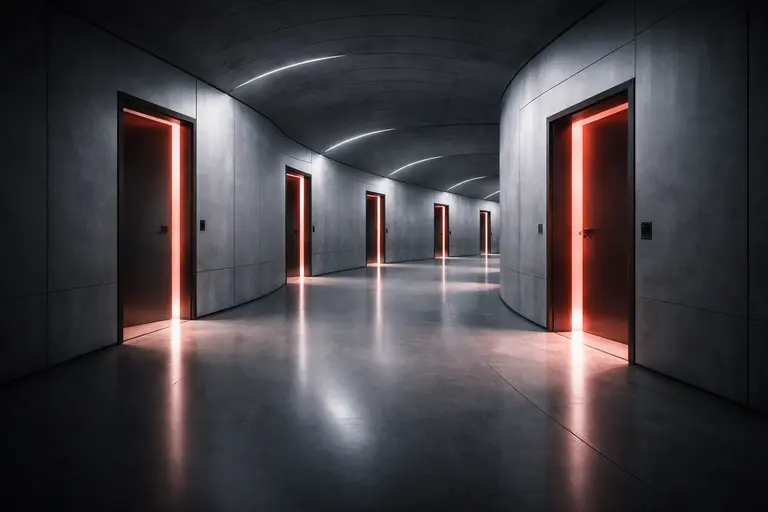
That’s the specific quality of this version — the one that stays longest, the one that’s hardest to explain to anyone who asks what the dream was about. There was no threat you could name. No attacker, no pursuer, no danger you could point to and say: that. Just a room, or a street, or a space that looked exactly as it should, and inside that ordinary space, a fear that was completely and entirely real.
You looked for the source. You scanned the room, the street, the faces of people going about their business in the background of the dream. You checked systematically, the way you check when you know something is wrong but can’t locate it. And the checking produced nothing. The room was empty. The street was ordinary. The people were fine. Nothing was threatening you, and the fear was unchanged.
I find this the most underestimated dream in the entire anxiety cluster — not because it’s the most dramatic, but because it’s the most honest. Every other anxiety dream gives you something to organize around: a pursuer, an attacker, a trap, a watcher. This one gives you only the feeling. And that’s not a failure of the dream to produce adequate content. That is the dream being more accurate than any of the others.
Fear with no reason has a reason. The reason is just not attached to any single, addressable thing. And the absence of a target is itself the most important information the dream contains.
Quick Answer
- Fear with no reason is not irrational and not random — it is the amygdala accurately reporting that the source of anxiety has become diffuse rather than specific, ambient rather than located at a single addressable point
- The absence of an identifiable threat in the dream is the most important information the dream carries — not a failure to produce content, but a direct report on the nature of the anxiety’s source
- The amygdala is designed to generate directed fear — fear aimed at a specific threat-object; when the source is structural rather than situational, the alarm activates without being able to aim at a single point
- This is the dream that most directly maps chronic, diffuse anxiety — the kind that has spread beyond any specific situation into the ambient quality of waking life itself
- The continuous scanning for the threat — looking around, trying to locate the source — is the dream’s encoding of the waking experience of monitoring everything and finding no single point where the problem lives
- When fear with no reason arrives during a period that feels relatively fine, the waking management has been working well enough that no specific source seems urgent; the dream reports what the management was successfully obscuring
- This dream appears most consistently in people who are carrying a total load that has become larger than any single element of it would account for — the fear is proportional to the sum, not to any individual part
- The dream that returns repeatedly with the same sourceless quality is the nervous system reporting that the diffuse condition has been running consistently, not episodically
- The most useful question after this dream is not “what was I afraid of?” but “what is the total quality of what I have been carrying lately — not the specific stressors, but the overall weight of all of them together?”
- Sourceless fear in a dream that feels deeply familiar — like you have been here before, like this quality of the room has visited you before — is the body recognizing a chronic state it has been in for longer than any single situation would account for
Common Scenarios
You are somewhere familiar and everything is visually normal, but the air itself has a different quality. The most fundamental version. Nothing visible to react to. The threat is not in the objects of the scene but in the ambient texture of the space. The body has registered something that the visual field hasn’t confirmed. This is the most direct rendering of diffuse anxiety: the nervous system is running the alarm, the alarm has no specific address, and the space carries the quality of the alarm without any visible cause to attach it to.
You scan the room or the environment looking for the source, and finding nothing makes the fear stronger. The scanning behavior is itself diagnostic. Every other fear dream gives you the threat directly. This one withholds it. The act of looking — systematically, urgently, without result — is the dream mapping the waking experience of monitoring a situation you can feel is generating pressure without being able to locate which specific element is the primary source. The not-finding intensifies the alarm because an unlocatable threat requires continuous vigilance.
Someone is present — not threatening, not doing anything wrong — and their presence makes everything worse. The body is using a familiar element to carry the ambient load. The person hasn’t changed. Your relationship to them in the dream hasn’t changed. But the ambient quality of the fear is in the air around them, and proximity to them carries the heaviness of whatever the sourceless fear is made of. In waking life, this person or what they represent is probably one element of the total load — not the source, but a surface on which the diffuse pressure lands.
The fear escalates without any event occurring — nothing happens but the feeling grows. The escalation without cause is the most specific encoding of structural anxiety. In every other fear dream, something happens that drives the fear higher. Here, the fear rises autonomously, driven by accumulation rather than event. This is the body accurately rendering the experience of anxiety that has been building through sustained pressure rather than through any specific incident.
You wake from it with the fear still present and nothing in the room to account for it. The crossover version — the sourcelessness of the dream following you into waking. The alarm was real; the room contains no cause for it; and the body holds the post-alarm state for some time while the rational mind confirms there is nothing to point to. This particular morning quality — real fear, empty room — is the body’s honest condition when diffuse anxiety has been running at high enough levels that sleep, with its reduced regulation, tipped it over.
The dream repeats across multiple nights with the same characterless fear — no scenario changes, only the sourcelessness is constant. The recurring sourceless dream is the clearest possible report on chronic diffuse anxiety. The variation that would indicate a shifting specific source — different scenarios, different content, different threatening elements — is absent because the source isn’t shifting. The same ambient quality returns because the same ambient condition is present. Night after night, the amygdala finds the same diffuse load and generates the same sourceless alarm.
What Your Body Already Knows
Woke up afraid of nothing and unable to name what the fear was about → because the fear was accurately sourceless — not a failure of memory or a gap in dream-recall, but the dream’s precise rendering of anxiety that has no single address; there is nothing to name because the source is not nameable as a single thing
Woke up with the specific exhaustion of sustained scanning — the tiredness of having looked for something without finding it → because continuous threat-scanning is metabolically and neurologically expensive; the dream ran the attention at full vigilance without providing anything to focus on, and the body carries the cost of that sustained unfocused alertness
Woke up and noticed the fear was familiar — the same quality as something you carry during the day, just without the day’s insulation → because the dream removed the management mechanisms that make the waking anxiety tolerable; what you felt in the dream is what the body carries underneath the management; the recognition is the body knowing its own chronic state
Woke up and immediately began checking — phone, the day ahead, what’s happening — as if looking for the source the dream couldn’t provide → because the scanning behavior that was running in the dream continued briefly into waking; the nervous system was still in locate-the-threat mode and the morning’s first instinct was to search waking reality for the source the dream couldn’t locate
Woke up with a quality of the dream still in the room — not a visual, not an image, a texture → because sourceless fear doesn’t leave an image-residue; it leaves a quality; the specific ambient heaviness of a space that held something the visual field couldn’t confirm is what persists, because that quality was the content
What “No Reason” Actually Means — The Neurology of Directionless Fear
The phrase “fear with no reason” contains an assumption worth examining directly: that fear without a visible cause is unreasonable, irrational, or somehow in error. In my experience, this assumption is what makes this dream hardest to sit with. The person who wakes from it feels, on top of whatever the fear was, a layer of confusion about why they were afraid of nothing — as if the absence of a visible cause makes the fear suspect.
The neurobiology is more interesting than that.
The amygdala is designed to generate threat responses at specific objects. This is its default mode: something is identified as threatening, the threat-response activates, the attention is directed toward the threat. This is the architecture of every other fear dream. There is a pursuer; the amygdala directs the fear at the pursuer. There is an attacker; the amygdala directs the fear at the attacker. There is a trap; the amygdala generates the experience of confinement. The threat and the response are aligned.
This architecture requires something: a specific threat-object for the amygdala to aim at.
When anxiety has become structural — when the source of pressure is not a specific situation but the total quality of an extended period, not a single stressor but the accumulated weight of many stressors running simultaneously — the amygdala activates the alarm without having a specific object to direct it at. The alarm is genuinely running. The activation is completely real. But the threat-processing architecture that normally produces directed fear finds no single point to aim at, because the source is everywhere and therefore nowhere specific.
What the body generates in this condition: the alarm at full intensity, with no object attached. Fear, running complete, without a face.
This is not the amygdala malfunctioning. This is the amygdala doing the best it can with an input — diffuse, systemic, ambient anxiety load — that its directed-fear architecture wasn’t designed to process cleanly. The sourcelessness of the fear is not a reporting error. It is an accurate report on the nature of the source.
You are in the room and the room is the room — your room, or a room that carries the quality of yours without being quite yours, with the quality of belonging that familiar spaces have in dreams. Nothing is different. The light is correct. The objects are where objects should be. You stand in it and the room is fine and you are not fine, and the gap between the ordinariness of the space and the thing running in your chest is the most specific thing about the whole experience. You look for what you’re reacting to. You check the corners. You check the door. You check the faces of anyone there. Nothing. The fear is complete and the room is empty and both of these things are simultaneously, entirely true.
Fear and Anxiety Dreams — What Your Mind Is Trying to Warn You About maps the full architecture of how the nervous system delivers unresolved pressure during sleep — and why the delivery happens at the one moment when the management mechanisms are offline.
The Scanning That Has No Place to Land
There is a specific physical experience that characterizes the fear-with-no-reason dream, and it’s worth naming precisely because it’s also the experience that characterizes the waking anxiety state the dream is built on.
It is the experience of continuous scanning that finds no point to rest on.
In directed fear, the attention has a focus. There is a specific threat and the attention is organized around tracking it. This is uncomfortable but manageable — the system knows where to look. The attention has a landing place.
In sourceless fear, the attention is running at full vigilance without a landing place. It scans — the corners, the faces, the exits, the environment — and nothing provides the confirmation that would let the scanning rest. No threat is located. No place is marked safe. No element of the environment provides the information that would allow the vigilance to downregulate.
The continuous unfocused scanning is metabolically expensive and neurologically exhausting. It is also, in waking life, exactly the experience of living with diffuse structural anxiety: monitoring everything, finding no single point where the problem lives, unable to conclude that anything is safe because unable to conclude that any specific thing is dangerous. The attention cycles through the available inputs without finding the signal that would let it rest.
The dream encodes this precisely. The looking that finds nothing. The checking that doesn’t produce clearance. The room that is fine and doesn’t feel fine. That specific experience — not the absence of a threat, but the absence of a clear enough threat to organize around — is what diffuse structural anxiety feels like when the management is gone and the body has direct access to it.
Being Trapped — Pressure You Can’t Escape maps a related but distinct territory — when the anxiety has crystallized around a specific structural condition rather than remaining diffuse; the pressure that has a shape even if it has no exit.
Why Structural Anxiety Produces Sourceless Fear — What the Dream Is Built On
This is the section that matters most for people who keep having this dream.
There are two kinds of anxiety, and they produce two different kinds of fear dreams.
Episodic anxiety is anxiety with a source: a specific situation, a specific stressor, a specific period of pressure that has a beginning and a probable end. This kind of anxiety produces fear dreams with content — pursuits, attacks, traps — because there is a specific source the amygdala can use to construct a threat-scenario.
Structural anxiety is anxiety without a single source: the accumulated quality of an extended period during which multiple pressures have been running simultaneously, during which certain things have been chronically unaddressed, during which the total load has become larger than any single element of it. This kind of anxiety doesn’t have a specific situation to point to. It has become the ambient quality of the waking life itself — present everywhere, located nowhere specifically.
The fear-with-no-reason dream is what structural anxiety looks like when the management mechanisms are offline and the body has direct access to the load.
What I find consistently in people who have this dream repeatedly: when you ask them what specifically they’re anxious about, they can produce a list. A work situation. A relationship dynamic. A financial concern. A health question. A transition that hasn’t resolved. But each individual item on the list feels manageable on its own. None of them seems large enough to account for the quality of anxiety they’re actually carrying. The mystery is that the total feels larger than the sum of any of the individual parts.
This is structural anxiety. The total load has become its own condition, separate from the individual stressors that compose it. The fear-with-no-reason dream is accurately reporting on the total, not on any individual part.
The useful shift is from “what am I afraid of?” to “what has the total quality of what I’ve been carrying been like lately?” Not the individual stressors — the total. The aggregate. The weight of everything together over time. That is what the dream was built on. That is what it is asking you to look at.
Dream Timestamp
The sourceless fear dream arrives during periods of high total load with no single dominant stressor → when the anxiety is distributed across multiple active situations — none individually alarming, collectively generating significant pressure — the dream produces fear without a face because the source has no face
The sourceless fear dream arrives during periods described as “fine but something feels off” → this specific phenomenology — objectively manageable, subjectively not quite right — is the surface presentation of structural anxiety; the dream reports on the subjective layer that the management is successfully obscuring from the objective description
The sourceless fear dream arrives when the duration of pressure has been longer than any single stressor would account for → time compounds structural anxiety; the dream is reporting not on what is currently active but on what has been continuously active; the dreamwork encodes duration
The sourceless fear dream intensifies when management strategies have become more active → counterintuitively: the harder the waking system works to contain the diffuse anxiety, the more depleted the regulatory capacity becomes; more active management → lower regulation at sleep onset → more intense sourceless fear during REM
The sourceless fear dream quiets when the total load genuinely reduces — not when specific items are explained but when the aggregate actually lightens → because the source is the total, the relief is felt in the total; individual understanding of individual stressors, without reducing the overall load, doesn’t change what the dream is built on
The Sentence This Dream Was Trying to Say
“The fear wasn’t irrational. The reason just isn’t small enough to point at — it’s the whole thing, all of it together, what it has been like to carry all of this for this long.”
The Morning After
You are awake. The room is fine. You know it is fine. And something in the chest is still running — not the peak intensity of the dream, but the specific quality of an alarm that didn’t find a cause and therefore didn’t fully close.
This takes longer to metabolize than the mornings after directed fear dreams. There’s nothing to conclude. No pursuer to confirm the absence of, no attacker to process the safety from. Just the ambient quality of the alarm still present in a body that has confirmed no specific threat exists.
What I would say to anyone sitting in this particular morning: the dream was not confused and you are not broken. The brain produced the most honest available rendering of something that is genuinely present — anxiety that has become structural, that has spread beyond any single addressable point, that carries the weight of everything together rather than the weight of any one thing specifically.
The question this morning is not what you are afraid of. It’s a larger question, and a harder one: what has the total quality of what you have been carrying been like lately — the whole of it, not the parts — and when did you last set any of it down?
FAQ
Fear with no reason is the amygdala accurately reporting that the source of anxiety has become diffuse rather than specific. The alarm is completely real; what’s absent is a single addressable threat-object, because the source isn’t a single thing — it’s the total quality of an extended period of accumulated pressure. The absence of a target is the target. The dream is being more honest, not less, than every fear dream that provides a specific threat to organize around.
Not necessarily. Sourceless fear in dreams occurs in people without clinical diagnoses who are carrying a high total load — multiple active stressors running simultaneously, sustained duration of accumulated pressure, the weight of everything together exceeding the weight of any individual part. When this dream recurs frequently, or is accompanied by significant daytime anxiety, professional support is worth seeking — not because something is wrong with you, but because the load the dream is reporting on is worth addressing at the appropriate level.
Because the scanning behavior runs the vigilance system at full intensity without providing anything that would let it rest. In directed fear, finding the threat allows the attention to organize around it — uncomfortable but focused. In sourceless fear, the search returns nothing, and the absence of a finding means the scanning cannot complete. Each pass through the environment that finds nothing confirms that the source is unlocatable, which keeps the vigilance running at full intensity indefinitely.
Because a nightmare gives you something to process. There is content — a monster, an attack, a specific loss — and the emotional processing can run to completion on the content. Sourceless fear has no content to complete the processing on. The alarm is real, the source is unlocatable, and the vigilance system cannot close because there is nothing to confirm as resolved. The residue lingers longer precisely because there is nothing to point to and say: that was it, that is over, I am clear of it.
Both involve alarm without a specific external cause, but they operate differently. Fear with no reason is primarily an experiential and attentional phenomenon — you are afraid, the fear has no focus, the awareness is scanning without finding. A panic attack dream is primarily physiological — the body is running the full alarm protocol: elevated heart rate, altered breathing, cortisol spike. Fear with no reason may include some physiological activation; a panic attack dream is defined by it. Both report on chronic anxiety load; the panic attack dream reports on a higher activation threshold.
Not “what am I afraid of?” — that question looks for a specific source that doesn’t exist as a single thing. The more useful question is: what has the total quality of what I’ve been carrying been like lately — not the individual stressors but the aggregate weight of all of them together, over the full duration? And: when did I last genuinely reduce any of that total, rather than manage it more effectively? The dream is reporting on the whole, not the parts.
Next Stages
Panic Attack Dreams — Why Your Body Reacts Even in Sleep — what happens when the diffuse load crosses the threshold — from sourceless fear into full physiological alarm, before any content has assembled
Being Chased by Something You Can’t See — the version where the diffuse source acquires movement — when the unlocatable becomes a presence that is gaining on you
Darkness and Fear — The Unknown You Avoid — the environmental version of sourceless fear — when the unlocatable is encoded as obscured space rather than empty room
Overthinking — Why Your Mind Won’t Stop — the cognitive version of the same scanning — when the mind runs the search continuously in thought rather than in the visual field