Writing Wrong Answers in a Dream — When the Problem Isn’t What You Know

You write the answer. Then you stare at it.
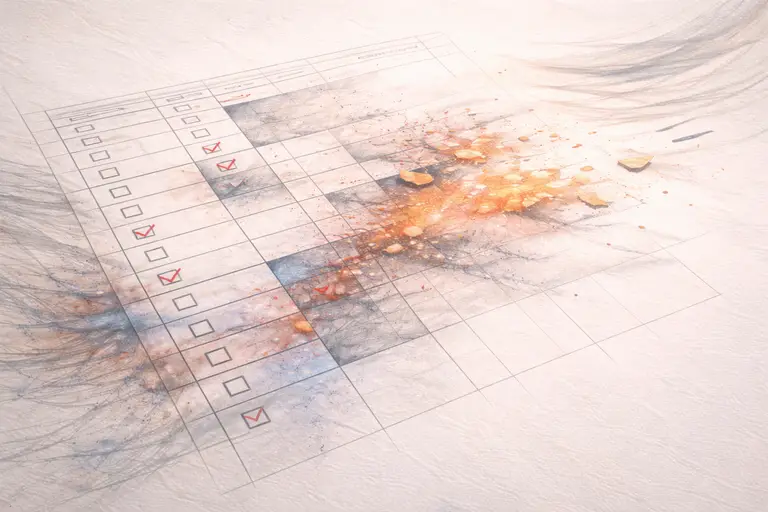
The answer is correct. You know it’s correct — the same way you know anything you actually know, with the specific quality of recognition rather than retrieval. It’s there. It’s right. And the longer you stare at it the more it looks like something else. Something suspect. Something that needs checking. So you erase.
You write it again.
Same answer, possibly. Or something slightly different, slightly safer, slightly more what you imagine the expected answer looks like rather than what you actually know. And it has the same quality as the first attempt: it looks wrong the moment it exists. Not wrong because it is wrong. Wrong because it came from you, and somewhere between the knowledge and the production something happened to your trust in what comes out of you.
That somewhere is what the dream is about.
I want to say directly what I’ve found consistently across the years I’ve spent working with exam dreams: the writing-wrong-answers dream is not about capability. It’s not in the same cluster as the forgetting dream, the blank-paper dream, the unprepared dream. Those are about access — about whether the knowledge is present and reachable. This dream specifically stages a situation where the access is working and the trust has failed. You have the answer. The problem is that your own evaluation of the answer arrives at “wrong” before the examiner has had a chance to weigh in.
Tim Wilson and Jonathan Schooler documented what they called “verbal overshadowing” — the finding that asking people to verbally articulate their reasoning about a problem they had solved intuitively actually reduced their subsequent ability to solve similar problems. The analysis interfered with the process. The watching made it worse. The dream is generating the spatial image of this precise mechanism: you write, you watch what you wrote, the watching undermines what you wrote, you erase. The erasing is the watching completing its work.
What produced the watching is the question the dream is actually asking.
Quick Answer
- The writing-wrong-answers dream is specifically about the failure of trust in your own output — not the failure of capability; you have the knowledge, the access is working, and the problem is that your own evaluation of what you produce arrives at “wrong” before any external examiner has weighed in
- Tim Wilson and Jonathan Schooler’s verbal overshadowing research established the mechanism: analytical monitoring of intuitive production actually degrades the production; the watching makes the output look wrong because watching itself disrupts the process; the erasing loop is this mechanism rendered as a spatial image
- The dream distinguishes itself from every other exam dream by its specific structure: in the forgetting dream, the material is absent; in the unprepared dream, the preparation is absent; in this dream, everything is present and the problem is a single malfunctioning relationship between the producer and the judge — both of which are you
- Daniel Kahneman’s System 1 and System 2 research helps locate the specific failure: System 1 — the fast, automatic, intuitive process — produces the correct answer; System 2 — the slow, deliberate, analytical process — then evaluates it and finds it wanting; the dream stages the moment when System 2 has been trained to override System 1’s correct output
- The person who trained the judge is almost always identifiable — accumulated input from a specific source whose corrections have been internalized as the default evaluation standard; the erasing isn’t happening from within, it’s happening from a voice that was installed by someone else
- When you choose a wrong answer deliberately to end the loop, the dream is encoding pre-emptive self-disqualification — the specific coping mechanism that sacrifices accuracy for the relief of having made a definite decision; this has an active address in waking life
- When the paper wears through from erasing, the effort has consumed the medium — not just the answer but the surface on which the answer could have been written; this encodes the specific exhaustion of someone whose self-correction cycle has been running long enough to erode the capacity for output itself
- When someone is watching the erasing — when the loop has an observer — the judge has been externalized; what the dream is encoding is not internal self-doubt but external evaluation that has become the operating standard
- Pauline Clance’s research on impostor phenomenon found it most consistently in people who were performing at or above their actual level of recognition — high performers who had systematically learned to undervalue their own output; the writing-wrong-answers dream belongs specifically to this group
- The dream stops when the judge is retrained — not when the answers get better, but when the evaluation standard shifts back to the person’s own criteria rather than the internalized criteria of the source that installed the doubt
Common Scenarios
You write the answer you know is right and immediately erase it. The foundational loop. Not hesitation about the material — recognition of the answer followed immediately by disconfirmation of the recognition. The knowledge and the doubt arrive at the same time. You are simultaneously the most reliable available source on this answer and the first voice to find it untrustworthy. This version maps the specific waking experience of someone whose evaluative voice has been trained to find their own output suspect regardless of its actual quality.
You erase and write the same answer again. The repetition loop. Not looking for a better answer — looking for a version of the same answer that survives your own evaluation. It doesn’t exist, because the problem isn’t the answer. The second version has the same quality as the first because it came from the same source, and the source is what the judge has been trained to distrust. Writing it again is the dream’s image of trying to solve through repetition what can only be solved through addressing the evaluation standard.
You choose a wrong answer deliberately to stop the loop. The pre-emption version — and the one that produces the most specific shame on waking, which is itself information. At some point the exhaustion of trying to produce something that survives evaluation exceeds the cost of being definitively wrong. You write something you know is wrong and you leave it. The decision is made. It’s finished. In waking life, this corresponds to pre-emptive self-disqualification: declining the opportunity before the rejection arrives, conceding the argument before it’s made, not submitting the work before the criticism can land. The choosing-wrong is already happening somewhere in your waking life. The dream is showing you the internal logic of it.
The paper wears through from erasing. The medium-destruction version. The effort of self-correction has consumed not just the answer but the surface on which any answer could be written. This is the dream’s most honest image for the endpoint of the erasing loop: prolonged enough, the cycle doesn’t just fail to produce a stable answer — it destroys the capacity for output. The paper is gone. There is nothing left to write on. In waking life, this maps the specific state of someone whose creative, intellectual, or professional output has been so consistently scrutinized and revised before reaching the world that the generative capacity itself has been eroded.
Someone watches while you erase. The externalized version. The internal judge has acquired a face. The evaluation is no longer something running inside you — it’s located in a specific observing presence whose reaction you’re writing toward rather than writing for yourself. This version tends to correspond to the most identifiable source of the internalized correction: the person whose watching in the dream is the person whose assessment has become the primary evaluation standard in waking life. The dream has stopped being abstract about the origin.
You finish but look back and all the answers look wrong. The retroactive version. Not the struggle to produce — the impossibility of accepting what was produced. The exam is done. You review it. Everything looks wrong, even the answers you were confident about during writing. This version encodes the most chronic form of the problem: the doubt isn’t only prospective, running in real time during production. It’s also retroactive, applying to everything that has already been produced. Nothing can be settled even after completion.
What Your Body Already Knows
Woke up with the hands — not pain, the specific residual tension of a grip that was held too long → because the motor cortex was running the erasing gesture throughout the dream; the repeated motion of writing and erasing was somatically encoded at full physiological detail; what remains in the hands is the body’s record of sustained, failed effort — the specific muscle memory of work that kept undoing itself
Woke up with a tiredness that belongs to fighting rather than to exertion → because the dream was running the conflict between two systems — the producing system and the evaluating system — simultaneously and in opposition; this kind of internal conflict has its own metabolic cost; the tiredness on waking is not from the writing but from the hours of running both systems against each other
Woke up with the doubt already active before the dream assembled into narrative → because the evaluating voice the dream was processing is the same voice that runs in the waking life; it was already running when consciousness returned; the first waking moments carry the dream’s evaluative standard as their default orientation; whatever the first self-assessment of the morning is, it arrived from the same source the dream was about
Woke up and a specific person or context was already present before any deliberate thought → because the judge has a source, and the source has an address, and the brain assembled that address throughout the dream; whoever or whatever arrives in consciousness first corresponds to the person or context whose evaluation has been internalized as the primary standard; this is the most specific information the dream provides
Woke up with a quality of pre-emptive self-correction already running → because the evaluating-before-externalizing cycle extended into waking; the first thoughts of the day are already being checked by the installed standard before they’ve been allowed to exist; the dream and the morning are running the same process
The Judge Was Installed — The Most Important Thing This Dream Is Saying
Here is the specific thing the writing-wrong-answers dream is most precisely about, and the thing that requires the most honesty to sit with.
The judge — the evaluating voice that finds your output wrong the moment it exists — is not native. You did not generate this standard from within yourself. It was installed by accumulated input from a source whose corrections you received often enough and from a position of sufficient authority that the correction became internal. You are now doing for free, in advance, the work the source used to do when it saw your output.
Pauline Clance’s research at Georgia State University on impostor phenomenon documented this installation process with precision. What she found was not that people who doubt their own output are genuinely insufficient for their roles. The opposite: impostor phenomenon appears most consistently in high performers — people who are demonstrably capable, producing demonstrably valuable output, who have nonetheless learned to systematically undervalue what they produce. The learning is relational. Someone taught them that their output requires correction before it can be trusted.
In waking life, the source is identifiable. A manager who consistently offered “better ways” before you’d finished explaining your version. A partner who remembered shared experiences differently, consistently, with the implication that your version was wrong. A parent whose expression of approval always came with the correction appended. A colleague whose first response to your ideas was adjustment.
Each individual instance was manageable. The accumulation is what produced the installation. You internalized the standard. Now you apply it yourself, in advance, to everything you produce. The dream is showing you the cost: write, doubt, erase, write, doubt, erase. The paper wears through.
The dream is not asking you to produce better answers. It’s asking you to examine whose standard you’ve been applying to the answers you already have.
The answer is on the page. You know it. You look at it and the knowing doesn’t make it stable. Not because the answer changed — because the judge arrived the moment the pen lifted. Same judge, same verdict, different answer would produce the same result. The judge isn’t evaluating the answer. The judge is evaluating you. And the verdict was set before the exam began.
Dream About Failing an Exam — What Your Brain Is Actually Being Evaluated On maps the broader evaluation architecture — why the brain reaches for the exam room when external measurement is at its most acute, and what the specific failure to produce stable answers corresponds to in the waking evaluation structure.
The Watching That Makes It Worse — Wilson and Schooler’s Finding
There is a counterintuitive piece of neuroscience that explains the most specific feature of this dream: the more carefully you monitor what you’re writing, the worse the writing becomes.
Tim Wilson and Jonathan Schooler at the University of Virginia documented what they called verbal overshadowing in a series of experiments on intuitive performance. When people were asked to verbally describe how they had solved a problem — to make the process explicit, to bring the monitoring online — their subsequent performance on similar problems decreased significantly. The conscious monitoring of an intuitive process disrupted the process. The analysis interfered with the output.
In the dream, this is the erasing loop. You write from intuition — from actual knowledge, accessed through the fast, automatic, associative system. You then monitor what you wrote — bring the slow, deliberate, analytical system to evaluate the output. The monitoring generates doubt. You erase. You write again. You monitor again. The monitoring generates more doubt. The loop accelerates.
What’s important about Wilson and Schooler’s finding is that the intuitive output was correct. The problem wasn’t the quality of the answers. The problem was the application of an analytical monitoring system to a process that functions below that level. The monitoring didn’t improve the output. It degraded it.
The dream is the brain generating the spatial image of this precise degradation. The answer was right. The watching made it wrong. Not by changing the answer — by changing your relationship to the answer you had.
Choosing Wrong on Purpose — What That Specific Moment Contains
This is the detail people describe with the most shame, and therefore the one that contains the most specific information.
At some point in the loop, something shifts. The exhaustion of trying to produce something that survives your own evaluation exceeds the cost of definitive failure. And you choose a wrong answer deliberately and leave it there.
There’s a specific quality to that moment in the dream — not defeat exactly, something more specific: the specific relief of certainty, even negative certainty. You don’t know if the right answer would be accepted. But you know the wrong answer is wrong. The wrong answer is closed. The right answer in your own evaluation keeps failing to be closed. So you close it yourself, with wrongness, because wrongness at least has an endpoint.
In waking life, this moment has a precise correspondence. The application you didn’t submit because you’d already decided the answer would be no. The argument you conceded before it was made because the correction was coming and you’d rather concede than be corrected. The answer you didn’t give in the meeting because you’d already applied the installed standard and found it wanting. The work you didn’t show because the judge had already rendered the verdict before the audience arrived.
Pre-emptive self-disqualification. The dream is naming it specifically: you are already doing this somewhere. The choice to be wrong on your own terms rather than right on terms you can’t trust has already been made in some domain of the waking life.
The dream isn’t judging that choice. It’s showing you its internal logic — which is precisely the same logic the dream generates: the loop became more exhausting than the certainty of failure.
Dream About Forgetting Everything During an Exam maps the adjacent territory — when the failure is not trust in output but access to knowledge; the distinction between having the answer and trusting the answer, and what each failure mode corresponds to in the waking evaluation structure.
Dream Timestamp
The writing-wrong-answers dream arrives when the accumulated experience of having output corrected has crossed the threshold of structural self-doubt → not after a single correction, however significant — after enough corrections, from sources with enough relational weight, that the correcting voice has been fully internalized as the default evaluative response to self-generated output; the dream appears after the installation, not during it
The externalized version — someone watching the erasing — arrives when the source of the installed standard is most specifically active in current life → when the person whose evaluation has become the primary standard is present, prominent, or recently influential; the watching presence in the dream corresponds with precision to whose standard the judge is currently running
The paper-wearing-through version arrives when the generative capacity is most depleted → when the erasing cycle has been running long enough to produce not just failed output but reduced capacity for output itself; this version corresponds to creative, intellectual, or professional states of sustained self-suppression
The retroactive version — all answers look wrong after completion — arrives when the doubt has become independent of the production moment → when the evaluation is no longer running in real time during production but is being applied retrospectively to everything that has been produced; the past output is no longer stable either; nothing that came from you can be accepted as adequate
The dream stops when the evaluative standard shifts → not when the answers improve — when the judge is retrained; when the evaluation of output returns to the person’s own criteria rather than the internalized criteria of the installed source; this requires identifying the source and consciously disengaging the automatic application of its standard
The Sentence This Dream Was Trying to Say
“Someone taught me that what comes out of me requires correction before it can be trusted — and I’ve been doing the correcting myself ever since, in advance, faster than anyone else can, which means I’ve been the one erasing my own answers before the examiner gets to them.”
The Morning After
The hands are still. The erasing has ended.
Before the day resumes and the loop restarts in its waking form: one question, held directly.
Whose voice arrives the moment you produce something? Not the voice of your own informed evaluation — the voice that arrives first, before you’ve assessed what you made, with the specific quality of a verdict that precedes the evidence. The voice that says: this needs fixing, this isn’t quite right, this would be better if —
That voice has a source. It has a face, possibly, or a history, or an accumulated quality of feedback from a specific direction. And it is not your voice, even though it sounds like it now. It was installed. It was taught. It was repeated enough times from a position of sufficient authority that you took over the work.
The question worth sitting with today: if that voice went quiet — if the judge took the day off — what would you write, and leave?
FAQ
This dream is specifically about the failure of trust in your own output — not the failure of capability. You have the knowledge. The access is working. What has failed is the evaluating system’s relationship to what the producing system generates. The moment you write an answer, your own evaluation finds it wrong — not because it is wrong, but because the evaluating system has been trained to find your output suspect. The dream stages this precise mechanism spatially: write, doubt, erase, write, doubt, erase. The loop isn’t about what you know. It’s about who taught you not to trust what comes out of you.
Because the watching is the problem, not the answer. Wilson and Schooler’s verbal overshadowing research showed that conscious monitoring of intuitive performance degrades that performance — not by changing the underlying knowledge but by disrupting the process of accessing it. In the dream, the evaluating system applies itself to the output of the producing system and generates doubt regardless of the answer’s actual quality. The answer came from you. The judge has been trained to find what comes from you suspect. Different answers produce the same result — they all came from the same source.
It means pre-emptive self-disqualification has arrived. The exhaustion of trying to produce something that survives your own evaluation has exceeded the cost of definitive failure. Choosing wrongness deliberately provides what the correct answer couldn’t: closure. A definite verdict. An endpoint. In waking life, this corresponds to not submitting work before it can be criticized, conceding arguments before they’re made, not giving answers before they can be found wrong. The dream is showing you the internal logic of this coping mechanism. It’s already running somewhere in your waking life. The dream named it.
The judge was installed by accumulated input from a specific source — someone whose corrections you received often enough, from a position of sufficient relational authority, that the correcting voice became internal. You are now doing the correcting yourself, in advance, faster than anyone else can. Pauline Clance’s impostor phenomenon research found this specifically in high performers: people who are demonstrably capable but have learned, through accumulated external correction, to systematically undervalue their own output. The voice that arrives the moment you produce something — before you’ve assessed it — has a source. It has a face, or a history, or a quality of feedback from a specific direction. Identifying that source is the most direct available path to retraining the judge.
The forgetting dream and the unprepared dream are about access — whether the knowledge is present and reachable. Writing wrong answers is specifically about trust. The knowledge is present. The access is working. The system that evaluates output has been trained to find it wanting regardless of its actual quality. Different failure modes, different solutions. Forgetting points to what disrupts retrieval under pressure. Unprepared points to a real preparation gap. Writing wrong answers points to a relational history in which the evaluating voice was recalibrated away from your own criteria toward someone else’s.
Not by improving the answers — by retraining the judge. The dream stops when the evaluation standard shifts back toward your own criteria rather than the internalized criteria of whoever installed the doubt. That requires two things: identifying the source (whose voice arrives the moment you produce something?), and consciously, repeatedly, applying your own standard instead of the installed one. This is slower than it sounds and more specific than general “building confidence.” It requires catching the installed voice in the moment it applies itself, recognizing whose voice it is, and choosing a different evaluation before the erasing reflex completes.
Next Stages
Failing an Exam — What Your Brain Is Actually Being Evaluated On — the pillar of this cluster — the broader architecture of why the brain reaches for the exam room when evaluation pressure is high, and what kind of external measurement generates the most acute dream response
Forgetting Everything During an Exam — When Access Fails — the adjacent failure mode — when the problem isn’t trust in output but access to knowledge; what happens when the material was there and disappeared rather than being present and doubted
Being Caught Cheating on a Test — When You Already Know the Answer — the inverse of the same dynamic — when instead of doubting correct output, you’re using someone else’s as a substitute; what the reaching for external answers reveals about the same trust failure
Teacher Watching You Fail — When the Evaluation Has a Face — the externalized version of what this dream internalizes — when the judge is visible and specifically positioned; what happens when the evaluating gaze is no longer inside