Seeing Your Name on a Blank Gravestone: The Finality of the Unwritten
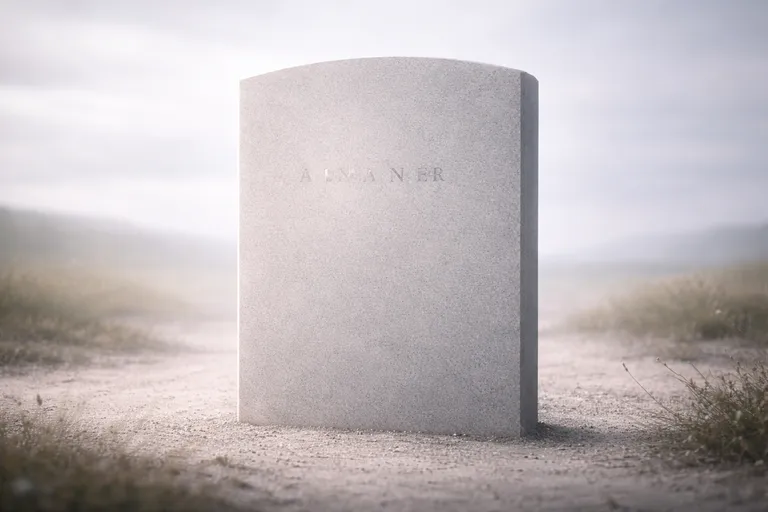
Your name is already there. That’s the part nobody tells you about first.
Not the blank space below it — that comes second. The first thing is seeing your name on stone, and recognizing it before you’ve finished processing what you’re looking at. The letters, the way they’re formed, the specific quality of your name existing in a permanent material in a place where names that belong to the finished are kept.
And then you see the blank.
No dates. No epitaph. No sentence about what this person did or who this person was. Just the name, and below it, an uncarved field of stone that is perfectly smooth, waiting to receive something, holding space for information that hasn’t arrived.
Here’s what I want to say about this dream that most interpretations don’t: the blank is not automatically a condemnation. The blank is the most ambiguous element the dreaming mind can produce. It means you’re standing in front of something that has your name on it and has not been finished. Whether that’s terrifying or liberating — and it’s often both simultaneously — depends on where you are in the story it’s waiting to record.
Your name is already carved. The rest is still yours to write.
Quick Answer
- Seeing your name on a blank gravestone means you’re confronting the unfinished quality of your own life — specifically the gap between the existence that has been established (the name is there) and the story that has not yet been written (everything below it).
- The blank is not failure. It is waiting. Whether it’s the right kind of waiting depends on the rest of the dream.
- The location of the stone tells you which dimension of your life is being reflected.
- The font — whether it looks like your own handwriting or something foreign — tells you whether this is your story or one you’ve been handed.
- The feeling in the dream is the most important thing: relief, terror, sadness, and recognition can each mean something completely different.
Common Scenarios
- Stone in a cemetery, name in your handwriting → this is your story; you’re looking at the record of your own life from a distance
- Stone in a forest, covered by nature → the story is being absorbed into something larger without having been written
- Stone in a city, mid-sidewalk → you’re visible and acknowledged and passing through without leaving a trace in the social world around you
- You polish the stone or trace the letters → over-identification with the monument; you’re maintaining the marker rather than living the story
- You feel relief seeing the blank → the dream is giving you permission to stop being what you were; the blank is freedom
What the Body Registered
- The cold of the stone — specific, real, transferred briefly after waking → the permanent material registered as genuine
- The recognition of your own name — before the analysis, before the processing → the identification was immediate and pre-cognitive
- The weight of the blank — heavier in some versions, hollow in others → the body read the blank as either absence or potential
- Something about your legacy or your current direction was already present on waking → the gravestone already had a story it was pointing to
Why Your Name Is Already There
The dream didn’t generate a blank stone with no name on it. That would be a different dream — the erasure of identity, the question of whether you exist at all.
Your name is there. Cut into the material. Already done.
The transformation this cluster works with involves ending and beginning — the death of what was and the emergence of what comes after. The gravestone with your name is the mind’s image for the part that has been established: you exist, you have been here, the fact of your presence in the world has been acknowledged in permanent form. That part isn’t in question.
What’s in question is what comes after the name. What the stone is waiting to record. What the blank space beneath it will eventually hold.
In waking life, this dream appears when the gap between your established existence and your unwritten story has become acute enough to require confrontation. Not because the story is over — the blank means it isn’t — but because the question of what goes there has become urgent in a way that daily life doesn’t provide space to ask.
You look at your name and it’s unmistakably yours. The letters have a specific quality — the way certain letters in your name have always looked, the particular shape of the first letter, the proportion of the whole. You know this is your name before you’ve decided to know it. And then you see what comes after it: nothing, yet.
The Three Readings of the Blank
Not everyone who has this dream arrives at the same feeling about the blank. The same empty stone produces different experiences depending on where the dreamer is.
The terror reading: the blank is the accusation. Everything that was supposed to have been accomplished, everything that was supposed to have been done with this name and this life, hasn’t been. The stone is waiting and you have nothing to give it yet. The blank is not potential — it’s the absence of the life that was supposed to have filled it.
The permission reading: the blank is the liberation. Seeing your name on an unfinished stone means the story isn’t written yet. You’re not dead. The ending hasn’t been carved. Whatever version of yourself was supposed to fill in those dates and that epitaph — that version hasn’t been locked in. The blank is room. The blank is still yours.
The threshold reading: the blank is accurate. You’re in a transition — the old chapter has ended, the new one hasn’t started. The stone is mid-process, the way gravestones are when the person’s life is still unfolding. The blank isn’t failure or freedom. It’s the specific in-between of a life that has closed one form and hasn’t fully opened the next.
Which reading belongs to you depends on the feeling the dream left. Not the analysis — the feeling.
When the Stone Is in a Forest
This version carries its own specific weight that deserves separate attention.
The stone is in the forest. Vines are moving over it. Moss is filling the grooves of the letters. The specific process of natural reclamation is happening — slowly, without hostility, simply because nature fills available surfaces and the stone has been here long enough to become available.
What this version is saying isn’t that you’ll be forgotten. It’s that something in your current situation has been still long enough for the organic world to start moving over it. The story you were supposed to be writing has been stationary for long enough that the environment has started to incorporate the monument into its own story.
In waking life, this appears when something that was supposed to be in motion — a direction, a project, a version of yourself in development — has been held in place long enough that the surrounding world has started to adapt to its stillness. Not disaster. The natural process of things moving over surfaces that aren’t moving themselves.
The letters of your name are still there, under the green and grey. You can read them if you brush away what’s grown over them. The clearing takes effort. The letters are intact. They’ve been here for a while.
When the Stone Is in the Middle of the City
Different from the forest version in almost every way.
No nature reclaiming anything. No quiet. The stone is in a street, a lobby, a public space that is full of people moving through it — and your name is right there, in stone, in the middle of all of it, and nobody is stopping to read it.
This version is about social invisibility. Not death, not stagnation — the specific experience of having an established existence (the name is there, solid and real) while that existence passes through the social world without registering. People walk around the stone without seeing it. The permanent fact of you is in the middle of everything and is making no impression.
Watching your own funeral from the crowd is about being present and unrecognized. The urban gravestone is about being present and illegible — existing in the middle of a world that is too busy to stop for the fact of you.
The stone is right there on the pavement. It catches your shoe. You look down and there’s your name, smooth and cold, in the middle of a Tuesday, while the people behind you keep their pace and work around the interruption without looking at what it says.
What You Feel Determines What the Blank Means
This is the interpretive crux and it can’t be substituted with analysis.
Relief when you see the blank: the dream is telling you something the FAQ version of this article actually gets right — the blank is permission. The version of yourself that was supposed to fill in those dates has reached its end. The story of that person isn’t going to be carved here. You can stop trying to be the person who was supposed to arrive at a different ending. The blank is the door being left open.
Terror when you see the blank: the dream is confronting you with the gap between what you’ve done and what you meant to do, between the life being lived and the life that was supposed to be recorded. The blank isn’t freedom — it’s the space where the evidence of a meaningful life should be and hasn’t appeared yet.
Sadness when you see the blank: you’re at the threshold. Something that had a story — a version of you, a chapter of your life, a period that mattered — is complete enough to have a stone but hasn’t been fully mourned or fully acknowledged. The blank is the part that’s waiting for the ceremony.
Curiosity when you see the blank: the dream is oriented forward. The stone is a question being posed to the future, not a verdict on the past. You’re looking at something that is waiting to receive information you haven’t lived yet.
When This Dream Arrives
At points of genuine reckoning — when the question of what your life is building toward has become too specific to dismiss.
Not during ordinary periods of self-doubt. The gravestone appears when something in the internal accounting has reached a level of concreteness that the mind needs a concrete image for. A blank stone is the most direct image the mind has for: the record exists, and what fills it is still yours to determine, and that determination is more urgent than you’ve been treating it.
The Psychology Behind It
Mortality salience — the psychological activation that happens when death is made salient, when the fact of finite time is brought directly into awareness — consistently produces two effects: it reduces concern with trivial things and increases investment in what matters most.
The gravestone dream with your name is one of the purest forms of mortality salience the mind can generate. It doesn’t produce a distant death statistic. It produces your name, in stone, in a place designed for endings. The personal specificity of the image — your name, your stone — produces the full activation of the mortality-salience response.
The blank below the name is the mind’s way of preserving the function of the activation while removing the finality that would make it only about grief. You’re not looking at a completed record. You’re looking at one that’s still open. The salience serves its function — wake up, this matters, the time is finite — while the blank preserves the possibility: the story isn’t over.
The Sentence This Dream Was Trying to Say
“My name is already carved — the question is what fills the blank below it, and I’ve been treating that question as less urgent than it is.”
The Morning After
Your name is already there. That part was done before you arrived at the dream. You didn’t put it there and you can’t change it.
The blank is the part that’s still yours.
Before the day fills with everything that feels more immediately urgent: what do you want carved in that space? Not the full epitaph — just the quality of it. Not the sentence — just the direction. The stone is waiting. The waiting has a timeline.
FAQ
What does it mean to see your name on a blank gravestone? It means your mind is confronting you with the gap between the existence that has been established — your name, your presence, the fact that you’ve been here — and the story that hasn’t yet been written. The blank below your name is not empty in the nihilistic sense. It’s uncarved. It’s waiting. The dream produces this image when the question of what your life is building toward has become too concrete to continue treating as abstract. Your name is already there. The blank is still yours to fill.
Why does the stone have my name but no dates or epitaph? Because you’re still alive, and because the dream isn’t about your death — it’s about the unfinished quality of your story. The name exists because you exist. The blank exists because the story is still in progress, or because the progress has slowed to the point where the blank has become visible. No dates means: this hasn’t completed. No epitaph means: the sentence that summarizes this life hasn’t been earned or written yet. The combination is the dream’s most direct image for the specific experience of being mid-story without being sure where the story is going.
Why do I feel relief when I see my name on a gravestone? Because the version of you that was supposed to fill in that particular stone — the version organized around a specific set of demands, expectations, or self-definitions that have become exhausting — has permission to end. The blank isn’t accusation in the relief version of this dream. It’s the door being left open. What was supposed to be the ending of that story isn’t going to be carved here. You’re free to write a different one.
Next Stages
If the gravestone appeared after a fight — if the dream included confronting an older version of yourself rather than just observing its monument → dream about fighting a dead version of yourself meaning — when the name on the stone belongs to a version of you that isn’t finished yet, and the finishing requires a confrontation
If the blankness of the stone felt like a lack of care — if you sought help for what was ending but found only empty hallways → walking through a hospital with no staff: systemic abandonment — when the anxiety is that the “infrastructure of recovery” is present but hollow, leaving you to navigate the crisis without an external witness or guide.
If what the blank gravestone was marking felt less like a personal ending and more like the end of everything — if the stone was in a context of general dissolution → dream about your childhood house crumbling into the sea meaning — when the monument is one of many things ending simultaneously rather than an isolated marker
If after the gravestone the dream shifted into something that moved — if the static monument gave way to something that continued → dream about death and rebirth meaning — when the blank stone is the still point before the transformation begins moving again