Dream About Losing Control Meaning
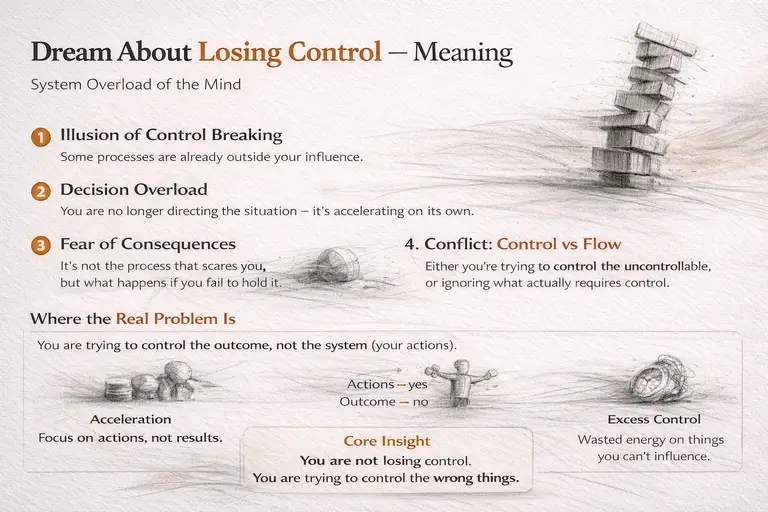
Control is the one thing humans will do almost anything to maintain.
We’ll stay in bad jobs, wrong relationships, impossible situations — as long as we feel like we have some say in what happens next. The illusion of agency is often enough. The sense that our actions produce results. That our voice matters. That when we reach for the door handle, something responds.
Losing control in a dream removes that illusion completely. And what it reveals underneath — the raw, unmediated experience of effort that produces nothing — is one of the most visceral things the sleeping mind can generate. Not because it’s dramatic. Because it’s accurate.
I’ve paid close attention to when this dream cluster appears in people’s lives. The timing is almost never random. It arrives when the gap between how much someone is trying and how much is actually moving has become too wide to keep filing under “temporary.” When the effort is real and the results have stopped cooperating with it. When the hands that are supposed to grip things have stopped finding purchase.
The losing control dream isn’t telling you that you’ve failed. It’s telling you what it actually feels like to be where you are. And that translation — from the managed version of your life you present to the world into the honest version your sleeping mind knows — is worth more than any solution it could offer.
Quick Answer
- A dream about losing control means the gap between your effort and your results has become large enough that your nervous system is staging a direct experience of it.
- The specific form of the loss — body, voice, legs, environment — maps precisely to which domain of your waking life has stopped responding.
- The dream isn’t predicting breakdown. It’s reporting on a threshold already crossed.
- Control was never absolute. The dream is showing you where the limits of it actually are.
- Recurring losing-control dreams mean the waking situation is still in the same state — nothing has changed, so nothing in the dream has changed.
Common Scenarios
- Reaching for something and your hand passes through it → effort without traction; you’re applying force to something that won’t receive it
- Trying to move and unable to → the direction forward has been blocked for long enough that the block is now structural
- Screaming and producing no sound → your signal isn’t reaching the person or situation it’s aimed at
- Body moving without your permission → you’ve been required to function in ways that exceed what you can consciously sustain
- Everything in the environment stops responding at once → the loss has become systemic; it’s not one area, it’s the whole arrangement
What Your Body Already Knows
- Woke up with heavy limbs and a specific exhaustion — not tired, depleted → the dream was running the actual state of your reserves
- The helplessness transferred out of the sleep → your body spent the night processing what your waking mind has been managing
- Racing heart that wasn’t from fear but from the specific frustration of trying harder with the same result → the effort response was real
- Something in your current situation was already identified on waking → the dream knew exactly where to point
Why Control Is the Thing the Mind Reaches For
Before understanding what losing it means, it’s worth understanding what it is.
Control, psychologically, is the experience of agency — the sense that your actions have a relationship to outcomes. That when you do something, something happens in response. That the world is causally organized around your participation in it.
This isn’t vanity. It’s survival architecture. Agency is how humans have always navigated a world that can be dangerous: the ability to take action and have that action produce a result is what allows escape from threat, acquisition of resources, maintenance of relationships. The loss of agency — the experience of trying and nothing happening — activates the same neural pathways as physical danger. The brain processes it as: something is very wrong.
The losing control dream takes this experience and stages it completely. Not the intellectual knowledge that things aren’t working — the full somatic, spatial experience of reaching for something and finding nothing. Trying to speak and hearing silence. Moving and staying still. Everything you do producing no result.
You reach for the door. Your hand passes through it. You try again. Your fingers close on air. The door is right there — you can see it, you can see exactly how it should work — and the mechanism that was supposed to connect your reaching to its opening is simply absent. You reach again. And again. The reaching keeps being real. The door keeps being unresponsive.
This is the dream’s core gift and its core instruction: stop. Whatever the strategy has been, the strategy has stopped working. The door isn’t the problem. The mechanism is.
The Family of Control Dreams — What Each Variation Is Saying
This dream doesn’t come in one form. It comes in a family of forms, each of which is pointing to a different domain where the loss is happening.
When you can’t move or run — when the body works but forward motion doesn’t occur — the loss is directional. Something is blocking progress specifically. The legs work. The traction isn’t there. In waking life, this is the project, the conversation, the situation where effort is completely genuine and advancement has stopped happening. Trying to run but staying in place is the most physically frustrating version because the body is doing everything right and producing nothing.
When you can’t speak or your voice produces no sound — when the apparatus of communication works but the signal doesn’t arrive — the loss is expressive. What you’re trying to communicate isn’t landing. The voice is there. The reception isn’t. Screaming but no sound comes out is about the specific exhaustion of having something urgent to say and watching it disappear before it reaches anyone.
When your body moves without your permission — when the thing that was supposed to execute your intentions has started executing something else — the loss is somatic. The most intimate version. Your own body has stopped being fully yours. The body moving without your control maps to the experience of being so thoroughly required by your circumstances that the autonomous self has started breaking down.
When the environment stops responding — the phones, the doors, the tools — the loss is systemic. It’s not one thing that has stopped working. It’s the entire architecture of daily function. Everything stops responding at once is what the mind generates when the sense of being ignored or ineffective has become comprehensive rather than specific.
The Difference Between Losing Control and Not Having It
This is the distinction that changes everything about what the dream is pointing at.
Some situations are ones where control was never available — where the outcome was genuinely not determined by your actions and trying to control it was the mistake. The dream in those situations isn’t about loss. It’s about the recognition of a limit.
Other situations are ones where control was working, was being exercised, was producing results — and something changed. The mechanism that was operating between your actions and their effects has been disrupted. That’s loss. That’s different.
The quality of the dream distinguishes between these. Loss of control that feels like something was taken produces a different emotional texture than loss of control that feels like you’ve been reaching for something that was never there to be reached. Both are real. Both require different responses.
What’s producing the dream — the honest version of the answer — already lives in you before you’ve finished waking up.
What the Dream Is Asking You to Stop Doing
Every losing control dream is structured around the same loop: you try, nothing happens, you try again, nothing happens, you try harder.
The loop is the message.
Not: try differently. Not yet. First: stop trying the same way. The dream generates the loop specifically to show you what you’ve been doing as clearly as possible. The hand that keeps reaching for the door that won’t receive it. The voice that keeps pushing harder into silence. The legs that keep generating motion that produces no movement.
The first gift of this dream is the clarity of the image. Whatever has not been working has been made spatially, physically, unmistakably clear. You reached for it seventeen times in the dream and it didn’t work seventeen times. That’s the information.
What to do with that information is a separate question, and a genuine one. The dream doesn’t provide the answer. It provides the honest diagnosis: this is what you’ve been doing, and this is the result it’s been producing.
When This Dream Arrives
Not at the beginning of the difficulty — at the point where the difficulty has been sustained long enough that the effort-without-result pattern has become established.
The losing control dream appears when the gap between trying and getting has been running for long enough to generate a structural image. Not a single bad day. A period. And the period has been managed through more trying, which kept the gap from being fully acknowledged as a gap rather than a temporary obstacle.
The dream makes the acknowledgment unavoidable.
The Psychology Behind It
The prefrontal cortex — the region that handles goal-directed behavior, executive function, and the sense of agency — maintains a continuous model of the relationship between actions and outcomes. When that relationship breaks down — when actions consistently fail to produce expected results — the model updates.
The update isn’t comfortable. The model had been predicting that effort would produce result. The evidence keeps contradicting the prediction. Under sustained contradicted expectation, the system eventually generates the image of the pure contradiction: effort that produces nothing. Reaching that produces nothing. Running that produces nothing. The action as isolated from its result.
The dream is the system’s way of making the discrepancy impossible to continue managing at the level of framing. It has been managed as “temporary.” The dream ends that framing by making it a spatial, physical, inescapable experience.
The Sentence This Dream Was Trying to Say
“I’ve been trying harder at something that has stopped responding — and somewhere below the trying, I already know it.”
The Morning After
The heaviness is still there. The specific weight of effort that produced nothing.
Before the day restarts the loop: sit in the image for a moment.
What specifically were you reaching for that wouldn’t receive your reach? Not the metaphor — the actual thing in your waking life. The situation, the person, the system, the part of yourself. What have you been applying effort to that has been returning nothing?
The answer is already in you. The dream just made it impossible to look away from.
FAQ
What does a dream about losing control mean? It means the gap between your effort and your results has become large enough that your nervous system is staging a direct experience of it during sleep. Not a prediction of future breakdown — a report on a current condition. The specific form of the loss tells you which domain: body means somatic overload, voice means communicative failure, movement means blocked progress, environment means systemic unresponsiveness. The dream isn’t warning you. It’s translating something you’ve been managing into something you can no longer look away from.
Why does the dream keep repeating? Because the waking situation is still in the same state. Recurring losing-control dreams don’t return because you failed to understand the first one. They return because the thing generating them — the sustained gap between effort and result, the system that has stopped responding, the situation that keeps not moving — is still exactly as it was. The dream will stop when the situation changes. Not when you understand the dream better.
Is this dream a sign of anxiety or a disorder? No. It’s a sign of load. The losing-control family of dreams appears reliably during periods of sustained effort against resistance — chronic overload, significant transitions, situations where agency has been consistently blocked. It’s the mind’s accurate representation of a real condition, not the creation of a false one. The people who have this dream most intensely are usually the ones who have been trying the hardest and getting the least traction. That’s not a disorder. That’s an honest response to an honest situation.
Next Stages
If the loss of control was specifically in movement — if you were running and going nowhere, legs working and position unchanged → dream about trying to run but staying in place — when the loss is directional, when effort is present and forward motion has stopped
If the loss was in your voice — if you were trying to communicate something urgent and the signal wasn’t arriving → dream about screaming but no sound comes out — when what’s failed is the channel between what you need to say and what anyone is receiving
If the loss was in your body itself — if your own physical movements were happening without your authorization → dream about body moving without your control — when the loss has reached the most intimate level: your own body has stopped taking your instructions