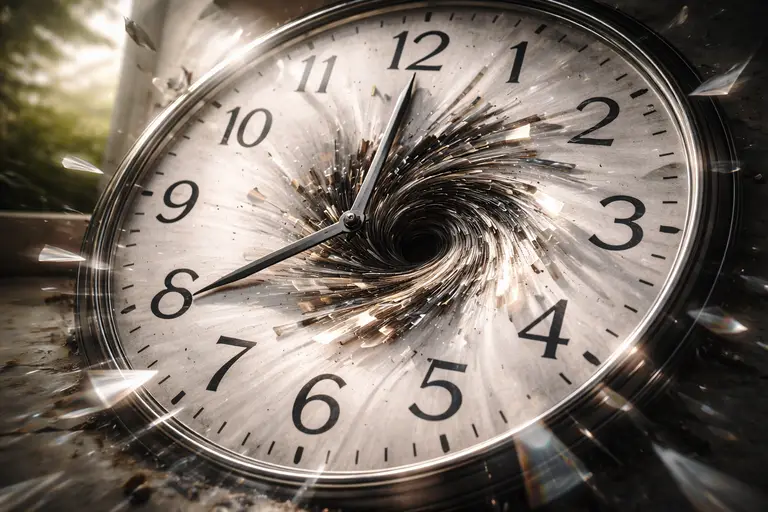
Repeating the Same Situation Again and Again

Тип B. Пишу — у этой темы своя особая уникальная психологическая территория.
Dream About Repeating the Same Situation — Meaning & Interpretation
You already know how this ends.
That’s the specific quality that distinguishes the loop dream from every other form of frustration the dreaming mind can produce. In other dreams, the difficulty is discovery — you don’t know what’s coming, you’re responding to what arrives. In the loop dream, you know exactly what’s coming. You have the full information of the previous cycle. You understand the sequence. And you are going to reach the same ending anyway.
That foreknowledge without power to change the outcome is the most specific and in some ways most honest thing this dream produces. The knowledge that you already have is not the piece that’s missing. The piece that’s missing is something else — something the knowledge alone cannot supply — and the loop continues until whatever that is becomes available.
There’s a specific moment in the loop dream that people describe with particular clarity: the moment of recognition. Not the first time through the sequence, but the moment — somewhere in the second or third or fifteenth repetition — when you understand with complete certainty that you’ve been here before, that you know how this goes, and that knowing this won’t change it. That moment of recursive awareness inside the loop is the dream’s most precise and most uncomfortable gift.
Quick Answer
- A dream about repeating the same situation means something in your waking life keeps returning to the same configuration despite your engagement with it — the loop is accurate, not symbolic.
- The specific loop matters: what repeats and what always fails is the dream’s address to a specific pattern.
- Having the knowledge of the loop doesn’t help — because the missing piece isn’t knowledge.
- The dream is not a punishment. It’s the brain’s most sustained attempt to find what the knowledge isn’t providing.
- The loop ends when something changes that the repetitions couldn’t change — not through more cycles, but through something different in kind.
Common Scenarios
- Same argument that reaches the same impasse → the conversation keeps having the same shape because the underlying dynamic hasn’t changed
- Same task that fails at the same step → the point of failure is the same each time; the dream is showing you the exact location of the block
- Starting over the moment failure arrives → the brain keeps resetting to give you another chance; the chance keeps producing the same result
- You have knowledge from previous loops but it doesn’t help → the information exists; the thing that would change the outcome isn’t information
- The loop starts to change slightly → something has shifted; the next iteration will be different from the previous ones
What the Body Registered
- The exhaustion that isn’t physical — the specific tired of having done the same thing many times → the body ran multiple attempts and the body remembers
- The particular quality of waking mid-loop — the sense of the cycle being interrupted rather than completed → the continuation instinct transferred briefly after waking
- What the loop was about was identifiable before you were fully conscious → the pattern already had its waking address
- The specific point of failure — the exact moment where each iteration ends the same way → the body knows exactly where the loop breaks
What Foreknowledge Without Power Actually Is
The loop dream has a specific structure that distinguishes it from other stuck dreams.
In the dream about trying to run but staying in place, you’re trying and not advancing — the effort is present and the traction is absent. In the dream about a door that won’t open, you’re applying effort to a specific barrier and the barrier doesn’t respond. Both of those dreams contain the problem but not the history.
The loop dream contains the history. Each iteration carries the knowledge of the previous ones. And the knowledge doesn’t help. Which is the dream’s most specific message: the missing piece isn’t information.
The losing control cluster is about different forms of agency failing. The loop is the version where the failure is recursive — the same situation, the same response, the same outcome, cycling. Not because you’re not learning. Because the thing that would change the outcome isn’t something that learning produces.
In waking life, this maps to patterns that operate below the level of understanding. The relationship dynamic that you understand completely — can describe it, can predict it, can trace its origins, can articulate exactly why it keeps happening — and that keeps happening anyway. The professional situation you can diagnose with precision and that keeps producing the same diagnosis. The personal pattern that has been named, analyzed, processed, and discussed in detail, and that continues to structure behavior in the same way.
Knowledge is not the barrier. Something else is. And the loop continues until that something else changes.
You know the sequence. You know it with the specific certainty of someone who has been through it enough times to have it fully memorized. The key goes in. The engine dies. You blink and you’re at the front door. You know what will happen and you try anyway. The knowing doesn’t change it. You’ve noticed that too, in the dream — that the knowing is complete and is not what’s needed.
What the Loop Is Trying to Find
The brain doesn’t generate loops because it enjoys futility. It generates them because it’s looking for something.
Threat simulation — the brain’s process of running scenarios to find safe outcomes — is what the loop dream is an extreme version of. Under ordinary circumstances, this process runs a scenario, evaluates the outcome, adjusts the approach, runs the scenario again. The adjustment and the running again is what produces problem-solving.
When the loop runs without producing an adjustment, it’s because the adjustment available isn’t the right kind. The brain keeps running the scenario because it believes — correctly — that the scenario is relevant and unresolved. It keeps running it without adjustment because the adjustment it knows how to make doesn’t change the outcome. It would need a fundamentally different kind of input — not more iterations of the same kind, but something new in kind — to generate a different result.
The loop is the brain’s persistent attempt to solve a problem with tools that aren’t adequate to the problem. The persistence is the brain’s correct assessment that the problem is real and unresolved. The inadequacy of the tools is the honest state of available resources.
The Specific Point Where It Always Breaks
Every loop has its breaking point — the specific moment in the sequence where each iteration ends.
This is the dream’s most diagnostic piece of information and the one most worth holding after waking. Not the whole loop, not the general pattern — the specific point. The exact step where the sequence stops producing progress and resets.
In the dream, this point has a specific texture: the engine that sputters and dies, the argument that reaches a particular word or moment, the task that fails at a specific stage. The precision is real. The dream isn’t being vague about where the loop breaks. It’s placing you at exactly that point, repeatedly, until the exact nature of the breaking is undeniable.
In waking life, the breaking point is the location of what actually needs to change. Not the pattern in general. The specific place where the pattern’s resolution requires something that hasn’t yet been available. The moment in the relationship conversation where genuine change would require something from one of the participants that hasn’t been offered. The point in the professional situation where a different outcome would require a different kind of resource or decision. The exact step where the loop ends because what comes next hasn’t been found yet.
When the Loop Starts to Change
Some versions of this dream — the ones that appear later in a process of genuine engagement with the underlying pattern — include a moment when something is different.
The sequence starts the same way. The familiar elements appear. And then something shifts: a different word in the argument, a different door in the building, a different quality of what happens at the usual breaking point. The loop is still running, but it’s not identical to the previous cycles.
This is the most important version of this dream, and it tends to be the one that gets overlooked because the change is often small and the overwhelming familiarity of the loop is what people remember.
When the loop changes, it means the waking situation has changed — something has shifted in the underlying pattern in a way that has updated the scenario the brain is running. The simulation is receiving new input. The cycle that had been identical is now generating a variation.
Variation is the loop’s way of signaling that resolution is becoming possible. Not that it has arrived. That the conditions for a different outcome are starting to develop.
When This Dream Arrives
When a pattern in waking life has been running long enough and with enough consistency that the brain has identified it as a structure rather than a series of isolated events.
The loop dream doesn’t appear the first time a situation fails. It appears after enough repetitions that the repetition itself has become the fact. The pattern is the thing now, not the individual instances of the pattern. The brain has noticed the shape.
It also appears during periods when a pattern is being actively worked on — when there’s genuine engagement with trying to understand and change it — because the brain is running the scenario more intensively than usual in service of the active problem-solving.
The Psychology Behind It
The hippocampus — the brain’s memory consolidation center — is highly active during REM sleep. One of its functions during sleep is to replay experiences to consolidate learning and to test what was learned against novel configurations. When a pattern from waking life has been operating consistently, the hippocampus runs versions of it during sleep to consolidate the pattern and search for exits.
When the pattern’s exit requires something not yet available in the brain’s repertoire — a new kind of understanding, a new kind of resource, a different kind of response — the hippocampus keeps running the scenario without finding the exit. The result is the experience of the loop: the same situation, the same elements, the same point of failure, cycling.
The loop isn’t the brain failing to solve the problem. It’s the brain correctly identifying that the problem is real and that the current solution set is insufficient. The loop stops when the solution set expands enough to produce a different ending. Until then, the brain will keep running the scenario because the scenario is genuinely unresolved.
The Sentence This Dream Was Trying to Say
“I already know every detail of this pattern — and the knowing isn’t what would change it.”
The Morning After
The loop has stopped. You’re in the ordinary morning that doesn’t repeat itself.
Before the day resumes its own version of the pattern: the specific point where the loop broke. Not the whole pattern — the one moment. The exact place in the sequence where the same ending arrived.
That point is the location of what needs something you haven’t had yet. The dream ran it enough times to make that location undeniable. The question the morning is asking is: what would need to be different — in kind, not in degree — for the sequence to reach a different ending?
FAQ
What does it mean to keep repeating the same situation in a dream? It means a pattern in your waking life has been running long enough and consistently enough that the brain has identified it as a structure — and is searching, through repeated simulation, for the input that would allow it to produce a different outcome. The loop is accurate, not symbolic. The brain is running the scenario because the scenario is real and unresolved. The repetition continues not because you’re failing to learn, but because the thing that would change the outcome isn’t information — it’s something different in kind.
Why doesn’t knowing what happens in the loop help me change it? Because the missing piece isn’t knowledge. This is the loop dream’s most specific message: the foreknowledge you have from previous cycles is real and complete, and it’s not sufficient to change the outcome. Whatever would produce a different ending isn’t more understanding of the pattern. It’s something that operates at a different level from the analytical knowledge — a different kind of resource, a different kind of response, a shift in what’s available that the intellectual understanding alone can’t supply.
When does the loop dream stop? When the underlying situation changes in a way that produces a different kind of input for the brain’s simulation. Not more cycles of the same scenario, but something different in the scenario’s fundamental elements — a shift in the relationship dynamic, a change in the professional situation, a new resource or capacity that makes a different ending possible. The loop stops when the scenario the brain is running starts producing different results. Until then, the brain will correctly keep running it, because the problem it’s simulating is genuinely unresolved.
Next Stages
If the loop was about a specific conversation that kept reaching the same impasse — if the same argument kept failing at the same moment → dream about not being able to speak meaning — when the loop’s breaking point is specifically communicative, when the same thing keeps not being received
If the loop started to change — if something in the most recent cycle was different from the previous ones → dream about trying to control something that keeps slipping — when the grip on the pattern has shifted from the loop stage into the stage of something that’s changing but not yet resolved
If the loop felt less like a scenario and more like a location — if you were looping in the same space rather than through the same sequence → dream about being stuck while others move meaning — when the repetition is spatial rather than narrative, when the same position rather than the same events is what recurs