Dream About Not Being Able to Run: The Kinetic Lock

Your legs are working. That’s what makes this one different.
In some paralysis dreams, the body has simply stopped — the signal goes out and nothing happens, and the horror is in the total failure of the system. This dream isn’t that. In this dream, the legs are trying. The muscles are firing. The motion is genuine. And nothing is happening in the direction you need to go.
That specific gap — effort completely present, result completely absent — is the most honest thing this dream produces. Not weakness. Not failure of will. The machinery is running at full capacity and generating no distance.
There’s a moment in this dream that people describe with a particular clarity: the moment they realize the running isn’t working. Not at the beginning, when the threat appears and the legs start moving. Later. After the effort has been real and sustained. The moment when the brain does the math and arrives at: this has been happening for a while and my position has not changed.
That moment is what the dream came to show you.
Quick Answer
- A dream about not being able to run means effort is completely present and forward movement isn’t — the machinery of progress is running and generating no distance.
- This is specifically not about paralysis: your legs are working, the running is real. What’s failing is the traction between effort and result.
- The threat behind you is what’s being avoided. But the dream is precise: avoidance has stopped being a viable strategy.
- The quality of the air or ground in the dream tells you what’s creating the resistance.
- The moment you realize the running isn’t working is the most important moment in the dream.
Common Scenarios
- Legs pumping, ground not moving → the effort is real, the progress isn’t; maximum input producing zero output
- Running in slow motion while threat moves normally → the speed differential is the message — something is gaining on you at a rate your available strategy can’t match
- Ground turns to liquid or sand under your feet → the foundation has become unreliable; the surface that was supposed to support the movement is contributing to the lack of it
- You drop to all fours trying to find grip → the abandonment of the upright strategy for something more primal, which also doesn’t work
- You finally turn and face what was chasing you → the avoidance has ended; the running stops when you stop running
What the Body Registered
- The specific burn in the legs — muscle memory of effort that produced nothing → the body ran a full effort sequence and the body knows it went nowhere
- The particular exhaustion that isn’t from exertion but from futility → burning the fuel without the movement
- The threat from behind is still present as a feeling after waking → the thing being run from transferred out of the dream
- A specific waking situation already present before the analysis → the running already had a destination before you finished waking up
What the Legs Are Telling You
The running in this dream is not metaphor for how hard you’ve been working. It’s the literal image of it.
The losing control cluster maps the different domains where agency fails. Not being able to run is the version where the failure is directional — specifically forward, specifically away from threat. The legs are working. The traction isn’t there.
In waking life, this maps to the specific experience of effort that has become disconnected from movement. The project that gets worked on consistently and doesn’t advance. The conversation that keeps happening and covers the same ground. The relationship that receives sustained attention and stays in the same configuration. The situation where trying harder produces more of the same trying rather than a different outcome.
The running isn’t the problem. The surface the running is happening on is the problem. And the dream is precise about where you are: mid-run, fully committed, going nowhere.
Your legs are pumping. You can feel each step — the push, the reach, the landing. The motion is completely real. You look ahead and you understand, by some dream-logic that bypasses the need for calculation, that the distance between you and where you’re trying to reach is not decreasing. You’ve been running this long. The distance is the same. Your legs keep going. The distance stays the same.
The Moment You Notice It Isn’t Working
This is the dream’s most specific gift, and it tends to get lost in the terror.
There’s a moment — somewhere in the middle of the running — when you do the math. Not consciously, not analytically. You just know. The threat behind you is still at the same distance. The destination ahead is still at the same distance. The effort is sustained. The position is fixed.
In waking life, this moment is the one that has been avoided. The recognition that the strategy has been running on full and producing nothing. The acknowledgment that what has been called “trying harder” or “being persistent” or “staying the course” is a loop, not a direction.
The dream forces you to have this moment. Not gently. You’re in the middle of the run, legs burning, threat present, and the moment arrives anyway: this isn’t working.
What you do with that moment — in the dream and in the waking life it corresponds to — is what the dream has been building toward. Some people keep running. Some people stop. Some people turn around. The dream is watching which one you are.
What Is Actually Chasing You
The specific nature of what’s behind you is as important as the inability to run.
Some threats in this dream are enormous and indistinct — a presence, a force, something that doesn’t have a specific form. That version corresponds to a diffuse accumulated pressure rather than a specific identifiable situation. The threat is the total weight of everything that hasn’t been addressed, personified as momentum.
Some threats are specific — a person, a known situation, something that has a face. That version corresponds to a specific thing in waking life that has been in pursuit while you’ve been using the running strategy to maintain distance.
What the dream is precise about: the running has been the response to whatever is behind you, and the running has stopped being adequate. The threat hasn’t gotten faster. The ground has become less cooperative. The avoidance strategy — running, maintaining distance, keeping what’s behind you at the same distance — has worn down to the point where the terrain itself is no longer supporting it.
The question isn’t whether you should keep running. The question is what would happen if you turned around.
Why Turning Around Ends the Dream
This is the thing most people don’t know about this dream.
In most cases, the dream resolves not through successful escape but through the end of the attempt to escape. When you stop running — when you turn to face what was behind you, or when you let the running fail completely and simply stop — the dream often shifts. The nature of the encounter changes. The specific texture of confrontation-with-whatever-was-being-avoided is different from the endless texture of running-from-it.
The dream has a logic: it runs as long as the running runs. When the running stops, the dream’s work is finished. What was being avoided has been approached, or accepted, or faced. The loop ends.
In waking life, this maps exactly. The situation that has been behind you for however long — the situation that has been driving the effort-without-progress loop — doesn’t change through more running. It changes when the running stops and something different becomes possible.
When This Dream Arrives
When avoidance has been running long enough that it has become structural.
Not at the beginning of avoiding something — the beginning has a different quality, the distance feels manageable, the running feels like it’s working. This dream arrives after the avoidance has been sustained long enough that the legs are burning, the terrain is working against you, and the gap between effort and movement has become the defining feature of the situation.
It also appears during periods when multiple things are simultaneously being avoided — when the running has too many directions to maintain and the effort has been split across too many simultaneous retreats.
The Psychology Behind It
During REM sleep, the motor cortex is partially active while the actual muscles are inhibited — the brain generates the experience of movement without the body executing it. This is the physiological substrate of running dreams. In the not-being-able-to-run version, this partial disconnection between the motor experience and actual movement gets recruited by the psychological content: the brain is running the scenario of effort that produces no result, using the body’s own REM-sleep mechanism as the medium.
The result is the most physically convincing possible image for the gap between trying and moving. It isn’t abstraction. It isn’t symbol. It is the literal experience of running and staying still, conducted in the neural architecture of actual running.
When the brain generates this experience, it’s doing something specific: it’s making you feel the gap. Not think about it. Feel it. In the legs. In the breath. In the burning of effort applied to a treadmill. The gap between effort and movement, rendered as physical sensation.
The Sentence This Dream Was Trying to Say
“I’ve been running as hard as I can from something that keeps pace — and the running has stopped changing the distance.”
The Morning After
The legs are fine. The burning from the dream has cleared.
What hasn’t cleared: the specific quality of the thing that was behind you. The running has stopped but the thing that was being run from is still approximately where it was.
One question worth sitting with before the day resumes the loop: what would it change if you stopped running and simply turned around? Not fought, not fixed, not solved. Just: stopped moving away from it. What would be different in the distance between you and it?
FAQ
What does it mean when you can’t run in a dream? It means effort is fully present and forward movement isn’t — the machinery of escape is running at capacity and producing no distance. This is specifically about the traction between trying and moving, not about the quality of the trying. The legs are working. The surface isn’t cooperating. In waking life, this maps to the experience of sustained effort in a situation that keeps returning to the same configuration: the trying is real, the movement isn’t happening.
Why can’t I speed up no matter how hard I try? Because the dream is being accurate about a waking situation where trying harder has stopped producing a proportional result. The disconnect between effort and speed is the dream’s spatial image for a real phenomenon: you’ve been applying more energy to a situation and the situation has been staying in the same place. The dream removes the possibility of outrunning it so that the only remaining option is something other than the running strategy.
Does this dream mean something is wrong with me physically? Occasionally the heavy-leg quality of this dream has a physical component — circulation, sleep position, sleep apnea can all contribute. But the most common version is psychological: the body is translating a real experience of effort-without-progress into the dream’s most literal available image. If the physical versions of the dream feel significantly different from ordinary heavy-leg discomfort, and if the content is always directional and involves threat, it’s almost always the psychological version.
Next Stages
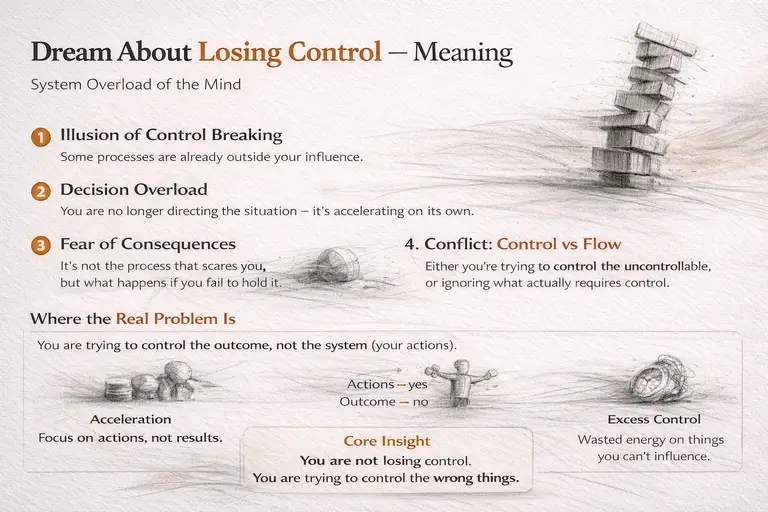
If the running became stillness — if the legs stopped being the problem and everything became entirely fixed → dream about not being able to move meaning — when the failure stops being about traction and becomes about the body refusing to move at all
If what was chasing you caught up — if the running ended in contact rather than in you stopping → dream about being chased by a killer meaning — when the avoidance strategy fails completely and the encounter happens
If the running never ended — if you stayed in the loop, legs burning, going nowhere indefinitely → dream about losing control meaning — when the kinetic failure is one version of a broader experience of effort producing nothing