Dream About Teeth Falling Out
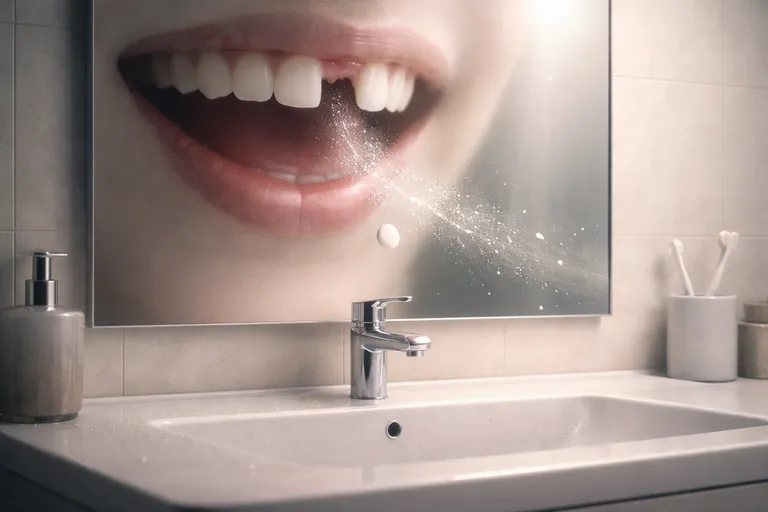
Your body used teeth before it had language. That’s worth remembering when they fall out in a dream and the feeling doesn’t leave with the image.
This is the most common dream reported across cultures, age groups, and psychological profiles. Not because teeth are interesting. Because what they represent — the ability to hold, to speak, to present yourself without flinching — is the thing most people are quietly negotiating with when life starts to apply pressure. The dream arrives at exactly the moment when something about that negotiation has reached a point the waking mind hasn’t fully processed yet.
Quick Answer
- Teeth falling out in a dream → your body registering a loss of grip, voice, or control before the conscious mind has admitted it
- Dream feels vivid and stays with you → the signal is current, not historical — something is happening now
- You feel shame in the dream → the loss is tied to how you appear to others, not what you’ve actually lost
- You try to catch the teeth or hide them → you’re managing the appearance of the loss more than the loss itself
- The teeth fall painlessly → the detachment already completed before the dream arrived — the bloodless version is its own signal
Common Scenarios
- Teeth fall one by one, you’re aware of each departure → the losses are individual and traceable — each one points to something specific
- All teeth fall at once → the sense of total collapse, a threshold crossed rather than a gradual erosion
- You’re in public when it happens → the loss is about visibility and reputation, not just internal experience
- You swallow them → you’ve internalized something that was supposed to stay external — you’re carrying what you should’ve released
- Someone else watches it happen → there’s a witness to your loss; the shame has an audience
- You try to push them back in → you know what’s happening and you’re still trying to undo it — the same mechanism as the crumbling version
What Your Body Already Knows
- Jaw tense after waking → you’ve been clenching through something — the body was doing the work your words weren’t
- Ran your tongue over your teeth immediately → physical verification of what the dream made uncertain — the body checked before the mind caught up
- Woke with a feeling of exposure → something that was contained is now out — the seal broke
- Specific dread rather than general anxiety → the dream wasn’t abstract — it was pointing at something with a name
When the Teeth Fall in Public
You’re mid-sentence. The words are forming. And then something shifts in the geometry of your mouth — a looseness where there used to be structure — and you feel them coming. You try to keep talking. You press your lips together. The person in front of you is still waiting for you to finish the sentence. And you’re holding your jaw shut with the specific concentration of someone trying to keep something from happening in front of a witness.
This version is about the intersection of loss and visibility. The teeth aren’t just falling — they’re falling where someone can see. That detail isn’t incidental. The dream is mapping the specific anxiety of a loss that will become public: a reputation shifting, a role dissolving, a version of yourself that other people depend on starting to give way.
The connection to waking life is usually relational or professional — a situation where your competence, your credibility, or your stability is what other people are oriented around, and you can feel that orientation starting to waver. The fear of being seen losing control carries the same architecture as panic in a public space — the internal event becoming visible before you’ve decided to show it.
When They All Fall at Once
The sequential version gives you something to track. This one doesn’t.
One moment your mouth is intact. Then it isn’t — completely, suddenly, without a warning that would have let you brace. This is the threshold version of the dream, and it appears at moments when something has crossed a line rather than eroded past one. A relationship that ends not through slow withdrawal but through a single event. A decision that collapses a structure you’d been maintaining. The sense that a before and an after now exist, and you’re standing in the after without having fully agreed to be there.
Your palm fills with them. White, small, nothing raw about where they came from. You look at what you’re holding and the counting starts automatically — you’re trying to establish whether this is total or partial, whether anything is left. Nothing is left. The counting was its way of delaying the acknowledgment.
The suddenness matters. The brain processes acute loss differently from gradual erosion, and the all-at-once version is the dream’s representation of that specific register — the moment of recognition that something is gone and the inventory was complete without you knowing it was your last one.
When You Swallow Them
This version is specific and deserves precision.
The teeth don’t fall out into your hand, don’t fall to the floor. They go inward. You swallow what was supposed to depart. The loss doesn’t leave — it becomes part of the body that created it.
This maps to the experience of absorbing a loss rather than releasing it. The grief, the anger, the acknowledgment of what’s ending — instead of moving through you and out, it’s going somewhere inside. You’re carrying it. The body is holding what should have been expressed, and the dream is showing you the specific direction that unexpressed departure is taking. What doesn’t leave through the mouth tends to organize itself into physical sensation — the body finding other ways to register what the voice hasn’t said.
You feel them going down. Not pain — just the awareness of something solid moving the wrong direction. And the specific wrongness of it isn’t the sensation. It’s the knowledge that you’ve just made this harder to retrieve.
When the Teeth Crumble Instead of Fall
There’s a distinction the dream is making that matters: departure versus deterioration.
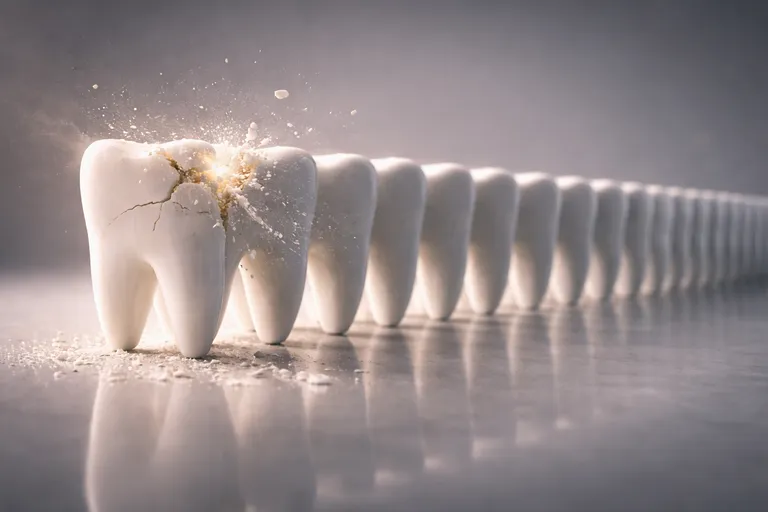
Falling teeth leave cleanly. Something that was intact releases and is gone. Crumbling is a different report — it means what’s leaving is doing so through progressive failure rather than clean departure. Each piece that breaks off is smaller than the piece before it. The loss is accumulative, incremental, and the end point isn’t a single moment of departure — it’s the gradual elimination of structural integrity.
The waking correlate is usually a relationship or situation that isn’t ending in one event but is becoming less and less what it was, fragment by fragment, without a moment you can point to as the one where it changed. The crumbling is the honest representation of that specific process. Something that used to hold is no longer holding, and it’s losing its form while still technically present.
When You Try to Put Them Back
You have them. You know where they came from. The attempt seems logical until the mouth won’t receive them.
You press them to the gums. The biology doesn’t respond. You try again, with more pressure, then with more certainty — as if confidence might close the gap between what fell and where it used to be. The gum has already smoothed over. It doesn’t need them back. The place that held them has already started to become something else.
This is the version that appears during the period between knowing something has ended and accepting that it has. The teeth are gone. You’re aware of that. And the attempt to restore them isn’t about believing it will work — the dream makes clear it won’t — it’s about the gap between knowledge and acceptance that everyone who has ever held onto something too long will recognize precisely.
Why This Dream Happens — The Psychology Behind It
Teeth occupy a unique position in the body’s symbolic architecture: they are the only bones that are visible, the instruments of both aggression and communication, and the thing most associated with how we present ourselves under social pressure. The amygdala processes threat, and the prefrontal cortex manages self-presentation — the teeth dream sits precisely at their intersection. Neurologically, this dream cluster activates during periods of elevated cortisol, which is why it appears consistently during transitions, relational ruptures, and situations where the sense of control or competence is under strain. The REM system, which handles emotional consolidation, returns to this symbol because it is the most efficient representation the sleeping brain has found for the experience of losing something that was integral to how you function and present in the world. Freud identified it as anxiety about castration — that reading has aged poorly. The modern psychological consensus is more precise: it is the body’s report on a perceived loss of personal power, social standing, or relational security, rendered in the physical language the sleeping brain finds most available.
Dream Timestamp
- During a period of high social or professional pressure → the dream is about performance anxiety hitting structural levels — not surface nervousness but something deeper giving way
- After a relationship begins to shift → the teeth represent what held the connection; their departure maps the departure of the bond
- When something you’ve been maintaining through effort starts to require more effort than it’s worth → the body knows the structure is failing before the mind admits it
- Recurring over weeks or months → the situation hasn’t resolved — the dream will keep returning until the waking acknowledgment catches up with what the body already knows
The Sentence This Dream Was Trying to Say
Something I used to rely on is no longer holding — and the part of me that already knows this has been waiting for the part that makes decisions to catch up.
The Morning After
The dream is still in your mouth. That specific residue — the phantom check your tongue does, the jaw that woke up tighter than you went to sleep.
Don’t decode it yet. Do one thing: name, without softening it, one thing in your current life that you’ve been maintaining through effort that used to be maintained through genuine connection. One relationship, one role, one version of yourself. Just name it. The dream already knows what it is. It was showing you the mechanism, not the symbol.
FAQ
What does it mean to dream about teeth falling out? It means something your body has already registered as a loss — of control, of voice, of a connection that used to hold — is waiting to be consciously acknowledged. Teeth in dreams function as the physical map for self-presentation and personal power. When they fall out, the dream is reporting that something integral to how you function or present yourself is giving way. The specific details of how they fall, where you are, and what you feel tell you exactly which territory the dream is navigating.
Is dreaming about teeth falling out a bad omen? It’s not an omen at all — it’s a report. The sleeping brain uses the body as its most precise available language, and teeth are the symbol it reaches for when the nervous system needs to communicate something about loss, control, or self-presentation. The dream isn’t predicting anything. It’s reporting on something that’s already in motion at a level the waking mind hasn’t fully processed yet.
Why do so many people have this dream? Because the experiences it maps — loss of control, fear of how others see you, something integral giving way — are universal. The specific symbol varies slightly by culture, but the underlying architecture is consistent: teeth represent the visible, functional interface between the inner self and the social world. When that interface feels compromised, this is the dream the brain generates.
What should I do after this dream? One concrete thing: before the day fully begins, identify what in your waking life is costing you more effort to maintain than it used to. Not a general audit — one specific thing. The dream has already identified the territory. Your job is to name it clearly enough that the decision-making part of you has something precise to work with.
Next Stages
If the teeth didn’t fall but crumbled — if the loss was gradual, incremental, each fragment smaller than the last → Dream About Teeth Crumbling — when the departure is erosion rather than departure
If the fall was clean and bloodless and the feeling was quieter than it should have been → Dream About Teeth Falling Out No Blood — when the detachment completed itself before the dream arrived
If what’s losing its hold isn’t a tooth but a person — if the loss the dream is pointing to has a face → Dream About Losing Someone You Love — when the departure is relational and the grief has somewhere specific to point
If the exposure in the dream wasn’t about teeth but about being seen — if the public quality was the dominant feeling → Dream About Feeling Anxious in Public — when the loss is about visibility and what others see when they look at you