Teeth Breaking in Dream Meaning
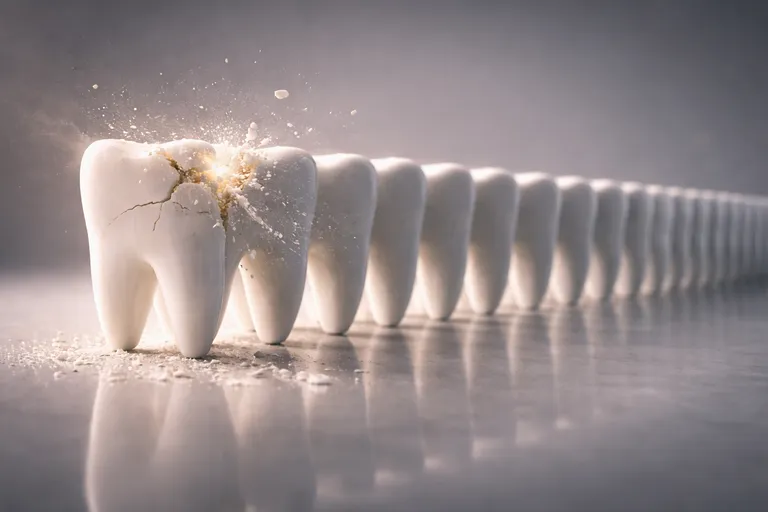
There was pressure before the crack.
That’s the specific thing about this dream — the thing that distinguishes it from every other teeth dream and the thing most interpretations flatten into the same general category of teeth-anxiety. The falling-out dream has no pressure event. Something loosens, something goes, and the loosening was already happening before the dream began. You don’t know the moment it stopped holding because there wasn’t a moment — there was a gradual absence of the hold.
This dream has a moment.
You felt the load before the fracture. Something was applied — bite force, pressure, the specific demand of something that required your structure to hold it — and you held it, until the point where holding it was no longer structurally possible, and then something cracked. The fragment in your mouth arrived at a specific instant. Before that instant the tooth was intact. After it, the piece was in your hand or on your tongue, and the gap where something had been was real and immediate and irreversible.
That sequence — load, resistance, fracture — is the dream’s most important information. Not the fragment. Not the gap. The sequence that produced them.
I want to say directly what I’ve found in the people who have this dream: it almost never appears in people who are anxious about their teeth, their appearance, or their social presentation in the general sense. The falling-out dream belongs more naturally to that territory. The breaking dream appears in people who have been carrying something — a demand, a responsibility, an obligation, a standard — at or near the limits of their structural capacity, and for whom something recently asked one thing too many.
Not weakness. The load exceeded the structure. That’s a different thing.
Quick Answer
- The teeth-breaking dream is specifically about pressure exceeding structural capacity — not gradual loss, not passive vulnerability, but the precise experience of something that was holding under load until the load crossed the threshold of what the structure could sustain
- The somatosensory cortex devotes a disproportionately large neural territory to the mouth and teeth — larger than any equivalent area relative to physical size — which is why this dream produces one of the most physically specific residues of any dream: the crack, the fragment, the gap are somatically encoded with unusual precision
- The critical distinction from teeth-falling-out dreams: falling out is passive and gradual; breaking is active and instantaneous — there was a causal sequence that ended in fracture, and the dream preserves that sequence
- The nature of the pressure matters: biting down on something harder than expected encodes encountering unexpected resistance; something hitting the tooth encodes external impact; grinding under load encodes sustained accumulated pressure finally reaching the breaking point
- When only one tooth breaks, the dream is being specific — the location and function of the tooth carries information about which particular domain of your capacity was exceeded
- When multiple teeth break at once, the loading exceeded multiple structural points simultaneously — the overwhelm was systemic, not localized
- When you try to hide the broken tooth, the structural failure is one you’re managing rather than addressing — the fracture happened and the response is concealment
- When the breaking is painless, the fracture was something the system had been approaching long enough that it registered as completion rather than injury — a structural limit reached with something like relief
- The fragment in your hand or on your tongue is always information: its size corresponds to the scale of the structural failure; a large piece means something substantial gave; a small chip means the damage was partial but real
- The recurring version means the load is still at or above the threshold that produced the fracture — the structure hasn’t been given the conditions to rebuild, and the pressure hasn’t been reduced
Common Scenarios
You bite down and something cracks. The foundational version. The motion was ordinary — the specific everyday act of applying pressure for a normal purpose. And the tooth that was supposed to hold the pressure didn’t. This is the dream’s most direct encoding of a waking situation where a routine demand produced a structural failure that shouldn’t have happened: an ordinary request that should have been manageable, in a system that has been under load long enough that ordinary is no longer sustainable. The crack wasn’t the problem. The accumulated load that made the crack possible was.
Something hits your teeth from outside. The impact version. The force came from external contact rather than internal application. You didn’t bite down — something arrived that your teeth had to absorb. In waking life this maps the experience of an external demand or event that required you to absorb impact you hadn’t prepared for and that your current structural state wasn’t able to take cleanly. Not a gradual accumulation. A specific arrival of something that hit harder than the structure could handle at this point in the load cycle.
The tooth crumbles gradually under pressure — doesn’t snap, just loses integrity. The dissolution-under-load version, sitting between breaking and crumbling. The pressure was sustained rather than acute, and what failed wasn’t in a single moment but across several moments of continued application. The structure held, then held less, then stopped holding. This version maps sustained, ongoing demands — the kind that don’t produce a single crisis but that wear through something over time, until what was supposed to be solid stops being solid.
You’re grinding and something gives. The accumulated-tension version. The grinding isn’t purposeful — it’s what happens when the body has been holding stress long enough that the jaw carries it even in sleep. And something breaks not from a single excessive demand but from the cumulative load of sustained clenching. In waking life: a period of sustained performance under sustained pressure, where the breaking point wasn’t any one thing but the total of all the things held for too long.
You try to hide that a tooth broke — you keep the fragment, you don’t tell anyone. The management version. The fracture happened. The response is concealment. This version is particularly specific: the structural failure is known and is being actively kept from the awareness of others. In waking life, this maps the experience of something having broken — a capacity, a limit, a standard you’ve been holding — that you are managing around rather than acknowledging. The concealment in the dream is the dream’s honest rendering of the concealment in the waking life.
The breaking is painless — a clean snap, no distress. The completion version. Something broke and the breaking carried no suffering — just the fact of the fracture and the fragment. This version tends to appear when a structure that had been holding something past its natural endpoint finally gave way. Not a failure of something healthy. The structural conclusion of something that had already been stressed past its productive capacity for long enough that the breaking was, in some real sense, the right ending of an overextended hold.
What Your Body Already Knows
Woke up with the specific texture of it still in the mouth — the phantom fragment, the gap where something was → because the somatosensory cortex encoded the breaking with genuine precision; the mouth and teeth occupy a neural map far larger than their physical size, and the dream ran the fracture through that map at full resolution; what remains after waking is the somatosensory trace of an experience the nervous system processed as real — the body held the fragment even after the dream released it
Woke up running the tongue over the teeth — checking, verifying → because the structural-integrity verification is automatic; the body’s first response to a breaking event is to assess the current state of the structure; you were checking before you were fully conscious of why, because the checking was part of the same system that had been running the alarm
Woke up with a specific quality of tiredness that isn’t sleep tiredness → because holding under load is metabolically expensive; the dream was encoding a sustained-load experience and the body ran the physiological correlate of that load throughout the dream period; the tiredness on waking is the system carrying the cost of what the dream was processing
Woke up and a specific obligation, demand, or responsibility was already present in consciousness before any deliberate thought → because the dream had a precise address; the load that exceeded the structure came from somewhere specific; whatever arrives before analysis is where the pressure in the dream was actually pointing
Woke up with something that wasn’t quite pain but was in the same neighborhood — a soreness around the jaw or the temples → because bruxism — grinding during sleep — and stress-load dreams often correspond; when the waking load is high enough to generate breaking dreams, the body frequently holds that load physically during sleep; the jaw or temporal soreness is the body’s record of having literally clenched through what the dream was encoding
What Breaks and What Falls Out — The Crucial Distinction
I’ve spent years working with teeth dreams, and the conflation of breaking and falling-out is the single most common interpretation error I see. They’re not the same dream. They don’t process the same experience. They require completely different readings.
Teeth falling out is the passive version. Something that was in place — held by nothing special, just by the ordinary mechanics of its position — loosens and goes. There’s no cause event, or the cause event was so diffuse and gradual that no single moment can be identified as the origin. The tooth was in place, and then over time it wasn’t. The falling-out dream processes vulnerability, gradual erosion, the quiet departure of things that used to be reliably present.
Teeth breaking is the active version. Something caused this. A load was applied. A force arrived. The tooth absorbed the input until the input exceeded the tooth’s structural capacity at that moment, and then the structure failed. There is a before — the tooth intact, under load — and an after — the fragment, the gap, the irreversible change in the structure. The breaking requires a causal sequence. The sequence is the interpretation.
This distinction matters clinically because the responses are different. The falling-out dream calls for attention to what has been quietly departing — to what has been loosening gradually without a specific event that could be addressed. The breaking dream calls for attention to the load. What was applying pressure before the crack? What in the current life is at or beyond the structural capacity of the person carrying it?
The body used to hold this. Before whatever brought the load to this level, the structure was adequate. Something changed the load, or something depleted the structure’s capacity to hold the same load it used to hold without breaking. Either way, the question the breaking dream is asking is specific: what is the current load, and is the structure that’s holding it currently in a condition to hold it?
You feel the resistance before you feel the crack — the specific quality of something that has met its limit, the brief moment where you can feel the structure at the edge of its capacity before it crosses it. That fraction of a second where you know what’s about to happen but the knowing arrives just barely ahead of the event. And then the crack — immediate, total, irreversible in the way that all structural failures are irreversible. The piece is in your mouth. The gap is real. Something that was solid is now in two pieces and one of them is in your hand.
Dream Symbols and Their Spiritual Meanings — Complete Guide maps the full architecture of why the brain reaches for the body’s hardest structures when processing the experience of structural failure — and why teeth specifically carry the weight they carry in dream language across every culture that has documented its dreams.
The Load Before the Fracture
This is the section that takes the most honesty to sit with.
The tooth didn’t break because it was weak. It broke because the load exceeded what the structure could hold at this point in time. That’s a different statement, and it matters.
There is a version of this dream that people interpret as a comment on their own fragility — as the mind saying: you are not strong enough for this. That is almost never the correct reading. The breaking dream appears in people who have been carrying significant loads. The dream isn’t saying you’re fragile. It’s saying the load-to-structure ratio has crossed a threshold.
What was the load? In waking life, this is usually identifiable, even if naming it is uncomfortable. A professional demand that has been expanding past the reasonable for long enough that ordinary performance is now running at what used to be exceptional. A relational dynamic that has been asking more than it’s returning, for long enough that the deficit has become structural. A personal standard — internal, self-imposed — that has been maintained at a level that required more than the available reserve, until the reserve ran low enough that holding the standard became the thing that was breaking something.
The load is identifiable. The question is whether you’re willing to look at its actual size.
Robert Sapolsky’s research on sustained psychological stress documents the specific physiological effects of load-carrying: the hippocampus under sustained glucocorticoid exposure, the immune suppression, the cardiovascular changes, the cognitive narrowing. The body doesn’t distinguish between weight and worry at the level of the stress response. A sustained load — maintained long enough, at a sufficient level — produces genuine structural changes in the systems carrying it. The breaking dream is the mind’s honest accounting of that process. Not a prediction. A current-state report.
The Fragment Is Information
When a tooth breaks, there’s a fragment. Always. The fragment is in your mouth, in your hand, on the surface in front of you. And the size of the fragment — the amount of the structure that failed — is among the most specific pieces of information the dream produces.
A small chip means the fracture was partial. Something gave, but the structural loss was limited. The tooth is still mostly there. In waking life, this maps a partial failure — a capacity that has been compromised but not eliminated, a standard that has cracked but not collapsed. The damage is real and requires attention. It isn’t total.
A large piece — half the tooth, a significant structural section — means the failure was substantial. What broke was load-bearing, and its absence changes the mechanical situation of everything around it. In waking life, this maps a significant structural failure: not a crack but a genuine change in the capacity available. Something that was distributing load is no longer doing so, and what was sharing the load with it now carries more than it was designed for.
The entire tooth is the rarest version and the one that produces the most acute waking distress. The structure is gone. Whatever that tooth was doing — whatever that particular capacity was holding — is no longer available. This corresponds to complete failure of a specific domain of capacity: not reduced, not compromised, but structurally absent.
What the fragment is telling you: this is how much gave. Not as self-criticism. As structural accounting. Something of this scale is no longer available to the load-carrying system. What was depending on it now needs to be redistributed, rested, or acknowledged as unavailable until the rebuild is possible.
The Painless Break — When Fracture Is Relief
The painless version deserves specific attention because it consistently produces the most confusion on waking.
You expected breaking to hurt. It didn’t. The crack arrived — clear, precise, immediate — and the fragment landed in your hand, and there was no pain. Just the fact of the fracture and then a specific quality of quiet.
This version appears when the structure that broke had been under load past the point where breaking is injury. When something has been held so far past its natural endpoint that the breaking registers not as damage but as the completion of a strain that couldn’t have continued. The painless break is the dream’s encoding of a structural limit that was reached not with violence but with a kind of inevitability — the load finally crossing a threshold that it was always going to cross.
In waking life, this corresponds to moments when something that has been sustained through sheer effort — a position, a standard, a way of operating, a version of a relationship — finally gives way, and the giving way carries something adjacent to relief. Not because the loss is welcome. Because the holding was already past what the structure was genuinely able to provide, and the body knew it even when the mind was still insisting on maintaining the load.
The painless break is honest. It’s the dream acknowledging that what broke was already done.
Dream About Losing Teeth — What the Body Was Already Knowing maps the comparison directly — the passive departure that doesn’t require a pressure event, and what the distinction between losing and breaking tells you about which kind of structural question your current waking situation is asking.
Dream Timestamp
The teeth-breaking dream arrives when the load has reached or crossed the structural threshold of what can currently be held → not the first day of a demanding period — when the accumulated load has brought the structure to the point where ordinary demands are producing extraordinary stress on the capacity to hold them; the dream appears at or after the threshold, not as advance warning
The grinding-and-fracture version arrives when the load has been sustained for long enough to become somatic → when the body is physically carrying the accumulated pressure through jaw tension, temporal tightening, the specific muscular work of holding something through sustained clenching; this version tends to correspond with actual bruxism
The hidden-break version arrives when a structural failure has already occurred and is being managed rather than acknowledged → when the fracture is real and known and is being kept from the surface; the concealment in the dream maps the concealment in the waking situation; this version keeps recurring until the acknowledgment happens
The painless version arrives when the structure that broke had been held past its natural endpoint → when the breaking is relief-adjacent rather than injury-adjacent; what failed had already been over-extended; the absence of pain is the dream’s accurate registration that the failure was completion rather than damage
The recurring version means the load is still above the threshold that produced the fracture → the structure hasn’t been given the conditions to rebuild and the pressure hasn’t been reduced; the dream returns each night the load-to-capacity ratio remains at the level that generated the break; it stops when either the load reduces or the structural capacity genuinely recovers
The Sentence This Dream Was Trying to Say
“Something has been under more load than it could hold — not because it was weak, but because what was being asked of it finally exceeded what the structure was able to give — and the dream showed me the crack so I’d stop pretending it wasn’t there.”
The Morning After
The phantom fragment is gone. The teeth are all where they’re supposed to be.
Before the day reloads the same structure with the same pressure: sit with the sequence. Not the crack — what came before it.
What was the load? What in the current arrangement of your life has been asking your structure to hold something at or near the limit of what it can hold? Not in the abstract — specifically. The obligation, the standard, the demand, the relationship, the version of yourself you’ve been performing at a level that requires everything to stay intact.
And the second question, which is harder: has the structure been given any time to rebuild? Or does it go from load to load without the interval that structural recovery requires?
The breaking dream doesn’t say you’re not strong enough. It says the load and the structure are currently mismatched — and that mismatch has a name, and the name corresponds to something specific in the waking life that you already know.
The tooth broke because it was asked to hold more than it could at the moment it was asked. That’s not a character verdict. That’s a load-to-capacity calculation. And it has a solution.
FAQ
It means something that has been under load has reached the threshold of what the structure can currently hold. Not weakness — a load-to-capacity calculation. There was pressure before the crack: something was applied, the structure absorbed it, and then the absorption failed. In waking life, this maps the specific experience of carrying a demand, obligation, or standard at or near structural capacity for long enough that an ordinary moment finally produced an extraordinary failure. The crack is information about the load. Not a character verdict. A structural report.
The most important distinction in the teeth dream category. Falling out is passive — something loosens and goes without a specific causal event; it processes gradual erosion, quiet departure, vulnerability without a pressure moment. Breaking is active — there was load, there was resistance, there was a moment of fracture; it processes a specific structural failure under specific pressure. The falling-out dream asks: what has been quietly loosening? The breaking dream asks: what was the load before the crack, and is it still at that level?
The structure that broke had been under load past its natural endpoint. When the breaking is painless, the fracture registers as completion rather than injury — the structural limit reached by something that had already been over-extended long enough that the breaking carries something adjacent to relief. Not because the loss is welcome. Because the holding was already past what the structure could genuinely provide, and the body knew this before the mind was ready to acknowledge it. The painless break is honest. What broke was already done.
It’s structural accounting. A small chip means partial failure — something gave, the damage is real, the structure is mostly intact. A large piece means substantial failure — something load-bearing gave way and what was sharing the load with it now carries more than it was designed for. A complete tooth means that particular structural capacity is no longer available. The fragment size isn’t about the severity of the judgment. It’s about the scale of the structural change: this is how much gave, and this is how much needs to be redistributed or rested before the structure can return to full function.
The structural failure is real, known, and being managed rather than acknowledged. The fracture happened; the response is concealment. In waking life this maps the specific experience of something having broken — a capacity, a limit, a standard you’ve been maintaining — that you are keeping from the surface while continuing to present as intact. The concealment in the dream is the dream’s honest rendering of the concealment in the waking life. This version recurs until the acknowledgment happens, because the dream is tracking the gap between the actual structural state and the presented one.
No. It means something already has. The dream is diagnostic, not predictive — it reports the current structural state of a load-bearing capacity in your waking life. The fracture the dream is encoding has a waking-life address, and it has already occurred or is occurring. The useful response is not dread about what’s coming. It’s accurate accounting of what the current load is, what the current structural capacity is, and whether the ratio between them is one that will continue to produce cracks if left unchanged.
Next Stages
Dream About Losing Teeth — When Something Loosens Without a Pressure Event — the passive version — when teeth go without a causal sequence; what the absence of a pressure event tells you about which kind of structural question the dream is processing
Teeth Crumbling Dream Meaning — When the Structure Dissolves From Inside — the dissolution version — not snapping under load but losing integrity gradually; what it means when the failure has no single moment and no identifiable cause
Dream About Failing an Exam — When the Structure Is Tested From Outside — the same load-exceeding-capacity structure in a different form — when what’s being tested is readiness rather than physical integrity, and the evaluation reveals the gap
Drowning in a Dream — When the Overwhelm Becomes the Medium — what happens after enough structural failures — when the load stops being a discrete event and becomes the environment; when the breaking produces submersion