Dream About a Dog Chasing You
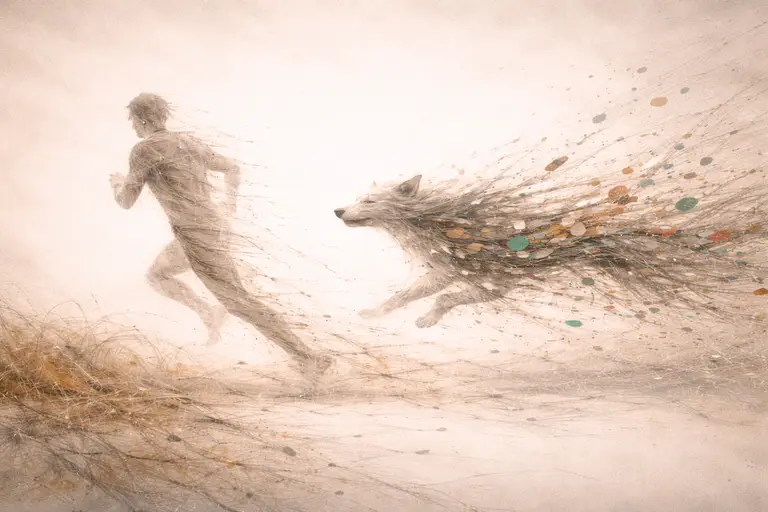
The sound behind you never changes distance.
That’s the specific thing. You’re running — actually running, with the body’s full urgency — and the sound of what’s behind you doesn’t fade. You go faster. You change direction. You find open ground and push harder and still the footfall stays exactly where it was: two steps back. Not closing. Not falling behind. Two steps. Constant. As though the dog already knows exactly where you’re going and has decided to stay at this precise distance regardless of how hard you work to increase it.
Most chase dreams are about something closing in. This one is different. This one is about something that maintains.
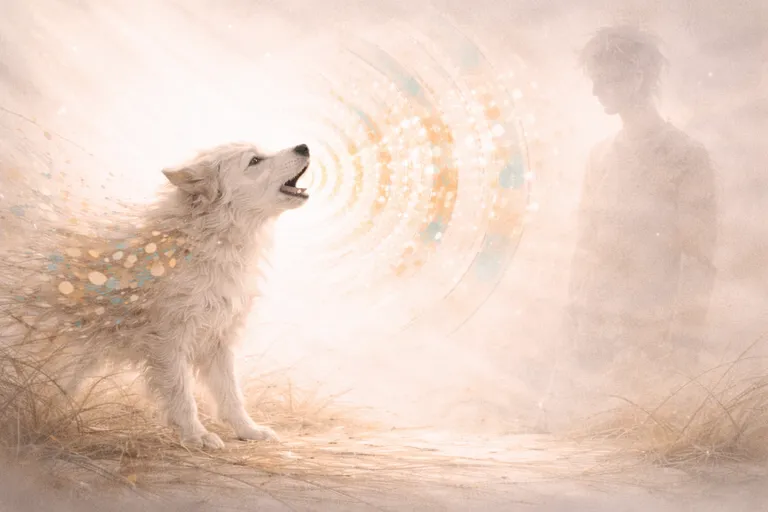
The dog chasing you in a dream is not hunting. A dog that wanted to catch you would catch you — dogs are faster than humans on straight ground, the physics are not in your favor. But this dog isn’t closing the gap. It’s keeping the gap. It’s maintaining a specific distance from you that corresponds exactly to the distance you’re keeping from it. The dog is not pursuing you as prey. The dog is following you as something that belongs near you — something pushed into the position of chaser entirely because you keep moving away.
The chase is the form that following takes when you won’t stand still.
Quick Answer
- A dream about a dog chasing you means something inside you has stopped waiting at a safe distance and has started moving to stay close to you as you move away from it
- The dog doesn’t chase strangers — it chases what it recognizes; the pursuit exists because there’s history, not because there’s threat
- The distance stays constant because the dog is running your run — it knows your pace, your direction, your tendencies better than a stranger ever could
- You are running from something familiar, not from something external; the familiar thing has been waiting long enough that it followed you
- If you stopped and turned around in the dream, the dream almost certainly shifted: the confrontation the running was avoiding was never as difficult as the running was
Common Scenarios
Dog chasing and the distance never closes → the avoidance is still working, barely; the thing pursuing you is keeping pace but hasn’t broken through; the maintenance of the gap is the whole dynamic
Dog chasing and your legs won’t cooperate → the effort isn’t translating into distance anymore; the avoidance has been running long enough that the body’s capacity for it is failing
You recognize the dog while running → the most specific version; you know what’s chasing you; the brain isn’t being obscure about the source
You turn around and the dog slows or stops → the confrontation the running was preventing turns out to be simpler than the running; the pursuit existed because of the movement away, not in spite of it
The dog is silent while chasing → no growling, no barking, just running; that silence is the most unsettling quality; the pursuit without aggression is patient certainty, not rage
The dog chases you somewhere specific → where you end up when you’re running from this thing is as meaningful as what you’re running from; the dream is showing you what the avoidance has been moving you toward
What Your Body Already Knows
The specific exhaustion of effort that didn’t work → your legs ran in the dream; the waking body remembers the running without the distance; the feeling of effort that produced no result
The sound that was behind you → the particular quality of footfall that maintained; not approaching, not retreating; the body holds the sound of constant two-step pursuit
Whether you looked back or kept facing forward → the choice to look or not look is in the body’s memory; what you were and weren’t willing to see while running is itself information
The specific guilt mixed into the fear → it’s there; this dream doesn’t produce pure fear; something underneath the running knows what’s being avoided and has complicated feelings about the avoidance
Why the Dog Already Knows Where You’re Going
Here is the thing about being chased by a dog that distinguishes it absolutely from being chased by a stranger.
A stranger has to follow your movements. They react to your decisions. Every turn you make is new information for them. The chase involves reading, adjusting, responding. There’s a strategy to it on both sides.
The dog doesn’t follow your movements. The dog tracks you.
It knows your pace. It knows how you run when you’re really afraid versus how you run when you think you might have enough lead. It knows which direction you’ll turn when the space opens up. It knows when you’re about to slow down before your legs slow down. The dog has been close to you long enough to have internalized your patterns. It doesn’t need to react to you — it anticipates you.
You turn. The dog has already adjusted. You cut left. The sound behind you moves with the cut without missing a step. You try something you’ve never tried in a chase, something that should create surprise — and the dog is already there, maintaining its specific distance, unruffled, as though it was always going to be wherever you ended up. The pursuit has the quality of something that knows you very well.
This is why the dog chase dream produces a specific quality of dread that a stranger-chase dream doesn’t. The stranger might be beaten through cunning or speed. The dog cannot be beaten this way because cunning and speed are already accounted for. The dog isn’t outrunning you. It’s running alongside you at a specific remove. And the only thing that would change the chase is not running.
You Left Before It Chased
Here is the thing the dream never shows you but that is always true: the running started first.
You moved away. The dog followed. The chase is your departure with pursuit attached.
In every version of this dream, the dynamic was created by your movement, not by the dog’s aggression. The dog was somewhere — close, present, part of the landscape — and you began moving away from it. And the dog, being what dogs are in dreams — something loyal that responds to the person it’s connected to, something that has difficulty with separation from what it belongs to — followed.
The chase exists because you left. The pursuit is the consequence of the avoidance.
The moment that would clarify everything is the moment before the dream shows you the running. The moment when you first became aware of the dog and decided — not consciously, not with deliberation, but with the body’s own rapid decision-making — to move away from it. That decision was the beginning of everything. The chase didn’t begin when the dog started running. It began when you did.
In waking life, this corresponds exactly to what the dream is about. An instinct, an emotion, a part of yourself — something that had a place in your life — that has been consistently moved away from. Not destroyed, not rejected outright, but consistently given the signal that it’s not welcome in the interior. The dog has been chasing you for as long as you’ve been running. The running is what made it a chase.
What’s Pursuing You Has Been Waiting Longer Than the Dream
The dog in this dream is not something that appeared suddenly. It appeared in the dream suddenly. But whatever it represents in your waking life has been present for much longer than the dream suggests.
The pursuit exists because the avoidance has been running long enough to generate it. Something was there. You moved away from it. It followed. You moved away further. It followed further. The pursuit has the momentum of accumulated avoidance — it’s not chasing you because it just noticed you. It’s chasing you because it has been tracking you through a long series of moves you made to create distance.
The urgency of the pursuit in the dream is proportional to the duration of the avoidance.
It’s not running faster than you. It doesn’t need to. It’s been running this long already. The specific patience of something that has been maintaining pursuit through everything you tried is different from the urgency of something that just started chasing. This has been running for a while. And it will keep running for exactly as long as the running continues on your side.
This is what happens when the same situation keeps recurring regardless of what you try to change — where every approach loops back to the same dynamic because the dynamic exists at a level deeper than the approach can reach. The dog keeps chasing not because it’s determined in the way a predator is determined, but because the relationship between the running and the pursuit is structural. The running creates the chase. Stop running and the chase stops. Keep running and the chase continues indefinitely at the same constant two-step distance.
What the Dog Is Actually Chasing You Toward
Every step away from the dog is a step in a particular direction.
The chase is usually framed as running from — from the dog, from the feeling, from what the dog represents. But running away always means running toward something. The direction of the avoidance is as meaningful as the avoidance itself.
What have you been running toward while running away from this?
The dream often shows you where you end up. You run into a corner. You run into a dead end. You run toward open ground and find it closes. The destination of the chase — where the running takes you when you keep running — is the brain showing you where consistent avoidance has been leading.
A corner means the avoidance has run out of room. You can’t keep moving in this direction. The thing behind you and the thing in front of you have converged.
Open ground that keeps going means the avoidance still has space — but space that will eventually run out.
A dead end means the direction the running has taken you is not sustainable. The thing being avoided will still be there when the running stops. The location you ended up in is not better than the location you started from.
You’ve been running for a while. Long enough that you’ve made real distance — or thought you had. Then you register where you are. It’s not where you intended to be. The running took you somewhere. You chose the direction by choosing to run, and the running has accumulated into a location. Behind you, two steps back, the sound continues. You look at where you’ve arrived. This is where consistent avoidance has taken you.
Turning Around
The dream almost always changes when you stop.
Every variation of the dog chase dream contains this possibility, even if the dreamer doesn’t access it. The confrontation that has been made impossible by the running becomes possible the moment the running stops. Not easy — possible. The dog that was pursuing closes into encounter, and the encounter that felt like it would be devastating turns out to have a different quality than the anticipation of it.
Sometimes the dog stops when you turn. Sits. Waits.
Sometimes it reaches you and the reaching turns out not to be the catastrophe the running was treating it as.
Sometimes the thing it’s been trying to deliver — the instinct it’s been carrying, the emotion it’s been representing, the part of yourself it’s been chasing you with — can finally be received, now that the running has stopped.
You stop running. You turn. The dog stops too. It stands there, still, looking at you with the specific patience of something that has been very clear about what it was doing and is now waiting for you to also be clear. You look at each other. The space between you is smaller than it was in the entire dream. And somehow the smallness of the space is less frightening than the constant pursuit was.
What avoidance is really about when the pursuer is familiar — when it’s not threat from outside but something known that has been pushed into the position of chaser — always comes down to this: the running costs more than the confrontation would. The dream runs the chase until you’re ready to find this out. The moment you turn is the moment the chase ends.
What Is Being Chased Toward You
Here is the inversion that changes the whole dream’s meaning.
You have been reading the dream as: I am running away from something.
Try reading it as: something is trying to reach me.
The dog is not pursuing you as a threat. It’s pursuing you as something that has something for you — something you’ve been consistently moving away from receiving. An instinct that’s been suppressed. An emotion that’s been deprioritized. A part of yourself that’s been consistently given the signal that it’s not welcome in the interior. The dog has been trying to reach you with it. And the running has been the sustained refusal to receive it.
The core of what dogs represent in dreams is always loyalty — trust already given, already active, already inside the relationship between you and the part of your life the dog represents. The dog chasing you is that loyalty, activated into pursuit. Not by aggression. By your departure.
What has been trying to reach you while you’ve been running?
That’s the question the dream is actually asking. Not “what are you afraid of.” Not “what are you running from.” What has been trying to get to you that you’ve been consistently moving away from receiving?
The answer is what will stop the chase.
Dream Timestamp
If the dream arrived during a period of sustained busyness or transition → something internal has been deprioritized long enough to start pursuing; what you’ve been too busy to attend to has decided to follow you instead
If this dream keeps recurring → the avoidance is still running; the thing being avoided hasn’t been addressed; the dream returns because the chase hasn’t ended in waking life
If the pursuit feels more urgent than previous versions → the avoidance has been running longer; the thing being avoided is closer to crossing from pursuit into the territory of what happens when you can’t run anymore
Why This Dream Happens — The Psychology Behind It
The brain creates pursuit when avoidance has been running long enough to require an urgent image.
During waking hours, the avoided thing can be held at bay — below the line of attention, behind the management of daily demands, reliably deprioritized through the structures of a busy life. The suppression works. The instinct or emotion or part of the self stays down, mostly, with the occasional surfacing that can be managed.
But suppression has a cost. The energy required to keep something down that keeps trying to surface accumulates. The cognitive overload builds. And the brain, during sleep, generates the clearest available image for the accumulated pressure of sustained avoidance: something familiar, persistent, that knows you, giving chase.
The pursuit is proportional to the suppression. Two steps back corresponds to the specific distance of what has been consistently held at bay — close enough to have been present all along, far enough to have been managed. The running in the dream is the running in waking life. The dog’s patience is the persistence of what has been waiting to be heard.
The Sentence This Dream Was Trying to Say
Something that belongs near me has been given no choice but to chase me — and the chase will last exactly as long as the running does.
The Morning After
The sound is gone. The dream is gone. You’re in the room and nothing is behind you and the two-step distance no longer applies.
But the thing the dream was about is still there. Still at the distance your consistent avoidance has established. Still moving at the pace you set when you keep moving.
Before the morning covers it with its demands: what was the dog? Not the breed or the color — what did the pursuit correspond to? What in your waking life has the specific quality of something familiar that you’ve been consistently moving away from? An instinct you’ve been managing. An emotion you’ve been routing around. A part of yourself that keeps surfacing in ways you keep addressing without addressing.
And one question worth sitting with: what would happen if you stopped running and turned around?
Not in the dream — in whatever situation the dream was showing you. What would the confrontation actually cost? Is it possible the cost of facing it is less than the cost of the running, which has been accumulating since you started?
The chase will last exactly as long as the running. That’s not a threat. That’s information.
FAQ
What does a dream about a dog chasing you mean? It means something inside you — an instinct, an emotion, a suppressed part of yourself — has been avoided long enough that the avoidance has become pursuit. The dog chases you because you’re moving away from it, not because it’s a threat. The specific quality of the dog chase dream is that the distance stays constant: the dog maintains a specific remove that corresponds to how much distance you’ve been keeping in waking life. The chase will last exactly as long as the running does.
Why doesn’t the dog ever catch you? Because it’s not trying to catch you. Dogs that want to catch humans catch them — the physics favor the dog on straight ground. The dog in this dream is maintaining a distance, not closing it. It’s running your run — following at the pace of your avoidance, staying at the distance you’re keeping from it. The pursuit is not about predation. It’s about something that belongs near you following at the only distance available when you won’t stand still.
What does it mean when my legs won’t work in the chase? It means the avoidance has been running for long enough that the body’s capacity for it is failing. The effort you’re applying is no longer translating into distance. The dream has shifted from “avoidance working, barely” into “avoidance is no longer a viable strategy.” The legs that won’t cooperate are the brain’s image for reaching the limit of what sustained suppression can maintain.
What happens if I turn around in the dream? Almost always, the dream shifts. The pursuit loses urgency. The dog slows or stops. The confrontation that felt impossible while you were running turns out to be manageable the moment you stop avoiding it. This is the dream’s most specific message: the threat existed because of the running. Face it and the dynamic changes. What’s been pursuing you has been trying to reach you, not to destroy you.
Next Stages
If the chase ended with the dog reaching you — if the distance finally closed → when the avoidance collapses and contact is made: dream about a dog biting you — when what’s been following finally crosses the line the running was preventing it from crossing
If the dog chasing you felt desperate rather than relentless — if the pursuit came from something that had nowhere to go → when the chase is displacement, not aggression: dream about a stray dog — when what’s pursuing you is itself looking for somewhere to belong
If there was a warning before the chase — if the dog signaled before it followed → the moment before pursuit began: dream about a dog barking at you — when the signal was there before the running started, and what you heard or ignored in that signal shaped everything that followed