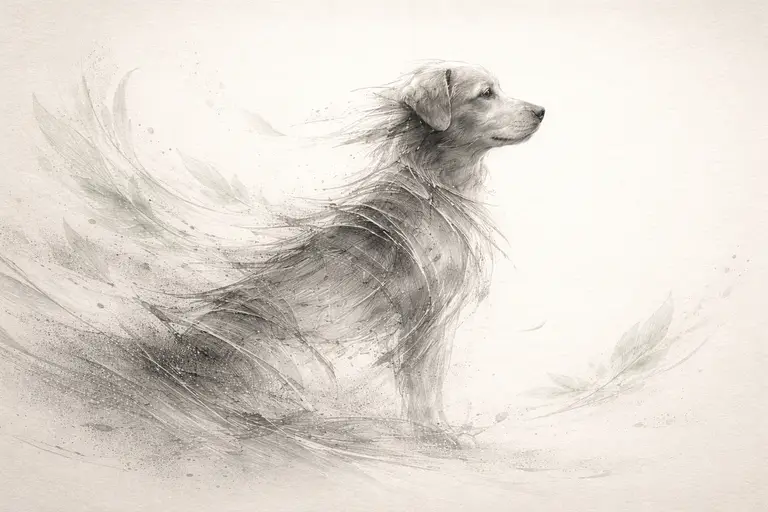
Dream About a Stray Dog — Meaning & Interpretation
You recognized it before you decided to.
That’s the specific thing about the stray dog in dreams. You see it and something responds before you’ve assembled any thought about it — before you’ve asked where it came from, before you’ve decided whether you know it, before you’ve classified it as threat or non-threat. Just recognition. Prior and physical. The body knowing something before the mind confirms it.
Because the stray dog in this dream is never a stranger. That’s the most important thing to understand about it, and it’s the thing that separates it from every other dog dream. The stray didn’t come from nowhere. It came from somewhere that used to include you.
Something that was once part of the structure of your life — a relationship, a part of yourself, a creative practice, a connection, a value — has been displaced from that structure without being formally ended. Not destroyed. Not rejected. Not actively sent away. Just left outside the architecture of your current life. Without the attention, the maintenance, the daily contact that would keep it connected. Until it became a dog with no address. Until it started wandering. Until it turned up in your dream, at a specific distance, following your pace, recognizable in a way that produced guilt before it produced anything else.
That guilt is the message. And the dream is asking what you’re going to do about it.
Quick Answer
- A dream about a stray dog means something that was once loyal to you — and you to it — has been displaced from your life without being formally released
- The guilt this dream produces is specific: not the guilt of having done harm, but the guilt of having stopped doing good; not “I shouldn’t have done that” but “I should have kept doing that and I didn’t”
- The stray follows you because it still recognizes you; the following is the dream’s most important image — loyalty with no rational reason to continue except the fact of its own continuity
- You are always the one who knows what the stray represents; the recognition the dream produces is the guide
- The distance between you and the stray is the distance you created through accumulated not-doing; it is not fixed
Common Scenarios
The stray follows at a distance but doesn’t approach → the loyalty is still present but the connection has been reduced to proximity; the stray hasn’t given up, but it also knows better than to assume welcome
You try to approach and it retreats → the distance has been running long enough that trust has thinned; what you neglected has developed its own wariness
The stray looks sick or thin → the dream being specific about the consequence of sustained neglect; not cruelty — the slow result of something no longer being fed
You feed it and it stays → the reaching is accepted; what was displaced is still within range of being reclaimed; the attempt was received
It looks at you with eyes that are clear even though the rest of it isn’t → the most specific image in this dream; what was left behind still sees you; it still knows you; and you know that it knows
The stray appears with a collar but no tags → it belongs somewhere, or belonged; the evidence of connection is present; the connection itself is not
What Your Body Already Knows
The specific quality of guilt before grief → not the grief of losing something — the guilt of not maintaining it; the body registering the difference between “this was taken from me” and “I let the distance grow”
The recognition that came before the thought → the body identified something familiar before the mind had context; whatever the stray represents, some part of you already knows
The specific quality of the following → whether the stray was close or far, the fact that it tracked you stayed; that persistence is in the body even after waking
The impulse toward and away simultaneously → wanting to close the distance and also not wanting to acknowledge what closing it would require; the body holding both the pull and the resistance
Why the Stray Is Never a Stranger
Every other dog dream involves a relationship that is present. The dog in your house, the dog attacking you, the dog dying — all of these are about connections that are active and current, things that are inside your life right now and doing something there.
The stray is different. The stray is about a connection that was active and has become peripheral.
The dog didn’t appear from outside your life. It appeared from somewhere that used to be inside it. The specific quality of recognition the dream produces — the way something in you responds before you’ve decided anything — is the brain’s signal that this isn’t unfamiliar territory. You have history with this.
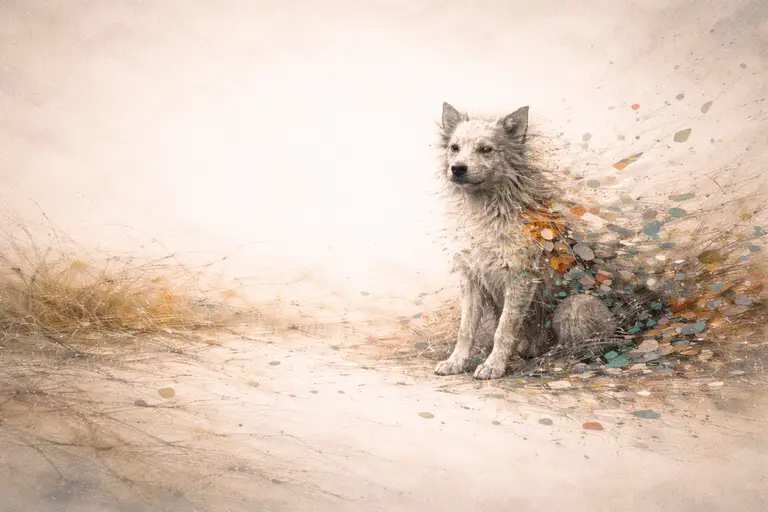
You see it from a distance. Something in you adjusts before you’ve processed what you’re looking at — a shift in attention, a specific alertness, something that isn’t quite recognition yet but is already moving in that direction. Then you take it in fully. It’s thin. It’s keeping its distance. Its eyes are on you with a steadiness that isn’t aggression and isn’t warmth exactly — more like patience. The patience of something that has been waiting for long enough to have gotten used to waiting. You know this dog. That’s the thing. You don’t know why you know it, but you know it.
The stray in the dream is always something that was once closer than it is now. The drift happened gradually — not through a decision, not through an event, but through the accumulation of days where something was not attended to. Days where the attention went elsewhere. Days where what was once central became peripheral without any announcement of the transition.
By the time the dream shows you the stray, the peripheral has been peripheral for a while.
The Guilt of Having Stopped, Not the Guilt of Having Done
There are two kinds of guilt and this dream produces only one of them.
The guilt of having done something produces a specific urgency — the need to undo, to apologize, to make right the specific thing that was done. It has a clear object. Something happened that shouldn’t have, and the guilt is attached to that event.
This dream produces the other kind. The guilt of not having kept doing something. The guilt of omission rather than commission. The slow guilt of sustained inattention. The kind that doesn’t have a specific event as its origin because the origin was a pattern — the accumulated not-doing — rather than a moment.
It’s thin. You can see that. And nothing dramatic happened to make it thin. No illness, no injury, no event that thinned it. Just days of not enough. Days where it wasn’t fed. Days where the structure it needed to be maintained in wasn’t maintained. It got to this condition through the specific arithmetic of accumulated not-enough. Nothing dramatic. Just ongoing. And you are looking at the result.
This specific guilt is harder to address than event-guilt because it has no moment to point to. You can’t go back to the day the drift started. You can’t identify the specific choice that began the neglect, because there wasn’t one — there was a pattern, a gradual reorientation, a slow drift of attention from one thing to another until the first thing was outside the structure and the reorientation had been running long enough to have become invisible.
What the dream is producing guilt about is: whatever this stray represents, you know when you last really attended to it. And you know how long ago that was.
The Following and What It Means
The stray follows you. This is the most important image in the dream.
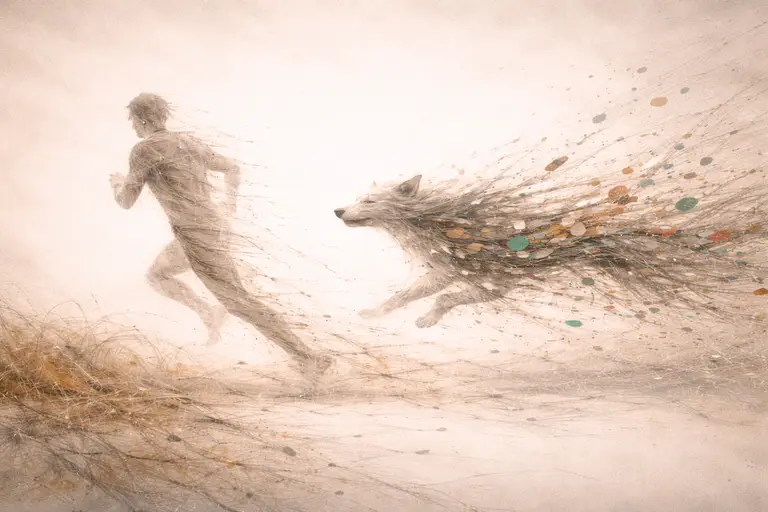
Not approaching — following. Maintaining a specific distance. Adjusting its pace to yours. Keeping you within its radius without closing the gap between you. Not asking for anything you can name. Just following.
This following is the dream’s clearest image for loyalty that has no rational reason to continue except the fact of its own continuity. The stray gets nothing from following you. The following doesn’t produce warmth, or attention, or food, or any of the things that would make the following a transaction. It follows because following is what it does. Because it still recognizes you. Because it cannot stop recognizing you regardless of what the distance between you has become.
Two steps behind. Always two steps. You slow down and it slows down. You turn and it adjusts. It doesn’t try to close the distance. It doesn’t retreat. It maintains the specific geometry of something that knows better than to assume welcome, but also cannot entirely give up proximity. The following isn’t demanding. It’s just there. Patient in the specific way of something that has been doing this for a while.
In waking life, this image corresponds to something that has been displaced from the active center of your life but hasn’t entirely let go. A relationship that has become occasional rather than regular — still there when you slow down, still recognizable, still adjusting to your movements, but not quite close enough to be part of the daily structure. A part of yourself that gets expressed occasionally when the conditions allow but has stopped being a regular presence. A connection that you would recognize immediately if you encountered it but that you haven’t specifically sought in a long time.
The following tells you: it’s still there. The distance is yours.
What the Stray Is Made Of
This is the dream where identification is the most personal and the most specific, and the recognition the dream produces is the guide.
The stray can be any of these things, and only you know which one your dream was showing you:
A relationship that drifted — a friendship that wasn’t ended, wasn’t damaged, just slowly became less frequent until it became rare until it became occasional until you realize you can’t remember the last real conversation. Not broken. Unattended. The stray is the friendship, still recognizable, following at a distance.
A creative part of yourself — the writing you used to do, the music you used to make, the art practice that was part of who you were before life got louder and the practice got quieter until it stopped. Still present as something you identify with when asked. Not actually present in your days.
A value or commitment — something you believed in or cared about that has been consistently deprioritized without being abandoned. You still claim it. You haven’t been living it. The gap between the claim and the living is the stray.
A part of your identity — the version of yourself that existed before a particular shift in role, circumstance, or relationship. The self that was once central and has been displaced by the person you became in response to what the life required.
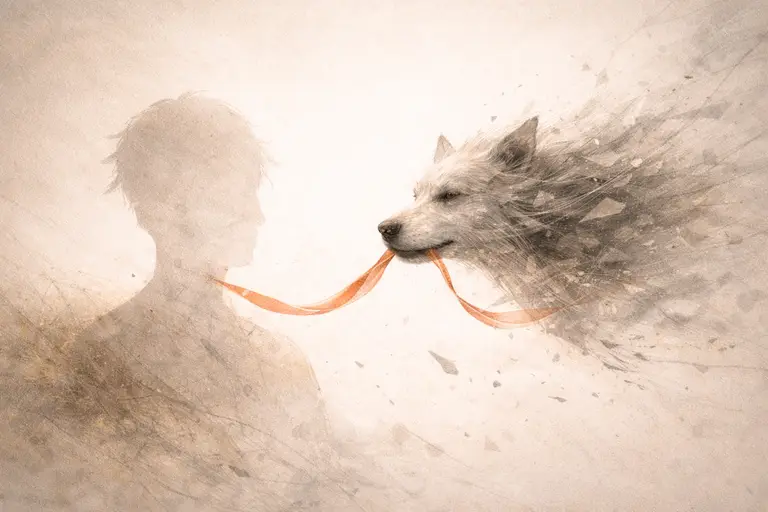
The same displaced connection that surfaces in dreams about someone you no longer talk to — the person who wasn’t formally released from your life but drifted outside its active structure — is exactly the territory the stray dog maps in its most relational form. The stray is the relationship. Recognizable. Following. At a distance that is entirely the result of accumulated not-doing.
Whether to Close the Distance
Here is the question the stray dog dream is actually asking.
Not “what does this mean.” You already know what it means. You recognized it before you decided to. The recognition came before the analysis.
The question is: are you going to close the distance?
The dream doesn’t tell you you must. It doesn’t claim that the stray represents something that must be reclaimed. Some things drift for reasons that are real — a relationship that changed in ways that made the drift appropriate, a part of yourself that needed to recede for the new version to develop, a value that genuinely transformed rather than being neglected.
But it does ask. And the asking has a specific quality: the stray is still there. The following is still happening. The recognition is still mutual. The distance is not fixed. It is entirely the product of accumulated inattention, which means it is reversible by the opposite: attention.
You crouch down. You hold out your hand. Something in it shifts — a small movement, a change in the set of its shoulders, something that registers your gesture without quite committing to it. You wait. The distance between you doesn’t close, but it doesn’t grow either. It’s making its own assessment. It’s deciding whether you mean it. Whether you’re going to be here next time, or whether this is a single moment of reach that will be followed by more of the same absence.
The dog in its fullest form is always loyalty that is given and received. The stray is loyalty that is still given — still following, still recognizing, still within range — waiting to find out whether it will be received. Whether the hand reaching out will still be there tomorrow. Whether there’s going to be a next time.
That’s the whole question of the stray dog dream. Is there going to be a next time?
Dream Timestamp
If this is the first time → the displacement has just crossed the threshold where the brain needs to surface it; something has been drifting long enough that it’s now outside the structure enough to appear as a stray
If this dream recurs → whatever the stray represents has not been tended to; the dream returns because the distance hasn’t changed; the stray is still out there, still following, still at the same distance
If the stray’s condition worsens across recurring dreams → the neglect is ongoing and its effect is accumulating; the window during which reclaiming is possible may be narrowing
Why This Dream Happens — The Psychology Behind It
The brain generates the stray when the gap between what you’ve been attending to and what you’ve been neglecting has become large enough to require a direct image.
During waking hours, the neglected thing remains peripheral — present at the edges, not demanding, not causing crisis. The brain can manage it there indefinitely, as long as the neglect doesn’t produce something acute.
But the cognitive load of sustained neglect — the continuous low-level awareness of something unattended, the ongoing guilt of not-doing — accumulates. The brain processes this during sleep. It reaches for the image that most precisely corresponds to the experience of something loyal that has been left outside the structure: a dog without an address, recognizable, following at a distance, patient in the way of something that has given up expecting something while still being unable to give up presence.
The stray is not an accusation. It’s an image. An accurate, specific image of something that was yours, or close to yours, or part of you, that the structure of your current life has left outside. The dream is asking for your attention. Not your guilt. Your attention.
The Sentence This Dream Was Trying to Say
Something loyal is still following me — and the entire distance between us is made of days I didn’t turn around.
The Morning After
The stray is gone from the dream. You’re in the room. The guilt is probably still there — the specific kind, quiet and low, the kind that doesn’t accuse you of a moment but holds you accountable for a pattern.
Before the day covers it with its ordinary demands: what was the stray? Not the breed, not the color, not the details of the dream — what did the recognition land on? What in your waking life do you know, when you sit with the feeling the dream left, is what the stray was showing you?
Something once close to you is at a distance that is entirely the result of accumulated inattention. That’s the dream’s whole message. Not that you did something wrong. That you stopped doing something right.
And the stray is still out there. Still following. Still at the distance you created.
One question: if you turned around today — fully, deliberately, with the intention of closing the distance — would it still be there?
You probably already know the answer. The question is whether you’re going to act on it.
FAQ
What does a dream about a stray dog mean? It means something that was once close to you — a relationship, a part of yourself, a value, a connection — has been displaced from the active structure of your life through accumulated inattention rather than through any specific decision or event. Not hurt. Not rejected. Left outside. The stray represents whatever that is, and the recognition the dream produces before you consciously process anything is the guide to what it specifically corresponds to. The guilt the dream generates is specific: not the guilt of having done something wrong, but the guilt of having stopped doing something right.
Why does this dream produce guilt rather than fear? Because the stray isn’t threatening you. It’s following you. The guilt is the appropriate response to the specific situation: something loyal that hasn’t given up is still there, still recognizable, still within range — and the entire distance between you is the result of your accumulated inattention, not any external force. Fear corresponds to threat. Guilt corresponds to responsibility for a gap you created. This dream produces guilt because it is accurately identifying your relationship to the stray.
What does it mean if the stray dog is sick or thin? The condition of the stray is the condition of what it represents. Sickness and thinness in the dream correspond to the consequence of sustained neglect — not cruelty, just the slow result of not enough. Whatever the stray represents in your waking life, it has been running below the level of maintenance that would keep it healthy. The specificity of the condition is useful: the more deteriorated the stray appears, the longer the neglect has been running.
What does it mean when the stray follows but doesn’t approach? It means the loyalty is still present but the trust has thinned with the distance. The stray knows you — recognizes you, adjusts its pace to yours — but has learned enough from the experience of the distance to not assume welcome. The following without approach is the most specific image in this dream: loyalty that continues not because it expects something but because it cannot entirely give up proximity. The distance is yours to close. The stray is waiting to see if you mean it.
Next Stages
If the stray finally came close — if the distance closed and the connection was attempted → when the reach toward what was displaced becomes active: dream about saving a dog — when the attempt to reclaim what was left behind is the central event of the dream
If the stray had once been specifically yours — if the displacement felt like loss of something that knew you fully → when the drift became final: dream about your own dog dying — when what was displaced was the version of loyalty that had the most intimate access to who you are
If the patience of the stray ran out — if what followed you eventually stopped following and turned → when neglect exceeds what loyalty can sustain: dream about a dog biting you — when what waited outside the door long enough finally expressed what waiting costs