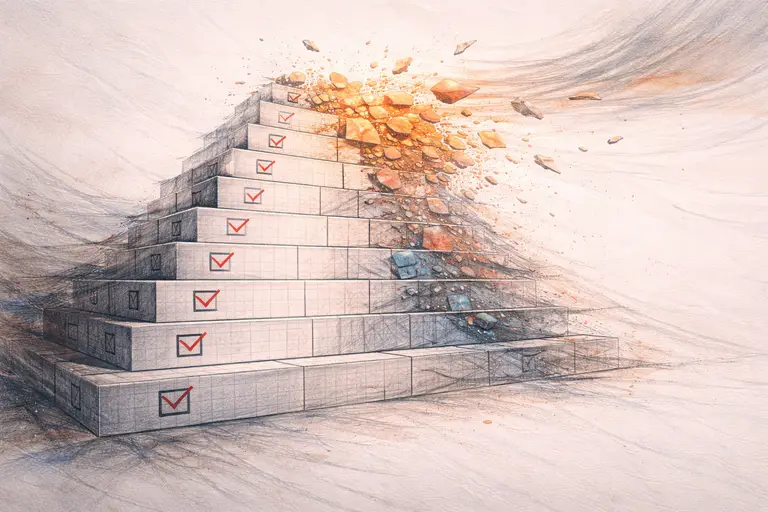
Being Late for an Exam in a Dream — The Hallway That Keeps Extending
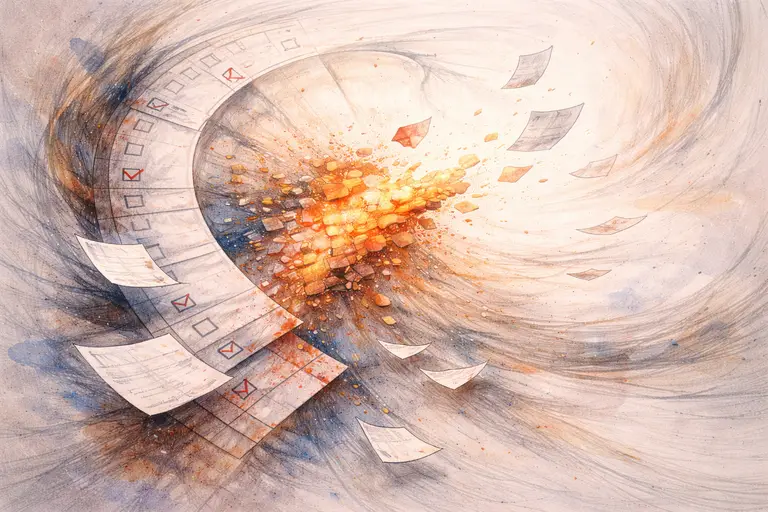
The hallway keeps extending. That’s what you notice first.
Not that you’re running late — you’re running, actually running, the body doing everything it’s supposed to do. But the corridor has developed a logic of its own. The door you need keeps being further ahead than it was a second ago. You know the room. You can see the direction. The distance refuses to close.
By the time you arrive — if you arrive — everyone is already halfway through. Heads are down. Pens are moving. You’re standing at the threshold of something that started without you, and whatever the gap between you and the rest of the room is, it was there before you walked in.
What makes this the most universally reported dream across demographics has nothing to do with exams. Adults who haven’t sat in a classroom for twenty years have this dream with the same frequency as students in the middle of exam season. Something in that universality is the key to the reading: if this were about academic anxiety, it would cluster around students. It doesn’t. It clusters around anyone in a period where the experience of being behind on something with stakes — something that won’t wait and keeps measuring — has become the ongoing condition.
The hallway isn’t a hallway. It’s the gap that keeps not closing.
Quick Answer
- The being-late-for-an-exam dream is about a gap — between where you currently are and where something that involves being evaluated requires you to be — that has reached the level of urgency this image represents; specifically, a gap that your effort isn’t closing as fast as the evaluation is approaching
- Robert Sapolsky’s research on anticipatory stress — documented in Behave and Why Zebras Don’t Get Ulcers — establishes the neurological mechanism: the human brain generates the same physiological stress response to anticipated problems as to actual ones; the hallway that extends is the brain’s spatial image for a waking situation where the anticipated gap keeps being present regardless of effort
- The hallway-that-extends scenario is the dream’s most specific and most honest spatial rendering: in ordinary physics, the distance between you and a destination is closed by movement; in the dream’s physics, movement doesn’t close distance; this corresponds directly to the waking experience of effort not translating into progress — of the gap between current position and required position persisting despite genuine forward movement
- The distinction between this dream and the missing-exam dream is precise and important: missing the exam is exclusion — the window closed; being late is still-possible — the window is still open, you’re inside the possible, and the experience is of being behind within the possible rather than outside it entirely
- When the legs move slower than they should despite genuine effort, the dream is encoding the specific experience of output not corresponding to input — trying harder isn’t producing proportional results in the waking situation
- When the clock shows the wrong time or jumps forward, the temporal reference system has become unreliable; the experience of not being able to accurately track where you are in relation to the deadline corresponds to a waking situation where the real position in a high-stakes process has become difficult to assess
- When you arrive and someone is already in your seat, arrival hasn’t restored position — something about the standing was displaced during the absence, and simply getting there doesn’t restore it
- Rosalind Cartwright’s research on REM and current emotional states is directly applicable: the dream processes the ongoing emotional background of waking life; when being-behind-while-being-evaluated has been the sustained condition, the late-exam dream appears and recurs; it’s tracking a state, not predicting an event
- The dream is specific to evaluation pressure combined with time pressure: the general lateness dream is about timing; this version adds that the lateness is happening while being measured; both dimensions are active simultaneously
- The recurring version means the behind-while-being-evaluated state is the ongoing condition; each recurrence reports that the gap is still present; the dream stops when the gap closes, the evaluation ends, or the position relative to the standard is genuinely recalibrated
Common Scenarios
Running toward the room and not closing the distance. The foundational version. The effort is present, the direction is correct, and the gap doesn’t close. You’re moving. The arrival isn’t happening at the rate the moving should produce. In waking life, this is the experience of a gap between current position and required position that work doesn’t seem to be closing — the career position that keeps being further away despite development, the relational state that keeps not arriving despite effort, the internal standard that keeps feeling equally distant despite preparation.
The hallway itself keeps extending. The specifically disorienting version. Not that you’re running slowly — the corridor is generating more length. Each step produces more hallway to cover. In waking life, this encodes a specific quality of some situations: they keep generating new requirements faster than existing requirements can be met. The project whose scope keeps expanding. The relationship dynamic that keeps revealing more demands than the previous ones indicated. The situation that keeps adding more hallway just as you were about to reach the door.
Arrive to find everyone already halfway through. The behind-before-you-started version. You’re inside the window. You made it. And the starting position you’ve arrived at is already behind everyone else’s current position. In waking life, this maps the specific experience of entering a context late — the organization whose culture has been developing for years before you joined, the relationship whose important early conversations happened before you were in it, the professional field whose foundational work was done in a period you weren’t present for.
The legs move slower than they should. The effort-output-mismatch version. The body is applying everything available. The speed produced doesn’t correspond to the effort applied. This is among the most physically specific scenarios in the dream vocabulary — the direct somatic image of output not matching input. In waking life: working harder without proportional progress, applying more energy to a situation that keeps not advancing at the rate the energy should produce.
The clock shows wrong time or jumps forward. The temporal disorientation version. The reference system for tracking position relative to the deadline has become unreliable. You can’t accurately assess how late you are, or the assessment keeps changing. In waking life, this corresponds to the specific experience of a high-stakes situation where it’s genuinely difficult to assess current position — where the metrics for tracking progress are either unavailable, unreliable, or keep shifting.
You arrive and your seat is taken. The displaced-position version. The arrival happened and position wasn’t restored by arriving. Someone else occupies what was yours. Simply getting there wasn’t sufficient to reclaim the standing that the absence created. In waking life, this corresponds to the specific experience of returning to a context after a period of absence and finding that the position wasn’t held — that the gap created by not being present has itself created a structural change that presence alone doesn’t undo.
What Your Body Already Knows
Woke up with the heart already moving faster than the room requires → because Sapolsky’s research on anticipatory stress documents a full physiological response to anticipated threats — the same cortisol release, cardiovascular activation, and muscle preparation that an actual emergency produces; the body ran the full late-exam urgency response and the physical state persists briefly into waking; the heart is still calibrated to the dream’s pace
Woke up with the legs carrying the residue — not pain, the specific quality of effort that wasn’t producing its expected speed → because the motor system was running the running simulation throughout the dream at full somatosensory detail; what remains in the legs is the body’s record of effort applied and distance not closed; the specific quality of legs that were working and wrong is preserved as its own somatic signature
Woke up and the room or context that the exam was about was identifiable immediately → because the hallway always had an address; the brain assembled the extending corridor from a real waking-life situation where the gap between current position and required position has been the ongoing condition; whatever arrives before deliberate analysis is the address
Woke up with a specific quality of already-behind rather than about-to-be-behind → because Cartwright’s research establishes that the dreaming mind processes the current emotional state, not a future one; the behind-ness wasn’t anticipatory in the dream — it was current; the body carries the feeling of current-behind, not future-might-be-behind, and that quality persists into the morning as its own distinct texture
Woke up and checked something — a message, a status, a timeline — before the analysis of the dream started → because the verification behavior the dream was running extended into waking; not the question of preparation (I’ve been working) but the question of position (how far behind am I); the checking is the gap-assessment behavior the dream was encoding, briefly continuing into the morning
What Rosalind Cartwright Found — And Why This Dream Persists
Rosalind Cartwright spent three decades at Rush University running longitudinal studies on dream content and waking emotional life. The central finding of The Twenty-Four Hour Mind is the one most directly applicable to the late-exam dream: the dreaming mind during REM sleep is not generating random imagery — it is processing the current emotional state with specificity, returning to whatever emotional material has the most active charge in the waking life.
What this means for the late-exam dream is that its persistence is proportional to the persistence of the waking state it’s processing. The dream doesn’t appear on the night before a single high-stakes deadline. It appears during extended periods when behind-while-being-evaluated has been the ongoing condition. And it recurs as long as that condition persists.
I find this framework more useful than the standard interpretation of this dream — which tends to locate it in general anxiety or performance pressure — because Cartwright’s insight is specific about the emotional architecture being processed. It’s not generalized anxiety. It’s the particular combination of evaluation (something with stakes is measuring you) and temporal position (you’re behind the place you need to be). That combination is the specific material the dream is built from. When that combination is the ongoing waking condition, the dream keeps returning.
What would stop it: not the resolution of anxiety in general, but the resolution of the specific condition. The gap closes. The evaluation ends. The position relative to the standard is genuinely recalibrated to match the actual current position rather than being held at the level of an unreachable requirement.
Sapolsky adds the physiological dimension: the anticipatory stress response — the activation of the same systems as actual threat in response to anticipated threat — runs continuously when the situation keeps presenting as potentially-behind-and-being-measured. The body has been running a version of this response throughout the period that generated the dream. The dream concentrates and delivers it, and the morning’s physical state carries the report of what the body has been doing.
You’re running. The body is doing the right things. The direction is correct. The door is there — visible, clear, recognizable as the one you need. And the relationship between your running and your arrival at the door has been disrupted. The running is happening. The closing of the distance isn’t. And you know — with the specific certainty of dreams — that whatever time everyone else has had in that room before you arrived, you’re already starting from behind.
Failing an Exam — What Your Brain Is Actually Being Evaluated On maps the full evaluation architecture — and why the exam room is the brain’s most efficient image for external assessment combined with temporal pressure; the specific combination that makes this dream one of the most universally reported across all demographics.
Being Late vs Missing — The Distinction That Changes Everything
These two dreams are often conflated and shouldn’t be. The distinction is the most important structural element in the late-exam dream.
Missing the exam is exclusion. The window closed. The evaluation happened without you. Whatever verdict was produced, you weren’t present for any part of it. The outcome is already determined and you had no participation in it. That’s a different psychological structure.
Being late is still-possible. You’re inside the window. The exam is in progress. The evaluation is happening and you are in the process of arriving into it. The gap is real — you’re behind where you need to be, the others have had time you didn’t — but you’re not out. The door hasn’t locked.
The specific quality of the late-exam dream — the quality that makes the hallway-extending scenario so precisely distressing — comes from this still-possible structure. The worst possible structure for an anxiety dream isn’t exclusion. Exclusion is closed. It’s over. There’s nothing to do. The worst possible structure is still-possible-but-behind: inside the window, still in the game, with the gap between current position and required position actively present and the verdict still open.
That combination keeps the urgency system active in a way that exclusion doesn’t. Exclusion deactivates the urgency — there’s no action that would help. Still-possible-but-behind keeps it running — there’s action that would help and it might not be enough and the evaluation is still in progress.
The dream encodes this structure precisely because it corresponds to a specific waking experience: not the situations that have already resolved badly (those produce different dreams), but the situations that are still in progress, where the position is behind, and where the outcome is still being determined. The opening is what keeps the urgency running.
Why Adults Without Exams Keep Having This Dream
The most telling fact about the late-exam dream is that it doesn’t cluster around students.
It appears across age groups. People who haven’t sat an exam in thirty years have it with the same frequency as people in the middle of a graduate program. This distribution tells you something precise about what the dream is actually processing.
The exam is borrowed framework. The brain stored the exam years ago as its most concentrated available symbol for formal evaluation with a hard start time — the template, established through years of actual exams, for what being-measured-while-behind-schedule feels like. When current life produces the same emotional structure, the brain reaches for the clearest available template. The exam isn’t the memory. The exam is the format.
What current adult life produces that generates this dream: the performance review that’s been running alongside a period of feeling behind on output. The creative or professional project with a deadline and a gap between where it is and where it should be. The relationship dynamic that has been implicitly measuring something and where the position feels insufficient. The internal standard that has been running as an ongoing evaluation without a fixed endpoint.
None of these are exams. All of them produce the late-exam dream when they combine evaluation with temporal position-behind. The brain reaches for the most efficient available symbol. The classroom was where the template was built.
Running Out of Time in an Exam Dream — When What’s Required Exceeds What’s Available maps the version of this same pressure that arrives inside the exam rather than outside it — when the gap is between questions remaining and time available rather than between arrival position and required position; the distinction between being late to the evaluation and running out of time within it.
Dream Timestamp
The late-exam dream arrives during sustained periods when behind-while-being-evaluated has been the ongoing emotional condition → not before a single known deadline — during the extended period when multiple things are simultaneously in the state of being measured while the position relative to the measurement feels insufficient; the dream appears after the pattern has been sustained, not at its beginning
The hallway-extending version is the most common and appears across the full range of intensity → from mild versions that appear during moderately pressured periods to the most extended versions that appear when the gap has felt unresolvable for a sustained duration; the length of the extending corridor is roughly calibrated to the duration and intensity of the behind-while-measured state
The arriving-with-others-already-ahead version arrives when the position is specifically comparative → when the behind-ness isn’t measured against an abstract standard but against other people’s current position; when the assessment isn’t “I’m not where I should be” but “I’m not where they are”
The legs-moving-slowly version arrives when the effort-output gap is most specifically active → when not just the position but the mechanism between effort and progress has been failing; when trying harder hasn’t been producing proportional progress
The recurring version tracks the ongoing state → the dream recurs as long as the behind-while-being-evaluated condition persists; each recurrence is Cartwright’s brain accurately processing the current emotional state; it stops when the gap closes, the evaluation ends, or the position is genuinely recalibrated
The Sentence This Dream Was Trying to Say
“I’m running toward something that started without me, and the gap between where I am and where I need to be isn’t closing as fast as the evaluation is forming its conclusion about me.”
The Morning After
The urgency clears as the room establishes itself. The hallway resolves. The ordinary morning’s pace replaces the dream’s pace.
Before the day reinstates its ordinary structure: the hallway was always about something specific. The brain assembled it from a real waking-life condition.
Two questions worth sitting with before the day starts.
First: what is the gap? Not the dream’s corridor — the actual situation where the position relative to the evaluation feels behind. What specifically keeps being further ahead than where you are?
Second: is the gap real — genuinely behind in a way that corresponds to actual position — or is it the anxiety’s perception of behind-ness in a situation where the actual position is more adequate than the dream’s panic suggests? Cartwright’s research documents that dreams are accurate reporters of emotional state; they are not always accurate reporters of actual circumstances. The feeling of behind-ness and the reality of behind-ness can diverge significantly, especially under sustained evaluation pressure.
The hallway was real. What it was leading to was real. The question worth asking this morning is not how to run faster — it’s whether the door is as far away as the dream insisted, or whether the anxiety had its own reasons for extending the corridor.
FAQ
Being behind on something that involves being evaluated, in a situation where the gap isn’t closing as fast as the evaluation is forming its conclusion. Robert Sapolsky’s anticipatory stress research explains the physiological intensity: the brain generates the same stress response to anticipated problems as to actual ones. Rosalind Cartwright’s longitudinal dream research established why it persists: the dreaming mind during REM processes the current emotional background; when behind-while-being-evaluated has been the sustained condition, the dream appears and recurs until the condition changes.
Because the dream is accurately representing a waking experience in which effort isn’t closing the gap. In ordinary physics, movement closes distance. In the dream’s logic, movement doesn’t — because the situation being processed is one where work disappears into the situation faster than it accumulates. The extending hallway is the spatial image for the gap that keeps being present despite genuine forward movement: the project with as much undone as before you worked on it, the preparation that keeps feeling insufficient despite being real.
Because the exam is borrowed framework — the brain’s stored template for evaluation-with-a-hard-start-time. When current life produces the same emotional combination (being measured while feeling behind), the brain reaches for the most efficient available format. The exam isn’t the memory; it’s the structure current stress is being processed through. The specific evaluation — professional, relational, internal — changes. The structure of behind-while-measured is what generates the dream, regardless of when exams last occurred.
Missing is exclusion — the window closed, the evaluation happened without you, the outcome is determined. Being late is still-possible — you’re inside the window, behind but not out, the verdict is still forming. Still-possible-but-behind produces more sustained anxiety than exclusion precisely because it keeps the urgency system active: there’s action that could help, it might not be enough, and the evaluation is still in progress. The opening is what sustains the pressure.
The effort-output gap — output not corresponding to input. The body is applying everything available; the speed produced doesn’t match the effort applied. This is among the most direct spatial images for a specific waking experience: working harder without proportional progress. Applying more energy to a situation that keeps not advancing at the rate the energy should produce. The slow legs are the dream’s honest rendering of the specific frustration of sustained effort in a context that isn’t responding to effort at the expected rate.
By changing the underlying condition — not by arriving earlier in the dream. Cartwright’s research is specific: the dream tracks the current emotional state; it stops when the state changes. The conditions: the gap closes and position reaches the standard, or the evaluation ends, or the position is genuinely recalibrated to match the actual current position rather than being held at the level of the unreachable standard. Running faster in the same hallway isn’t the resolution the dream is pointing toward.
Next Stages
Failing an Exam — What Your Brain Is Actually Being Evaluated On — the pillar — the full evaluation architecture; why the exam room is the brain’s most efficient template for formal assessment under time pressure
Running Out of Time in an Exam Dream — When What’s Required Exceeds What’s Available — the version inside the exam — when the gap is between questions remaining and time available rather than between arrival position and required position
Failing the Test You Prepared For — When Effort and Outcome Stop Speaking to Each Other — what happens after arriving — when being late compounds into being prepared and still failing; when the gap before the exam becomes the gap inside it
Being Unprepared for an Exam — When the Gap Is Real and Known — the version where the issue isn’t position relative to the start time but position relative to the required preparation; the distinction between arriving late and arriving without what the evaluation needs