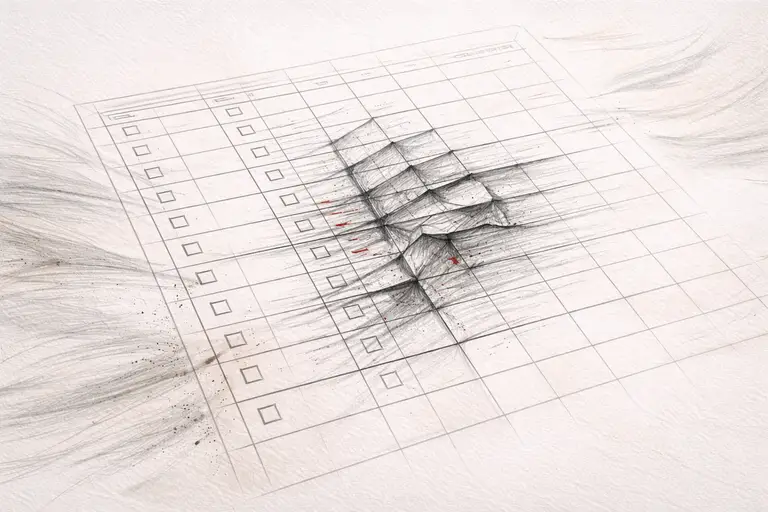
Failing the Test You Prepared For — When Effort and Outcome Stop Speaking to Each Other
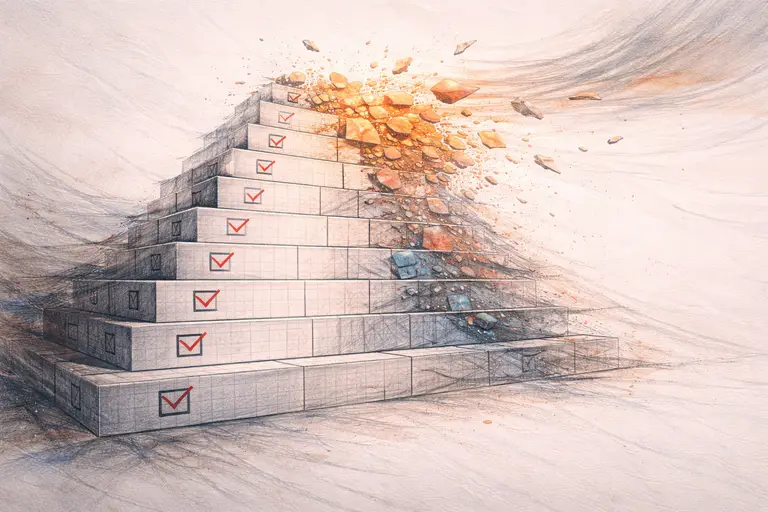
You put in the work. That’s what makes this one different.
Every other exam dream has an explanation available — you didn’t prepare, you ran out of time, you never found the room. Those dreams stage the absence of something. This dream stages the presence of everything required, and the failure anyway. You studied. You reviewed. You carried the material in. And when the paper was in front of you, something between the preparation and the outcome failed to connect.
The specific quality of this dream — the thing that stays after waking — isn’t panic. It’s something quieter and more corrosive. The particular frustration of someone who did what was supposed to be done and watched it fail to produce what it was supposed to produce. Not: I should have prepared better. But: the preparation was real and it wasn’t enough.
That frustration is the dream’s most honest message. Not about competence. About the mechanism that was supposed to translate competence into outcomes.
I want to say directly what I find consistently in people who have this dream: it is not the dream of someone who is genuinely underprepared. People who are genuinely underprepared tend to dream about the blank paper, or about not finding the room. This dream — the specific dream of having studied and failing anyway — appears in people who are capable, who do the work, and who have been in a period where the work keeps not producing the expected results. The dream isn’t documenting a deficit in preparation. It’s documenting a breakdown in the relationship between effort and outcome that has been running long enough to require a dream this specific.
Quick Answer
- This dream is about the failure of the effort-reward mechanism — not the failure of preparation; the preparation was genuine, the capability is real, and the outcome failed anyway; the dream documents the specific experience of the link between input and output breaking down
- Martin Seligman’s foundational research on learned helplessness — the discovery that repeated non-contingency between actions and outcomes produces a specific and lasting shift in how the brain approaches future situations — establishes the neurological mechanism this dream is processing; when effort consistently fails to produce expected outcomes, the brain doesn’t just feel frustrated: it begins to update its model of whether effort and outcome are connected at all
- Albert Bandura’s research on self-efficacy — the belief in one’s own capacity to produce outcomes through actions — documents the specific belief this dream is processing; Bandura found that self-efficacy isn’t built from knowledge or capability alone but from the experience of outcomes corresponding to efforts; when they stop corresponding, the belief itself begins to erode
- The distinction from every other exam dream in this cluster is precise: blank paper removes the framework; forgetting removes the access; running out of time removes the resource; this dream removes the correspondence — the framework exists, the access is working, the time is present, and the outcome still fails
- When the questions shift to something unrecognized — when you studied for the right exam and the paper is about something else — the standard has changed; the preparation was real and was aimed at a target that is no longer the target
- When the material is accessible but doesn’t connect to what’s being asked, the problem is relevance rather than access: the knowledge is present and the knowledge doesn’t answer the question; this maps the experience of having developed genuine capability that the current evaluation isn’t measuring
- The quiet, corrosive quality of the aftermath — not panic but a low erosion — is the dream’s most honest emotional product; it’s the specific feeling of having protected yourself with preparation and the protection having not worked
- Rosalind Cartwright’s research on REM processing established that the dreaming mind processes the emotional state of current life with specificity; the studied-but-failed dream appears during periods when the effort-outcome relationship has been disrupted long enough to constitute the ongoing emotional background, not just a single event
- When the dream ends before the grade arrives, the anxiety about the verdict has become more intense than the verdict itself; the anticipation of finding out has become the primary experience; this corresponds to the waking state of someone who has been performing and is afraid to see the result of the performance
- The recurring version means the non-contingency is ongoing — the pattern of effort not producing proportional results is still the current condition; the dream stops when either the correspondence is restored, or the expectations are genuinely recalibrated to match the current environment
Common Scenarios
You recognize the material and still can’t access it adequately. The access-under-evaluation version. You studied this. You can feel that you studied this — the specific density of the preparation, the hours that went into it. And between the knowing and the demonstrating, something isn’t working. The door between preparation and performance is locked. You prepared for the knowledge. You didn’t prepare for the door. In waking life, this maps the experience of genuine capability that keeps not converting into the form the evaluation is looking for — not because the capability is absent but because something in the translation is failing.
The questions are about something you didn’t prepare for. The changed-standard version — perhaps the most disorienting of all. The preparation you did was for a real exam. This exam is not that exam. The questions have no relationship to what you reviewed. Your preparation is sitting inside you, completely applicable to an evaluation that isn’t happening. In waking life, this is the specific experience of the moving target: the role that was redefined after years of development for the original version, the relationship whose expectations shifted without announcement, the standard that changed while you were meeting the previous one. The preparation wasn’t inadequate. The exam changed. Those are different problems.
You write answers that look correct and still feel wrong. The performance-that-doesn’t-land version. You’re not blank. You’re not frozen. You’re producing output that corresponds to the questions — and something in the output keeps having a quality of insufficiency that the preparation didn’t prevent. This version corresponds to the specific waking experience of performing well by every observable measure and the performance consistently failing to register. Not incompetence. Something about the context that doesn’t let the competence fully land.
Others pass on the same material while you fail. The comparative version. The preparation that worked for everyone else didn’t work for you. You’re all in the same room, under the same standard, using the same material — and the outcome is different. In waking life, this is the experience of watching others navigate the same environment successfully while something about your specific relationship to that environment keeps not working. Not a capability question. A fit question. Something about the match between you and this specific context.
The dream ends before the grade arrives. The anticipation version. The performance is over. The result is imminent. The dream stops before you find out. What stays after waking is the specific quality of the held breath — the anxiety about the verdict has become more prominent than the verdict itself. In waking life, this corresponds to the state of someone who has submitted something significant and is waiting to find out how it was received, and the waiting has become the dominant experience.
What Your Body Already Knows
Woke up with a quiet frustration rather than sharp panic — something that sits differently than fear → because Seligman’s learned helplessness research documents a specific emotional signature for non-contingency: not the acute alarm of threat but a lower, more erosive quality — the specific feeling of a system that has been trying and is beginning to update its model of whether trying produces anything; the body ran this specific state throughout the dream and carries it briefly into waking
Woke up and the domain where effort hasn’t been translating was immediately identifiable → because the exam was always a reference; the brain chose this dream to process something specific; the waking-life address was built into the dream’s construction and arrives before deliberate analysis; whatever comes to mind first is what the dream was reporting on
Woke up with the specific quality of prepared-and-still-failed — different from the quality of unprepared → because the body knows the difference between failure that has an explanation and failure that doesn’t; failure from preparation is more specific and more corrosive than failure from absence; the somatic signature of having done the work and watched it not convert is its own distinct quality
Woke up and assessed something — a project, a professional context, a relationship — not for what was done but for whether what was done was sufficient → because the verification behavior the dream was running extended briefly into waking; not the question of what the effort was but the question of what the effort produced; the checking is the brain looking for correspondence between input and output
Woke up with the erosion quality already present — a quieter version of whatever it is that makes continued effort feel uncertain → because Bandura’s self-efficacy research documents that repeated outcome-effort non-correspondence degrades the belief in one’s own capacity to produce results through actions; this degradation is gradual and below conscious awareness until the dream surfaces it; the erosion that waking carries is the body’s record of the accumulation
What Seligman Found — And Why This Dream Is Honest
Martin Seligman’s research in the 1960s and 70s — the foundational work that eventually became the theory of learned helplessness — produced a finding that changed how psychology understood the relationship between effort and outcome.
What Seligman documented, first in animal experiments and then in human subjects, was this: when actions consistently fail to produce expected outcomes, the nervous system doesn’t simply increase effort or try different approaches. It begins to update its model of whether actions and outcomes are connected at all. The specific updating produces a state — which he called learned helplessness — characterized by reduced motivation to try, difficulty recognizing when actions do produce outcomes (because the model has been updated to not-expect-it), and a specific emotional quality of passive disengagement rather than active fear.
What I find important about applying Seligman’s framework to this dream is that it explains both the dream’s content and its specific emotional quality.
The content: the dream stages the experience of preparing and failing precisely because the brain is processing a period in which effort and outcomes have been non-contingent. The exam is the most concentrated available symbol for formal effort → formal evaluation → formal result. The dream uses it to process the waking experience of the same structure breaking down.
The emotional quality: the corrosive quiet of the aftermath — not panic, not fear, but that low erosion — is the specific quality Seligman documented. It’s not the alarm of an acute threat. It’s the beginning of the update that says: maybe trying and arriving aren’t connected in the way they’re supposed to be. That update is the thing the dream is most honestly encoding.
The corresponding insight from Bandura: self-efficacy — the belief that one’s actions produce outcomes — isn’t built from knowledge or intention alone. It’s built from the experience of correspondence. When the exams you study for produce the results studying is supposed to produce, the self-efficacy belief is reinforced by experience. When that correspondence breaks down consistently, the belief starts to lose its experiential foundation. The dream is processing this erosion before the waking mind has fully acknowledged it.
You did the work. You’re holding the paper and you know you did the work. You can feel the density of the hours — the specific weight of preparation that was genuine and is now present in you and is not connecting to what’s being asked. The door between what you prepared and what you can demonstrate has a lock on it you didn’t know was there. You studied for the knowledge. The lock is something else entirely.
Failing an Exam — What Your Brain Is Actually Being Evaluated On maps the full architecture of evaluation anxiety — why the exam room is the brain’s most concentrated symbol for external measurement, and why the specific scenario the dream generates tells you precisely which kind of evaluation failure the current waking situation is producing.
The Changed Standard — The Hardest Version
The version of this dream where the questions are about something entirely different deserves its own direct attention, because it points to a specific and particularly disorienting waking experience.
You prepared for the real exam. This is not that exam. The preparation you did was genuine and complete for something that isn’t what’s being measured. Your effort is present and applicable to an evaluation that isn’t happening.
In a straightforward failure, the gap is addressable: more preparation, different approach, better access to what you know. The gap is between your preparation and the standard, and it’s a gap you can work on.
When the standard changes, there is no gap to address. The preparation was sufficient for the target. The target moved. These are different situations and they require different responses — one requires more effort in the same direction, the other requires recognizing that the direction has changed.
In waking life, this version appears when a significant standard-shift has occurred that wasn’t announced or wasn’t fully registered. The organization that changed what success means without explicitly saying so. The relationship that shifted its expectations without conversation. The internal standard that the person applied to themselves throughout a period of effort that has since been replaced by something different — so the effort that was accumulating toward the old standard now doesn’t count toward the new one.
What the dream is encoding: the work was real. The target changed. The work doesn’t convert. That’s a different failure from not working hard enough, and it requires a different kind of response.
Why The Quiet Aftermath Is More Honest Than The Fear
Most exam dreams produce acute distress — fear, panic, the urgency of physical threat. This dream produces something quieter. Something that sits low and stays longer.
That quiet quality is not a lesser version of the dream’s distress. It’s a more honest one.
Seligman’s learned helplessness research documented the specific emotional signature of non-contingency: not the alarm of an acute threat (which produces energized response, mobilization, the urgency of fix-this-now) but the low, erosive quality of a system that has been testing the effort-outcome connection and updating its model. That update is slow. The erosion is gradual. And the emotional quality it produces is more quiet than fear precisely because it isn’t predicting a specific threat — it’s updating a general model.
The dream’s quiet aftermath is the body carrying the beginning of that update. Not: this specific thing is dangerous. But: the mechanism that was supposed to protect you through preparation is less reliable than you thought. That second thing is both less acute and more fundamental, and the body registers it accordingly.
Writing Wrong Answers in a Dream — When the Problem Isn’t What You Know maps the case where the judgment system itself is the problem — when the answers are there and the internal judge keeps finding them wanting; the distinction between effort not producing outcomes (this dream) and effort not being trusted by the self (that one).
Dream Timestamp
This dream arrives when the effort-outcome relationship has been non-contingent long enough to begin updating the brain’s model of whether trying and arriving are connected → not after a single disappointing outcome — after enough of them that the pattern has been registered; the brain doesn’t update its fundamental models from single data points; this dream appears after the pattern has established itself
The changed-standard version arrives during or shortly after a significant standard-shift → when the target that the effort was aimed at has changed, and the effort accumulated toward the old target isn’t counting toward the new one; this version tends to appear relatively soon after the shift is registered, even if the shift hasn’t been consciously named
The recurring version means the non-contingency is ongoing → the dream returns as long as the pattern holds; each recurrence is the brain accurately reporting that the effort-outcome relationship is still disrupted; it stops when correspondence is restored or when the expectation is genuinely recalibrated to match the current environment
The quiet-aftermath version — the corrosive rather than acute quality — arrives when the non-contingency has been sustained long enough to begin the Seligman update → the acute alarm of early non-contingency is replaced by the lower, more erosive quality as the duration extends; the dream’s emotional texture shifts from urgency to the specific quiet of a system beginning to disconnect effort from expectation
The Sentence This Dream Was Trying to Say
“I did everything that was supposed to protect me from this outcome — and the outcome happened anyway. And it’s happened often enough that I’m starting to wonder whether the things that are supposed to protect me actually do.”
The Morning After
The quiet frustration is still there. Low, specific, sitting differently than fear.
Before the day reinstates its ordinary logic — the logic that says effort produces outcomes, which is usually true enough to be livable — the dream was processing something honest about a period in which that logic has been less reliable than expected.
Three questions worth sitting with separately:
First: what is the test? Not the dream’s exam — the specific waking domain where the preparation has been real and the results have been insufficient.
Second: is the problem the preparation, the access to the preparation under pressure, or the standard — did the standard change while you were working toward the previous one?
Third, and the one the quiet aftermath is most specifically about: has the experience of effort not translating been sustained long enough to begin affecting the belief that effort translates?
That third one is the Seligman question. The dream is asking it. The morning is a reasonable time to begin answering it honestly.
FAQ
The failure of the effort-outcome mechanism — not a failure of preparation. The preparation was genuine. The capability is real. The outcome failed anyway. Martin Seligman’s research on learned helplessness established why this is psychologically specific: when actions repeatedly fail to produce expected outcomes, the brain doesn’t just feel frustrated — it begins updating its model of whether effort and outcome are connected at all. This dream appears during periods when that update has been running long enough to require processing. In waking life: the work that doesn’t get recognized, the investment that doesn’t return, the professional effort that keeps meeting indifference despite being genuine.
Every other exam dream has an addressable gap — you could have prepared more, arrived earlier, found the room. Each failure points somewhere. This dream removes the addressable gap. The preparation was done. The capability is present. The outcome failed anyway. That’s a different psychological structure from inadequacy: it’s the specific experience of protection that didn’t protect. Albert Bandura’s self-efficacy research explains what this erodes: the belief — built from the experience of correspondence — that one’s actions produce outcomes. When correspondence breaks down repeatedly, the belief loses its experiential foundation.
The standard changed. The preparation was aimed at a target that is no longer the target. This is qualitatively different from ordinary failure: in ordinary failure, more preparation in the same direction would help; here, the direction itself has changed. In waking life: the role redefined after years of development toward the original version, the relationship whose expectations shifted without conversation, the goal that moved while you were building toward the previous version. The work was real. The exam changed. That requires recognizing the shift, not increasing effort in the same direction.
Because this is the specific emotional signature of non-contingency, which Seligman’s research documented: not the alarm of acute threat but the low, erosive quality of a system beginning to update its model of whether effort produces anything. Acute fear is a response to a specific threat. The quiet erosion is a response to a pattern — the gradual degradation of the belief that trying and arriving are connected. The dream’s aftermath is quieter than panic precisely because what it’s processing is more fundamental: not “this specific thing is dangerous” but “the mechanism that was supposed to protect me is less reliable than I thought.”
No — and this is the precise point where the dream’s honest assessment and the Seligman update diverge. The dream is accurately reporting that effort and outcome have been non-contingent in a specific domain during a specific period. That’s a report about the current environment, not about the fundamental relationship between effort and outcome. Bandura’s research is clear: self-efficacy, once eroded by non-contingency in one domain, doesn’t permanently transfer to all domains. The appropriate response to this dream is identifying the specific domain and the specific reason for the non-contingency — not updating the general model that effort is futile.
By restoring the correspondence — either by changing the conditions that are producing the non-contingency, or by genuinely recalibrating the expectations to match the current environment. The dream tracks the effort-outcome relationship. It stops when either the relationship is restored (outcomes begin to correspond to efforts again) or when the expectations are honestly adjusted (the model of what this environment produces is updated to match reality rather than the expected standard). Studying harder for an exam that keeps testing the wrong things is not the solution the dream is pointing toward.
Next Stages
Failing an Exam — What Your Brain Is Actually Being Evaluated On — the pillar — the full architecture of why the brain reaches for the exam room when external evaluation is at its most acute, and what the specific failure mode tells you about the current evaluation structure
A Teacher Watching You Fail — When Failure Becomes Evidence — the version where the failure-despite-preparation has an observer; when the breakdown of effort-outcome correspondence is being watched by someone whose version of you incorporates what they’re seeing
Writing Wrong Answers — When the Problem Isn’t What You Know — the adjacent case — when the issue isn’t the correspondence between effort and outcome but between output and the evaluation of that output; what happens when the work is done and the judging system still finds it wanting
Repeating the Same Exam Again — When the Loop Won’t Close — the sustained version — when failing the test you studied for isn’t a single event but a repeating scenario; what the brain is reporting when the same effort keeps meeting the same insufficient outcome