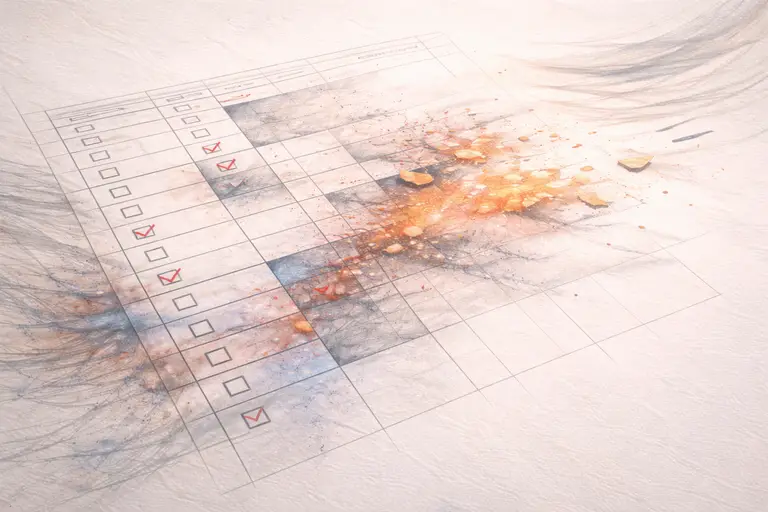
A Blank Exam Paper in a Dream — When Performance Is Expected Without Terms

The paper is in front of you. You’re waiting for the questions.
They don’t come.
Not: you don’t know the answers. Not: the questions are hard or strange or in a language you can’t read. The page is simply white. The situation that was supposed to present you with something to demonstrate your knowledge against has simply not presented anything. The framework for performance is absent. The expectation of performance is not.
You’re in a room full of people who immediately started writing. You can hear it — pens moving, pages turning, the productive sound of people who were given a question and are using it. They received something to respond to. You received a white field.
What distinguishes this dream from every other failure in the cluster is what’s missing. In the forgetting dream, the knowledge is gone. In the running-out-of-time dream, the window is closing. In the writing-wrong-answers dream, the judgment is failing. This dream removes something more fundamental than any of those: the question itself. The terms. The stated criteria. The definition of what the performance is supposed to be.
I want to be precise about what this means, because most people immediately map this dream to general performance anxiety and miss the specific thing it’s encoding. This is not the dream of someone who is afraid they’re not good enough. This is the dream of someone who has been placed in a situation that requires them to be good at something and hasn’t been told what the something is.
Quick Answer
- The blank-exam-paper dream specifically encodes the experience of being required to perform in a situation that has withheld the framework defining what the performance should be — not incompetence, not unpreparedness, but the absence of stated criteria in the presence of expected output
- Mark Solms’ predictive processing model of the brain — developed in The Hidden Spring — establishes why this experience produces such specific distress: the brain continuously generates predictions about what the environment will provide; when the expected input doesn’t arrive, the prediction-error signal is activated; the white paper is the brain’s spatial image of a prediction error running at maximum intensity
- Daniel Kahneman’s research on System 2 — the slow, deliberate problem-solving system — establishes that it requires a problem to be stated in order to begin; without a defined problem, System 2 runs but cannot engage; it is present, ready, and without a target
- Herbert Simon’s concept of satisficing — finding a “good enough” solution — cannot operate without a defined solution space; when the criteria haven’t been provided, there is no way to determine what “good enough” would look like, and the system runs without the ability to find a stopping point
- The everyone-else-is-writing detail is essential and almost universally present: the framework was distributed and yours is missing; the dream is encoding the specific experience of a structural absence that is yours specifically, not universal
- When the paper is blank and you don’t know what subject this is, the disorientation has extended past the absence of questions to the absence of context: not just no criteria but no category for what criteria would even belong to
- The stillness of this dream is its most specific physical quality: no running, no racing clock, no urgency because urgency requires direction — the absence of criteria removes the vector that would tell you which way to move and how fast
- The hand-on-pen-pen-on-paper-nothing-written scenario is the dream’s most precise spatial image for the experience of having the mechanism and not the target: capability present, direction absent
- When pages keep being blank as you flip through, the framework absence is complete — not one question but the entire examination structure has been withheld
- The dream corresponds in waking life to any situation where the expectation of output exists without the definition of what the output should be: the project without a brief, the relationship expectation never articulated, the professional standard that exists and hasn’t been communicated, the internal demand whose criteria haven’t been named
Common Scenarios
The paper is blank and everyone else is writing immediately. The foundational version. You’re in the same room, under the same rules, with the same amount of preparation — and they have something to respond to and you don’t. The framework was distributed. Yours is missing. This is not about what you don’t know. It’s about what wasn’t given to you. In waking life, this corresponds with precision to the experience of operating in a context where others seem to have access to information, expectations, or unwritten criteria that were never provided to you — where the framework appears to exist and to be legible to others and to have not reached you.
The paper is blank and you don’t know what subject this exam is. The context-dissolution version. Not just the questions missing — the category for what the questions would belong to has also gone. You’re holding a blank page in an exam for something you can no longer identify. In waking life, this encodes a more complete version of the same experience: not one unclear domain but the general organizing framework for what you’re being asked to produce has become genuinely uncertain. During significant life transitions or identity disruptions, this version tends to arrive: not just unclear criteria in one area but the general question of what any of it is supposed to be for.
The hand is on the pen, the pen is on the paper, nothing comes. The mechanism-without-target version. Everything that would allow writing is present and functioning. The readiness is real. And it has nothing to execute against. This version encodes the specific experience of capability that has no direction to deploy itself in. Not blocked. Not failing. Genuinely present and genuinely without a target. The professional skill that has nowhere to apply itself. The capacity for relationship that hasn’t been given the terms of what kind of relationship is being built. The readiness that keeps being ready without receiving what it’s ready for.
Pages keep being blank as you turn them. The systematic-absence version. Not one question — the whole examination structure withheld. Every part of the framework that was supposed to tell you what to produce has not been provided. This version tends to arrive when the absence of criteria is pervasive rather than isolated — when multiple domains of a life are simultaneously operating without clear standards, when the general question of what success would look like in the current arrangement has become unanswerable from any angle.
The paper was supposed to have questions but they were removed. The specific-absence version. Not blank by design — blank because something was taken out. There’s an evidence of prior presence: the page that should have had questions had them removed. This version encodes the experience of criteria that were present and are now absent — expectations that existed and have been withdrawn without explanation, standards that were in place and have been changed mid-performance without notification. The blank paper here is not original emptiness but departed structure.
You fill the blank paper with something — anything. The self-generated criteria version. Faced with the absence of a framework, something in you begins producing one. You write without knowing if what you’re writing is what’s wanted, because waiting for the framework to arrive has become untenable. In waking life, this corresponds to the specific response of setting your own criteria when none have been provided — defining the terms of your own performance rather than waiting for external definition. The dream generates this sometimes as relief and sometimes as dread, depending on what the self-generated criteria encounter.
What Your Body Already Knows
Woke up with the specific quality of the white still present — not visual, a quality of absence → because the brain was running the prediction-error signal throughout the dream at high intensity; Mark Solms’ model documents how prediction errors produce a specific valenced signal — the felt quality of expected-input-not-arriving; this signal is somatic, not just cognitive; what persists after waking is the body’s record of having run that signal for the duration of the dream
Woke up with a particular stillness — not the stillness of rest but the stillness of unreleased readiness → because the mechanism was primed and had no target; the motor system and the decision system were both in the ready state and both running without the input that would allow them to execute; this state has its own somatic quality — different from relaxation, different from activation, the specific texture of readiness-without-direction
Woke up and the situation in waking life where performance is expected and criteria are absent was identifiable before any analysis → because the dream had an address; the paper was always representing something specific; what arrives before deliberate thought is the waking-life situation whose structure the dream was built on
Woke up with something that resembles the confusion of waking from a dream that wasn’t distressing but wasn’t resolved → because this dream doesn’t produce the shock residue of the threat dreams or the shame residue of the failure dreams; it produces the specific quality of incompletion without drama; the absence of strong negative emotion sometimes makes this dream harder to take seriously, which is precisely the thing the dream was encoding — the way unclear criteria are easy to not address because they don’t produce a crisis strong enough to demand attention
Woke up and checked something — a task, a project, a relationship — not for progress but for definition → because the verification behavior the dream was running extended briefly into waking; what you checked was not whether you’d done it but whether you understood what it was; the dream was asking about the definition, and the question followed you into the morning
What the Stillness Is Telling You
Most exam dreams have urgency. The clock, the running, the frantic writing. This dream is almost always still.
You’re in the chair. The pen is touching the paper. Time passes. The paper stays white. There is no urgency because urgency requires a direction, and the direction is what’s missing. The racing heart needs something to race toward. The panic response needs a threat to respond to. Neither is available from a blank page. The page isn’t threatening. It’s simply absent.
This stillness is the dream’s most precise physical encoding, and the one most worth attending to after waking. It corresponds to a specific experience that is easy to mistake for calm: the experience of having the capacity and not the criterion. The readiness without the target.
Mark Solms, in The Hidden Spring, develops the predictive processing account of brain function: the brain is fundamentally a prediction machine, running continuous forward models of what the world is about to provide, and generating error signals when what arrives doesn’t match the prediction. The blank paper is the brain’s most direct available image for a prediction error running at maximum intensity: the environment was expected to provide structure, the structure hasn’t arrived, and the error signal — the specific distress of prediction unmet — is what the stillness contains.
Daniel Kahneman’s System 2 adds the functional dimension: the deliberate problem-solving system requires a problem to be stated before it can begin. It is not the case that System 2 can’t operate. It is the case that it has no target. It runs. Nothing comes from the running. The pen is on the paper. Nothing comes from the readiness. This is not a failure of the system. It is the system accurately representing that it has been placed in position without the input it needs to execute.
You’re looking at white. Not white that had words and had them erased — original white, as if the expectation was placed there but the content that would allow you to respond to it was forgotten. The pen is in your hand. The hand is ready. The paper is there. And there is nothing for any of this readiness to meet.
Failing an Exam Dream — What Your Brain Is Actually Being Evaluated On maps the full architecture of the evaluation-anxiety cluster — why the exam room is the brain’s most concentrated image for external assessment, and how the specific scenario the dream generates tells you precisely which kind of evaluation failure is being processed.
Wrong Is Different From Blank — The Most Important Distinction
Here is the distinction that changes the entire reading of this dream, and the one that gets flattened when people file it under general exam anxiety.
Wrong answers exist within a framework. There was a question. You produced a response. The response didn’t match the correct response. Within that structure, failure is assessable — it has a location, an explanation, a path forward. You could have studied more. The preparation could have been different. The failure points somewhere.
A blank page removes the framework entirely. There’s nothing to be wrong about because there’s nothing to respond to. The performance is expected but the terms of the performance haven’t been stated. You’re supposed to produce something and you don’t know what it is.
In waking life, the blank-paper situation is everywhere and consistently underdiagnosed — because it doesn’t present as a clear problem. It presents as vague underperformance, as chronic uncertainty, as the persistent sense that something isn’t right without a specific location for the wrongness. The project you keep not starting because you don’t know where to start. The professional context where you keep producing things that seem off but the feedback is always vague. The relationship where something is expected and you keep not delivering it and the expected thing has never been articulated. The internal pressure to be producing something — a version of yourself, a life that means something — without a definition of what that something would be.
The blank paper isn’t about what you failed to know. It’s about what was never given to you. That distinction is worth carrying into the morning.
The Sound of Everyone Else Writing
This is the detail that makes the dream specifically uncomfortable rather than just puzzling.
They’re writing. Immediately, confidently, heads-down. They received what they needed and they’re using it. The room has the productive sound of people who were given a question and are producing an answer.
You didn’t receive the question.
What I find consistent in people who have this dream is that the sound of the other pens corresponds with precision to a waking experience: the specific feeling of being uninformed in a context where others appear to be informed. The meeting where everyone seems to know things that weren’t shared with you. The professional context where the unwritten rules are legible to some and opaque to others. The social situation where the terms of engagement are clear to everyone around you and haven’t reached you.
The people writing don’t know you don’t have questions. They’re in their own version of the exam. But the sound of their pens — productive, purposeful, directed — is the dream’s most concentrated image for the experience of structural exclusion: the framework was distributed, and yours is missing.
Writing Wrong Answers in a Dream — When the Problem Isn’t What You Know maps the adjacent experience — when the framework exists and the problem is the evaluating system’s relationship to the output; the distinction between having questions and doubting the answers, versus having no questions at all.
Dream Timestamp
The blank-paper dream arrives when the absence of criteria has been running long enough to generate sleep-level processing → not on the first day of an unclear situation — when the absence of framework has been sustained long enough that the system’s attempts to generate output without criteria have themselves become a background strain; the dream arrives after the sustained unclear condition, not at its beginning
The everyone-else-is-writing version arrives when the structural absence is specifically comparative → when the absence of criteria is yours specifically within a context where others seem to have them; when the framework gap has a social dimension — when others are performing and you are still waiting for the definition of what performance is
The context-dissolution version arrives during identity or life-phase transitions → when not one domain but the organizing framework for multiple domains has become simultaneously uncertain; when the question of what any of it is supposed to be producing has become genuinely open in a way that extends past any specific situation
The self-filling version arrives when the coping mechanism of self-defined criteria is emerging → when the person has begun or is beginning to generate their own standards rather than waiting for external provision; this version sometimes precedes a genuine shift in the waking situation — the beginning of the transition from waiting for criteria to setting them
The recurring version means the criteria are still absent → the dream returns as long as the performance is expected and the terms of it remain undefined; it stops when the framework either arrives from outside or is consciously generated from within
The Sentence This Dream Was Trying to Say
“I’m expected to produce something — the expectation is real, the pressure is real, the readiness is real — and the definition of what I’m supposed to produce has never been given to me.”
The Morning After
The white is still present, briefly. That specific quality of a surface that hasn’t received what it was supposed to receive.
Before the day fills the space with its own structure: the blank paper in the dream had a waking-life address. It was always representing something specific. Whatever situation — professional, relational, internal — where the expectation of output exists and the criteria for what the output should be have not been provided: that’s the address.
Two questions worth sitting with:
First: who was supposed to provide the framework — and haven’t? External definition that was expected and hasn’t arrived? Internal definition that was supposed to crystallize and hasn’t?
Second, more immediately useful: what would it look like to fill the paper yourself? Not to wait for the questions — to generate them. To decide what the performance is supposed to be, without the external provision that keeps not coming.
The paper can stay blank indefinitely while you wait for something to appear on it. Or you can pick up the pen and write the question yourself. The dream doesn’t tell you which one to do. It tells you that the waiting has been going on long enough to reach sleep.
FAQ
Being required to perform in a situation that has withheld the framework defining what the performance should be. Not incompetence — the stated criteria are missing. Mark Solms’ predictive processing model explains the specific distress: the brain continuously generates predictions about what the environment will provide; when the expected input doesn’t arrive, the prediction-error signal activates. The white paper is that signal rendered spatially. In waking life: the project without a brief, the relationship expectation never articulated, the professional standard that exists but hasn’t been communicated, the internal demand whose criteria haven’t been named.
Hard questions exist within a framework. There was a question. You produced a response. The response was inadequate, but inadequacy has a location and a path forward. A blank paper removes the framework entirely. There’s nothing to be inadequate about because there’s nothing to respond to. Daniel Kahneman’s System 2 — the deliberate problem-solving system — requires a problem to be stated before it can begin. Without a defined problem, it runs but cannot engage. The mechanism works; the target is absent.
Because the dream is being precise: the framework was distributed, and yours is missing. Not universal absence — specific absence. In waking life, this corresponds to the experience of operating in a context where others appear to have access to information, unwritten rules, or unstated criteria that were never provided to you. The sound of other pens is the dream’s most concentrated image for structural exclusion: the same context, the same room, a framework that reached others and hasn’t reached you.
Because urgency requires a direction, and the direction is what’s missing. The racing heart needs something to race toward. Panic is a response to threat and the blank paper isn’t threatening — it’s absent. The stillness is the somatic quality of readiness without a target: the system is primed, present, ready to execute, and has no input to execute against. It corresponds in waking life to the experience of capability that has no vector to deploy itself in — not blocked, not afraid, genuinely present and genuinely without a stated purpose.
The organizing framework has dissolved, not just one domain’s criteria. Not just unclear questions in one area — the category for what kind of questions any of this would belong to has become uncertain. In waking life, this version appears during significant life-phase transitions when not one situation but the general framework for making sense of the current arrangement has become genuinely open. Not: I don’t know how to answer this specific question. But: I don’t know what the questions are, or what field they belong to, or what any of this is producing.
By providing the framework — either by getting the criteria from the source that was supposed to provide them, or by generating the criteria yourself. The dream tracks the absence of defined terms in the presence of expected output. It stops when the terms exist — either because they were finally communicated from outside, or because you stopped waiting and wrote the questions yourself. The second is slower and often more sustainable than the first. The paper can stay blank indefinitely while you wait for something to appear on it.
Next Stages
Failing an Exam — What Your Brain Is Actually Being Evaluated On — the pillar — why the brain uses the exam room for evaluation anxiety, and what the specific failure mode tells you about the structure of the waking evaluation
Writing Exam in Unknown Language — When the Framework Exists But Is Unreadable — the adjacent version — when the framework exists but the terms are incomprehensible; the distinction between no framework and an unreadable one
Running Out of Time — When What’s Required Exceeds What’s Available — the version where the framework exists and time is the constraint; what changes when the problem is defined but the window closes before the solution can be delivered
A Teacher Watching You Fail — When Failure Becomes Evidence — what happens when the blank paper has an observer; when the absence of framework is being watched by someone whose evaluation of what the absence means carries weight