Dream About a White Dog

White isn’t soft. White shows everything.
This is the thing most interpretations of this dream get wrong. They read white as purity, as innocence, as something gentle and reassuring. They’re half right. White is those things. But white is also the most demanding color available — the surface on which nothing can hide, on which every mark shows, on which the difference between clean and compromised is impossible to miss.
A white dog cannot pretend. Whatever has touched it is written on its coat. Whatever has happened to it is visible. The coat that was white and remains white is telling you something. The coat that was white and is now stained is also telling you something. Both readings are equally important. Both require you to actually look.
That’s the specific quality of the white dog in dreams: it insists on being seen clearly.
Not ideally. Not in the version you’d prefer. The white dog stands in front of you in a way that doesn’t permit you to look past it or around it or at a lower resolution that would allow you to maintain the version you’ve been comfortable with. Whatever the trust it represents — however it’s been maintained, however it’s been compromised — the condition is on the surface. You have to see it.
The discomfort this dream sometimes produces isn’t about the dog. It’s about what seeing clearly requires of you.
Quick Answer
- A dream about a white dog means trust is present in a form that insists on being seen clearly — its condition is on the surface and cannot be missed
- White is not goodness. White is visibility. A clean white dog means the trust is intact and its intactness is undeniable. A dirty or stained white dog means the trust has been compromised and the compromise is equally undeniable.
- The discomfort this dream sometimes produces is the discomfort of clarity — of being unable to continue holding a lower-resolution version of something that is now visible in full
- An injured white dog means something pure in the connection is bleeding, visibly, and the visibility is the dream’s point
- The dog cannot hide. Neither can what it represents.
Common Scenarios
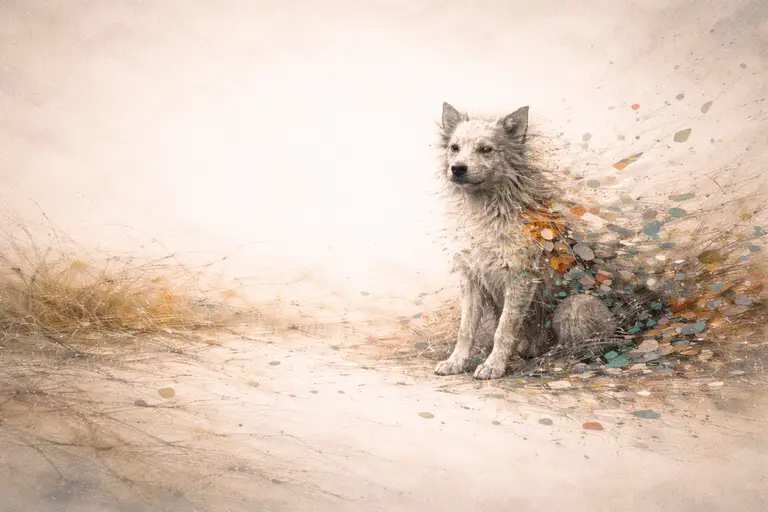
Clean white dog standing still, looking at you → the trust is intact and asking you to see it as it is; no performance, no obscuring; just: this is what’s here
White dog that’s been dirtied or stained → something has touched the trust that has changed its quality; the compromise is visible; the dream is not letting you look away from it
White dog that was white and became dirty in the dream → you watched the compromise happen; something changed while you were present; the staining is recent
White dog injured, bleeding → something pure in the relationship or in yourself is losing what it needs to remain intact; the loss is ongoing and visible
White dog that glows slightly → the clarity is heightened beyond normal; the dream is emphasizing that this is undeniable; this is the version that makes some people uncomfortable
White dog that is yours, standing in a familiar space → the clarity was already in your house; you stopped looking at it clearly; the dream is returning you to something you live with
What Your Body Already Knows
The specific quality of feeling seen → not the way you manage being seen in public — the way the dog saw you; clear, complete, without the edited version; the body registered being looked at by something that has no interest in the performed self
Whether the white made you calm or nervous → the body’s response to clarity is the most specific information this dream leaves; calm means you can handle being seen; nervous means the clarity is landing on something you’ve been preferring not to see
The texture of the coat if you touched it → the body may hold the specific quality of the contact; clean and smooth versus rough or dirty; the texture told you about the condition before you looked directly
The specific quality of what stayed after waking → this dream often leaves something very specific — not a feeling, more like a knowing; something understood that was less clear before the dream
What White Actually Means in Dream Language
In every symbolic tradition that has engaged with color in dreams, white occupies a specific and consistent position.
It is not the color of innocence. Innocence implies a lack of knowledge — something that hasn’t yet been touched by experience. White in dreams is different. White is the color that reveals. The color that makes the condition of a thing legible in a way that darker colors do not.
A black dog can carry things unseen. You can be with a black dog and not know what it’s carrying. Its coat hides the marks.
A white dog cannot hide. Every change in color is immediately visible. Every stain. Every shadow. Every injury. The white coat is the dream’s most honest surface — the one on which whatever is true about the trust is written in a way that cannot be smoothed over.
It stands in the middle of the room. The coat is so uniformly white that the room’s ordinary light seems insufficient for it — it has its own quality of brightness, a visibility that isn’t warm exactly, just complete. You can see the exact shape of every breath it takes. You can see the very small mark on its left shoulder that would be invisible on any other dog. You can’t not see it. That’s the thing about white. It doesn’t permit not-seeing.
This is why the white dog dream can produce discomfort even when nothing in the dream is threatening. The discomfort isn’t about danger. It’s about being required to see something at full resolution that you’ve been seeing in lower resolution.
Whatever the trust this dog represents — the relationship, the part of yourself, the commitment, the connection — the white coat is showing you its actual current condition. Not the version you’ve been telling yourself. The actual condition, legible on the surface.
Clean White vs Compromised White
The condition of the coat is the entire interpretation.
A clean white dog — the coat is intact, the color is uniform, nothing has stained it — means the trust it represents is intact. Not idealized. Actually intact. The clarity is genuine. Whatever this trust is, it has not been compromised by what has touched it. The dream is not offering you comfort — it’s offering you evidence. Evidence that can’t be falsified, because the coat would show falsification.
This version sometimes produces a specific kind of discomfort: the discomfort of being unable to maintain doubt about something that’s actually fine. If you’ve been waiting for the other shoe to drop, if you’ve been looking for the catch, if you’ve been scanning for the lie in something that’s actually honest — the clean white dog removes those doubts by providing evidence that can’t be disputed. The trust is clean. Believing that requires something of you.
A dirty or stained white dog — some mark, some discoloration, something that touched the coat and left evidence — means the trust has been compromised and the evidence is on the surface. Not hidden. Not ambiguous. Visible.
The coat was white. Something got on it — you can see the mark, you can see exactly where the mark is, you can see the shape of what caused it. The dog doesn’t seem aware of the mark. It stands there the same way it would stand if the mark wasn’t there. But you see it. You can’t unsee it. That’s the point of a white coat: nothing that lands on it stays invisible.
In waking life, this version corresponds to a trust that has been genuinely touched by something — a breach, a moment, a revelation, a gradual accumulation of things that have changed what was once clean. The dream is not telling you what to do about it. It’s requiring you to acknowledge what you’ve been able to see.
The Discomfort of Clarity
Here is the specific thing about white dog dreams that surprises people.
They expect the white dog to be comforting. White is associated with peace, with cleanliness, with gentleness. And the dream often is, in some way, those things. But underneath the peace is a demand that most dreams don’t make.
Clarity requires looking.
Most emotional experiences can be managed in lower resolution. “Things are mostly okay.” “This relationship is basically fine.” “I think the trust is there, more or less.” The lower resolution is comfortable because it leaves room for the version you prefer. The version that doesn’t require you to do anything. The version that allows the ambiguity to continue without being resolved.
The white dog removes that room.
Whatever is true about the trust is on the surface, in full resolution, requiring acknowledgment. If the coat is clean, you have to acknowledge that something you’ve been doubting is actually okay. If the coat is stained, you have to acknowledge that something you’ve been minimizing has left a mark. Neither is comfortable in the way that ambiguity is comfortable.
You look at the dog. The coat tells you something you weren’t quite ready to see. Not something new — you had access to this information before. But you were keeping it at the distance of ambiguity, the soft focus of “maybe.” The white removes the soft focus. The information is right there in full detail. You feel the specific discomfort of seeing something you can no longer not have seen.
This is the same quality that clear water in dreams produces — the specific discomfort of being able to see to the bottom of something, of clarity that removes the comfortable opacity. Both are about the experience of something that shows its full condition rather than hiding behind murkiness. Both require the same thing: looking at what you can now see.
White Is the Color Between
Here is the deeper layer of what white represents, and why it appears at specific moments.
In alchemical and psychological traditions, white corresponds to a specific stage of process: the moment after darkness has cleared and before the new thing has fully formed. Not blank — ready. The clearing that makes space.
A white dog in a dream often appears in this specific temporal location in your inner life: after something has resolved, cleared, or ended, but before the next chapter is fully written. The white corresponds to the between — the space of readiness that follows one form of the story and precedes the next.
You walk into the dream and the dog is already there. The space around it feels different from how it usually feels — less cluttered, something has cleared. The dog is the most present thing in the scene, impossibly white in the room’s ordinary light. It’s not waiting for something specific. It’s simply there in the space that exists between what was and what comes next. And in that space, it is completely itself. Completely clear. Showing everything.
In waking life, this corresponds to the moments after resolution — after a period of confusion has ended, after something has been acknowledged, after the fog of a particular struggle has cleared — when the next thing hasn’t yet fully formed. The white dog appears to mark this space. To confirm: yes, something has cleared. Yes, you can see clearly now. Yes, the space that’s been created is real.
The complete spectrum of what dogs represent in dreams — trust in all its forms — runs from the black dog (what trust carries in shadow) to the white (what trust looks like when everything is visible). The white dog is the trust that has nothing to hide. Including its current condition, whatever that is.
What the Dream Is Asking You to Acknowledge
Every white dog dream contains a specific demand.
Not a request. A demand. Because the coat has already shown you the condition, and now you have seen it, and having seen it requires something.
If the coat is clean: Acknowledge it. Trust this. The thing you’ve been doubting is actually okay. The scan for the catch can stop. The thing you’re looking at is as clean as it appears. Believing that requires you to put down the wariness you’ve been carrying. The dream is asking you to put it down.
If the coat is stained: Acknowledge it. Name what you saw. The thing you’ve been minimizing has left a mark. Not a catastrophic mark, not necessarily — just a visible one. A mark that exists on the surface of the trust and cannot be told it isn’t there. The dream is asking you to stop telling it it isn’t there.
If the coat is injured: Address it. Something that was clean is losing what it needs. The visibility is the urgency. The dream isn’t showing you the injury so you can observe it — it’s showing you the injury so you can do something about it while there’s still time.
The white dog has no patience for the low-resolution version. It showed you the surface. The surface is the truth. What you do with that truth is the question.
Dream Timestamp
When something has recently clarified → the white dog appearing after a period of confusion or ambiguity means the clarity is new and real; the dream is confirming what just became clear
When you’ve been holding a lower-resolution version of a truth → the white dog arriving during a period of ambiguity means the clarity is available and you’ve been choosing not to see at full resolution; the dream is removing the choice
After a difficult period has resolved → the white corresponds to the specific quality of the space after — the clearing, the readiness, the between that exists after something has completed and before the next thing forms
Why This Dream Happens — The Psychology Behind It
The brain reaches for color when the quality of a state needs to be communicated in a way that content alone can’t. White specifically corresponds to the condition of visibility — when the brain needs to show you something at full resolution, without the softening that other contexts provide.
The white dog appears when the trust it represents has reached a condition that the brain needs you to acknowledge clearly. Not with the soft focus of “probably fine” or “I think it’s okay.” At full resolution. The coat tells you. The coat shows you. The coat does not permit the ambiguity that waking consciousness has been maintaining.
The dog is the container. The coat is the message. The message is always about the current condition of the trust — honest, visible, undeniable.
The Sentence This Dream Was Trying to Say
Something in the trust between me and what this dog represents is visible in full — and I’ve been seeing it at a lower resolution than the dream is allowing.
The Morning After
The coat’s condition is probably still with you — the specific quality of what you saw. Clean or marked. Whole or injured. The body holds it before the mind decides what to do with it.
Before the day provides the comfortable ambiguity of lower resolution again: what did the coat show you?
Not metaphorically. What specific condition of what specific trust was written on the surface?
The white dog doesn’t appear in a dream to confuse you. It appears because something that required full resolution has reached the point where the brain needed to show it to you undeniably. You’ve seen it. You know the condition.
One question worth sitting with: now that you’ve seen it clearly — what does seeing it clearly require of you?
The answer is already there. The coat already showed you. The only question is whether you’re going to look at what the looking revealed.
FAQ
What does a dream about a white dog mean? It means trust — in a relationship, in yourself, in something that matters — is presenting itself at full resolution. White is the color of visibility, not innocence. Everything is on the surface of a white coat: every mark, every change, every condition. The dream is not offering you comfort or reassurance — it’s requiring you to see clearly. A clean white coat means the trust is intact and that intactness is undeniable. A stained or injured coat means the trust has been compromised and that compromise is equally visible. The dream is asking you to stop seeing whatever this is at lower resolution than the coat is showing.
Why does a white dog dream sometimes feel uncomfortable? Because clarity is uncomfortable when you’re used to ambiguity. The white coat has shown you the full condition of something, and having seen it requires something of you. If the coat is clean, you have to acknowledge that something you’ve been doubting is actually fine — and that acknowledgment requires putting down the wariness. If the coat is stained, you have to acknowledge a mark you’ve been minimizing. Neither is comfortable in the way that ambiguity is comfortable. The discomfort isn’t about the dog. It’s about what full resolution requires.
What’s the difference between a white dog and a black dog dream? The difference is what the coat allows to remain hidden. A black coat hides. Marks don’t show. The shadow the black dog carries is in the unseen, in what the coat conceals. A white coat reveals. Nothing can be hidden on it. The black dog is about the trust that carries something unacknowledged. The white dog is about the trust whose entire condition is legible. Both are equally meaningful — they’re showing you different aspects of the same trust, from different angles of visibility.
What does it mean if the white dog was injured? That something pure in the connection is losing what it needs, and the loss is visible. Not hidden, not ambiguous — visible on the surface. The injury corresponds to something real in the trust that is currently being depleted or damaged. The dream is showing you the injury specifically because it wants you to see it while there’s still time to address it. An injured white dog is the brain’s most direct available image for: this needs your attention now, before the coat shows you more.
Next Stages
If the white dog was carrying something heavy — if the brightness of the coat was accompanied by a weight that shouldn’t be there → what trust carries in shadow: dream about a black dog meaning — the same loyalty seen from the other direction, the part that lives below the surface
If the white dog was walking away — if the clarity was leaving → when what was visible is becoming unavailable: dream about a dog dying — when the trust that was clear is ending, and what’s left is the specific grief of something that was genuine going away
If the coat was dirty and you tried to restore it — if the dream involved trying to clean what had been stained → when you reach toward what was compromised: dream about saving a dog — when the response to what the coat showed is not acceptance but the attempt to restore what was there before the mark