Watching Your Own Funeral from the Crowd

You’re there. You can see everything. Nobody can see you.
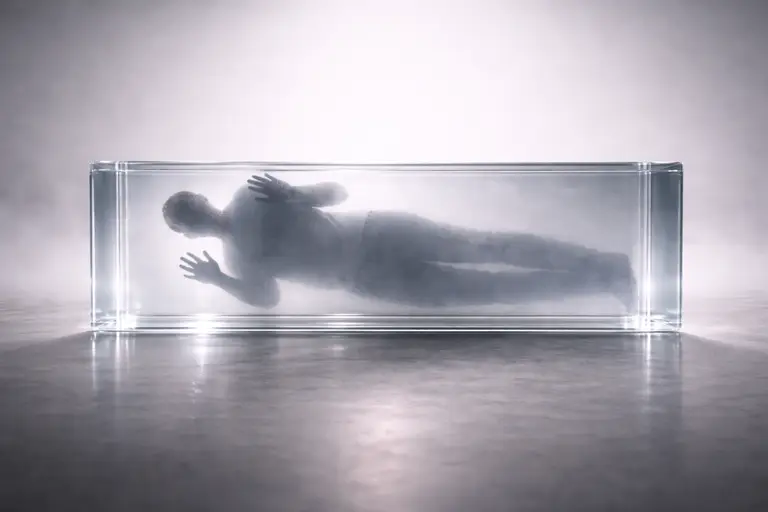
That’s the specific architecture of this dream — the one that makes it unlike the dream of your own death, unlike the dream of someone else’s funeral, unlike anything that can be properly understood without sitting in the position it creates. You’re in the crowd. You’re watching. The person in the casket is you. And you are present as the observer of something you’re not supposed to be able to observe.
There’s a particular quality to invisibility in this dream that isn’t ordinary invisibility. In most dreams of being unseen, the absence of recognition feels threatening. Here it’s something stranger. You’re not hiding. You haven’t been overlooked. You’ve been — temporarily, by the logic of the dream — released from being the person in the center of things, and placed in the position of someone who can watch that person be mourned.
Most people don’t expect what they feel when they describe this dream. They expect grief, or terror, or the vertigo of seeing their own death made ceremonial. What they actually find, when they look honestly at the experience, is something more complicated and in some ways more useful: a kind of clarity. The distance the dream creates is real. And from that distance, something becomes visible that isn’t visible from inside the life.
Quick Answer
- Watching your own funeral from the crowd means you’ve been placed, by your own dreaming mind, in the exact position needed to see your life as it appears to others — and to see yourself as something that has a relationship to the world rather than just being the center of it.
- The crowd’s response is information: who is there, how they feel, what the gathering looks like from the outside.
- The feeling in your own chest while watching is the most important thing in the dream.
- The gap between the person in the casket and the person watching is the gap between who you’ve been presenting and who is actually present behind that presentation.
- This dream is a gift the mind gives itself: the outside view, available only here.
Common Scenarios
- Large grieving crowd → the relationships you’re concerned about are represented; the dream is running a version of what your absence means
- Sparse or indifferent crowd → something about your current connections or trajectory is being assessed; the loneliness of the gathering reflects something real
- You try to reach people and can’t → the invisibility is total; the version of you that was known to them is the one in the casket
- The casket is empty or holds something unexpected → the dream is pointing at what was actually being mourned — not you, but something specific
- You feel nothing watching it → the dissociation is the message; being a spectator in your own ceremony reflects something about how present you’ve been in your own life
What the Body Recognized
- The specific quality of watching yourself from outside — the strangeness of that position — still present on waking → the outside view transferred
- Something about your relationships or how you’re seen was already in your mind → the crowd already had faces before you analyzed it
- The feeling during the service — whatever it was — is the most honest thing the dream produced → more honest than anything you’d produce while inside the life
- The invisibility felt real rather than metaphorical → the dream gave you a genuine observer position, and the body registered it as such
The Outside View the Mind Created
You spend your entire life inside your experience.
Every feeling you have, you have as yourself. Every relationship exists from your perspective of it. Every assessment of your own impact is made by the person doing the impacting. There is no natural position outside this — no vantage point that removes you from the center of your own perception and places you in the crowd.
The dream creates one.
The transformation work this cluster is about involves seeing yourself clearly enough to understand what needs to change. But seeing yourself clearly is one of the harder things to do from inside yourself. The dream solves this problem by temporarily removing you from the inside and placing you at the edge of the gathering, where you can see the ceremony that your life has produced without being the one performing it.
What you see from there is genuinely different from what you see from inside. Not distorted. Different. The crowd reveals something about what your presence has meant. Your own chest reveals something about how present you’ve actually been. The gap between those two things is the information the dream came to deliver.
You’re in the third row. You can see everything — the arrangement of people, who came, who is in the front, who is at the edges. You can see the casket and the flowers and the specific quality of grief or absence of grief in the faces around you. And you can feel, with a specificity you wouldn’t have from the center, exactly what this gathering means.
What the Crowd Is Actually Telling You
The composition of the crowd is worth examining — not as a verdict, but as a question the dream is posing.
A large, genuinely grieving crowd isn’t confirmation of success or social value in any simple sense. It’s the dream’s image for a life with significant weight in the lives of others — and the anxiety, often, that the weight of what others are carrying for you exceeds what you’ve been able to give back. The pressure of being mourned by many people is its own specific quality in this dream. Not pride. Something more complex.
A sparse or indifferent crowd isn’t the dream condemning your trajectory. It’s the dream asking a question: is the current arrangement of your life — how you’re spending yourself, who you’re in genuine relationship with — the one you’d recognize as yours if you could see it from the outside?
The people who are absent are often as significant as the people who are present. Who isn’t there that you’d expected? That absence is information about connections that exist in your assumptions rather than your actual life.
You look for specific people and find them or don’t. The finding or the not-finding tells you something your waking life has been managing around. Not cruelty — precision. The dream is showing you the current composition of what you’ve built.
The Gap Between the Two of You
There are two versions of you in this dream: the one in the casket, and the one in the crowd.
This is the element that most distinguishes this dream from dreaming your own death. In that dream, you are the one dying — the subject and object of the experience are unified. Here, they’re separated. The version that’s being mourned is one. The version watching is another. And the distance between them is the most specific piece of information this dream produces.
The person in the casket is the version others have known — the presented version, the one that exists in other people’s experience of you. The person in the crowd is something more interior — the part that’s been watching the performance of that version with varying degrees of recognition.
When the gap between them is small — when the person in the casket looks like someone you fully recognize — the dream is confirming an alignment between how you’ve been seen and who you actually are. When the gap is large — when the person being mourned is someone you observe with distance or strangeness — the dream is surfacing a discrepancy the waking life has been maintaining.
That discrepancy is worth examining. Not judging. Examining.
Why You Can’t Make Yourself Known
The invisibility has a specific quality that deserves attention.
You can see. You can feel. You can process everything that’s happening in the ceremony with full consciousness. You cannot be seen, touched, heard, or acknowledged. Your presence doesn’t register in the world of the dream. You are, for the duration of this, genuinely a ghost.
This isn’t punishment. It’s function. The outside view requires the outside position. You can’t be simultaneously in the crowd as an observer and in the casket as the subject. The invisibility is what makes the clarity possible.
But it also creates a specific experience that many people find the most affecting part of this dream: you reach for someone and can’t make contact. You try to speak and your voice doesn’t land. The people you love are three feet away, grieving what they believe is your absence, and you can’t tell them you’re here.
That experience — being present without being able to make presence known — is one of the more honest images the dream can produce for a state many people occupy in waking life without naming it: present in body, absent in the ways that actually reach people.
You move toward someone. You know exactly who they are. You extend a hand toward their shoulder and your hand passes through the space where they are without them feeling anything. You are here. You cannot be here in the way that would register. The distance isn’t between you and them — it’s between the version of you that’s present and the version of you that they can receive.
What You Feel While Watching
This is the question the dream is actually asking. Everything else is context.
Do you feel grief? Relief? The specific weight of wanting the ceremony to be different? Indifference that surprises you? Something that’s been named correctly by the people there? Something that hasn’t been named at all?
These feelings are cleaner in the dream than they are in ordinary life, because the observer position strips away the management. You don’t have to maintain anything for anyone. You’re not in relationship with your own impression in this moment. The invisibility creates the conditions for something actually honest.
I’ve talked with people who’ve woken from this dream with a very specific kind of sadness — not for the person being mourned, but for the gap between that person and who they knew themselves to be. And I’ve talked with people who woke with an unexpected peace — the ceremony was right, the people were there, the version being mourned was one they recognized and weren’t ashamed of.
Both are gifts. Both are information. The dream worked in each case.
When This Dream Arrives
At the intersection of dissociation and genuine self-examination.
This dream tends to appear during periods when you’ve been living at some distance from yourself — when the life has been running on momentum or performance or habit without much active presence from the person behind it. The observer position in the dream reflects an observer position that has been developing in waking life.
It also appears during periods of genuine reckoning — when questions about direction, legacy, relationships, and meaning are active enough that the mind needs to generate the outside view to answer them properly.
The two versions of this arrival are related. The dissociation produces the outside view. The outside view enables the reckoning.
The Psychology Behind It
The capacity for self-observation — the ability to see yourself as an object in the world rather than only as a subject — is one of the more sophisticated features of human consciousness. It’s also one of the more taxing, because it requires temporarily suspending the identification with your own experience that makes ordinary functioning possible.
The dream does this automatically. It places you in the crowd without requiring you to construct the observer position consciously. The result is a quality of self-perception that’s genuinely different from ordinary self-reflection — less defended, more spatial, organized around the outside view rather than the inside experience.
What the dream is processing is the question of your own legibility to others and to yourself. Not whether you’ve been successful or loved. Whether the person being lived has any relationship to the person being seen. Whether the ceremony that would mark your absence would be for the version of yourself you actually recognize.
The Sentence This Dream Was Trying to Say
“I stepped outside my own life for a moment — and what I saw from out there was different from what I’ve been telling myself it looks like.”
The Morning After
The outside view is fading back into the inside one. That’s how it always goes.
Before it goes completely: hold one specific image from the dream. The crowd, or the face of one person, or the casket, or the feeling in your chest. Not to analyze it immediately. Just to keep it close enough to let it ask its question.
The dream gave you the position you can’t normally occupy. What you saw from there — before the waking life closes back over it — is worth one honest minute of your attention.
FAQ
What does it mean to watch your own funeral in a dream? It means your mind placed you in the one position it can’t normally access: outside your own experience, watching yourself from the crowd. The dream creates a genuine observer position — you in the crowd, you in the casket, the ceremony of your absence playing out in front of you — and then gives you access to your own feelings about what you see. What you feel during the service is the most important information in the dream. It’s cleaner and less defended than anything you can produce while inside the life.
Why can’t anyone see me in the dream? Because the observer position requires the observer to be invisible. You can’t be simultaneously the subject of the ceremony and the person watching it from the crowd. The invisibility is what makes the outside view possible. It’s also accurate to something in waking life: the quality of being present without being receivable, of watching from behind glass, of occupying your own life as a spectator rather than a participant. The dream made that feeling spatial so you could see it directly.
What does the size of the crowd mean? It’s a question the dream is posing about the composition of your relationships and the weight of your presence in other people’s lives — not a verdict. A large crowd raises questions about expectation and pressure. A small crowd raises questions about connection and trajectory. Who’s present and who’s absent is often more specific: the people there, and the people the dream chose to exclude, are both telling you something about where your actual life and your assumed life have diverged.
Next Stages
If the funeral wasn’t a ceremony of the past, but a hunt for your future — if the finality wasn’t waiting for you in a casket but was actively pursuing you → dream about being chased by a killer — when the end isn’t something you observe from the crowd, but something that is trying to force its arrival before you are ready to meet it.
If what the funeral showed you was that the person in the casket was significantly different from the person watching — if the gap between the presented and the actual self was the dominant feeling → dream about fighting a dead version of yourself meaning — when the two versions don’t just observe each other but come into direct conflict
If the funeral wasn’t yours but someone you know was the subject — if you were in the crowd for someone else’s ceremony → dream about a funeral of someone you know meaning — when the ceremony is for someone else and the question is what ending you were there to witness
If the funeral became a conversation — if the invisibility broke down and someone acknowledged your presence → dream about dead relatives talking to you meaning — when the boundary between observer and participant dissolves and contact happens across what should have been an uncrossable distance