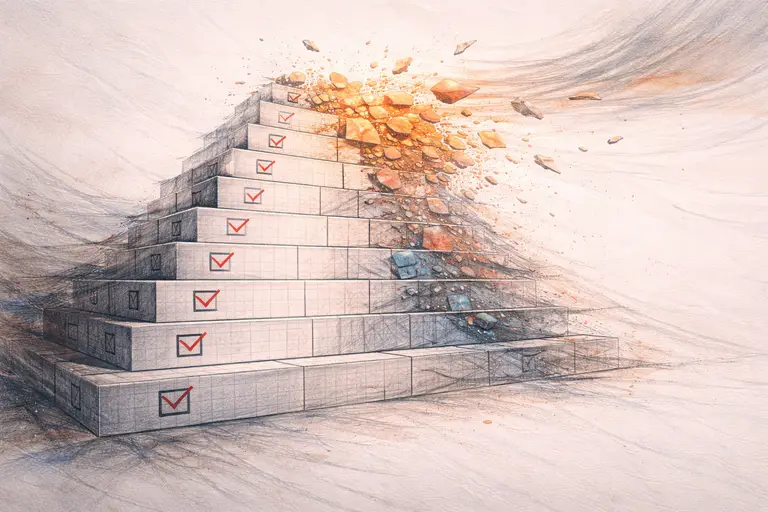
Forgetting Everything in an Exam Dream — The Betrayal That Comes From Inside

The answer was there yesterday. You’re certain of it.
You remember reviewing it. You could have recited it at ten o’clock last night, or in the car on the way here, or five minutes before you sat down. The material existed in you — real, accessible, yours. And now you’re in front of the question that needs it, and the place where it was is just not there. Not blocked. Not confused. Absent. The knowing that was yours has become a clean, complete, inexplicable space.
The reaching is what stays with people after this dream. Not the blank page, not the failing grade, not the room — the physical quality of stretching toward something that should be there and coming back with nothing. Trying harder produces the same nothing. Trying from a different angle produces the same nothing. The effort is entirely real and the material it’s aimed at has gone somewhere you cannot follow.
What makes this dream distinct from every other failure in the cluster is the direction of the betrayal. In most exam dreams, the failure arrives from outside: the test was harder than expected, time ran out, the preparation turned out to be wrong. There is something to point to that isn’t you. In this dream, there is nothing to point to but you. The test was yours to meet. The material was yours. The betrayal was your own mind, at the worst possible moment, taking what was there and making it absent.
I’ve sat with this dream more than any other in this cluster, because it produces a quality of aftermath that the others don’t — not just the anxiety of potential failure, but the more specifically corrosive question of whether the self can be trusted. Whether the capability that usually functions will be there when it matters most. That’s a different question from whether you’re good enough. It’s a question about reliability. And it’s the specific question this dream is actually asking.
Quick Answer
- The forgetting-everything dream is specifically about the reliability of access under maximum pressure — not capability, not preparation, but the bridge between stored knowledge and the production of it in high-stakes conditions
- Joseph LeDoux’s research on the amygdala’s two-pathway system establishes the core mechanism: the fast, subcortical alarm route can activate before the slower cortical route has completed its assessment, effectively closing the hippocampal retrieval route before the material can be accessed; the alarm comes for the retrieval path
- Robert Sapolsky’s work on glucocorticoids and the hippocampus provides the second layer: under acute stress, the cortisol that floods the system specifically impairs hippocampal retrieval function; the material is still in storage but the mechanism for accessing it has been temporarily compromised by the stress hormones the situation generated
- The direction of the betrayal is the defining feature: other exam dreams have external failure modes; this one is interior — your own mind, at the critical moment, did not deliver what was yours
- The reaching sensation is the dream’s most honest physical encoding: the specific quality of stretching toward a location that used to have something in it and finding empty space; this persists into waking more specifically than almost any other dream element
- When the forgetting spreads — past the material, to the subject, to the context, to what any of it means — the organizational framework itself has become unstable, not just one area of retrieval; this version corresponds to cognitive overload that has exceeded the system’s capacity to maintain coherent structure
- When others are writing normally while you are blank, the dream is encoding the specific experience of a failure that is yours specifically — not a universal condition, not a hard exam, but something occurring in your particular access system and not theirs
- The guilt quality of this dream — distinct from the fear of failure — corresponds to the experience of being let down by the self rather than by circumstance; you had this; your own mind didn’t deliver it
- When you reach for different approaches and each one returns empty, the dream is encoding the specific experience of comprehensive access failure: the material isn’t available from any angle, through any route, using any method; the problem is the bridge, not the direction of the crossing
- The dream stops when the cognitive load sustaining the elevated stress response is reduced to a level where hippocampal retrieval function is no longer being impaired — not when you study more, but when the system running the stress response is given the conditions to regulate down
Common Scenarios
You know the material and it isn’t accessible. The foundational version. The knowing is real — you can feel the shape of where it was, the surrounding context of related material, the texture of the preparation. And it isn’t coming. This is the dream’s most specific encoding: not absence of knowledge but absence of the path to the knowledge. Like knowing a room exists and finding a smooth wall where the door should be. In waking life, this corresponds to capabilities that function consistently under ordinary conditions and have been failing specifically in the conditions of maximum demand: the judgment that is usually clear but went absent in the meeting that required it most, the response that is usually immediate but took too long in exactly the conversation where speed mattered.
You try from different angles and each one returns empty. The comprehensive-failure version. Not one approach that doesn’t work — multiple approaches, each reasonable, each drawing from a different route to the same material, all returning nothing. The flexibility of the attempt is real. The material is simply not accessible from any direction. This version tends to correspond to the specific experience of a waking situation where every available approach to a problem has been tried and the problem has remained intractable. Not that one strategy failed — that the full range of available strategies produced the same result.
The forgetting spreads. The dissolution version. The material goes. Then the subject. You can no longer recall what the exam is testing. Then the context. You’re still in the physical position of taking an exam — still holding the pen, still in the room — and the semantic structure of the situation has become unclear. This version encodes a more comprehensive version of the waking experience: not one area of reliable access becoming conditional, but the general framework that structures experience becoming unstable. The organizing clarity of daily functioning has started showing gaps. Not forgetting facts. The underlying structure that allows facts to be located is itself becoming unreliable.
Others write normally while you are blank. The comparison version. The people around you have a different relationship to their own recall. They’re in the same room, under the same conditions, facing the same stakes — and the access is working for them in a way it isn’t working for you. The dream is encoding the specific experience of a failure that is internal rather than situational: not a hard exam that everyone is struggling with, but something occurring in your particular system and not in theirs. In waking life, this corresponds to the experience of watching others operate with apparent access to the capabilities you feel you’re missing in the moments you need them most.
You reach for it and feel the exact location where it was. The most physically specific version. The reaching has a texture. You can feel the shape of where the material was — the neighboring content, the associative connections, the specific quality of the prepared-and-available that used to characterize this location. And the location is there but the thing that was in it isn’t. This version encodes the most precise version of the waking experience: not general emptiness but the specific awareness of a vacancy — knowing exactly what should be there and finding exactly that it isn’t.
You almost get it — something appears and then disappears before you can write it. The threshold version. The material approaches the surface but doesn’t complete the emergence. You can almost see it. Something that might be it is present for a fraction of a second and then gone before it can be held. This version corresponds to the waking experience of capability at the threshold — consistently approaching the moments of delivery and not quite arriving; close to the accessed state but unable to hold it long enough to use it.
What Your Body Already Knows
Woke up with the reaching sensation still in the hands and chest — the specific physical quality of having stretched toward something and come back empty → because the dream ran the retrieval attempt with full somatosensory encoding; the reaching wasn’t metaphorical — the motor and somatosensory systems were running the attempt as a physical event; what persists after waking is the body’s record of a reaching that didn’t arrive at anything; this residue is more physically specific than almost any other dream element
Woke up with the specific quality of self-betrayal already present before any deliberate thought → because the failure in this dream is internal rather than external; the body processes being let down by the self differently from being failed by circumstances; the aftermath of internal failure has its own distinct somatic signature — something that doesn’t resolve into simple anxiety or simple fear but carries the specific texture of having needed yourself and not being there
Woke up and immediately tested something — tried to recall something, checked that something was accessible → because the verification behavior the dream was running extended briefly into waking; after a failure of reliable access, the system checks: is this specific capability available right now? What you reached for is the address of what the dream was measuring
Woke up with a specific quality of cognitive fogginess — not sleepiness, something more specific → because the dream was running the retrieval-failure state at sustained intensity, and the glucocorticoid system that Sapolsky’s research identifies as specifically impairing hippocampal function doesn’t reset instantaneously; the fogginess is the brief continuation of the impairment state the dream was encoding; it clears as the stress hormone levels normalize through the waking period
Woke up and something about the gap between what you know and what you were able to produce recently was already present → because the dream had a specific address; the forgetting was never abstract; the waking-life situation where reliable access has become conditional was already known before the dream surfaced it; what arrives before deliberate analysis is the address the dream was always pointing at
What the Alarm Does to the Access Route
Here is what’s actually happening in the brain when this dream occurs, and why understanding it changes the reading of the dream entirely.
Joseph LeDoux at NYU spent decades documenting what he called the two-pathway system of emotional response — specifically, the fear response. The first pathway is fast and subcortical: sensory input travels directly to the amygdala, which generates an alarm response before the cortex has finished its assessment. The second pathway is slower and cortical: the same input travels via the cortex, which then provides a more nuanced evaluation of the situation.
The fast pathway evolved for survival. When something moved in the grass that might be a predator, waiting for the cortical assessment to complete was less adaptive than generating an immediate alarm. The amygdala’s fast route is the reason humans survived long enough to be anxious about exams.
But here is the specific mechanism this dream is running: under conditions of high-stakes evaluation, the amygdala’s fast pathway activates before the cortical pathway has completed its work — and this activation can interfere with the hippocampal retrieval process that would allow the known material to be produced. The alarm system, designed to help with threat, closes part of the access route to what was prepared.
Robert Sapolsky’s research on glucocorticoids — specifically his documentation of how cortisol affects hippocampal function — provides the physiological detail. The hippocampus, the brain’s primary memory consolidation and retrieval center, is specifically sensitive to cortisol. Under moderate, acute stress, hippocampal function can be enhanced — the urgency of the situation sharpens retrieval. Under high, sustained, or especially high-stakes stress, elevated glucocorticoids begin to impair hippocampal function: consolidation becomes less reliable, retrieval becomes inconsistent, the gap between successful and unsuccessful access to the same material widens.
The material is in storage. What the dream is processing is the experience of the access route being closed by the same alarm that was supposed to help with the performance.
You reach for it. The location is clear — you can feel the shape of where it lives in memory, the surrounding context, the associations that should lead to it. You push from this direction. Nothing. You try from the adjacent material. Nothing. You can feel the outline of where it was. The outline is correct. What was in the outline is not there. And pushing harder from any direction produces the same result, because the pushing is using the same system that is currently not working.
Failing an Exam Dream — What Your Brain Is Actually Being Evaluated On maps the full evaluation architecture — why the exam room is the brain’s most efficient available image for high-stakes external measurement, and what the specific failure mode the dream stages reveals about the current relationship between pressure and performance in the waking life.
Why This Version Carries the Guilt the Others Don’t
There’s a specific quality to the emotional residue of this dream that distinguishes it from every other exam dream, and it’s worth naming directly: it feels like self-betrayal.
In most exam failure dreams, there is something external to account for the failure. The test was harder than expected. The time ran out before the effort could complete. The questions were wrong for what was prepared. The room couldn’t be found. Each of these has something outside the self that participates in the failure. There is something to point to.
In the forgetting dream, there is nothing to point to but the self. The preparation was real. The capability is genuine. The stakes were understood. And at the critical moment, the self did not deliver. The person who went in with the material did not come back with the material. The failure is interior.
Pauline Clance’s research on impostor phenomenon found it specifically in high performers — people who are demonstrably capable but who have developed a systematic doubt about whether their capability will be available when it matters. The forgetting dream is the specific nightmare of that doubt: the scenario where the capability that is usually available becomes precisely unavailable at the moment of maximum visibility and importance. Not evidence of insufficient capability. Evidence of insufficient reliability of access under maximum pressure. These are different things, but the dream presents them as the same, and the residue of self-betrayal is the body’s response to the conflation.
The most useful thing to understand about this dream’s guilt quality is that it’s pointing at a real experience — the experience of having let yourself down in a specific important moment — but it’s misattributing the cause. It wasn’t the capability that failed. The neurological mechanism of stress-impaired retrieval means the capability was there. What the dream is actually encoding is a stress response that has become too acute or too sustained for the hippocampal access to remain consistent.
The problem isn’t you. The problem is what you’ve been living inside.
The Reaching Sensation — What It Tells You
This is what people describe most consistently and most specifically, more than any other element of this dream.
Not the blank page. Not the failing grade. Not the room or the other students. The reaching. The specific physical quality of extending toward something that should be there and coming back with nothing.
Some people describe it as reaching into a coat pocket that should have something in it and finding it empty. Some describe it as trying to open a door that should have a handle and finding smooth wall. Some describe it as the specific quality of a word that is at the very edge of retrieval — almost, almost, almost — and then not arriving.
The reaching is the dream’s most honest image for a specific waking experience: the experience of trying to access a capability, a judgment, a response, a clarity that usually comes reliably — and finding that it isn’t coming. Not that you’re bad at accessing it. That access is failing specifically in this moment, in this condition, for reasons that aren’t about the quality of what’s being reached for.
In waking life, what has been producing the reaching sensation? The presentation that should flow and isn’t. The decision that usually comes clearly and is unclear. The response that usually feels right and feels effortful. The reaching is accurate data about the current state of reliable access. The dream is amplifying it to the level at which it can be examined.
Writing Wrong Answers in an Exam Dream — When the Problem Isn’t What You Know maps the adjacent experience — when it isn’t access that fails but the trust in what access produces; the distinction between reaching and finding nothing, and reaching and finding something but doubting it the moment it arrives.
Dream Timestamp
The forgetting dream arrives when the combination of high-stakes evaluation and sustained stress response has crossed the threshold of the hippocampus’s optimal retrieval conditions → not during ordinary anxiety — during the specific combination of high visibility, genuine importance, and sustained stress that produces glucocorticoid levels sufficient to impair hippocampal consistency; by the time the dream appears, the impairment has been happening in waking life for a period
The spreading-forgetting version arrives when the total cognitive load has exceeded the organizational capacity of the system managing it → not one domain becoming unreliable but the organizing framework itself showing instability; this version tends to arrive later in a period of sustained overload, when the gaps have spread from isolated failures to more systemic ones
The version where you can feel the outline of where the material was arrives when retrieval failure has been specifically recent → the dream generates the most precise version of the failure — the awareness of the exact location of what went absent — when the experience of reaching and not arriving is fresh; the detail of the dream corresponds to the recency and specificity of the waking experience
The others-writing version arrives when the failure has become comparative → when the gap between your access reliability and others’ apparent access reliability has become visible; when the failure is no longer only internal but has become something others can see
The dream stops when the stress response is regulated down to the level where hippocampal retrieval is no longer being impaired → not through studying more but through reducing the activation level the nervous system has been maintaining; rest, reduced demand, the genuine absence of high-stakes evaluation pressure — whatever allows the glucocorticoid levels to normalize; the dream tracks the neurological state, not the preparation level
The Sentence This Dream Was Trying to Say
“What I built to be reliable stopped being available specifically when it mattered most — and the alarm that was supposed to help is the thing that closed the access route.”
The Morning After
The reaching sensation has cleared. The ordinary mind is functioning at its ordinary level — the material is accessible again, the way it was yesterday, the way it usually is.
Notice that. The ordinary access is working. The dream was processing the specific impairment that occurs under maximum evaluation pressure — the state that stress hormones produce in the hippocampus during high-stakes conditions. The material was never gone. The access route was closed by the alarm.
Before the day loads up the same conditions again: the dream was not a diagnosis of capability failure. It was a report on a neurological state that has been generated by sustained pressure at a specific level of intensity. The system can access what it knows. Under the conditions the dream was staging, the alarm came for the access route.
The question worth sitting with today: what has been generating the alarm response at this level? Not what you need to know better or prepare more thoroughly. What has been sustaining the stress response at the intensity that impairs the hippocampal function that allows you to deliver what you actually know?
The material is there. The bridge to it becomes unreliable when the alarm is this loud. The dream wasn’t asking you to study more. It was asking about the alarm.
FAQ
This dream is about the reliability of access under maximum pressure — not capability or preparation, but the bridge between stored knowledge and the production of it in high-stakes conditions. Joseph LeDoux’s amygdala research and Robert Sapolsky’s work on glucocorticoids both point to the same mechanism: acute stress can close the hippocampal retrieval route before the access attempt completes. The material is still in storage. The alarm came for the path to it. In waking life, this corresponds to capabilities that are consistently available under ordinary conditions and have been failing specifically in the conditions of maximum demand and visibility.
Because the failure is interior rather than external. In most exam failure dreams, something outside the self participates in the failure — the time, the questions, the room. In this dream, the failure is yours specifically: you had the material, the preparation was real, and your own mind didn’t deliver. The guilt quality is real and it’s pointing at a real experience. But it misattributes the cause. The capability didn’t fail. The access mechanism was impaired by stress hormones at the level of the hippocampus. The problem isn’t you. It’s what you’ve been living inside.
Because the dream ran the retrieval attempt as a full somatosensory event. The motor and somatosensory systems were simulating the reaching throughout the dream at physiological detail. What persists after waking is the body’s record of a reaching that didn’t arrive at anything — the specific physical texture of having extended toward a location that used to have something in it and found empty space. This residue is among the most specific and most persistent of any dream element precisely because the body was fully engaged in the attempt.
Not in the clinical sense. It’s pointing at a neurologically real phenomenon — the specific sensitivity of hippocampal retrieval to sustained elevated cortisol — but not diagnosing a disorder. What it reflects is a stress response that has been sustained at a level sufficient to begin impairing retrieval consistency. The gaps between successful and unsuccessful access to the same information become wider when glucocorticoid levels are chronically elevated. The dream is a stress-test result, not a diagnosis. What it suggests is a closer look at the total stress load being maintained, not at the quality of the memory itself.
The organizational framework has become unstable, not just one area of retrieval. When the forgetting extends past the material to the subject, the context, what any of it means — you’re still in the physical position of taking an exam but the semantic structure has dissolved — the total cognitive load has exceeded the system’s capacity to maintain coherent organization. Not one domain becoming unreliable but the underlying framework itself showing gaps. This version tends to arrive later in a period of sustained overload, when the erosion has spread from isolated failures to more systemic ones.
By regulating the stress response down to the level where hippocampal retrieval is no longer being impaired — not by studying more or preparing differently. The dream tracks the neurological state produced by sustained high-stakes pressure, not the preparation level. Rest, reduced demand, the genuine absence of high-visibility evaluation pressure, sleep that consolidates without the interruption of the stress response — whatever allows the glucocorticoid levels to normalize. The material was always there. The alarm was coming for the access route. The solution is to reduce the alarm, not to add more material.
Next Stages
Failing an Exam — What Your Brain Is Actually Being Evaluated On — the pillar — why the brain reaches for this specific room for evaluation anxiety, and what the full architecture of exam-dream failure modes reveals about the current waking evaluation structure
Running Out of Time in an Exam Dream — When What’s Required Exceeds What’s Available — the temporal version of the same pressure — when it isn’t retrieval that fails but the window closes before what was accessible could be delivered
Writing Wrong Answers — When the Problem Isn’t What You Know — the trust version — when access works but the output of the access keeps being found wanting; the distinction between the material being absent and the material being doubted
Being Unprepared for an Exam — When the Gap Is Real and Known — the preparation version — when the forgetting is not access failure but genuine absence; what it means when the material was never there rather than being there and going absent