Dream About Repeating the Same Exam Again
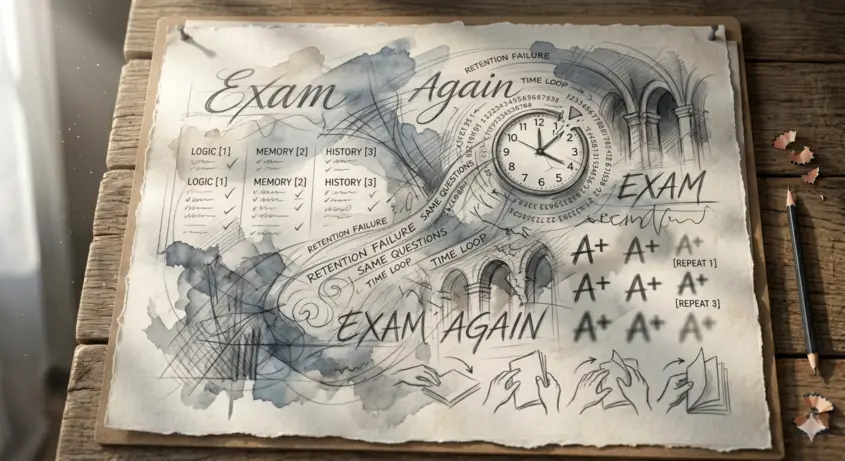
You sit down. The paper arrives. And you know.
Not déjà vu — something more specific. Actual knowledge. You have been in this chair. You have looked at this paper. You have tried to get through this and something went wrong and now you are back inside it, at the beginning, with everything still unresolved.
Other nightmares have the quality of something new happening. You’re being chased by something you haven’t seen before. The exam is harder than you expected. The room is unfamiliar. Newness is part of how those dreams function.
This dream removes newness entirely. You’re not encountering something unknown. You’re returning to something recognized. The paper, the room, the pressure, the sequence of events you’ve already lived — all of it is known, and all of it is still here, and you’re in it again.
The specific quality of the repeating exam isn’t fear. It’s a particular kind of heaviness. The weight of recognition without exit.
Quick Answer
- A dream about repeating the same exam means you’re inside a loop — something in your waking life keeps returning to the same configuration despite your engagement with it, and the dream is staging that structural fact as directly as it can.
- This is the loop version of the exam cluster: not one evaluation you’re afraid of, but the pattern of returning to the same threshold and not clearing it.
- Remembering the previous attempts inside the dream — knowing what you tried last time — is the most specific element: you’re applying intelligence to something that doesn’t respond to intelligence.
- The dream ends when the waking situation resolves. Not when you understand the dream.
- The heaviness that stays after waking is the most useful signal — it’s pointing at the specific pattern, not at the exam.
Common Scenarios
- Sit down, recognize the paper, know you’ve been here before → the loop is acknowledged; you’re not fooled into thinking this is new
- Remember the last attempt and try something different → applied intelligence to the loop; the loop still doesn’t respond to strategy
- Same failure point arrives despite different approach → the breaking point is structural, not strategic; changing the method doesn’t change the outcome
- The dream resets mid-performance → you don’t even finish the attempt before the reset; the loop is tighter than usual
- The exam changes slightly each time but the feeling is the same → the surface varies; the underlying pattern is consistent
What the Body Already Knows
- The heaviness was there before the analysis — not fear, something slower and deeper → the body registered the weight of the returning, not the shock of the new
- The tiredness that was present in the dream transferred → some part of the exhaustion was already there when the dream started; the body was already carrying it
- The specific situation the loop corresponds to was identifiable before full waking → the dream already knew which pattern it was running
- The unsettled quality after waking — harder to shake than other exam dreams → the body knows the loop is real, even if the classroom wasn’t
What Recognition Without Exit Feels Like
Every other dream in this cluster has an element of discovery.
The failing exam dream is about the anxiety of a new evaluation. The forgetting dream is about a new betrayal. Even the missing exam dream is about a new absence. These dreams use their newness to produce their specific quality of distress.
The repeating exam removes that mechanism entirely. There’s nothing to discover. Everything about this situation is already known. The knowledge is complete and the exit is absent. You’re inside something you’ve fully mapped and you’re still inside it.
In waking life, this is the experience of a pattern that has been running long enough to have been fully analyzed without being resolved. The relationship dynamic whose mechanics you can describe precisely and that keeps reasserting itself. The professional situation whose cause you’ve identified and that continues to produce the same outcome. The internal pattern you’ve named, traced, understood in its origins — and that keeps operating anyway. The loop isn’t running because you haven’t understood it. The loop is running because understanding hasn’t been what it requires to stop.
You sit down. The paper arrives. The first question is visible. You’ve read it before. You know what you tried before. You know what didn’t work. The knowledge is complete and present and it doesn’t help. You pick up the pen anyway.
When You Remember the Previous Attempts
This version of the dream is the most specific and the most instructive.
You don’t just know you’ve been here before in a general way — you remember the previous attempts. You remember what you tried. You remember exactly where it went wrong. And you’re applying that information.
Last time you ran out of time, so this time you start faster. But a different thing goes wrong. Or the same thing goes wrong regardless of the faster start. Last time you blanked on the second section, so this time you skip ahead. The blank is waiting in the third section instead.
You’re problem-solving inside a loop that doesn’t respond to problem-solving. And the specific frustration of that — of bringing genuine intelligence and effort and memory to something that doesn’t accept those things as sufficient to produce a different outcome — is what the dream is most precisely about.
In waking life, this corresponds to situations where strategy has been fully applied and the loop has continued. Not for lack of trying intelligently. For lack of something the trying doesn’t provide. Whatever the loop requires to stop is not more sophisticated execution within it.
The Difference Between Stuck and Broken
This distinction is the most important thing the repeating exam dream is trying to establish.
Broken would mean the capacity is gone. Something has failed structurally, permanently, in a way that won’t recover. Broken would explain the loop as the natural outcome of irreparable damage.
Stuck means the capacity is present and the path forward isn’t currently accessible. The loop is running not because something is permanently wrong but because the current configuration hasn’t yet produced the exit condition. The situation is waiting for something different — not more of what’s already been tried.
The dream is about stuck. Not broken. The heaviness it carries is the heaviness of sustained repetition, not of permanent damage. Stuck situations resolve. They require something different from what’s been available — a different kind of resource, a different kind of conversation, a different angle of approach — but they resolve.
The dream keeps running the exam specifically because the brain is still trying to find the exit. The persistence of the dream is the brain’s correct assessment that exit is possible and not yet found.
Why the Loop Doesn’t Respond to Strategy
This is the question the dream is asking most directly, and the answer is the most uncomfortable.
The repeating situation dream in the Control & Power cluster works with the same dynamic: the loop continues not because strategy hasn’t been applied but because the loop operates at a level below where strategy functions.
The breaking point in the repeating exam is structural, not strategic. Something in the underlying architecture of the situation keeps producing the same result regardless of what is tried within the current parameters. Not: try harder. Not: try differently within the same approach. Something about the parameters themselves needs to change.
What that structural thing is — what the loop is actually built around — is already in you. It’s identifiable. It’s the thing the dream keeps returning you to the same moment to find. The exam is the format. The breaking point is the address.
When This Dream Arrives
When a pattern in waking life has been running long enough and with enough consistency that the brain has registered it as structural rather than incidental.
Not after one failure at a threshold. After enough of them — in enough contexts, over enough time — that the pattern has been established as the shape of the situation rather than an anomaly within it.
It also appears during periods of active, sustained engagement with a pattern that hasn’t yielded — during therapy, during relationship work, during professional restructuring — when genuine effort is being applied and the loop keeps appearing anyway, because the structural element hasn’t yet been addressed.
The Psychology Behind It
The brain’s threat-monitoring system generates a shutdown signal when a threat has been resolved. The signal requires resolution — the complete closure of the threatening situation — before the monitoring can stop.
When the threat is a recurring pattern rather than a discrete event, the monitoring system doesn’t get its resolution signal. The threat hasn’t been resolved — it’s been recurring. During sleep, this unresolved monitoring generates the scenario that most directly represents what the system is tracking: the exam that keeps starting again, the loop that doesn’t produce closure.
The brain’s persistence — its continued running of the scenario — is its correct assessment that the situation hasn’t been resolved. The dream will stop when the loop closes. Not when you understand the dream better. When the waking situation that generates the loop changes enough to produce the closure the monitoring system is waiting for.
The Sentence This Dream Was Trying to Say
“I’ve been here before, I’ve tried what I tried last time, and the loop is still running — because what it requires to close isn’t more of what I’ve been doing.”
The Morning After
The heaviness is still there. That specific weight of the recognized trap.
Before the day reinstates the loop in its waking form: what is the exam? Not the dream’s paper — the specific pattern in your waking life that keeps returning you to the same configuration despite your engagement with it.
And the more specific question: where does the loop break? Not the whole exam — the exact moment. The specific point where every attempt reaches the same result. That point is already mapped in you. The dream has been running you through it enough times to make the location undeniable.
What would need to be different at that specific point — not in execution, but in kind — for the exam to produce a different ending?
FAQ
What does it mean to dream about repeating the same exam again? It means a pattern in your waking life has been running long enough and consistently enough that the brain has registered it as structural — and is generating the most direct available image for the experience of being inside a situation that keeps returning to the same configuration despite sustained engagement. The repeating exam is the brain’s image for the loop. It runs the dream because the loop is real and unresolved. The dream will stop when the loop closes.
Why doesn’t trying something different in the dream help? Because the loop operates at a level below strategy. The breaking point is structural, not in the execution. Changing what you try within the current parameters produces different attempts and the same result. What the loop requires to close is something different in kind from what has been tried — a different kind of resource, a different kind of response, something that addresses the structural element rather than adding another strategy to the existing ones.
Why does this dream linger after waking more than other exam dreams? Because other exam dreams process anxiety about a fictional event. This dream processes a real pattern. The loop quality transfers out of sleep because the loop is actually running in waking life — it wasn’t just a dream. The unsettled feeling after waking is the most useful thing the dream produces: it’s pointing directly at the specific recurring pattern, and the pointing doesn’t stop just because you’re awake.
Next Stages
If the repeating exam changed in each iteration — if the subject or room shifted but the feeling was the same → dream about classroom you can’t find meaning — when the loop isn’t about one exam but about perpetual disorientation in finding where you’re supposed to be
If the repetition produced a result in the final version — if the loop eventually delivered a verdict → dream about bad exam results meaning — when the loop closes not with resolution but with a formal conclusion about the whole cycle
If remembering the previous attempts produced frustration more than strategy — if the knowledge of the loop produced exhaustion rather than problem-solving → dream about not finishing the exam meaning — when the loop’s effect is depletion rather than the cycling of attempts