Dream About a Black Dog
It didn’t threaten you. It was just there.
That’s the thing about the black dog in dreams that distinguishes it from every other difficult thing the dream cluster produces. The attack has teeth. The chase has distance that keeps closing. The dying has weight in your hands. All of these are events — things happening, things moving, things crossing lines.
The black dog is a presence.
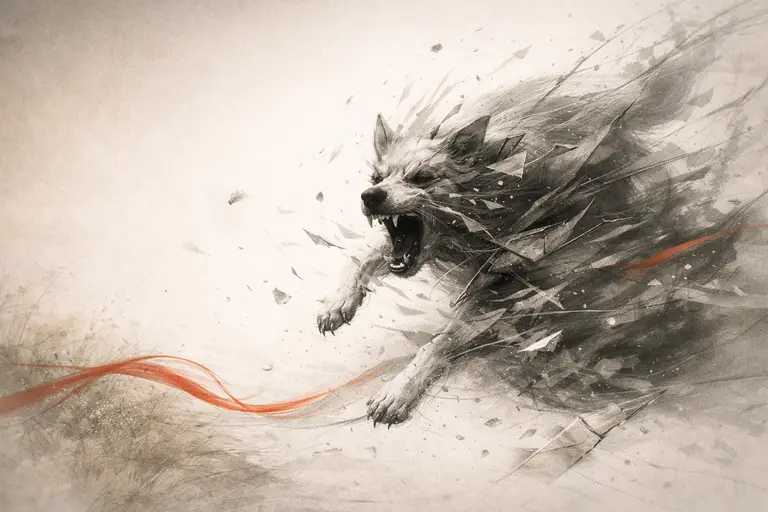
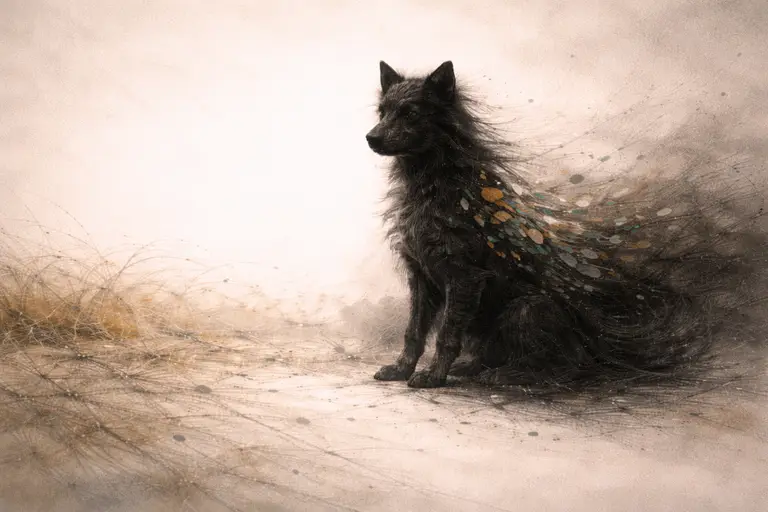
It stands in the room, or at the edge of the scene, or somewhere you keep becoming aware of it — not because it moves toward you but because it’s there. Consistently. With a specific quality of being there that the dream keeps returning to. You look away. You look back. It’s still there. Not waiting for anything you can name. Not requiring anything you can give. Just present with the particular weight of something that has decided this is where it stands.
That presence — its quality, its patience, its specific darkness in the space — is the entire interpretation.
Not what it did. What it was. What it felt like to be in a room with something that large and that still and that specifically, undeniably dark.
Quick Answer
- A dream about a black dog means something in your interior life that has been operating in shadow — below the level of daily attention, beneath the managed surface — has become visible enough to stand in the room with you
- The black dog doesn’t threaten. It witnesses. Its presence is the point.
- The darkness is not evil. Darkness in dream language is what exists before you’ve shone light on it — the unacknowledged, the unprocessed, the part of the self that operates without being invited
- The dog’s stillness is the most specific information: something has been waiting with the patience of something that has been waiting for a long time
- This dream arrives when the shadow layer of your life — the part that exists below what you present — has grown heavy enough to require acknowledgment
Common Scenarios
Black dog standing still, watching you → the most precise version; a presence you can no longer not see; the shadow has weight and has decided to make that weight visible
Black dog following at a distance → the shadow moves when you move; it doesn’t pursue, it accompanies; something dark has been with you longer than the dream, just at a remove
Black dog in your house, already inside → the shadow has crossed from peripheral to interior; it’s inside the space that is you, not outside it
Black dog that approaches slowly → the shadow is closing distance; something that has been at the edge is becoming more central; the movement is deliberate and patient
Black dog that you recognize as yours → the shadow is intimate; it knows you; it has been with you specifically, your darkness, your shadow
Black dog that disappears when you look directly → the shadow retreats from direct attention; the moment of full consciousness dissolves it; the dream is showing you the mechanism
What Your Body Already Knows
The specific weight that stayed in the chest → not fear, not dread — something denser and more specific; the body registering the presence of something with real mass
Whether you looked at it or away from it → the body remembers the choice; the impulse to not quite look directly, or the moment you did; both are significant
The quality of the dark → not the dark of night or absence; the specific dark of something that has a quality — deep, still, present; the body holds the texture of it
The specific tiredness after this dream → the black dog dream is tiring in a specific way; not the exhaustion of crisis but the weight of proximity to something heavy; the body carried that weight through the night
What the Black Dog Is Carrying
In 1840, Edward Jerningham wrote about “the black dog” as a name for a specific interior state. Winston Churchill famously used it for his depression — the persistent, heavy presence that would settle in and stay, patient and dark, regardless of what was happening in the visible life.
The black dog as a symbol predates both of them. It appears in folklore, in Jungian psychology, in dream records across centuries. It consistently represents the same thing: the shadow — the part of the self that operates below the managed surface, that carries what the conscious mind hasn’t claimed.
Not evil. Shadow.
Carl Jung distinguished between the persona — the face we present to the world, the managed version — and the shadow — the parts of the self that have been pushed below the threshold of what we acknowledge. The shadow contains what’s been rejected, suppressed, unexamined. It doesn’t go away when unacknowledged. It waits. It grows. It develops its own weight in the basement of the personality, patient in the way of things that don’t need your attention to continue existing.
The black dog in the dream is that weight made visible. It has the form of the most loyal, most load-bearing animal in the dream vocabulary — which means the shadow it’s carrying isn’t foreign. It’s yours. It has been with you with the same consistency that a loyal dog has been with you. The darkness has been attending to your life in the background while you attended to other things.
The dream put it in the room so you’d see it. Not to punish you. Because it has enough weight now that not seeing it takes more effort than seeing it.
The Patience of the Shadow
This is the quality that distinguishes the black dog from the other threatening presences in the dog cluster, and the quality that most people remember longest.
The black dog is not impatient. It doesn’t accelerate its approach based on what you do. It doesn’t raise stakes or intensify demands. It stands, or it follows at a steady distance, or it sits at the edge of the scene — and it does this with the specific quality of something that has been doing this for a long time and has made peace with the doing of it.
That patience is not neutrality. Patience is the behavior of something that knows it has time. Something that doesn’t need to rush because it will still be there regardless of how long this takes.
You look at it. It looks back. Not with the focused attention of threat — the particular attention of something that has been watching you for a while and has gotten comfortable with the watching. The eyes are patient. Not kind, not unkind. Patient. You look away. When you look back, nothing has changed. It hasn’t moved closer. It hasn’t moved away. It is simply still there, with the specific quality of something that intends to be here until something changes.
In waking life, this is the specific quality of depression that Churchill was naming — the state that doesn’t announce itself dramatically, doesn’t require a triggering event, simply settles with a specific heavy patience and stays. The black dog of depression doesn’t chase you. It walks beside you. Every step. With the specific patience of something that knows you and has decided this is where it belongs.
But the black dog dream isn’t only about depression in the clinical sense. It’s about the shadow in the broader sense — anything that has been operating below the level of acknowledgment with this specific quality of patient, sustained weight.
What Lives in the Dark
The shadow in Jungian terms is not simply negative content. This is the thing most people misunderstand about this dream.
The shadow contains what’s been rejected. That includes — certainly — the difficult things: the anger that hasn’t been given space, the grief that hasn’t been processed, the fear that has been managed rather than felt, the darkness that is genuinely difficult and has been kept below the threshold because the above-threshold version of the self can’t easily integrate it.
But the shadow also contains what’s been suppressed for other reasons. The instinct that was too intense for the social context. The creative impulse that was judged impractical. The part of the self that is powerful in a way that felt dangerous to let out. The wildness that the managed version of you decided was incompatible with the life being built.
The black dog isn’t just carrying your sadness. It’s carrying your anger, and your wildness, and the intensity you decided wasn’t allowed, and the grief that didn’t have a place, and the power that felt too large for the spaces you were operating in. All of it. Everything the managed self couldn’t hold has been here, in this dog, patient and dark and present in the background of your life for longer than you’ve been looking.
This is why the black dog, when it finally stands in the room and makes itself visible, sometimes produces not just weight but something that sits alongside the weight — something almost like recognition. The shadow knows you. It has been carrying your specific unacknowledged contents. When it looks at you, it looks with the knowledge of what it’s been holding.
What dogs represent at their most fundamental — the loyalty that doesn’t require the performed version, the trust that sees the real thing — reaches its most complex expression in the black dog. This loyalty has been present for the least acknowledged version of you. The shadow knows things about you that even your most intimate relationships don’t know. It has been with you in the spaces where nothing else follows.
The Dream Where You Finally Look Directly
Most black dog dreams involve a specific relationship to looking.
You’re aware of the dog. You keep becoming aware of it. But there’s a quality in the awareness that isn’t quite direct — a peripheral engagement, a not-quite-looking-at-it that allows you to remain aware without having to fully receive what you’re seeing.
This partial looking is the dream’s most honest image of what the waking mind has been doing with its shadow. Aware. Managing the awareness. Not looking directly.
You know it’s there. You’ve been knowing it’s there while you moved through the rest of the dream. You’ve been making decisions about other things with the peripheral awareness of this presence at the edge of everything. And then: you look at it. Directly. For the first time in the dream you actually direct your full attention at what you’ve been managing around. The dog holds the attention without flinching. It looks back. You see the full size of it — the actual scale, the actual darkness, the actual patience — and the first feeling isn’t fear. It’s recognition.
Recognition, because you’ve been aware of this for longer than you admitted. The shadow isn’t new information. It’s information that has been present and managed at the periphery. The direct looking doesn’t create the shadow — it acknowledges it. The acknowledgment is the thing the dream has been moving toward.
In waking life, this corresponds to the specific shift from managing an interior state to actually looking at it. The depression that’s been peripheral for months, finally looked at directly. The grief that’s been held in check, finally given room. The anger that’s been managed, finally allowed to surface fully enough to be known.
The shadow doesn’t require much, in the end. It requires being looked at. Not solved, not fixed, not integrated through a single act of acknowledgment — just seen. Seen fully, without the managing distance.
When the Black Dog Follows You
Some versions of this dream don’t show you a stationary presence. They show you a companion.
The dog follows. Not closely — enough distance to be almost not-there. But it moves when you move. When you turn, it’s still there, adjusted to maintain the same remove. When you accelerate, the distance stays constant. You can go faster; you can’t leave it behind.
You’ve been walking for a while now. You’re aware of it somewhere behind you to the left — not threatening, not urgent, just there. You try something: you walk faster. The distance between you stays the same. You slow down. It slows down. The gap is fixed. You are walking through a landscape and there is a dark presence that is maintaining an exact and patient relationship to your movement. You are not being chased. You are being accompanied. Against your preference.
This is the specific experience of carrying depression or unacknowledged shadow as a companion. It doesn’t interrupt. It doesn’t demand. It simply maintains its relationship to you — its specific, patient, dark presence at a specific remove — regardless of what else is happening. You live your life. The dog follows. You achieve things. The dog follows. You have good days. The dog is still at the same distance.
The dream is accurate about this. The shadow that accompanies isn’t affected by surface-level changes. The depression that walks with you doesn’t lift when external circumstances improve. It maintains its specific distance from you because the source of its presence isn’t in the circumstances — it’s in the interior, in the unacknowledged contents, in what has been living below the surface.
The experience of being afraid of something familiar — of something that knows you and has shifted into a presence you can’t ignore — runs through this dream in its deepest form. The black dog is the most intimate possible form of this: the shadow that knows everything about you because it’s made of everything you haven’t acknowledged. And you can’t outpace what has been walking at your side for years.
Toward the Dog or Away
Here is the dream’s most direct question, and the one most worth recovering from the morning.
What did you do when you became fully aware of the black dog?
Every version of this dream contains a moment where awareness becomes unavoidable — where the peripheral management stops working and the full presence of the shadow has to be dealt with. What happens in that moment varies. And the variation is the interpretation.
You moved toward it. You closed the distance, slowly or all at once. You approached the darkness rather than managed it. This corresponds to the specific courage of turning toward the shadow rather than continuing to carry it at the periphery. Not a small act. The black dog doesn’t make approach easy.
You held still. Neither toward nor away. This is acknowledgment without engagement — the recognition that it’s there, without yet knowing what to do with that recognition. Held still is a legitimate position. The shadow has been there. You’re seeing it now. The next move hasn’t been determined.
You moved away. The management reinstated. The peripheral return. The awareness encountered and then reduced back to something manageable. This is also honest — the dream is showing you that the movement away is still available, and showing you its specific cost: the dog maintains the distance.
You could go toward it. You know that. The distance between you is crossable. And something in you is making the calculation — of what crossing it would mean, of what full contact with this would produce, of what you’d have to hold once you stopped managing from a distance. The dog waits. Patient. As it’s been patient for longer than this dream.
Dream Timestamp
When something heavy has been present below the surface for a long time → the dream arrives when the weight has accumulated past the threshold the periphery can hold; the shadow has grown heavy enough to require seeing
During periods of managing rather than feeling → the black dog appears when the distance between the surface and the interior has been maintained at significant cost; something below has been waiting while something above has been busy
After or during a period of depression → the dream is often the mind’s most direct image for the state itself; the patient, dark, present companion that doesn’t respond to surface changes
Why This Dream Happens — The Psychology Behind It
The brain generates the black dog when the shadow content — the unacknowledged, the suppressed, the managed-at-distance — has accumulated to a weight that requires a direct image.
During waking hours, the shadow can be kept peripheral through the sustained effort of managing it around: the good days, the productivity, the forward motion, the useful structures of a functioning life. The effort is real and it works, up to a point. Past that point, the weight becomes sufficient to require something the periphery can’t provide: acknowledgment.
The black dog is the brain’s most direct available image for shadow content that has reached that threshold. Not a symbol for something to be decoded. The actual weight, given a form that requires you to see it. In the room. Patient. Waiting for you to stop managing around it and start acknowledging what’s actually there.
The dream isn’t a diagnosis. It’s a request. The shadow is asking to be seen. Not solved, not eliminated, not fixed in a single act of understanding — seen. Acknowledged as present. Given the specific reality of being looked at directly, by the part of you that has been looking everywhere else.
The Sentence This Dream Was Trying to Say
Something I’ve been carrying in shadow has grown heavy enough that it stood in the room — and asked me to look at it instead of around it.
The Morning After
The dog is gone from the room. The weight probably isn’t entirely gone.
The specific heaviness of this dream tends to stay longer than other dreams. Not fear-residue. Weight-residue. The body carried something heavy for the duration of the night and the carrying is still present in the morning.
Before the day provides the mechanisms for managing it back to the periphery: what was the black dog? Not the dream-dog specifically — what in your interior life has the quality of what you saw? What has been present with that specific patience, that specific weight, that specific darkness — in the background of your waking life, accompanying you, waiting?
The shadow doesn’t require dramatic intervention. It requires what the dream was providing: your eyes, directed at it, without the managing distance.
One question, worth sitting with before the day takes over: what would change if you stopped carrying this at the periphery and started acknowledging it as something that’s actually there?
The dog waited this long. It will wait for you to be ready. But it will also still be there.
FAQ
What does a black dog in a dream mean? It means the shadow — the part of your interior life that operates below the managed surface, that carries what hasn’t been acknowledged, processed, or given space — has grown visible and present enough to stand in the dream and require seeing. The black dog is one of the oldest and most consistent images for this in dream symbolism and psychological tradition. Not evil, not threatening in the attack sense — present with a specific, patient, dark weight that corresponds to something real in your interior life that has been carried in the background for a significant amount of time.
Is dreaming about a black dog a bad omen? Not in the predictive sense. The black dog doesn’t forecast external events. It represents an interior state — specifically, the shadow content of your psychological life that has been kept below conscious acknowledgment. In the Jungian tradition and in the long cultural history of this symbol, the black dog’s appearance is a signal that something in the unacknowledged layer has grown heavy enough to require attention. That’s not a bad omen. That’s an honest report about what’s been running in the background.
What’s the difference between the black dog and a regular dog in dreams? The color is the interpretation. A dog in dreams is a trust that operates inside your life. The black dog is that same trust, but specifically carrying the shadow layer — the parts of yourself that have been operating below acknowledgment, in the dark. The regular dog can represent many kinds of loyalty and trust. The black dog specifically represents the loyalty of your own shadow to you: the part of yourself that has been there through everything, carrying what you haven’t claimed, patient and dark and present.
Does dreaming of a black dog mean depression? It often correlates with the experience of depression in the broad sense — the specific patient, heavy, present quality that Churchill named as the “black dog” because it accompanies without threatening, persists without dramatic cause, and maintains its presence regardless of surface-level changes. The dream uses the same image for the same reason: this kind of weight has this specific quality. Whether that corresponds to clinical depression or to a specific period of shadow-heaviness is not something the dream determines. What it does indicate is that something with this quality has been present, and has been growing in weight, and has become visible.
Next Stages
If the black dog approached and the distance between you began to close → when shadow becomes active rather than present: dream about a dog attacking you — when what was patient presence crosses into confrontation, and the shadow stops waiting to be seen and starts demanding response
If instead of the weight of the shadow, the animal appeared in a form of clarity and protection → dream about a white dog — when the subconscious offers a symbol of purity, guidance, or an emerging part of the self that carries light rather than burden.
If alongside the weight of the black dog you felt something that wasn’t entirely dread → the shadow contains not just difficulty but suppressed power: dream about a dog chasing you — when the shadow is in pursuit because you’ve been moving away from something that belongs near you
If the black dog felt like yours — if the shadow was intimate, specific, the darkness of your own life → when the shadow is the most personal possible version: dream about your own dog dying — when what’s in shadow has the specific history of having been with you through everything, and what threatens it threatens something irreplaceablet you do with that need is the interpretation