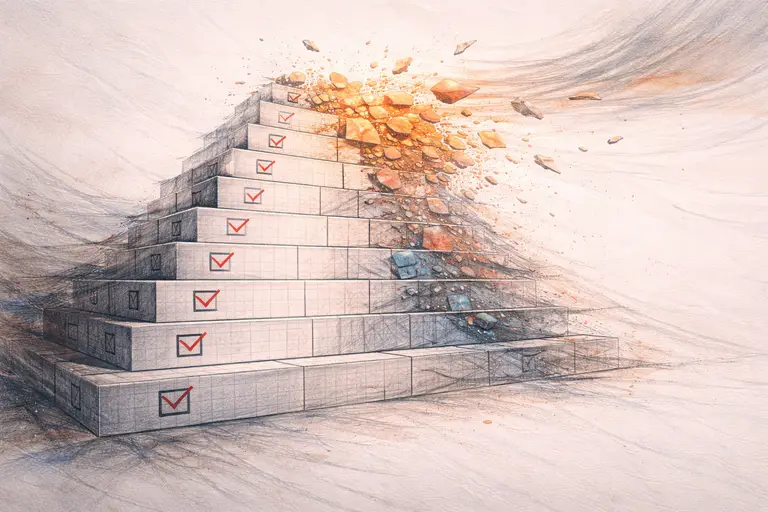
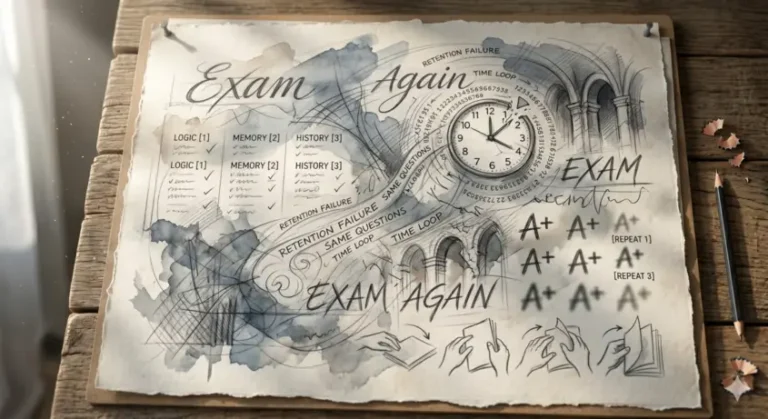
Dream About Not Finishing the Exam

There are still questions on the page.
That’s the specific thing this dream leaves behind. Not the grade. Not the number. Not the comparison to anyone else in the room. Just the image of questions you didn’t reach — sitting there, unanswered, visible, waiting on a page that’s about to be collected whether you’re finished or not.
You were in the middle of something when it ended. Not stuck, not blank, not lost in the corridor — actually in it, pen moving, thoughts connecting, the work happening. And then something cut it short. Time called. The dream ended. The pen stopped mid-word. The last answer trails off somewhere between the question and its answer and stays there, a sentence with no period.
A dream about not finishing the exam doesn’t belong with the nightmares about not knowing, not arriving, not understanding. This one is different. This one had you performing. The failure isn’t about what you lacked — it’s about what you didn’t get to complete. And those are not the same wound.
Quick Answer
- A dream about not finishing the exam means something real was interrupted before it reached its end
- The failure here isn’t inability — you were doing it; something ended the doing
- Incompleteness and failure are different. The dream knows which one this is.
- What stays isn’t shame — it’s the specific ache of unfinished work you were capable of finishing
- This dream surfaces when waking life has accumulated things that stopped before they were done
Common Scenarios
Time called mid-answer → pen moving, thoughts clear, the answer forming — and the examiner’s voice ending it
Questions you never reached → finished what you could, ran out of clock before the page ran out of questions
Dream cuts off at the worst moment → mid-sentence, mid-thought, the answer half-written; you wake holding the incomplete thing
Handed in something unfinished → you saw the gaps before you submitted; the incompleteness was visible and unavoidable
Trying to keep writing after time is called → the rule says stop; your hand can’t stop; the answer is right there
What Your Body Already Knows
The urgency still in your hands → the body was still writing when you woke; the motion didn’t finish either
Not dread but incompleteness → a different quality than anxiety; something that sits open rather than pressing down
The specific frustration of proximity → you were close; the body registered how close before the clock made it irrelevant
Something unresolved that hasn’t named itself yet → the dream pointed at something; you haven’t identified it yet; the pointing continues
The Exam You Were Actually Passing
Here is the thing this dream almost never gets credit for.
You were doing it.
Every other nightmare in this cluster has you arriving wrong — unprepared, lost, blank, excluded, running from the start. This dream had you inside the performance. The pen was moving. You knew things. The answers were forming. Whatever this exam was testing, you had something to offer it.
You’re on question four. Maybe question seven. The answer you’re writing is real — you can feel the shape of it, the direction of the argument, the specific thing the question was asking for that you actually understand. Your pen is moving the way a pen moves when it knows where it’s going. And then the voice comes. Time. Pens down. You look at the questions you haven’t reached.
The dream isn’t about being incapable. It’s about being interrupted. That’s an entirely different experience. And the fact that you were in the middle of something — actually in it — is the first thing most interpretations of this dream miss.
What a Sentence Without a Period Does to You
There is something specific that happens when a thought gets cut off before it ends.
It doesn’t disappear. It hovers. An unfinished sentence doesn’t resolve — it just stops, mid-meaning, and the mind keeps trying to complete it because incompleteness is physiologically uncomfortable in a way that finished-and-wrong isn’t. A wrong answer is at least over. An unfinished answer keeps pulling.
The last thing you wrote is somewhere between the second and third sentences of an answer that had four. You can see the rest of it. You know what the rest of it was going to say. The rest of it is not on the page. The rest of it doesn’t exist anywhere that will be graded or seen or credited — only in the part of you that was in the middle of writing it when the time ran out.
This is what the dream is actually carrying: not the absence of knowledge but the presence of unfinished knowledge. The thought that existed and didn’t get to land anywhere. The answer that was real and never became official.
In waking life, this feeling has a precise texture. You know it. It’s the project that was 80% done when something happened. The conversation that ended before the point was made. The thing you were building that stopped before it was finished. Not destroyed — interrupted. Still there. Incomplete.
Why Not Finishing Hurts Differently Than Failing
Failure has a kind of clarity to it.
When you fail — when the answer was wrong, when you didn’t know, when the grade comes back marked down — at least the thing is complete. It happened. It produced a result. The result is bad, but it exists. You can hold it, argue with it, learn from it, put it down.
Incompleteness doesn’t give you that.
The unfinished exam sits open. The questions you didn’t reach are still there in the unanswered position — not answered incorrectly, just not answered. There’s no verdict on them. There’s no result to process. The loop stays open because it was never closed, and open loops are what the brain cannot put down.
You handed in the paper. You know what was on it — the four questions you answered, the three you didn’t reach. Somewhere, those three questions exist in their unanswered state. Not failed. Not attempted. Just not reached. The grade is partly a grade on what you did. It is also, invisibly, a grade on what the clock decided you wouldn’t get to.
The dream belongs to the broader territory of exam failure anxiety — but it maps the specific variant where the failure isn’t in the performance. It’s in the interruption of the performance. That distinction changes what the dream is actually asking you to look at.
The Things in Waking Life That Got Cut Off
The exam was never just an exam.
Think about what in your waking life currently has the quality of an incomplete sentence. Not something you failed to start. Not something you avoided or gave up. Something you were genuinely in the middle of when it stopped.
The relationship that ended before it reached its conclusion — whatever that conclusion might have been. The creative project that got interrupted at the most generative moment and never resumed at the same heat. The chapter of life that closed with things still unresolved inside it. The conversation you were having with someone when the conversation became impossible to continue.
These things don’t stop existing when they stop being active. They sit in the same position as the unanswered questions on the exam — not failed, not finished. Hovering. Still pulling. Open loops that the mind returns to not because they were failures but because they were interrupted.
This dream tends to arrive with the accumulated weight of those interruptions. When enough things have been cut off mid-sentence, the brain produces this image: the exam, the pen moving, the questions not reached, the clock that ended something before it was done.
The Specific Grief of Proximity
There’s a grief that only incompleteness produces, and it’s different from the grief of failure.
The grief of failure has an object. Something went wrong. The attempt was made. The result was inadequate. You can point to the gap and name it. The grief is proportional and located.
The grief of incompleteness is about distance. How close you were. What you would have written if there had been three more minutes. The question you were about to reach. The answer that was forming when the time ran out. Proximity to completion, without completion, produces a very specific kind of ache — one that failure doesn’t produce because failure doesn’t end in almost.
This is why the dream returns. The closeness is the thing. Time that moves too fast for what needs to be done doesn’t produce the same residue as time that ends one minute before something is complete. The first is a loss of quantity. The second is a loss of almost-arrival.
In waking life, almost is one of the most psychologically charged positions available. This dream maps it exactly.
When This Dream Arrives
When a project or chapter is ending unresolved → not failed — interrupted; the closing came before the completion
When effort has been real but something keeps cutting the work short → the doing is there; the finishing keeps being denied
When proximity to something has become its own kind of pain → almost-done is its own category; the dream is naming it
Why This Dream Happens — The Psychology Behind It
The brain has a specific mechanism for unfinished tasks — the Zeigarnik effect: incomplete things stay in working memory in a way that completed things don’t. Finished work gets filed. Unfinished work keeps circulating, keeps making itself available to conscious attention, keeps insisting.
When waking life accumulates unfinished things — projects interrupted, conversations that didn’t land, chapters closed before they resolved — the working memory load of all that incompleteness generates a sustained low-level pressure. During sleep, the brain renders it as the most concentrated available image: the exam you were taking, the pen that was moving, the questions you didn’t reach.
It isn’t processing failure. It’s processing openness. The loops that didn’t close. The answers that formed and never got written down. The brain knows the difference between done-badly and not-done. This dream is about the second one.
The Sentence This Dream Was Trying to Say
I wasn’t failing. I was in the middle of something — and the middle is where it ended.
The Morning After
You woke up with unfinished answers still in your hands.
That’s the feeling. Not the guilt of failing, not the shame of being found lacking — just the specific weight of something that stopped before it was done.
Before the day covers it: somewhere in your waking life, there is something in that same position. Not abandoned, not failed. Interrupted. Something you were actually doing when it stopped.
One question worth sitting with: is it still possible to finish — or have you been treating an interrupted thing as though it’s the same as a finished one, carrying its incompleteness as though it were a conclusion?
Because those require different responses. And only one of them lets you put it down.
FAQ
What does it mean to dream about not finishing the exam? It means something in your waking life was interrupted before it reached completion — and the incompleteness is still circulating. This dream is precise about the distinction: you weren’t failing. You were performing. The interruption came from outside the performance, not from within it. The brain produces this image when unfinished things have accumulated enough to become a pressure system.
Why does this feel different from dreaming about running out of time? Because running out of time is about the clock — the external pressure, the deadline approaching, the race against a visible countdown. Not finishing is about the incompleteness itself. The focus is on what’s left on the page, not on the time that ran out. The grief is about proximity: you were almost there. That almost is the specific thing this dream is processing.
Why do I keep trying to write even after time is called? Because the answer is right there. The body knows how close the completion was, and stopping voluntarily when completion is that close is physiologically counterintuitive. The impulse to keep writing after time is called is the dream’s most honest image of what it feels like to be this close to finishing something and have the window close anyway.
Does this dream mean I have unresolved things in my past? Not necessarily past — more often present. The dream tends to appear when current, active things have the quality of incompleteness: work that keeps stalling before it’s done, situations that keep ending before they resolve, an accumulation of things the brain is still holding as open because they never properly closed.
Next Stages
If what ended the exam was specifically the clock — if time was the force that cut it short, and you watched it happen → the relationship between your pace and the deadline has its own weight: dream about running out of time in exam
If the incompleteness led back to the beginning — if not finishing meant having to face it again → the loop of return has its own specific exhaustion: dream about repeating the same exam again
If you did finish but what you wrote felt wrong — if completion arrived but the answers weren’t right → finishing and being done are different problems: dream about writing wrong answers